
Font size
 Worksheets
Unit 4 Review
Total questions: 130
Worksheet time: 2hrs 41mins
A DNA nucleotide includes...?
deoxyribose sugar, nitrogenous base, phopshate group
deoxyribose sugar, nitrogenous base
deoxyribose sugar, phosphate group
nitrogenous base, phosphate group
Which 2 molecules forms the sides (backbone) of the DNA ladder?
deoxyribose (sugar) and adenine
deoxyribose (sugar) and a hydrogen bond
deoxyribose sugar and the nucleus
deoxyribose (sugar) and phosphate
Which bond is responsible for holding the two strands of the DNA double helix together?
weak hydrogen bonds between the nitrogenous bases
strong covalent bonds between the nitrogenous bases
strong hydrogen bonds between the nitrogenous bases
weak covalent bonds between the nitrogenous bases

Name this structure
double helix
nucelotide
DNA
nucleic acid
Which sequence of DNA bases would complementary pair with this parent strand
ATG TGA CAG
ATG TGA CAG
TAC ACT GTC
GTA AGT GAC
CAT TCA CTG
Which scientist was responsible for discovering the base pairing rule?
Erwin Chargaff
Rosalind Franklin
James Watson
Francis Crick
Which scientist was responsible for discovering the basic structure of DNA using X-Ray Crystallography?
Erwin Chargaff
Rosalind Franklin
James Watson
Francis Crick
Which scientist was responsible for furthering the discovery of DNA structure using the results from X-Ray Crystallography?
Erwin Chargaff
Rosalind Franklin
James Watson and Francis Crick
What type of bonds hold neighboring nucleotides together in the backbone of the DNA?
Strong Covalent bonds between the sugar and phosphate of the next nucleotide.
Strong Hydrogen bonds between the sugar and phosphate of the next nucleotide.
Weak Covalent bonds between the sugar and phosphate of the next nucleotide.
Weak Hydrogen bonds between the sugar and phosphate of the next nucleotide.
Which of the following illustrates the correct orientation of DNA strands to one another?
Antiparallel
3'------------5'
5'------------3'
Parallel
3'------------5'
5'------------3'
Antiparallel
5'------------3'
5'------------3'
Parallel
5'------------3'
5'------------3'
The 5' end of a DNA stand has which piece of the nucleotide exposed at the end?
Nitrogenous Base
Phosphate Group
Deoxyribose sugar
It depends
Which of the following was probably not present in the atmosphere of the primitive Earth?
Methane
Oxygen
Water
Carbon dioxide
What was the product of the Miller-Urey Experiment?
Simple amino acids
Simple nucleotides
Simple lipids
Simple monosaccarides
Based upon the conditions of the early Earth, which forms of live most likely appeared first?
Prokaryotic and aerobic
Prokaryotic and anaerobic
Eukaryotic and aerobic
Eukaryotic and anaerobic
The idea that Earth's early oceans had organic molecules that became the first life is called the..
Primordial soup hypothesis
Bubble hypothesis
Miller-Urey Experiment
Radioactive dating theory
RNA World Theory states that ...
Life came from RNA
Life came from life
Life came from non living things
Life came from outer space
Which scientist(s) tested the primordial soup model by using an electrical spark to produced amino acids from the molecules believed to be present on early Earth?
Oparin-Haldane
Miller-Urey
Pasteur
Spallanzani
Which scientist(s) hypothesized the primordial soup model?
Oparin-Haldane
Miller-Urey
Pasteur
Spallanzani

AATCATGGA
The enzyme that comes first and synthesizes (builds) an RNA primer that then allows DNA polymerase to bind and start building the strand with new free-floating nucleotides.
Helicase
Primase
Polymerase
Nuclease
The "rungs" of the DNA ladder are made of:
phosphates and nitrogen bases
sugars
sugars and phosphates
nitrogen bases

Purine
Genetic material found in cells
Monomer of DNA
Nitrogenous base made of two rings
Nitrogenous base made of one ring
Pyrimidine
Genetic material found in cells
Monomer of DNA
Nitrogenous base made of two rings
Nitrogenous base made of one ring
What is B?
Leading strand
Lagging strand
Okazaki Fragments
DNA plymerase
Which direction does DNA build?
3' to 5'
5' to 3'
Towards the replication fork
Away from the replication fork
DNA Replication is
Conservative - The new strand would be two new daughter strands (a copy), while the original parent strand would not be changed.
Semi-conservative - The new strand has one parent and one daughter strand
Dispersive - Random alternating DNA between parent and daughter strand.
Cells of organism must replicate for ?
growth
repair of damaged cells
replacement of dying cells.
All of the above
In the G1 stage of the cell cycle, the cell (choose all that apply)
Grows
Replicated DNA
Carries on normal activities
Replicates organelles


The chromosome in the diagram (select all that apply)
is replicated
is 1 chromosome made up of two chromatids
is about to go through cell division
is chromatin
Which cell cycle checkpoint verifies cell size and checks the DNA for damage?
G1 checkpoint
S checkpoint
G2 checkpoint
M checkpoint
Which cell cycle checkpoint makes sure that the chromatids are correctly attached to the spindle fibers?
G1 checkpoint
S checkpoint
G2 checkpoint
M checkpoint
Which cell cycle checkpoint makes sure that chromosomes are duplicated and checks for damage of the replicated DNA?
G1 checkpoint
S checkpoint
G2 checkpoint
M checkpoint
Who type of protein prevents the cells with damage form continuing through the cell cycle?
tumor supressor
tumor initiator
stem cell suppressor
stem cell initiator

the division of the cytoplasm is called
mitosis
interphase
cytokinesis
somatic
Cell Cycle


What is cancer?
A group of diseases characterized by no cell growth
A group of diseases caused by the failure of chromosomes to separate
A group of diseases characterized by uncontrolled cell division
A group of diseases caused by excessive replication of chromosomes
Which type of protein prevents the cells with damage form continuing through the cell cycle?
tumor supressor
tumor initiator
stem cell suppressor
stem cell initiator
Which of the following is a true statement?
Benign tumors have cells that have broken away from the main tumor.
Malignant tumors have cells that have broken away from the main tumor.
Malignant tumors consist of cells that have stayed together.
Benign tumors spread through the blood and lymph to other organs
Which of the following is not a way that genes for cell cycle regulatory proteins can be damaged?
cell crowding
carcinogens
inherited mutations
exposure to certain viruses
Which two two factors can inhibit (prevent/slow down) the progression of a cell through the cell cycle?
cell crowding and a decrease in surface area to volume ratio
cell crowding and decrease in growth hormone

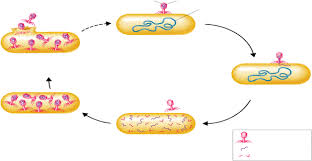
A _____________________ infection involves the virus DNA combining/splicing its DNA with the host cells DNA. Then hiding for an extended period of time.
lysogenic
lytic
vaccine
venereal
What does the word dormant mean?
DNA
awake
attack
inactive
A virus can contain which of the following genetic material?
DNA
RNA
DNA and RNA
DNA or RNA
Translation is the process where
mRNA is created in the Nucleus
mRNA is decoded to build a protein
glucose molecules are made
is where lipids are synthesized
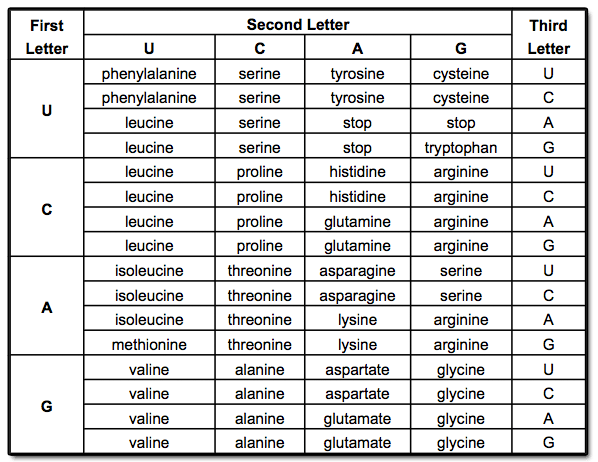
ATG GGA ACT CCA
What is the location in a eukaryotic cell for transcription?
nucleus
cytoplasm
ribosome
mitochondria
What is the location in the cell for translation?
nucleus
mitochondria in cytoplasm
ribosome in cytoplasm
chloroplast in cytoplasm
Which component of DNA determines the traits of an organism?
sequence of Nitrogen Bases
Sugar-Phosphate Backbone
Hydrogen bonds
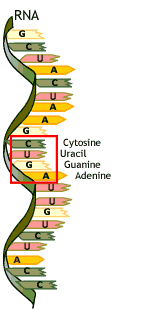
GTAGTCA
TGGCAAGTACGT
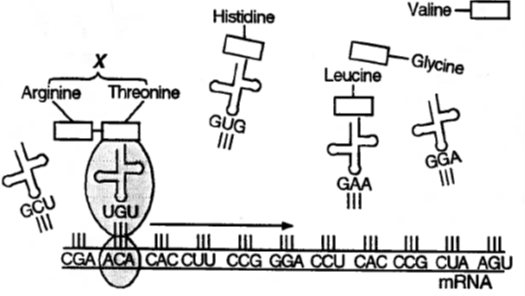
What is the three base sequence of tRNA that is complementary to the codon?
Anticodon
Codon
Protein
What is the Central Dogma of Biology?
DNA -> RNA -> Protein
RNA - > DNA -> Protein
DNA -> Protein -> RNA
RNA -> Protein -> DNA
Choose all that apply to RNA
Single Helix
Ribose sugar
Nucleic Acid
Uracil instead of Thymine
Why are proteins important? Check all that apply.
Proteins carry out almost all of the thousands of chemical reactions that take place in cells (enzymes).
They also help fight disease (antibodies) and transmit messages (hormones).
They form the majority of cell membranes.
Build bone and muscle.
Which enzyme adds free nucleotides to the mRNA strand?
DNA Polymerase
RNA Polymerase
RNA Primase
Helicase
The monomer of a protein is a(n) _________________. Each one of these is coded for by a ___________.
amino acid, codon
nucleotide, codon
amino acid, nucleotide
nucleotide, amino acid
What type of bonds are amino acids bonded to each other with?
Ionic Bonds
Hydrogen Bonds
Covalent Bonds
Peptide Bonds
Which strand is transcribed to RNA
Non-template strand
Template strand
Anticodon tRNA
Why is transcription and translation coupled in bacteria
Nucleus is absent
Mitochondrion is present
Chloroplast is absent
All


What is the correct sequence of protein synthesis?
A. tRNA brings amino acids to the ribosome
B. DNA molecules serve as the templates for mRNA.
C. mRNA molecules move to ribosomes.
D. Polypeptides are formed on ribosomes.
A-B-C-D
B-C-A-D
C-B-A-D
D-B-A-C
How many nucleotides make up one codon?
1
2
3
6

