Wayground logo

Free Printable Worksheets

Font size

S
M
L
XL
Worksheets

Genetics/Heredity

Total questions: 100

Worksheet time: 1hrs 3mins

Name
Class
Date
1.
The passing of traits from parent to offspring 
a)
Heredity 
b)
Genetics 
c)
Hybrid 
d)
Probability 
2.
Who was the father of genetics 
a)
Sagan 
b)
Issac Newton 
c)
Gregor Mendel 
d)
C.jenkins 
3.
The study of heredity and the variation of inherited characteristics 
a)
gene
b)
genetics 
c)
meiosis 
d)
hybrid 
4.
 which is heterozygous ?  
a)
Tt
b)
TT
5.
Which is homozygous ?
a)
Zz
b)
SS
6.
what predicts the outcome
a)
genetic engineering
b)
punnet square
c)
probability
7.
A homozygous dominant dog with brown fur is crossed with a heterozygous dog with brown fur. What are the percentages of the possible genotypes?
a)
100% BB
b)
75% BB and 25%Bb
c)
50 % BB and 50% Bb
d)
50% Bb and 50% bb
8.
Genotype refers to the ...
a)
physical expression of the genes
b)
the possible combination of alleles in a gene
c)
whether an allele is dominant or recessive
d)
how an organism will appear
9.
Squidward has light blue skin, and his genotype for this trait is Bb. Would Squidward be considered a purebred or hybrid for light blue skin?
a)
Purebred
b)
Hybrid
10.
An offspring will receive how many alleles from each parent to determine a specific trait?
a)
one
b)
two
c)
three
d)
five
11.
Which of the following is a phenotype?
a)
BB
b)
Bb
c)
bb
d)
Blue eyes
12.
What is a phenotype
a)
The genetic make up (code)
b)
The physical trait
13.
the passing of genetic traits from parent to offspring.
a)
heredity
b)
trait
c)
gene
d)
allele
14.
having two of the same genes for the trait (sometimes called purebred).
a)
homozygous
b)
hetrozygous
c)
protein
d)
chromosome
15.
having two different genes for a trait (sometimes called hybrid).
a)
protein
b)
homozygous
c)
heterozygous
d)
genotype
16.
Magda is a tall, 11 year old drummer. She has a scar on her right cheek. She is good at swimming. Which of her traits did Magda most likely inherit?
a)
height
b)
the scar
c)
ability to swim
d)
ability to play drums
17.
G = green, g = yellow
The genotype for a yellow plant is...
a)
GG
b)
Gg
c)
gg
d)
all of the choices result in yellow
18.
An allele whose trait only shows up when no dominant allele is present.
a)
hidden allele
b)
dominant allele
c)
recessive allele
d)
present allele
19.
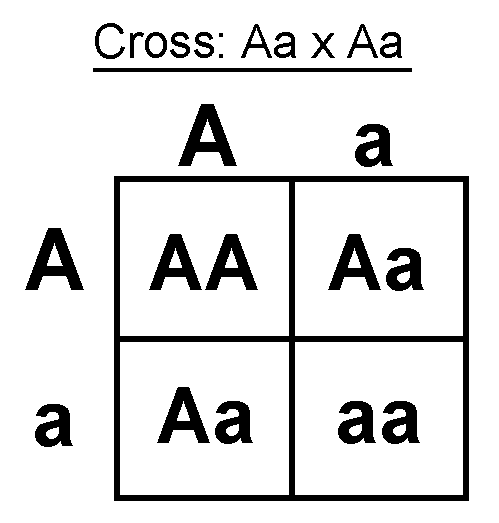
Two heterozygous (Tt) tall pea plants are crossed. Which describes their offspring?
a)
50% tall and 50% short
b)
75%tall and 25% short
c)
100%short
20.
An allele whose trait always shows up in the organism when the allele is present.
a)
recessive allele
b)
dominant allele
c)
hidden allele
d)
present allele
21.
one set of instructions for an inherited trait
a)
heredity
b)
allele
c)
trait
d)
gene
22.
A single piece of coiled DNA found in the cells; contains genes that encode traits.
a)
gene
b)
chromosome
c)
trait
d)
DNA
23.

The picture shows a sperm fertilizing an egg. We know this is sexual reproduction because

a)

The offspring will have the exact same genes as the parent.

b)

The offspring receives its genes from one parent

c)

The offspring has the exact same traits as its parents

d)

The offspring receives its genes from two parents

24.

This picture shows several forms of Asexual reproduction. What is true about asexual reproduction?

a)

It involves only one parent.

b)

Offspring have unique DNA different for either parent

c)

It involves two parents

d)

It helps creates variety in a population

25.

This picture shows several forms of Asexual reproduction. What is true about asexual reproduction?

a)

It involves only one parent.

b)

Offspring have unique DNA different for either parent

c)

It involves two parents

d)

It helps creates variety in a population

26.

Which statement is true about stem cuttings

a)

Offspring can produce different colored flowers from the parent.

b)

Cutting is a form of sexual reproduction

c)

Offspring will have the same DNA as their parent and the same colored flowers

d)

Cutting is not a form of reproduction

27.

Which is true about cross pollination?

a)

It is sexual reproduction because it involves 2 parents

b)

it is asexual reproduction because it involves 2 parents

c)

it is sexual reproduction because it involves 1 parent

d)

it is asexual reproduction because it involves 1 parent

28.

Why don't we use punnett squares to predict the offspring in asexual reproduction?

a)

Results are too unpredictable in asexual reproduction

b)

It is not possible to know the DNA of the parents

c)

Offspring have the exact same DNA as their parent in asexual reproduction

d)

Asexual reproduction uses more than two parents

29.

Chromosomes are made of:

a)

DNA

b)

Ribosomes

c)

Mitochondria

d)

Cells

30.

Which process did humans use for over thousands of years to create the many different breeds of dogs

a)

Selective breeding

b)

Gene therapy

c)

Genetic engineering

d)

Natural Selection

31.

Define Allele

a)

Different Forms of a gene

b)

The factors that control traits

c)

An organisms physical appearance

32.

Define Dominant

a)

An organism that had two identical alleles for that trait

b)

A trait that shows up in the organism when the allele is present

c)

An allele that is covered up

33.

Define Genotype

a)

A chart that shows all the genetic possibilities and combos

b)

Different physical characteristics

c)

An organism's genetic makeup or allele combos

34.

Define Homozygous

a)

An organism that had two different alleles for that trait

b)

An organism's physical appearance

c)

An organism that has two identical alleles for that trait

35.

Define Heterozygous

a)

Organism that has two different alleles for that trait

b)

Organism that has two identical alleles for that trait

c)

The factors that control traits

36.

Define Phenotype

a)

An organism's physical appearance

b)

The parents

c)

The kids

37.
Heredity is the passing of traits from _____________________ to _____________________
a)
predators to prey
b)
water to rain
c)
parents to offspring
d)
fungi to protists
38.
Why did Mendel choose to study pea plants in order to learn how traits are passed from parent to offspring?
a)
Pea plants grow quickly
b)
Pea plants are ultraviolet
c)
Pea plants are rare and expensive
d)
Pea plants are take years to grow
39.
What is probabilty? 
a)
is the mathematical chance of a specific outcome in relation to the total number of possible outcomes. 
b)
is the mathematical formula to additional and subtraction of genotypes
c)
is the mathematical chance of a specific relationship between genotype and phenotype
d)
All of the above
40.
Which of the following choices demonstrates a ratio (in a punnett square). 
a)
2/4 FF
b)
100/50 FF
c)
1/1 FF
d)
3/2 FF
41.
Each one of the boxes on the Punnett Square represents what probability of an offsprings' genotype?
a)
25%
b)
1%
c)
10%
d)
0%
42.
In a pedigree, what shape represents a male?
a)
circle
b)
square
c)
triangle
d)
diamond
43.
A green pea plant (GG) is being crossed with a green pea plant (Gg). What is the phenotype?
a)
100 % rainbow 
b)
50% yellow and 50% green 
c)
100% green
d)
100% yellow 
44.
A tall plant (TT) is crossed with a tall plant (Tt).  What is the genotype?
a)
2 TT: 2 Tt: 0 tt
b)
1 TT: 2 Tt: 1 tt
c)
2 TT: 1 Tt: 1 tt
d)
0 TT: 0 Tt: 4 tt
45.
If you have a male with large wings (DD) and a female with small wings (dd). What allele stands for large wings? 
a)
D
b)
d
c)
Dd
d)
dd
46.
What is the phenotype of the offspring? (A-Brown hair; a-blond hair) 
a)
50 % Brown Hair and 50% Blond Hair 
b)
25 % Brown Hair and 75% Blond Hair 
c)
75 % Brown Hair and 25% Blond Hair 
d)
0% Brown Hair and 100% Blond Hair 
47.
A homozygous dominant brown mouse is crossed with a heterozygous brown mouse (tan is the recessive color). 
a)
100 % tan
b)
100 % brown 
c)
50 % brown and 50% tan 
d)
75 % brown and 25 % tan 
48.
Two heterozygous red flower (white flowers are recessive) are crossed. What is the phenotype?
a)
75% red and 25% white
b)
25% red and 75% white
c)
100 White 
d)
50% red 50% red 
49.
W=white hair
w= non-white hair
If you cross a horse with WW and a horse with ww what fraction of the offspring would be expected to have white hair?
a)
none
b)
3/4
c)
1/2
d)
all
50.
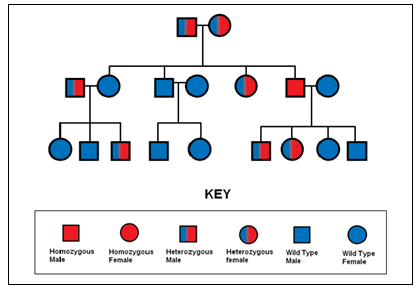
In the second generation-how many people are carriers of the trait?
a)
2
b)
3
c)
5
d)
6
51.
How many individuals are there in the 3rd generation?
a)
2
b)
3
c)
4
d)
6
52.
How many kids did the mother and father from the first generation have?
a)
2
b)
4
c)
5
d)
6
53.
How many alleles (letters) do each person carry for a trait?
a)
1
b)
2
c)
3
d)
4
54.
a)
Not affected Female
b)
Not affected Male
c)
Affected Male
d)
Affected Female
55.
a)
Not Affected Male
b)
Not Affected Female
c)
Affected Male
d)
Affected Female
56.
What do we use pedigrees for?
a)
To look at families
b)
To make determinations about the offspring
c)
To track traits in families
d)
Nothing
57.
What do half colored symbols represent?
a)
The individual is a carrier (heterozygous).
b)
The individual expresses the trait.
c)
The individual has both recessive alleles.
d)
The individual has both dominant alleles.
58.
Examine the pedigree. The allele for the presence of a widow’s peak is dominant. Therefore, we can tell from the chart that in the couple labeled 2:
a)
the male is heterozygous and the female is homozygous.
b)
the male is homozygous and the female is heterozygous.
c)
the male is homozygous and the female is homozygous.
d)
the male is heterozygous and the female is heterozygous.
59.
Is having a hitchhiker's thumb dominant or recessive? (The carriers are not marked.) 
a)
Dominant
b)
Recessive
60.
Lisa has two grandmothers in this picture.
a)
Mona and Jackie
b)
Marge and Mona
c)
Selma and Jackie
d)
Patty and Selma
61.
The Law of Inertia
a)
Newton's
1st
Law of Motion
b)
Newton's
2nd
Law of Motion
c)
Newton's
3rd
Law of Motion
62.
For every action, there is an equal and opposite reaction.
a)
Newton's
1st
Law of Motion
b)
Newton's
2nd
Law of Motion
c)
Newton's
3rd
Law of Motion
63.
An automobile you are riding in suddenly stops, but you continue to go forward.
a)
Newton's
1st
Law of Motion
b)
Newton's
2nd
Law of Motion
c)
Newton's
3rd
Law of Motion
64.
A stationary bumper car is set in motion by the outside force of another bumper car colliding with it.
a)
Newton's
1st
Law of Motion
b)
Newton's
2nd
Law of Motion
c)
Newton's
3rd
Law of Motion
65.
When the force on a car is doubled, the acceleration is doubled.
a)
Newton's
1st
Law of Motion
b)
Newton's
2nd
Law of Motion
c)
Newton's
3rd
Law of Motion
66.
A magician pulls a table cloth from under a table of dishes.
a)
Newton's
1st
Law of Motion
b)
Newton's
2nd
Law of Motion
c)
Newton's
3rd
Law of Motion
67.
A skater pushes another skater forward, but the one pushing moves backwards.
a)
Newton's
1st
Law of Motion
b)
Newton's
2nd
Law of Motion
c)
Newton's
3rd
Law of Motion
68.
The harder you hit a baseball, the faster it accelerates.
a)
Newton's
1st
Law of Motion
b)
Newton's
2nd
Law of Motion
c)
Newton's
3rd
Law of Motion
69.
You push against a wall and the wall is pushing back on you.
a)
Newton's
1st
Law of Motion
b)
Newton's
2nd
Law of Motion
c)
Newton's
3rd
Law of Motion
70.
The acceleration of a 4 kg bowling ball will be greater than the acceleration of a 6 kg bowling ball if the same force is applied to both.
a)
Newton's
1st
Law of Motion
b)
Newton's
2nd
Law of Motion
c)
Newton's
3rd
Law of Motion
71.
You push against the floor when you walk and the floor pushes back on you.
a)
Newton's
1st
Law of Motion
b)
Newton's
2nd
Law of Motion
c)
Newton's
3rd
Law of Motion
72.
You are carrying a lunch tray when you bump into the edge of a table.  Although the tray did not tip, your milk falls off of the front of the tray.
a)
Newton's
1st
Law of Motion
b)
Newton's
2nd
Law of Motion
c)
Newton's
3rd
Law of Motion
73.
A swimmer pushes water back with her arms but her body moves forward.
a)
Newton's
1st
Law of Motion
b)
Newton's
2nd
Law of Motion
c)
Newton's
3rd
Law of Motion
74.
What is Newtons 1st law of motion?
a)
Force= Mass multiplied by acceleration 
b)
An object at rest stays at rest unless acted on an unbalanced force.
c)
For every action there is a equal and opposite  re-action.
d)
Law of gravity 
75.
What is Newtons 2nd law of motion?
a)
Force= Mass multiplied by acceleration
b)
An object at rest stays at rest unless acted on an unbalanced force.
c)
For every action there is a equal and opposite  re-action.
d)
Law of gravity 
76.
What is Newtons 3rd law of motion?
a)
Force= Mass multiplied by acceleration
b)
An object at rest stays at rest unless acted on an unbalanced force.
c)
For every action there is a equal and opposite  reaction.
d)
Law of gravity 
77.
Mass is a measure of an object's inertia. Objects with greater mass have a greater inertia; objects with less mass have less inertia.
a)
true 
b)
false 
78.
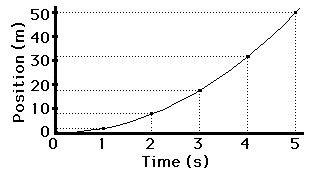
The picture of the position vs. time graph shows an object that is...
a)
accelerating/speeding up
b)
moving at a constant speed 
c)
not moving 
d)
accelerating/slowing down. 
79.
Which force produces a change in motion?
a)
unbalanced force
b)
balanced force
c)
gravitational force
d)
frictional force
80.
What is the standard unit force is measured in?
a)
Newtons
b)
pounds
c)
grams
d)
meters
81.
Which has more Inertia? (so need more force to move) 
a)
Truck
b)
Ant
c)
A cat
d)
A skateboard
82.
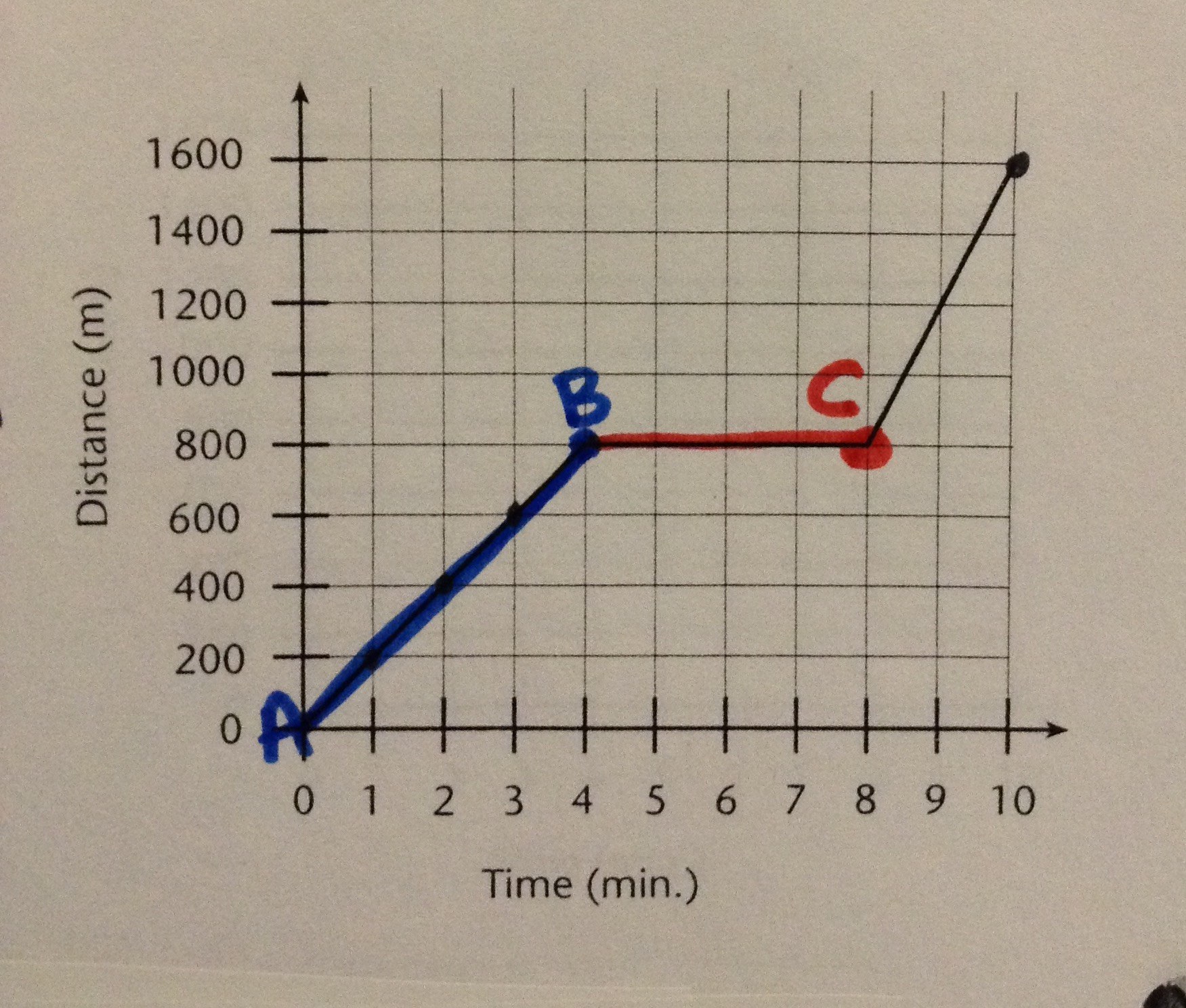
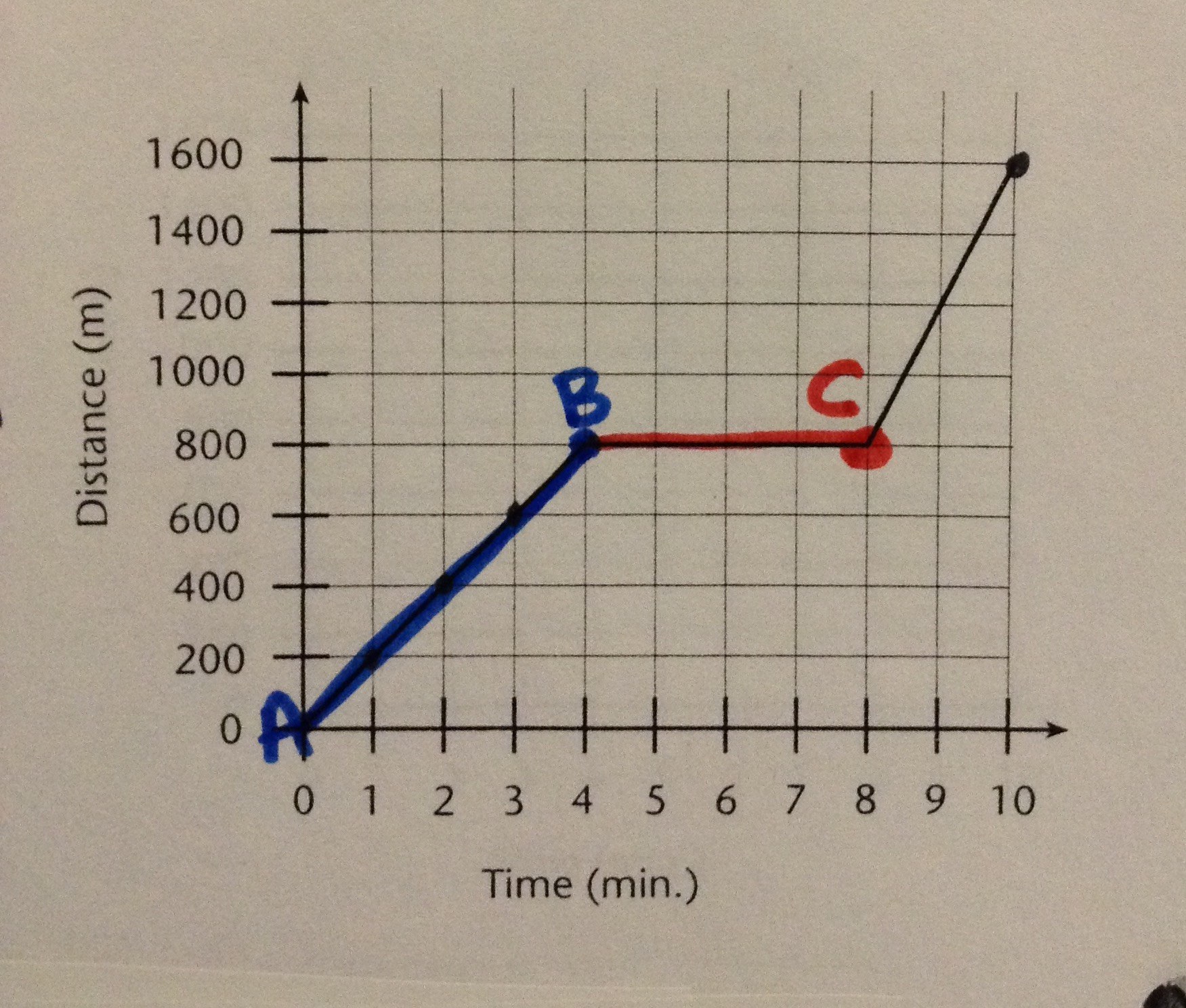
LT4: The graph shows Ashley riding her bike to Maria's house. 
What is occurring from point A to point B?
a)
they are traveling at a constant speed
b)
they are decreasing in speed
c)
they stopped to take a break
83.
LT4: The graph shows Ashley riding her bike to Maria's house. 
What was occurring from point B to point C?
a)
She was increasing her speed.
b)
She stopped for 4 minutes
c)
She was decreasing in speed
84.
When all the forces on an object are equal and opposite, & the net force is zero, that's...
a)
balanced forces
b)
unbalanced forces
c)
terminal velocity
d)
reaction forces
85.
The ____ of an object is the gravitational force exerted on an object.
a)
mass
b)
weight
c)
gravity
d)
newtons
86.

Who was Sir Isaac Newton?

a)

Famous British scientist who studied motion, gravity, and much more.

b)

Famous American scientist who studied ecology.

c)

German scientist that studied electricity.

d)

Chinese physicist that studied things.

87.
What is speed?
a)
how far you go
b)
how much distance is covered over a period of time
c)
how fast you accelerate
d)
the change in the location of a object
88.
Which runner won the race?
a)
A
b)
B
c)
C
89.
When a starfish grows a new body off a broken arm, what kind of reproduction is this?
a)
Sexual
b)
Differentiation
c)
Asexual 
d)
Specialization
90.
Sexual reproduction requires _____ parents and asexual reproduction requires ___ parents
a)
1,1
b)
2,2
c)
2,1
d)
1,2 
91.

All of the offspring of an organism have the same genetic material, which is identical to the parent organism. From this, we can conclude that this organism -

a)

makes its own food

b)

is unicellular

c)

live in a marine habitat

d)

reproduces asexually

92.

California blackworms, also known as mudworms, are able to break apart. Each body section that broke apart is able to become an identical new worm. What type of reproduction does this example represent?

a)

Sexual reproduction

b)

Asexual reproduction

93.

Penguins lay 1-2 fertilized eggs that the male and female take turns incubating on their feet. What type of reproduction does this example represent?

a)

Sexual reproduction

b)

Asexual reproduction

94.
What is a disadvantage of asexual reproduction?
a)
New species of organisms cannot come into being.
b)
The offspring does not multiply rapidly.
c)
The offspring does not live for long.
d)
All of these
95.
Which of the following describes the main advantages of sexual reproduction? 
a)
requires lots of time/energy
b)
no new gene combos can arise 
c)
diversity
d)
looks identical to the parent
96.
What are some of the facts about asexual reproduction?
a)
Takes only one mate to reproduce and takes a longer time to reproduce
b)
Takes a shorter amount of time to reproduce and it takes two mates to reproduce
c)
Reproduces diverse offspring and takes a longer time to reproduce
d)
Takes only one mate to reproduce and takes a shorter time to reproduce
97.
What are some of the facts about sexual reproduction?
a)
Takes two mates to reproduce and takes a longer time to reproduce
b)
Takes one mate to reproduce and takes a shorter amount of time to reproduce
c)
Takes two mates to reproduce and takes a shorter amount of time to reproduce
d)
Takes one mate to reproduce and takes a shorter amount of time to reproduce
98.

What process is shown in this picture?

a)

binary fission

b)

budding

c)

vegetative propogation

d)

sporulation

99.

A male sex cell is called a(an)___________

a)

ova

b)

sperm

c)

egg

100.

A female sex cell is called a(an) ______________.

a)

ova

b)

sperm

c)

spore