wayground logo

Free Printable Worksheets

Font size

S
M
L
XL
Worksheets

DNA Structure, Replication, Protein Synthesis, Mutations

Total questions: 91

Worksheet time: 1hrs 28mins

Name
Class
Date
1.
Which of the following best describes a DNA molecule?
a)
double helix
b)
contains ribose
c)
made of amino acids
d)
contains Uracil
2.
A nucleotide includes...?
a)
pentose sugar
b)
nitrogenous base
c)
phosphate group
d)
all of the above
3.
In DNA, Adenine bonds with ______________.
a)
Guanine
b)
Thymine
c)
Cytosine
d)
Adenine
4.
Guanine bonds with ______________.
a)
Adenine
b)
Guanine
c)
Cytosine
d)
Thymine
5.
Why is DNA important?
a)
it is very small and very complicated
b)
it's in everything
c)
it serves as the blueprint for making proteins
d)
because we eat it every day for energy
6.
Which 2 molecules forms the sides (backbone) of the DNA ladder?
a)
deoxyribose and adenine
b)
deoxyribose and a hydrogen bond
c)
sugar and the nucleus
d)
deoxyribose (sugar) and phosphate
7.
Which shows the correct complementary base pairing for DNA?
a)
C-A, T-G
b)
A-G, C-T
c)
C-G, U-A
d)
T-A, G-C
8.
What does DNA stand for?
a)
Deoxyribonucleic acid
b)
Denitrogenous acid
c)
Deribonucleic acid
d)
Diribonucleic acid
9.
What is responsible for holding the two strands of the DNA double helix together?
a)
hydrogen bonds
b)
alleles
c)
London dispersion forces
d)
deoxyribose sugars
10.
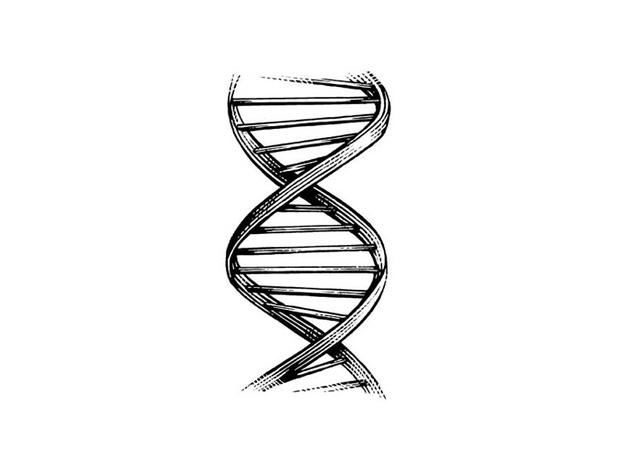
Name this structure
a)
double helix
b)
nucelotide
c)
twisted ladder
d)
hydrogen bond
11.
Which sequence of DNA bases would pair with this partial strand
ATG TGA CAG
a)
ATG TGA CAG
b)
TAC ACT GTC
c)
GTA AGT GAC
d)
CAT TCA CTG
12.
How do the leading, and the lagging strands differ?
a)
The leading strand is synthesized in the same direction as the movement of the replication fork, and the lagging strand is synthesized in the opposite direction.
b)
The leading strand is synthesized at twice the rate of the lagging strand.
c)
The leading strand is synthesized in short fragments that are ultimately stitched together, whereas the lagging strand is synthesized continuously. 
d)
The leading strand is synthesized by adding nucleotides to the 3' end of the growing strand, and the lagging strand is synthesized by adding nucleotides to the 5? end. 
13.
Suppose a double-stranded DNA molecule was shown to have 15% adenine bases. What would be the expected percentage of guanine bases in that molecule?
a)
15%
b)
35%
c)
85%
d)
Not enough information
14.
Consider the replication bubble diagrammed at the right. Which letters represent leading strands? 
a)
W and X
b)
Y and Z
c)
W and Z
d)
X and Y
15.
Consider the replication bubble diagrammed at the right. Which letters represent leading strands? 
a)
A
b)
B
c)
C
d)
D
16.
Which enyzme would be found only on the lagging strand?
a)
DNA polymerase
b)
Primase
c)
Ligase
d)
Topoisomerase
17.
In DNA , the amount of A is equal to the amount of 
a)
C
b)
G
c)
T
d)
U
18.
Which enzyme is needed to start DNA replication?
a)
DNA Polymerase
b)
Topoisomerase
c)
Ligase
d)
Primase
19.
Which enzyme is not working correctly if new DNA bases are not added to the template strand?
a)
DNA Polymerase
b)
Topoisomerase
c)
Ligase
d)
Primase
20.
Which enzyme is not working correctly if new DNA bases are not added to the template strand?
a)
DNA Polymerase
b)
Topoisomerase
c)
Ligase
d)
Primase
21.
Which enzyme is responsible for proofreading the newly composed DNA strand?
a)
DNA Polymerase
b)
Topoisomerase
c)
Ligase
d)
Primase
22.
Which of the following help(s) to hold the DNA strands apart while they are being replicated?
a)
RNA primase
b)
single–strand binding proteins
c)
DNA polymerase I
d)
DNA ligase
23.
What is meant by the description "antiparallel" regarding the strands that make up DNA?
a)
The twisting nature of DNA creates nonparallel strands.
b)
One strand is positively charged and the other is negatively charged.
c)
The 5' to 3' direction of one strand runs counter to the 5' to 3' direction of the other strand.
d)
Base pairings create unequal spacing between the two DNA strands
24.
What is meant that DNA replication follows a “semi-conservative” model?
a)
After DNA replication, each strand contains one side that is a parental strand and the other side is a daughter strand.
b)
After DNA replication, one completed strand contains only parental DNA while the other contains only daughter DNA.
c)
None of these identify the “semi-conservative” model.
d)
After DNA replication, one completed strand contains a mixture of both parental DNA and daughter DNA dispersed throughout the strand.
25.
Which scientist(s) stated that DNA contains phosphorus while proteins contain sulfur?
a)
Meselson & Stahl
b)
Hershey & Chase
c)
Watson & Crick
d)
Franklin & Watkins
26.
What determines the nucleotide sequence of the newly synthesized strand during DNA replication? 
a)
 the particular DNA polymerase catalyzing the reaction
b)
the relative amounts of the four nucleoside triphosphates in the cell
c)
the nucleotide sequence of the template strand 
d)
the primase used in the reaction e. the arrangement of histones in the sugar phosphate backbone
27.

In DNA replication , DNA is synthesized in the ____________ on both sides.

a)

5' to 3'

b)

2' to 4'

c)

3' to 5'

d)

4' to 2'

28.
If one strand of DNA had the sequence ATCCGGTAC, what is the sequence on the other strand
a)
UAGGCCAUG
b)
I don't know
c)
TAGGCCATG
d)
CATGGCCTA
29.
DNA molecule segment is : TTACGCAAG
The mutated DNA segment is TTACGCAAC. This is an example of ___ mutation.
a)
Substitution
b)
Insertion
c)
Inversion
d)
Translocation
30.
Are all mutations bad?
a)
Yes
b)
No
31.
Original: ATC CAT
Mutation: ATC GCAT
What mutation occurred?
a)
deletion
b)
insertion
c)
silent
d)
transverse
32.

What is the purpose of the sequences of Nitrogenous

Bases in DNA?

a)

gives DNA the shape needed

b)

prevents mutations

c)

forms hydrogen bonds

d)

carries instructions to make the proteins that determine traits

33.
What is transcription and where does it occur?
a)
I don't know
b)
The copying of RNA into mRNA; cytoplasm
c)
The copying of DNA into mRNA; nucleus
34.
What causes mutations?
a)
Mistakes in replication or environmental substances
b)
The amino acids
c)
Passed down by genetics
d)
It's how your born
35.
NORMAL
AAA-GCA-TTA-CGC
MUTANT
AAA-CCA-TTA-CGC
a)
insertion
b)
deletion
c)
insertion frameshift
d)
subsitution
36.
Where do mutations occur?
a)
DNA and RNA
b)
DNA 
c)
RNA
d)
mRNA and tRNA
37.

The addition, removal, or replacement of a single nucleotide nitrogen base

a)

Cell Mutation

b)

Chromosome Mutation

c)

Point Mutation

d)

Other Outcome

38.

When a nucleotide is added to DNA

a)

Insertion

b)

Removal

c)

Substitution

d)

Silent

39.

A change in the DNA sequence that doesn't change protein made.

a)

Nonsense

b)

Silent

c)

Missense

d)

Substitution

40.

When a nucleotide is replaces another nucleotide

a)

Insertion

b)

Removal

c)

Substitution

d)

Deletion

41.

A change in the DNA sequence that results in a premature stop codon

a)

Nonsense

b)

Silent

c)

Missense

d)

Substitution

42.

A change in the DNA sequence that can change entire protein

a)

Nonsense

b)

Silent

c)

Missense

d)

Substitution

43.

Often results in a non-functional protein product (too short)

a)

Nonsense

b)

Silent

c)

Missense

d)

Substitution

44.
What are the building blocks of proteins called?
a)
DNA
b)
RNA
c)
Ribosomes
d)
Amino Acids
45.
Why are insertion and deletion (frameshift) mutations so harmful?
a)
They change all of the codons from the mutation on down the line, which changes the amino acid sequence
b)
They insert things that an organism doesn't need.
c)
They often delete things that organisms need.
d)
Insertion and deletions are not any more harmful than substitution mutations.
46.
ATTTGAGCC- Original
ATTGAGCC - Mutated
The example above is an example of a 
a)
Insertion- Frameshift
b)
Deletion- Substitution
c)
Deletion -Frameshift
d)
All of the above
47.
DNA molecule segment is : TTACGCAAG
The mutated DNA segment is TTACGCAAC. This is an example of ___ mutation.
a)
Base Substitution
b)
Base Insertion
c)
Base Inversion
d)
Translocation
48.
In RNA, Uracil pairs with ______. 
a)
cytosine
b)
adenine
c)
guanine
d)
thymine
49.
The process to go from DNA to mRNA is _______
a)
translation
b)
transcription
c)
replication
50.
The process to go from mRNA to a protein is called ____
a)
transcription
b)
rRNA
c)
replication
d)
translation
51.
Choose the nucleotide sequence of the RNA strand that would be complementary to the following strand: 
GTAGTCA
a)
UATUAGA
b)
ACGACTG
c)
CAUCAGU
d)
CATCAGT
52.
The main function of tRNA is to...
a)
carry a message that, when translated, forms proteins
b)
form a portion of ribosomes
c)
string together complementary RNA and DNA strands
d)
bring amino acids from the cytoplasm to the ribosomes
53.
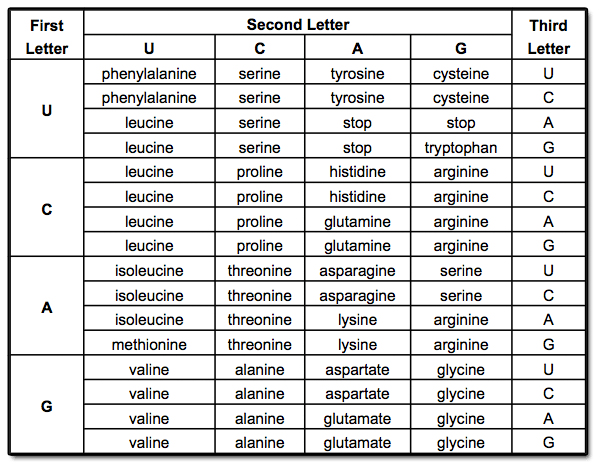
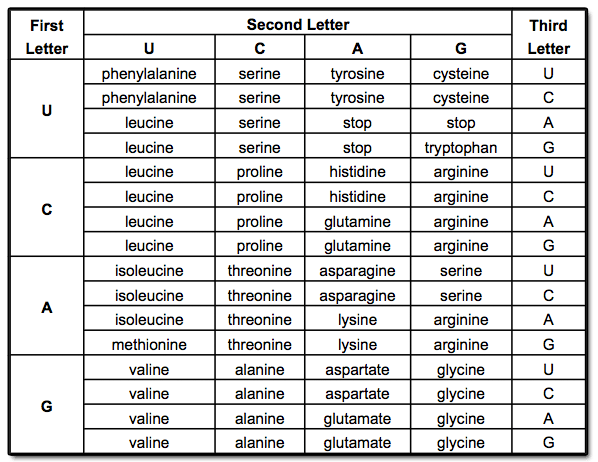
What amino acid is represented by the codon UUA?
a)
Phenylalanine
b)
Tyrosine
c)
Leucine
d)
Stop codon
54.
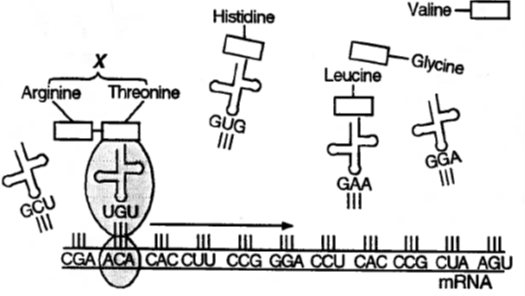
What process is going on in this photo? 
a)
Transcription 
b)
Translation 
c)
Replication 
d)
All the above 
55.
Which component of DNA determines the traits of an organism? 
a)
Nitrogen Bases
b)
Sugar-Phosphate Backbone
c)
Hydrogen bonds
56.
What is the location in the cell for translation?
a)
nucleus
b)
mitochondria
c)
ribosome
d)
chloroplast
57.
What is the three base sequence of mRNA that codes for a single amino acid?
a)
Anticodon
b)
Codon
c)
Protein
58.
What is the location in the cell for transcription?
a)
nucleus
b)
cytoplasm
c)
ribosome
d)
mitochondria
59.
Which is the mRNA molecule that would be transcribed from this DNA template:
TGGCAAGTACGT
a)
ACCGTTCATGCA
b)
UGGCAAGUACGU
c)
UCCGUUCUUGCU
d)
ACCGUUCAUGCA
60.
DNA has a _____________ structure. 
a)
double helix
b)
single strand
c)
ring 
d)
chain
61.
Does the order of amino acids in a protein matter?
a)
YES!
b)
NO!
62.
What is the correct amino acid sequence for the mRNA code AUGCCAGUAUGA
a)
Met-Pro-Ala-Val
b)
Met-Pro-Val
c)
Tyr-Gly-His
d)
Tyr-Gly-Arg-His
63.
How many amino acids are coded for by this sequence of nucleotides:
ATG GGA ACT CCA
a)
4
b)
2
c)
6
d)
12
64.

What is the shape of RNA?

a)

Double helix

b)

Triple hexagon

c)

Single Helix

d)

Quad bases

65.

What is the second step in protein synthesis?

a)

Translation

b)

Transcription

c)

Synthesis

d)

Metaphase

66.

How are amino acids held together?

a)

By the centromere

b)

By the peptide bond

c)

By the metaphase plate

d)

By the nucleus

67.

What sugar does RNA contain?

a)

phosphate

b)

ribose

c)

fatty acid

d)

Sugra

68.

What does RNA stand for?

a)

Ribosenucleic Acid

b)

Ribonucleic Acid

c)

Ribonose Acid

d)

Riba Nuke Leic Acid

69.

What would the code for the mRNA strand made from this DNA strand be? TAT GGC ATC

a)

UAU CCG AUG

b)

AUA CCG UAG

c)

GCG AAU CGU

70.

which of the following terms refers to the order in which amino acids are linked together in a protein.

a)

Primary

b)

Secondary

c)

Tertiary

d)

Quaternary

71.

The chain of amino acids folds and coils on itself

a)

Primary

b)

Secondary

c)

Tertiary

d)

Quaternary

72.

The entire polypeptide forms a three-dimensional structure

a)

Primary

b)

Secondary

c)

Tertiary

d)

Quaternary

73.

Two or more polypeptides attached together and work as one unit

a)

Primary

b)

Secondary

c)

Tertiary

d)

Quaternary

74.
What is a peptide bond?
a)
Bond that holds two amino acids together.
b)
A bond that holds hydrogen and oxygen molecules together.
c)
A bond that holds the phosphate group of one nucleotide and a sugar of a neighboring nucleotide.
d)
A bond that is formed by the sharing of electrons.
75.
How many different amino acids are there?
a)
15
b)
20
c)
25
d)
30
76.
What is the monomer of proteins?
a)
amino acids
b)
polypeptides
c)
nucleotides
d)
monosaccharides
77.

The diagram shows a bond forming between two amino acids. What is the name of this reaction?

a)

Condensation

b)

Hydrolysis

c)

Pepysis

d)

Oxidation

78.
Refers to the three-dimensional structure of an entire amino acid chain in a protein molecule
a)
tertiary structure
b)
primary structure
c)
secondary structure
d)
fibrous proteins
79.
What is the monomer of a protein?
a)
amino acid
b)
monosaccharide
c)
fatty acid
d)
nucleic acid
80.
The name of the initial chain of monomers in a protein is called.....
a)
polypeptide
b)
polysaccharide
c)
polyester
d)
polynucleotide
81.
The two types of folding in the secondary structure are.....
a)
alpha-helix & beta-pleated sheets
b)
polypeptide & nucleotide
c)
globular & fibrous
82.
The main bonding in the secondary structure of a protein is due to.....
a)
covalent bonding
b)
ionic bonding
c)
hydrogen bonding
d)
polar bonding
83.
The tertiary structure folding in proteins is primary due to the interactions of....
a)
the 'R' groups
b)
the 'P' groups
c)
the 'A' groups
d)
the 'S'
84.
The bond between two amino acids is called...
a)
Peptide bond
b)
Amino acid bond
c)
Nothing. There isn't a name for it
d)
Hydrogen bond
85.
Water-repelling
a)
hydrophobic
b)
myoglobin
c)
coagulation
d)
gluten
86.
Which is NOT a job of proteins in our bodies? 
a)
building muscle
b)
transportation
c)
quick energy
d)
body structure
87.
A protein that catalyzes chemical reactions.
a)
carbohydrate
b)
lipid
c)
monosacharride
d)
enzyme
88.
The structures in this protein labelled as C and D are typically called
a)
Beta-Pleated Sheet
b)
Alpha Helix
c)
DiSulphide Bridge
d)
Amadoori Compounds
89.
Alpha helix and beta pleated sheets are part of what level of protein structure?
a)
primary
b)
secondary
c)
tertiary
d)
quaternary
90.
This is one job proteins do NOT have in the body
a)
storing genetic information
b)
structure
c)
speed up chemical reactions
d)
transport things through cell membrane
91.
What is the highest level of protein structure this molecule exhibits?
a)
Primary
b)
Secondary
c)
Tertiary
d)
Quaternary