Wayground logo

Free Printable Worksheets

Font size

S
M
L
XL
Worksheets

Q3 8th Grade Review

Total questions: 60

Worksheet time: 52mins

Name
Class
Date
1.
Which arrow indicates the cause of day and night on Earth? 
a)
Arrow 1
b)
Arrow 3
c)
Arrow 4
d)
Both Arrow 1 & 4 
2.
The tilting of the Earth on its axis contributes to: 
a)
the different phases of the moon we see 
b)
the changing of seasons as Earth moves around the Sun 
c)
high and low ocean tides
d)
an increase in the gravitational force from the Sun 
3.
Katrina travels to Australia when the Earth is located at Arrow #1 and it is winter. She returns to Australia when the Earth is located at Arrow #4. What season will it be? 
a)
winter 
b)
spring 
c)
summer 
d)
autumn 
4.
 Sarah observes and records these moon phases. 
Which phase will she observe on Night 15? 
a)
A
b)
B
c)
C
d)
D
5.
When will we see a full moon rise above the eastern horizon? 
a)
around 2 AM in the morning 
b)
about the time of sunrise 
c)
middle of the day
d)
about the time of sunset 
6.
Which of the following characteristics do the Earth and Moon closely share in common? 
a)
makeup of the atmosphere 
b)
amount of gravitational force 
c)
approximate distance from the Sun 
d)
volume of water on the surface 
7.
Astronauts who walked on the Moon were able to “jump” two to three times higher than they were able to on Earth. This is primarily due to: 
a)
The lunar atmosphere is much less dense. 
b)
The Moon is much less massive than the Earth. 
c)
Special suits engineered by NASA made the astronauts more mobile. 
d)
Astronauts trained their muscles for the unique lunar surface. 
8.
Even though the Sun has a mass 27 million times greater than the Moon, the Moon has a greater impact on the Earth’s tides. This is because: 
a)
The Moon is much closer to the Earth.
b)
The Moon has more gravitational force than the Sun. 
c)
The Moon is made of solid elements instead of gases. 
d)
The Moon has a faster orbital period. 
9.
Which positions of the Moon will produce the highest tides on Earth? 
a)
A and B 
b)
A and C 
c)
B and C 
d)
B and D 
10.
A material that reduces the flow of heat by conduction, convection, and radiation is ____. 
a)
a conductor 
b)
 an insulator
c)
a solar collector
d)
condensation
11.
The transfer of energy that does NOT require matter is ____.
a)
convection
b)
radiation
c)
conduction
d)
combustion
12.
Which of the following would be the best insulator? 
a)
 air
b)
copper 
c)
silver
d)
aluminum
13.
Energy from the Sun travels to Earth as ____. 
a)
mechanical energy
b)
combustion
c)
radiant energy 
d)
chemical energy
14.
Liquids and gases are different from solids because they _____.
a)
conduct
b)
insulate
c)
flow
d)
have thermal energy
15.
How many producers are in this food web?
a)
1
b)
2
c)
3
d)
4
16.
How many organisms in this food web eat only producers?
a)
1
b)
2
c)
3
d)
4
17.
What season is the Northern Hemisphere experiencing at position C?
a)
winter
b)
spring
c)
summer
d)
fall
18.
What does the rotation of Earth on its axis cause?
a)
seasons
b)
day and night
c)
equinox
d)
solstice
19.
Star A is _________ and __________.
a)
dim and cool
b)
bright and hot
c)
bright and cool
d)
dim and hot
20.
What type of star is hot and dim?
a)
main sequence
b)
supergiants
c)
giants
d)
white dwarfs
21.
What type of geological feature will be found at a divergent boundary in the ocean?
a)
valley
b)
volcanic islands
c)
trench
d)
mid ocean ridge
22.
What type of geological feature will form at a transform boundary?
a)
fault
b)
rift valley
c)
mountains
d)
mid ocean ridge
23.
What determines an element's identity?
a)
electrons
b)
valence electrons
c)
protons
d)
neutrons
24.
What determines how chemically reactive an element is?
a)
electrons
b)
valence electrons
c)
protons
d)
neutrons
25.
An object in motion will stay in motion, and an object at rest will stay at rest unless acted upon by an outside force is Newton's law of __________
a)
force and acceleration
b)
inertia
c)
action-reaction
26.
Unbalanced forces describe objects that ___________
a)
travel at a constant speed
b)
travel at a constant velocity
c)
change speed/direction
27.
Groups on the periodic table..........
a)
are horizontal
b)
are rows
c)
are from left to right
d)
go up and down
28.
Periods on the periodic table ..........
a)
are verticle
b)
go from left to right
c)
are families
d)
go up and down
29.
Organisms who receive energy from dead or decaying matter.
a)
Prokaryotic
b)
Omnivore
c)
Heterotrophic
d)
Decomposers
30.
The process where plants use the light from the sun to convert carbon dioxide and water into glucose. 
a)
Phototropism
b)
Chloroplast
c)
Photosynthesis
d)
Prokaryotic
31.
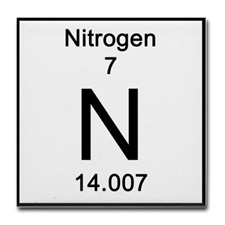
What is the number of protons that the element in this image contain?
a)
14
b)
7
c)
15
d)
18
32.
What does erosion do?
a)
Break down rock
b)
changes rock chemically
c)
changes sediment in rock
d)
moves broken pieces of rock, or sediment, from one place to another
33.
What is an earthquake?
a)
A sudden movement of the Earth's crust caused by a release of stress accumulated along geological faults or by volcanic activity.
b)
a.  energy that builds up inside a volcanic mountain
c)
a.  energy being released when erosion occurs
d)
a.  molten rock pushing up through Earth's surface.
34.
The process by which sediments settle out of water or wind
a)
deposition
b)
cementation
c)
weathering
d)
erosion
35.
The nucleus of the atom has  the 
___________ and ___________ in it.
a)
protons and neutrons
b)
electrons and neutrons
c)
protons and electrons
36.
The part of a cell that contains the chromosomes (wound up DNA) in eukaryotic cells.
a)
Chloroplasts
b)
Cell Wall
c)
Nucleus
d)
Homeostasis
37.
The genetic code for all of your traits.
a)
Nucleus
b)
DNA
c)
Chloroplast
d)
Recessive gene
38.
The organism's ability to maintain equilibrium in their body.
a)
Homeostasis
b)
Heterotroph
c)
Prokaryotic
d)
Autotrophic
39.
The process where plants use the light from the sun to convert carbon dioxide and water into glucose. 
a)
Phototropism
b)
Chloroplast
c)
Photosynthesis
d)
Prokaryotic
40.
Which of Newton's laws of motion explains why you must lift a cup if you want to drink from it?
a)
1st law--An object at rest will stay at rest and an object in motion will remain in motion unless a force acts upon it.
b)
2nd law--The amount of force needed to move an object depends on its mass and acceleration.
c)
3rd law--For every action there is an equal and opposite reaction
d)
4th law--Gravity depends on mass and distance
41.
Where are earthquakes most likely to occur?
a)
In the middle of plates
b)
In the oceans
c)
Along plate boundaries
d)
Anywhere on the Earth
42.
Some objects like the Sun produce their own light.  Others don't.  Why can we see objects that don't produce light?
a)
They absorb the light.
b)
They reflect the light.
c)
They transmit the light.
d)
They bounce the light around until it strikes our eyes.
43.
Why does the Earth orbit the Sun and not a planet in the solar system?
a)
The Sun is more massive than the planets so it's mass causes the gravitational pull.
b)
It just happened that way.
c)
The Earth pulls the Sun toward it  because it is so massive.
d)
The Earth is closer than the other planets so the distance causes the gravitational pull.
44.
Suppose you jump off a the front of a skateboard.  What are the action and reaction forces between you and the skateboard?
a)
The skateboard provides the action force and you react by jumping forward.
b)
There are two action forces and no reaction forces in this example.
c)
You provide the action force and the boat reacts by moving backwards.
d)
The forces are equal and opposite.  There's no action and reaction force.
45.
What's a mid-ocean ridge?
a)
An underwater mountain range formed where two plates collide. 
b)
An underwater mountain range formed where two plates slide past each other.
c)
An underwater mountain range formed where two plates subduct.
d)
An underwater mountain range formed where two plates separate.
46.
Suppose a pitcher threw a ball that traveled 60 m in 2 seconds.  How fast did he pitch the ball?
a)
120 m/s
b)
30 m/s
c)
60 m/s
d)
None of the above are correct.
47.

How do folded mountains form?

a)

They form when plate boundaries diverge.

b)

They form on the continent side of convergent boundaries.

c)

They form when plates collide or push against each other.

d)

They can form several different ways.

48.
In general what is the most dense form of matter?
a)
Solid
b)
Liquid
c)
Gas
d)
Plasma
49.
What is the number of protons that the element in this image contain?
a)
14
b)
7
c)
15
d)
18
50.
Which answer best fits a description of why Alfred Wegener is famous?
a)
German meteorologist that proposed the idea of continental drift
b)
proposed sea floor spreading
c)
Canadian geophysicist who combined sea floor spreading and continental drift into Plate Techtonics Theory
d)
theory that new seafloor is formed when magma is forced upward toward the surface at a mid ocean ridge
51.
Subduction is:
a)
process by which ocean crust is taken into the trenches and back to the mantle
b)
theory that new seafloor is formed when magma is forced upward toward the surface at a mid ocean ridge
c)
plates slide past each other in opposite directions
d)
a gradual movement of the continents across the Earth's surface over time
52.
2H2O + 2N → 4H + 2NO
The chemical symbols on the RIGHT are called:
a)
products
b)
reactants
c)
yields/produces
53.
2H2O + 2N → 4H + 2NO
The chemical symbols on the LEFT are called:
a)
products
b)
reactants
c)
yields/produces
54.
What is the atomic number of an atom with 13 protons, 14 neutrons, and 10 electrons? 
a)
1
b)
13
c)
27
d)
37
55.
The path of food energy from the sun to the producer then transferred to a series of consumers is known as a?
a)
Food Web
b)
Food Chain
c)
Energy Line
d)
Energy Transformation
56.
Which best explains what happens when a solid changes into a liquid?
a)
Molecules move closer together and give off heat.
b)
Slower moving molecules cause a chemical change.
c)
As energy increases, temperature decreases.
d)
As molecules absorb heat, they move faster and spread apart.
57.

Which is the chemical property of oxygen?

a)

Oxygen combines with iron to form rust.

b)

Oxygen boils at -183 degrees

c)

Oxygen dissolves in water

d)

Oxygen is colorless

58.

Which elements is the building block around which the molecules of life are built?

a)

Chlorine

b)

Carbon

c)

Iodine

d)

Sodium

59.

What is Gravity ?

a)

A planet

b)

the point in the orbit of a planet, asteroid, or comet at which it is furthest from the sun.

c)

a planet or other body draws objects toward its center. The force of gravity keeps all of the planets in orbit around the sun.

d)

The path that a body follows as it travels around another body in space as its Orbit

60.

When substance combines to form a new substance and it can't be undone

a)

chemical change

b)

anemomrter

c)

sea breeze

d)

barometer