wayground logo

Free Printable Worksheets

NEW

Font size

S
M
L
XL
Worksheets

Principles & Evidence of Evolution

Total questions: 70

Worksheet time: 55mins
Name
Class
Date
1.
Structures with the same parts have different functions; suggests that organisms share a common ancestry
a)
vestigial structures
b)
homologous structures
c)
adaptive radiation
d)
fossil
2.
If an organism has a vestigial structure, that structure likely once had a function in a(n)
a)
close relative
b)
early ancestor
c)
unrelated organism
d)
embryological stage
3.
The process by which populations slowly change over time is called__________
a)
selective breeding
b)
adaptation
c)
sepeciation
d)
evolution
4.
Some organisms that share a common ancestor have features that have different functions, but similar structures.  These are known as
a)
vestigial structures
b)
analogous structures
c)
homologous structures
d)
fossil structures
5.
Study of embryos of various organisms to show a common ancestor because of similarities in development
a)
natural selection
b)
embryology
c)
speciation
d)
evolution
6.
Which of the following is an example of a vestigial structure?
a)
the wings of a red-tailed hawk
b)
the hind limbs of a house cat
c)
the fins of sharks
d)
the tailbone of a human
7.
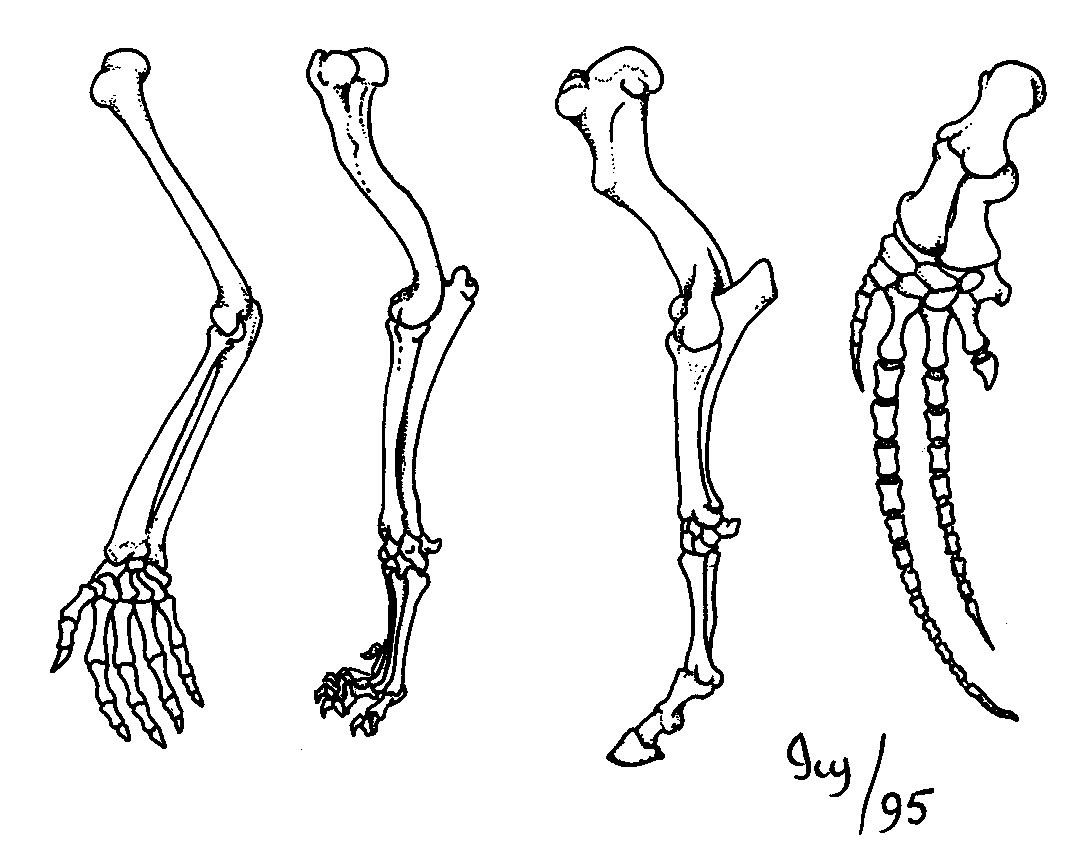
What type of structures are these?
a)
homologous
b)
vestigial 
c)
analogous
d)
fossil
8.
Two organisms that are closely related would have
a)
very similar DNA sequence
b)
exactly the same DNA sequences
c)
no proteins in common
d)
completely different DNA sequence
9.
If two organisms have similar traits of DNA they are probably
a)
share a common ancestor
b)
share a common environment
c)
share a common population
d)
speciation
10.
What does Darwin's theory of evolution suggest?
a)
species change over time
b)
extinct species are not related to living species
c)
different species can interbreed
d)
animals that look alike are most closely related
11.
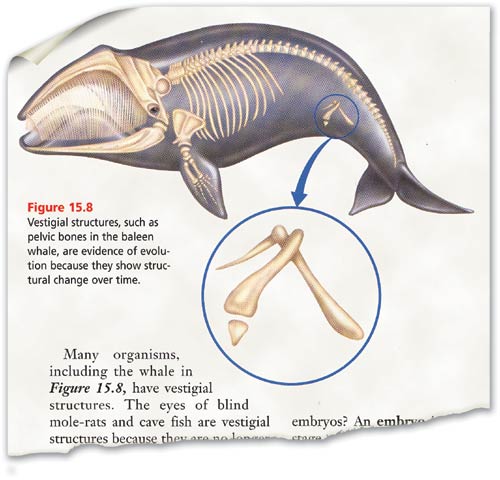
Whales are aquatic mammals that contain a pelvis bone.  Even though it does not aid in its movement, the function must have been used by a common ancestor of the whale.  Thus, the pelvis is referred to as a(n)
a)
vestigial structure
b)
analogous structure
c)
homologous structure
12.

Individuals that are well adapted to their environment will survive and reproduce:

a)

Fewer mutations

b)

Stronger genes

c)

More offspring

d)

Better traits

13.
Which of the following pieces of evolution evidence contain both homologous and vestigial structures?
a)
fossil record
b)
comparing embryology
c)
comparing biochemistry
d)
comparing anatomy
14.
protein sequences in one organism that resemble those of another suggest a 
a)
coincidence
b)
lack of evolutionary relationship
c)
great number of mutations
d)
shared ancestry
15.
The study of the early stages of development that is one evidence of evolution is:
a)
Homologous Structures
b)
Embryology
c)
Vestigial Organs
16.
The white feathers of a snowy owl allow it to blend in with its environment during the winter months (snow). This is an example of ________________
a)
Species
b)
Environmental Change
c)
Adaptation
d)
Variation
17.
A prey population consists of individuals with a variety of running speeds.
The adaptation that allows some of these animals to run fast would be an example of natural selection if it helps them —
a)
survive and undergo mutations in their DNA
b)
produce offspring that run at average speeds
c)
reproduce and increase the frequency of their genes in the population
d)
lower the mortality rates of the population
18.
Which best describes fossils?
a)
They are the preserved remains or evidence of ancient living things
b)
They are the preserved bones of ancient animals
c)
They are impressions of plant leaves in ancient rocks
19.

Which statement provides the best evidence that Ambulocetus natans is an ancestor of Basilosaurus isis?

a)

Homologous structures occur in each fossil

b)

Similar nitrogenous bases are found in the DNA of each fossil

c)

The fossils were found in different locations

d)

The youngest fossils is larger than the older fossils

20.

Genome maps provide the DNA sequences of chromosomes. Some scientists have compared the genome maps of a hedgehog and a sloth. What do these genome maps allow the scientists to determine?

a)

The color patterns of the offspring of each species

b)

How much the size ranges of the two species differ

c)

The methods of protein synthesis that each species uses

d)

How closely related the two species are to each other.

21.

A way to estimate age in rocks or carbon by measuring the amount of radioactive decay in the sample.

Example: Uranium (U) turning

to lead (Pb) in rocks.

a)

Radioactive dating

b)

Speed dating

c)

Casual Dating

d)

Punctuated Equilibrium

22.

The hypothesis that physical structures with no known purpose are leftovers from an ancestor.

a)

Homologous Structure

b)

Vestigial Structure

c)

Anatomical Analogy

d)

Developmental Homology

23.

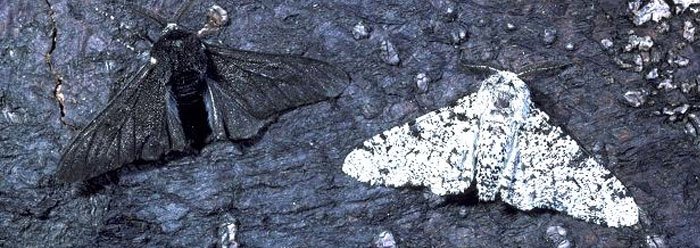
The trees that peppered moths used to live on were once white, but became covered in soot from coal factories. Which moth will be more successful in this environment?

a)

dark moth

b)

light moth

c)

both will be equally successful

d)

neither will be successful

24.

The cave fish and minnow are related to each other but the cave fish is blind and only has the remnants of an eye. What type of structure is this?

a)

homologous

b)

analogous

c)

vestigial

d)

convergent

25.
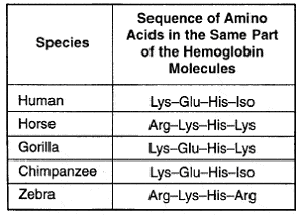
You look at two species and see very similar amino acid sequences. What does this likely tell you?
a)
These are the same animal.
b)
These animals have a common ancestor.
c)
These animals are not likely related.
d)
These animals are likely becoming one species.
26.
Survival of the Fittest and Evolution were proposed by what scientist?
a)
Charles Darwin
b)
Albert Einstein
c)
Steven Hawking
d)
Isaac Newton
27.
What is the advantage of having different shaped beaks?
a)
To look different from other species.
b)
To be able to eat the food readily available in the environment.
c)
To protect itself against predators.
d)
To protect itself against prey.
28.
Why are advantageous traits more likely to be passed onto offspring?
a)
Because they are more likely to survive and reproduce.
b)
Because they come from dominant alleles.
c)
Because they come from recessive alleles.
d)
Because the trait is an acquired phenotype.
29.
Which organisms are most likely to survive?
a)
the best adapted
b)
the fastest
c)
the strongest
d)
the most domesticated (tamed)
30.

1. Lamarck’s ideas about evolution were wrong because he proposed that

a)

species change over time

b)

species descended from other species

c)

acquired characteristics can be inherited

d)

species are adapted to their environments

31.

1. A farmer’s use of the best livestock for breeding is an example of

a)

natural selection

b)

artificial selection

c)

extinction

d)

adaptation

32.

The ability of an individual organism to survive and reproduce in its natural environment is called

a)

natural selection

b)

evolution

c)

descent with modification

d)

fitness

33.

Which of the following is an important concept in Darwin’s theory of evolution by natural selection?

a)

descent with modification

b)

homologous molecules

c)

processes that change the surface of Earth

d)

the tendency toward perfection

34.

1. A bird’s wings are homologous to a(n)

a)

fish’s tailfin

b)

alligator’s claws

c)

dog’s front legs

d)

mosquito’s wings

35.

1. What process produced the two different types of beaks shown?

a)

artificial selection

b)

natural selection

c)

geographical distribution

d)

disuse of the beak

36.

1. The large ground finch obtains food by cracking seeds. Its short, strong beak is an example of

a)

the struggle for existence

b)

the tendency toward perfection

c)

an adaptation

d)

a vestigial organ

37.
Which of the following is a factor in natural selection?
a)
Individuals of species compete with one another to survive.
b)
All species are genetically diverse.
c)
Individuals better able to adapt to changes leave more offspring.
d)
All are correct 
38.
The fossil record provides evidence that 
a)
Fossils cannot be dated.
b)
All species were formed during Earth’s formation and have changed little since then.
c)
The fossilized species have no connection to today’s species.
d)
Older species gave rise to more-recent species.
39.
Individuals that are better able to cope with the challenges of their environment tend to  
a)
Decrease in population over time.
b)
Leave more offspring than those less suited to the environment.
c)
Leave fewer offspring than those less suited to the environment.
40.
European rabbits were introduced to Australia in 1859. The rabbits reproduced rapidly in their new habitat, displaced other animals, and overgrazed vegetation. In an attempt to reduce the rabbit population, a virus was introduced in 1951. This virus is usually deadly to European rabbits. When the virus was first introduced, the rabbits died in large numbers, but the death rate decreased over time. Which of the following best explains the decrease in the rabbit death rate? 
a)
Young rabbits learned to avoid being infected with the virus.
b)
The lifespan of the virus was too short to affect rabbits over a long period of time.
c)
Natural selection favored rabbits that were resistant to the virus. 
d)
No correct choices.
41.
The Asian shore crab invaded parts of the eastern coast of the United States about 15 years ago. The Asian shore crab preys on blue mussels. In the time since the Asian shore crab arrived, the average shell thickness of the blue mussel population has increased. Which of the following is the most likely reason that this increase in shell thickness has occurred? 
a)
Blue mussels with thick shells attract more crabs that mussels without thick shells.
b)
Blue mussels with thick shells grow in larger colonies than mussels without thick shells.
c)
Blue mussels with thick shells catch more food per day than mussels without thick shells.
d)
Blue mussels with thick shells survive and reproduce more successfully than mussels without thick shells.
42.
Which of the following phrase best describes how Thomas Malthus influenced Charles Darwin’s idea of natural selection?
a)
The number of resources available can limit the survival of a species. 
b)
The survival of a species depends on the traits they acquire in their lifetime.
c)
The survival of a species is determined by how many offspring they leave behind.
d)
The Earth is constantly changing; seashell fossils were found at the top of the Andes Mountains. 
43.

Which of the following can be learned by using the fossil record?

a)

When organisms changed or evolved

b)

when organisms appeared on Earth

c)

when organisms became extinct

d)

All the above

44.

In which kind of rock do we usually find a fossil?

a)

sedimentary rock

b)

metamorphic rock

c)

igneous rock

45.

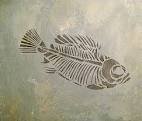
If scientists found this fossil, what could they infer?

a)

what fish are like today

b)

that this fish lacked oxygen

c)

that water once covered the area where this fossil was found
46.
In recent years "SuperBugs" (bacteria that aren't effected by antibiotics) are becoming more and more common. How could natural selection explain this?
a)
Superbugs survive antibiotics and reproduce
b)
Antibiotics cause bacteria to become superbugs
c)
We have always had the same amount of superbugs; modern media just discusses them more.
d)
There is no reliable data on the origin of super bugs.
47.
Why do peppered moths tend to be the same color as the trees on which they live?
a)
The coloring goes along with tasting like the tree. 
b)
It keeps the moth the same temperature as the tree. 
c)
It makes the moths faster than the birds
d)
It makes the moths harder to see.
48.
Which of the following explains adaptation.
a)
An individual organism changes to meet its needs in the environment. These changes pass down to their offspring.
b)
The species as a whole changes their characteristics.
c)
Beneficial traits allow organism to survive and pass on those traits
d)
New characteristics arise in a species as needed.  If these traits are helpful, they are passed down.
49.
Darwin studied which of these species on Galapagos?
a)
Pigeons and tortoises
b)
Tortoises and finches
c)
Finches and Pigeons
d)
Zebras and Mockingbirds
50.
Evolution works by 
a)
individuals changing to suit their environment
b)
Individuals learned new traits and pass them on
c)
sudden change in the environment cause a species change 
d)
small changes pass down through many generations
51.
Some people use similarities in embryos to support the the theory that 
a)
The organisms have the same ancestors 
b)
The organisms have similar numbers of offspring
c)
Cells naturally develop along similar line 
d)
There are no connections 
52.
Evolution typically happens...
a)
in a few weeks
b)
over millions of years
c)
never
d)
in 100 years
53.
Darwin said that within a species there will be _________________________
a)
nothing different
b)
variation/differences
54.
Mutations are a change in what?
a)
DNA
b)
tRNA
c)
genotype
d)
phenotype
55.
The trees these moths used to live on were white, but have been covered in soot from coal factories. Which moth will be more successful in this environment?
a)
Dark moth
b)
Light moth
c)
Both will be equally successful
d)
Neither will be successful
56.
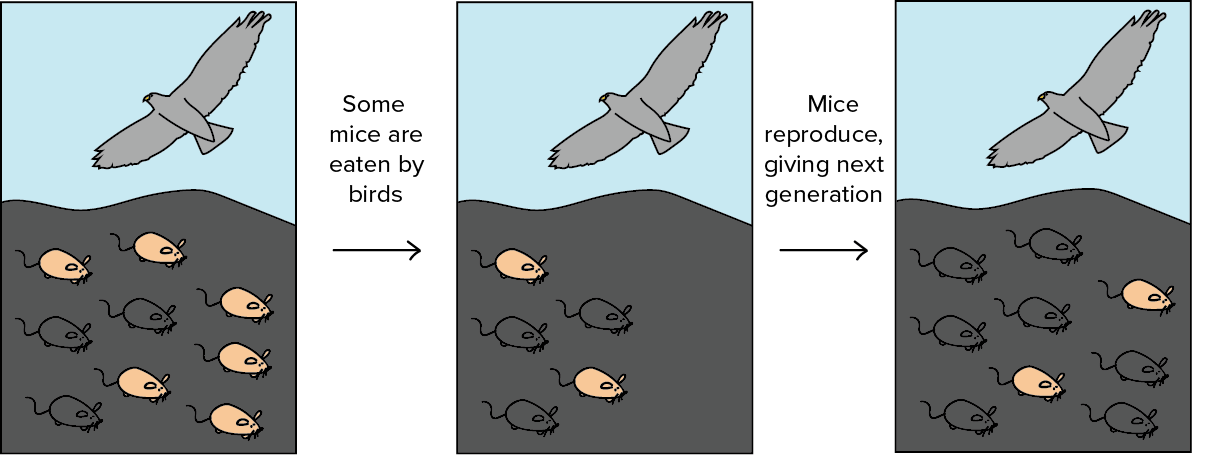
Why is the mouse population changing over time?
a)
The light mice can reproduce more successfully than the dark mice
b)
The hawks eat more dark mice than light mice because the dark mice taste better
c)
The hawks eat more light mice than dark mice because they can see the light mice more easily
d)
The hawks eat more dark mice than light mice because they can see the dark mice more easily
57.
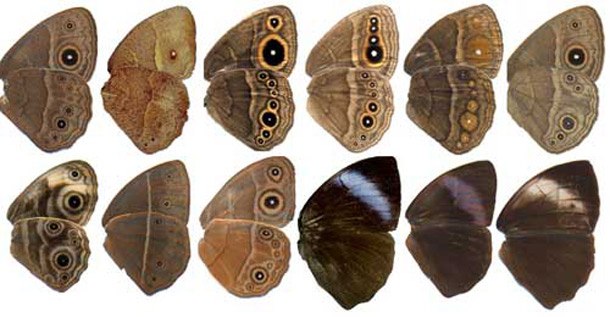
These moths are all the same species. The differences between their wings is an example of ________________
a)
Natural Selection
b)
Variation
c)
Homeostasis
d)
Extinction
58.

1. Lamarck’s ideas about evolution were wrong because he proposed that

a)

species change over time

b)

species descended from other species

c)

acquired characteristics can be inherited

d)

species are adapted to their environments

59.

1. Lyell’s Principles of Geology influenced Darwin because it explained how

a)

organisms change over time

b)

adaptations occur

c)

the surface of Earth changes over time

d)

the Galápagos Islands formed

60.

The ability of an individual organism to survive and reproduce in its natural environment is called

a)

natural selection

b)

evolution

c)

descent with modification

d)

fitness

61.

1. A bird’s wings are homologous to a(n)

a)

fish’s tailfin

b)

alligator’s claws

c)

dog’s front legs

d)

mosquito’s wings

62.

Darwin's ship?

a)

HMS Finch

b)

HMS Beagle

63.

What series of islands off the coast of South America did Darwin spend considerable amount of time and greatly influence Darwin's work.

a)

Hawaiian Islands

b)

Galapagos Islands

64.

Darwin collected what type of evidence on his voyage?

a)

Fossil & Specimen Evidence

b)

DNA & Biochemical Evidence

65.

Example of evolution

a)

Biochemical Analysis

b)

Homologous Structure

c)

Vestigial Organ

d)

Embryological Similarities

e)

Fossil

66.

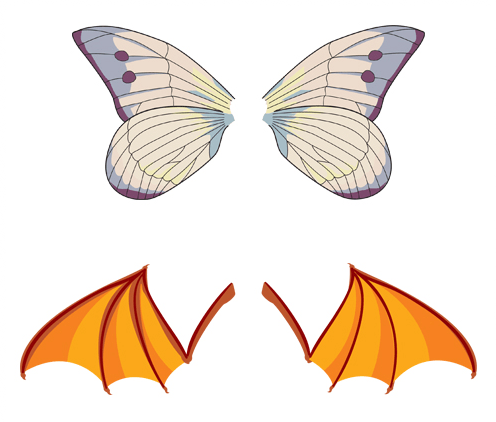
What is this an example of?

a)

Homologous structure

b)

Analogous structure

c)

Vestigial organs

d)

Functional adaption

67.
The picture shows the members of the Camelidae family. The physical features and the geographical origin of these animals provide evidence that - 
a)
they live in the same type of environment.
b)
have slowly evolved to become herbivores.
c)
have a common ancestor.
d)
exchanged DNA in the past.
68.

Individuals that are better able to cope with the challenges of their environment tend to

a)

Increase in population over time.

b)

Decrease in population over time.

c)

Leave fewer offspring than those less suited to the environment.

d)

Both (a) and (c)

69.
The trees these moths used to live on were white, but have been covered in soot from coal factories. Which moth will be more successful in this environment?
a)
Dark moth
b)
Light moth
c)
Both will be equally successful
d)
Neither will be successful
70.
Since the 1800s humans have stopped burning coal, and the trees have returned to their original color. Which moth will be more successful in this environment?
a)
Dark moth
b)
Light moth
c)
Both will be equally successful
d)
Neither will be successful