wayground logo

Free Printable Worksheets

Font size

S
M
L
XL
Worksheets

3NW Benchmark Review

Total questions: 55

Worksheet time: 46mins

Name
Class
Date
1.
Which processes are involved in the formation of metamorphic rock?
a)
erosion & deposition
b)
compaction & cementation
c)
cooling & crystalization
d)
heat & pressure
2.
Which of the following is not a property of a mineral?
a)
naturally occuring
b)
organic
c)
solid
d)
crystal structure
3.
Which large group of rocks is further subdivided into either foliated or unfoliated?
a)
sedimentary
b)
metamorphic
c)
igenous
d)
minerals
4.
Mineral crystals that cool slowly will --
a)
grow large
b)
remain small
c)
evaporate
5.
Formed from the cooling of magma, these rocks have visible crystals...
a)
clastic sedimentary
b)
foliated metamorphic
c)
igneous intrusive
d)
igneous extrusive
6.
The mineral in the picture has --
a)
fracture
b)
cleavage
c)
metallic luster
d)
magnetism
7.
According to the Moh's Hardness Scale, _____ will scratch feldspar.
a)
gypsum
b)
fluorite
c)
topaz
d)
calcite
8.
According to the diagram, which processes lead to the formation of sediments?
a)
compaction & cementation
b)
heat & pressure
c)
cooling & crystalization
d)
weathering & erosion
9.

Which of the following are properties of a mineral? Choose all that apply.

a)

inorganic

b)

naturally occurring

c)

crystal structure

d)

organic

e)

solid

10.

What are the two classifications of metamorphic rock? Choose TWO!

a)

intrusive

b)

foliated

c)

clastic

d)

nonfoliated

e)

extrusive

11.

Extrusive igneous rocks include all of the following except --

a)

pumice

b)

granite

c)

basalt

d)

scoria

12.

Which is a characteristic of all nonfoliated metamorphic rocks?

a)

presence of fossils

b)

cleavage planes

c)

lack of banding

d)

metallic luster

13.

One disadvantage of solar power is:

a)

The sun is not free.

b)

The solar panels are ugly.

c)

The solar panels are shiny.

d)

The availability of sun is inconsistent.

14.
Burning fossil fuels produces CO2. What is the largest concern we have with adding too much COto the atmosphere?
a)
makes too many clouds
b)
affects our breathing
c)
contributes to a warmer planet
d)
blocks out solar energy
15.
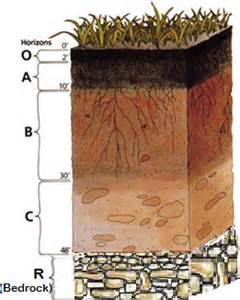
What is another name for horizon A in a soil profile?
a)
litter
b)
subsoil
c)
bedrock
d)
topsoil
16.
What is another name for horizon B in a soil profile?
a)
litter
b)
topsoil
c)
subsoil
d)
bedrock
17.
Although other factors may play a role, mass movement is caused by - 
a)
abrasion
b)
gravity
c)
chemical weathering
d)
deposition
18.
What kind of weathering causes the mineral composition of rocks to change?
a)
mechanical weathering
b)
permeable weathering
c)
chemical weathering
d)
physical weathering
19.
A rock containing iron becomes soft and crumbly and reddish-brown in color.  It probably has been chemically weathered by -
a)
abrasion
b)
carbon dioxide
c)
oxygen
d)
acid rain
20.
A hot wet climate causes weathering to take place -
a)
slowly
b)
rapidly
c)
unevenly
d)
at the same rate as when the climate is dry and cool
21.
What represents the steepest area on the map?
a)
area 1
b)
area 2
c)
area 3
d)
area 4
22.
What is the contour interval on the trail map?
a)
10 feet
b)
100 feet
c)
20 feet
d)
200 feet
23.
What is the approximate elevation of Point X in meters on the map?
a)
68 meters
b)
63 meters
c)
57 meters
d)
53 meters
24.
The longitude of a place, or how far it is from the prime meridian affects --
a)
the location's time zone
b)
how much rainfall the location receives
c)
the climate of the area
d)
average yearly temperatures
25.
How far a location is from the equator affects --
a)
the location's time zone
b)
the climate of the area
c)
when it is day and when it is night
d)
the length of its day
26.
Which is not a feature of Karst topography?
a)
limestone caves
b)
sinkholes
c)
groundwater mixed with CO2 forming carbonic acid
d)
granite caves
27.
What is the elevation of point B?
a)
800 ft
b)
850 ft
c)
900 ft
d)
1000 ft
28.
0 degrees latitude; an imaginary line that runs around the middle of Earth, like a belt
a)
Tropic of Cancer
b)
Equator
c)
Prime Meridian
d)
Tropic of Capricorn
29.
0 degrees longitude; an imaginary line that runs up and down through the United Kingdom
a)
Prime Meridian
b)
Equator
c)
International Date Line
30.

imaginary lines on a map that run horizontally and are measured north or south of the equator

a)

Latitude

b)

Longitude

31.

imaginary lines on a map that run vertically and are measured east or west of the prime meridian

a)

Latitude

b)

Longitude

32.
Which letter would you find at 15oS, 60oW?
a)
A
b)
C
c)
L
d)
H
33.
What is the approximate location of G?
a)
100oW, 40oN
b)
40oN, 100oW
c)
40oS, 100oW
d)
40oN, 100oE
34.
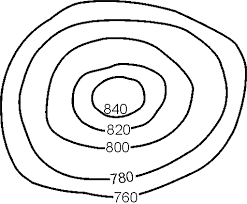
Determine the contour interval:
a)
5 m
b)
10 m
c)
15 m
d)
20 m
35.
What do contour lines that are farther apart represent?
a)
waterfall
b)
steep area
c)
gentle slope
d)
river
36.
What is the difference in elevation between Point X and Point Y?
a)
120 m
b)
240 m
c)
360 m
d)
340 m
37.
What is the maximum possible elevation at point X?
a)
1400 ft
b)
1599 ft
c)
1600 ft
d)
1699 ft
38.
As you travel from west to east, does it get later or earlier?
a)
Earlier
b)
Later
39.

The difference in longitude between point B and E is --

a)

0 degrees

b)

90 degrees

c)

60 degrees

d)

45 degrees

40.

On Earth, the time difference between Point A and B is --

a)

14 hours

b)

5 hours

c)

12 hours

d)

24 hours

41.

The latitude of the North Pole is --

a)

90°S

b)

90°N

c)

0°N

d)

180°N

42.

Which region, shaded in green, is known for having Karst topography?

a)

Coastal Plain

b)

Piedmont

c)

Appalachian Plateau

d)

Valley and Ridge

43.
In which horizon is most of the HUMUS?
a)
Horizon A
b)
Horizon B
c)
Horizon C
d)
Horizon D or R
44.

What type of rock could be described as course-grained because of the size of its crystals?

a)

granite

b)

pumice

c)

obsidian

d)

basalt

45.

Rocks, like the pumice seen here, that have holes are likely --

a)

foliated metamorphic

b)

clastic sedimentary

c)

igneous intrusive

d)

igneous extrusive

46.

What type of rock is seen in the picture?

a)

sandstone, clastic sedimentary

b)

gneiss, foliated metamorphic

c)

obsidian, igenous extrusive

d)

granite, igneous intrusive

47.

Most fossils are found in what type of rock?

a)

igneous intrusive

b)

metamorphic

c)

sedimentary

d)

igneous extrusive

48.

Which of the following renewable energy sources are found in Virginia? Choose all that apply.

a)

nuclear

b)

wind

c)

solar

d)

coal

49.

The line longitude found at 180° is called the --

a)

equator

b)

prime meridian

c)

international date line

d)

north pole

50.

Limestone that contains animal shells and coal that contains plant material would be classified as --

a)

organic sedimentary

b)

clastic sedimentary

c)

igneous intrusive

d)

igeneous extrusive

51.

Which layer in the picture is composed of partially weathered bedrock?

a)

Layer 1

b)

Layer 2

c)

Layer 3

d)

Layer 4

52.
The color of a mineral's powder is --
a)
streak
b)
luster
c)
hardness
d)
mark
53.
The way that a mineral reflects light is known as --
a)
fluorescence
b)
bioluminescence
c)
luster
d)
brightness
54.

When studying whether a mineral has cleavage or fracture, we are studying --

a)

how it reflects light.

b)

how it reacts with other elements

c)

the color of its powder.

d)

how it breaks.

e)

whether it will scratch other minerals.

55.

The repeated freezing and thawing of rain water inside the cracks of rocks often leads to rocks breaking apart. This is an example of --

a)

erosion

b)

mechanical weathering

c)

deposition

d)

chemical weathering