
 Worksheets
Plate Tectonics 2019
Total questions: 101
Worksheet time: 1hrs 13mins
Name
Class
Date
1.
The type of plate boundary where two plates come together is a .....
a)
Convergent Boundary
b)
Divergent Boundary
c)
Transform Boundary
d)
Plate Boundary
2.
Which of the following causes Earth's tectonic plates to move?
a)
Energy from the Sun
b)
Magnetic Pole Reversal
c)
Convection currents in the mantle
d)
Faults in Mountain Ranges
3.
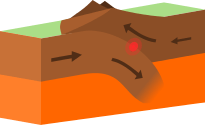
What type of plate boundary is this?
a)
Plate
b)
Divergent
c)
Convergent
d)
Transform
4.

What type of event will occur at this boundary?
a)
Earthquake
b)
Volcano Eruption
c)
Tornado
d)
Mountain Building
5.
A divergent boundary occurs when plates ....
a)
Pull apart
b)
Come together
c)
Slide past each other
d)
subducting
6.
Which of the following is the name of the ancient supercontinent formed 28 Million Years ago.
a)
Pangea
b)
Gondwanda
c)
Laurasia
d)
Neverland
7.
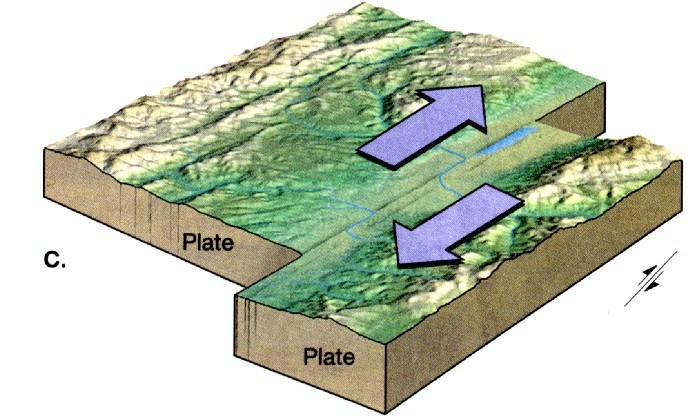
What type of plate boundary is this?
a)
Transform
b)
Convergent
c)
Divergent
d)
Plate
8.
The theory that says Earth's continents once made up an ancient supercontinent, and have been drifting apart ever since, is called the theory of...
a)
Pangea
b)
Plate Tectonics
c)
Natural Selection
d)
Gravity
9.
Oceanic Trenches are formed by _______ plate boundaries
a)
Convergent
b)
Transform
c)
Plate
d)
Divergent
10.
A fault is formed by the movement of a __________ plate boundary
a)
Transform
b)
Convergent
c)
Divergent
11.
Islands can from from magma which is pushed up at a __________ plate boundary
a)
Divergent
b)
Convergent
c)
Transform
12.
How is it possible for new crust to be formed without increasing the surface area of the Earth?
a)
Crust is destroyed at the same time it is created
b)
New crust is underwater where it sinks
c)
New crust breaks more easily than old crust
13.
Mountains are created when....
a)
Two continental plates collide
b)
Two oceanic plates pull apart
c)
An Oceanic plate subducts under a Continental Plate
d)
Two continental plates pull apart
14.
Which of these layers is ALL solid iron and nickle?
a)
inner core
b)
outer core
c)
lithosphere
d)
mesosphere
15.
Which of the following occurs because of convection currents?
a)
Tectonic plates on the crust move.
b)
The mantle increases in size.
c)
Pressure in the crust increases.
d)
Pressure in the crust decreases.
16.
The mantle of Earth is made partly of magma. When magma rises and sinks, this is called ______________.
a)
a conduction current
b)
a hot spot
c)
a volcanic eruption
d)
a convection current
17.

As you travel from the inner core to the crust, how would temperature, pressure and density of the material change?
a)
They would all increase
b)
They would all decrease.
c)
They would stay the same.
d)
Temperature would decrease, but pressure and density would increase.
18.

What would happen to the convection currents if the heat from the inner core disappeared?
a)
They would stop.
b)
They would change directions.
c)
It would not change.
d)
They would speed up.
19.
Mountains form from ...
a)
plates sliding past one another
b)
collision of plates
c)
plates moving away from each other
20.
Which is true about hotter material in the mantle?
a)
more dense, sinks
b)
less dense, sinks
c)
less dense, rises
d)
more dense, rises
21.
During sea floor spreading, molten material rises up from the mantle...
a)
along the continents
b)
at the mid ocean ridges
c)
deep ocean trenches
d)
at north and south poles
22.
Which of the following is where one plate slides under another plate?
a)
submarine zone
b)
divergence zone
c)
subduction zone
d)
lower zone
23.
This land formation occurs at a divergent boundary.
a)
mid ocean ridge
b)
deep ocean trench
c)
pacific hot spot
d)
rift valley
24.
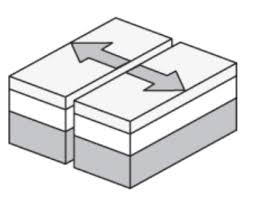
Name the boundary
a)
convergent boundary
b)
divergent boundary
c)
transform boundary
d)
sergent boundary
25.

Name the boundary
a)
convergent boundary
b)
divergent boundary
c)
transform boundary
d)
sergent boundary
26.
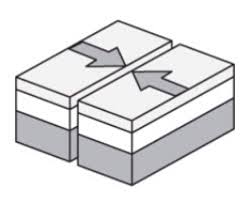
Name the boundary
a)
convergent boundary
b)
divergent boundary
c)
transform boundary
d)
sergent boundary
27.
Which ocean is expanding due to a mid-ocean ridge (divergent boundary)?
a)
Indian
b)
Dead Sea
c)
Atlantic
d)
Artic
28.
Which layer of the Earth is liquid iron?
a)
Crust
b)
Mantle
c)
Outer Core
d)
Inner Core
29.
The Great Rift Valley in Africa and the Mid-Ocean Ridge were all created by this boundary
a)
Divergent
b)
Convergent
c)
Reform
d)
Transform
30.
What are the two types of crust
a)
continental and oceanic
b)
ocean and upper
c)
lower and upper
d)
pizza and subway
31.
Which layer has convection currents?
a)
Inner Core
b)
Outer Core
c)
Mantle
d)
Crust
32.
subduction zones in the ocean can create which features?
a)
islands
b)
volcanoes
c)
earthquakes
d)
all of the above
33.
Earthquakes and volcanoes are most likely found in which locations?
a)
At plate boundaries
b)
in oceans
c)
in the middle of continents
d)
in the middle of plates
34.
When one plate sides under neath another, it _________ and the magma _________.
a)
hardens, sinks
b)
melts, sinks
c)
hardens, rises
d)
melts, rises
35.
The Himalayas in Asia are an example of what type of plate boundary?
a)
divergent
b)
continent-to-continent convergent
c)
ocean-to-continent convergent
d)
transform
36.
When an oceanic plate and a continental plate collide, which one will subduct?
a)
oceanic
b)
continental
c)
neither
37.
Which of the following is NOT a tectonic boundary?
a)
Convergent
b)
Divergent
c)
Sedergent
d)
Transform
38.

What is this image...
a)
Revolving boundary
b)
San Andreas (Transform)
c)
Convergent
39.

The physical layer of Earth made of solid rock and soil is called the ___________.
a)
mesosphere
b)
lithosphere
c)
asthenosphere
d)
mantle
40.
What does the theory of continental drift state?
a)
The continents were once joined in a super-continent and have moved over time
b)
Continents are stationary and do not move
c)
The Earth is broken into lithospheric plates that move due to convection currents
d)
none of the above
41.
Oceanic crust is
a)
Younger and less dense than continental crust
b)
Thinner, younger and more dense than continental crust
c)
Older, thicker and less dense that continental crust
d)
Bigger and younger than continental crust
42.
Earth's plates are...
a)
constantly moving and changing the face of the earth
b)
Never moves
c)
Moves seldom and very fast
d)
Moves when it feels like it
43.
Which type of plate boundary would cause folded mountains to form?
a)
transform
b)
convergent
c)
divergent
d)
subduction
44.
What type of evidence was NOT used by Alfred Wegener to support his continental drift hypothesis?
a)
evidence from landforms
b)
evidence from fossils
c)
evidence from human remains
d)
evidence from climate
45.
Most geologists rejected Alfred Wegener's idea of continental drift because...
a)
it did not agree with their current theory
b)
Wegener was interested in what Earth was like millions of years ago
c)
Wegener used several different types of evidence to support his hypothesis
d)
Wegener could not identify the force that moved the continents
46.
How did scientists discover that rocks farther away from mid-ocean ridges were older than those near it?
a)
by observing eruptions of molten material on the seafloor
b)
by mapping rocks on the sea floor using sonar
c)
by determining the age or rock samples obtained by drilling on the seafloor
d)
by measuring how fast seafloor spreading occurs
47.
The geological theory that states that pieces of Earth's lithosphere are in constant, slow motion is the theory of
a)
subduction
b)
plate tectonics
c)
evolution
d)
seafloor spreading
48.
The process by which the ocean floor sinks beneath a deep ocean trench and back into the mantle is known as
a)
convection
b)
continental drift
c)
subduction
d)
conduction
49.
What discovery caused scientists to rethink Wegener's continental drift theory?
a)
discovery of earthquake activity in California
b)
discovery of the ring of fire in the Pacific Ocean
c)
discovery of seafloor spreading in the Atlantic Ocean
d)
discovery of deep trenches off the coast of South America
50.

Matching ________ on different continents are evidence for continental drift.
a)
weather systems
b)
river systems
c)
rock structures
d)
wind systems
51.

The _________ is the thinnest layer of Earth.
a)
outer core
b)
inner core
c)
mantle
d)
crust
52.

The theory of continental drift was first proposed by __________.
a)
Thomas Edison
b)
Alfred Wegener
c)
Benjamin Franklin
d)
Harry Hess
53.

The theory of seafloor spreading was first proposed by __________.
a)
Thomas Edison
b)
Harry Hess
c)
Benjamin Franklin
d)
Alfred Wegener
54.

What is the correct order (starting from the surface) of Earth’s layers?
a)
mantle, outer core, inner core, crust
b)
crust, mantle, outer core, inner core
c)
outer core, inner core, crust, mantle
d)
crust, outer core, inner core, mantle
55.

The layer of caramel-like consistency that flows and moves the plates of the Earth is called the ________.
a)
mantle
b)
lithosphere
c)
crust
d)
asthenosphere
56.

_________ currents carry heat from the hot inner core to the cooler outer mantle and back again.
a)
River
b)
Radiation
c)
Convection
d)
Conduction
57.

Which type of plate boundary occurs at B?
a)
convergent
b)
divergent
c)
transform
d)
country
58.

The feature labeled C represents some of the deepest spots on the ocean floor. These areas are called ___.
a)
mid-ocean ridge
b)
trenches
c)
deep-sea vent
d)
abyssal plain
59.

The feature labeled D is part of the continuous underwater mountain range that circles Earth. It is called ___.
a)
mid-ocean ridge
b)
trenches
c)
deep-sea vent
d)
abyssal plain
60.

Which type of plate boundary is shown at A?
a)
transform boundary
b)
convergent boundary
c)
divergent boundary
d)
fractured boundary
61.
What forms when denser oceanic crust is pushed under less dense oceanic crust?
a)
mountains
b)
volcanic islands
c)
rift valleys
d)
mid-ocean ridges
62.
Large pieces of Earth's lithosphere that move around are called?
a)
sections
b)
plates
c)
land masses
d)
faults
63.
What were magnetic stripes on the ocean floor used to show?
a)
the seafloor was spreading outward from the mid-Atlantic ridge
b)
the seafloor was spreading inward toward the mid-Atlantic ridge
c)
the seafloor was effectively stationary
d)
natural magnetic rocks always form in the mantle of the Earth
64.
The youngest rocks on the seafloor are most likely found...
a)
closest to a mid-ocean ridge
b)
farthest from a mid-ocean ridge
c)
near the coastlines
d)
closest to a deep sea trench
65.
The Andes Mountains are a volcanic mountain range located on the western coast of South America. The plate boundary located in this region is most likely an area of-
a)
subduction because the plates are colliding
b)
folded mountains because the plates are colliding
c)
mid-ocean ridges because the plates are pulling apart
d)
ocean-floor spreading because the plates are spreading apart
66.
What do volcanic island arcs indicate about the plate tectonics in the region?
a)
a converging plate boundary
b)
a diverging plate boundary
c)
a transform plate boundary
d)
new seafloor being created
67.

Part of mantle where lithosphere floats
a)
Crust
b)
Core
c)
Asthenosphere
d)
Atmosphere
68.

Addition of new sea floor
a)
Subduction
b)
Sea Floor Spreading
c)
Sea Floor subduction
d)
Convergent
69.

Which was NOT evidence of Wegener?
a)
Seafloor spreading
b)
fossils
c)
puzzle piece
d)
glacier evidence
70.

Geologists study the inside of the Earth by using____
a)
seismic waves
b)
sound waves
c)
light waves
d)
EM waves
71.

Once magma reaches the earth's surface it is called.....
a)
Silica
b)
Rock
c)
lava
72.
Volcanoes can be found...
a)
on land
b)
under water
c)
on islands
d)
all of the above
73.
What is the difference between magma and lava?
a)
Lava is inside the Earth, magma is outside.
b)
Lava is outside the Earth, magma is inside.
74.
Which of the following is evidence for continental drift?
a)
old maps
b)
volcanoes
c)
earthquakes
d)
fossils
75.

What process is occurring at Z?
a)
Convection currents
b)
Subduction
c)
Two plates moving apart
d)
New ocean floor forming
76.
Supporting Evidence: fossils, continent shape, landforms
a)
Continental Drift
b)
Seafloor Spreading
c)
Plate Tectonics
77.
Supporting Evidence: subduction, earthquakes, volcanoes, Mid-Atlantic Ridge, older theories
a)
Continental Drift
b)
Seafloor Spreading
c)
Plate Tectonics
78.
Faults and tectonic plate boundaries are the same thing.
a)
True
b)
False
79.
The circular pattern of heating, rising, cooling, sinking of magma in the mantle causing tectonic plates to move.
a)
Plate Tectonics
b)
Convection Currents
c)
Pangaea
d)
Subduction
80.
Volcanoes are most often formed at this boundary.
a)
Divergent
b)
Convergent
c)
Normal
d)
Transform
81.
The Mid-Atlantic Ridge is formed at this boundary.
a)
Divergent
b)
Convergent
c)
Normal
d)
Transform
82.
Faults can occur at plate boundaries, near boundaries, and at other weakened areas of crust.
a)
True
b)
False
83.
There are 3 types of crust.
a)
True
b)
False
84.
Continental crust is more dense than oceanic crust.
a)
True
b)
False
85.
A fossil's location in the Earth's strata can help us know if it is older or younger than other fossils found in the strata.
a)
True
b)
False
86.
True or False.
The deeper you go into the earth, the greater the pressure.
The deeper you go into the earth, the greater the pressure.
a)
True
b)
False
87.
The core is made mostly of what two metals?
a)
Copper and Gold
b)
Silicon and Sulfur
c)
Iron and Nickel
d)
Barium and Silver
88.
Which layer of Earth flows slowly and causes the crust to move?
a)
Crust
b)
Mantle
c)
Inner Core
d)
Outer core
89.
What is a rift valley?
a)
It occurs when a deep ocean valley is formed a long divergent boundary that develops on land.
b)
It is when a plate from the ocean moves in the mantle and it make more crust.
c)
It is when a mountain is formed buy the ocean .
90.

What is this a picture of?
a)
plate tectonics
b)
continental drift
c)
pangea
d)
glacier scaring
91.
The crust and upper mantle make up the
a)
Lithosphere
b)
Asthenosphere
c)
Upper Mantle
d)
Lower Mantle
92.

Deep sea trenches are associated with:
a)
Finding Nemo
b)
Subduction zones
c)
Transform boundaries
93.

Which liquid is the least dense?
a)
oil
b)
water
c)
syrup
d)
plastic bottle
94.
The best evidence that the continents were once connected is that they have matching
a)
Weather, fossils, and Rock Types
b)
Rock types, fossils, coastlines
c)
Coastlines, weather, rock types
d)
Coastlines, weather, fossils
95.
The best evidence that the continents were once connected is that they have matching
a)
Weather, fossils, and Rock Types
b)
Rock types, fossils, coastlines
c)
Coastlines, weather, rock types
d)
Coastlines, weather, fossils
96.

When an oceanic plate is subducted under a continental plate, a deep valley is formed in the ocean. What is this valley called?
a)
a trench
b)
a rift zone
c)
ocean spreading ridge
d)
Continental crust
97.

When convergent plates collide, if both plates are pushed upward, this forms.
a)
Fissures
b)
Mountain Ranges
c)
Volcanoes
d)
Rock Cycle
98.
At what type of boundary are volcanoes most common?
a)
convergent
b)
divergent
c)
transform
99.
New crust is formed when oceanic plates....
a)
move towards each other
b)
move away from each other
100.
Island arcs are formed at what type of plate boundary?
a)
Convergent
b)
Divergent
c)
Transform
101.
Island arcs are formed at what type of plate boundary?
a)
Convergent
b)
Divergent
c)
Transform
100 %

