
 Worksheets
SFP Semester 2 Midterm
Total questions: 79
Worksheet time: 4hrs 47mins
Zeroth law of thermodynamics is:
Kinetic energy of molecules of a gas is zero
Ideal gas does not contain molecules
If two systems are thermal equilibrium third one is also in equilibrium
Absolute zero temperature cannot be obtained
What quantity of heat is required to raise the temperature of 450 grams of water from 15°C to 85°C? The specific heat capacity of water is 4.18 J/g/°C.
131670 J
159885 J
-131670 calories
none of the above
A measure of the amount of disorder or randomness in a system.
Entropy
Exothermic
First Law of Thermodynamics
Heat engine
The average kinetic energy of the molecules in an ideal gas is
directly proportional to the square root of the absolute temperature.
directly proportional to the absolute temperature.
independent of the absolute temperature.
inversely proportional to the absolute temperature.
Which one the explanations of the absolute zero of temperature is a wrong one.
The absolute zero of temperature is –273.15 °C
0K
At absolute zero of temperature, the substance has maximum internal energy
At absolute zero of temperature, the substance has minimum internal energy.
The ability to do work or produce heat is called
Endothermic
Exothermic
Energy
Temperature
Heat
The measure of random motions of the molecules of a substance is known as the substance’s
Endothermic
Exothermic
Energy
Temperature
Heat
Measuring energy by measuring temperature changes of water
exothermic
enthaply
heat of fusion
calorimetry

The amount of energy required to raise the temperature of 1 gram of a substance by 1o C is known as:
Specific heat capacity
Heat of fusion
Heat of vaporization
Melting point




Walking on the warm sand with your bare feet.
conduction
convection
radiation


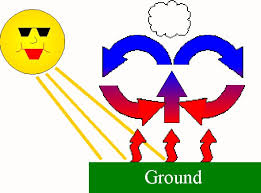
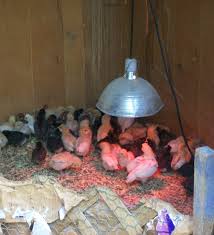


The law stating that energy is neither created nor destroyed; it only changes form. It is also known as the law of conservation of energy.
First Law of Thermodynamics
Second Law of Thermodynamics
Third Law of Thermodynamics
Fourth Law of Thermodynamics
A law stating that all spontaneous processes result in an increase in the total entropy of the system and its surroundings.
First Law of Thermodynamics
Second Law of Thermodynamics
Third Law of Thermodynamics
Fourth Law of Thermodynamics
How many electrons have been removed from a positively charged electroscope if it has a net charge of 7.5x10⁻¹¹ C?
7.5x10⁻¹¹ electrons
2.1x10⁻⁹ electrons
1.2x10⁸ electrons
4.7x10⁸ electrons
The force exerted on a particle with a charge of 5.0x10⁻⁹ C by a second particle that is 4 cm rgaway is 8.4x10⁻⁵ N. What is the charge of the second particle?
4.2x10⁻¹³ C
2.0x10⁻⁹ C
3.0x10⁻⁹ C
6.0x10⁻⁵ C

Three charges, A, B, and C, are located in a line, as shown above. What is the net force on charge B?
78 N toward A
78 N toward C
130 N toward A
210 N toward C
What is the charge on an electroscope that has
an excess of 4.8x10¹⁰ electrons?
3.3x10⁻³⁰ C
7.7x10⁻⁹ C
4.8x10⁻¹⁰ C
4.8x10¹⁰ C
Two charged bodies exert a force of 86 N on each other. If they are moved so that they are six times farther apart, what is the new force that they will exert on each other?
2.4 N
14 N
86 N
5.2x10² N
Two equally charged bodies exert a force of 90 N on each other. If one of the bodies is exchanged for a body of the same size, but three times as much charge, what is the new force that they will exert on each other?
10 N
2.7x10² N
30 N
8.1x10² N
How can acquiring charge be described at a microscopic level?
It is a process of balancing the charge on an atom.
It is the process of removing electrons from the nucleus
It is the process of transferring atoms
It is the process of transferring electrons
Explain what is meant by an electric field
Space in which a charge has an electric potential energy
The field produced by an electric charge
Area where a charge experiences a force
The electric force per unit charge


Suppose a hollow metal sphere has a large negative charge on it. The electric field strength inside the sphere is
large and positive.
zero.
large and negative.
weak and positive.
A circuit with 3 resistors, 10 Ohms, 30 Ohms and 20 Ohms are in series. What is the total resistance
30 Ohms
0.18 Ohms
60 Ohms
5.45 Ohms
A circuit with 3 resistors, 10 Ohms, 30 Ohms and 20 Ohms are in parallel. What is the total resistance
30 Ohms
0.18 Ohms
5.45 Ohms
100 Ohms

What is the total voltage for this circuit?
30 v
60 v
90 v
180 v

What is the resistance at R2?
5 ohms
10 ohms
25 ohms
50 ohms
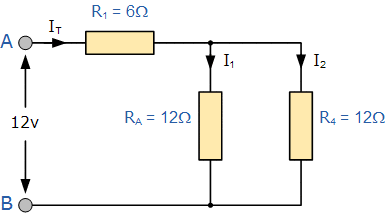
Find the total resistance.
12 Ω
6 Ω
18 Ω
3.5 Ω

Which diagram best fits this description: A circuit with a battery connected to four resistors, R1, R2, R3, and R4, as follows. Resistors R1 and R2 are connected in parallel with each other, resistors R3 and R4 are connected in parallel with each other, and both parallel sets of resistors are connected in series with each other across the battery.


Four resistors are connected across an ideal dc source of V = 8.0 V, as shown in the figure. Assume all resistances shown are accurate to two significant figures. What is the current through the 9.0-Ω resistor?
1.0 A
0.67 A
0.50 A
0.90 A

If emf of the ideal battery is V = 100 V, what is the potential difference across R5 for the circuit shown in the figure?
19 V
40 V
75 V
77 V
How is electrical power calculated?
Voltage X Current
I X V
Potential Difference X Current
V divided by I
What is the unit of Electrical Power?
Joule
Watt
Where
Amp
A heater has a power rating of 2000W, if it's left on for 5 hours, and each unit of electricity costs 10cents, how much is the cost?
$1
$2
$10
$2.50
Calculate the voltage applied when a 60 watt light-bulb uses a current of 5 amps
300 volts
30 volts
12 volts
0.08 volts


Which leg of the LED is the positive (cathode) side?
The longer one
The shorter one
There is no positive side
They are both positive, I'm positive of it.


Which picture (left or right) shows the correct way the battery wires should be attached?
Left
Right
They are both wrong
They are both correct
Resistor symbol is


Battery symbol is


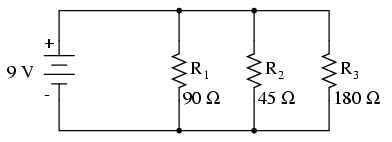

What is the total resistance of this circuit?
155 Ω
21.63Ω
40.90
31.94 Ω

