
 Worksheets
Unit 5 Review Quiz just for fun
Total questions: 51
Worksheet time: 26mins
Name
Class
Date
1.

Who was the naturalist that traveled the world to study plants and animals?
a)
Albert Einstein
b)
Charles Darwin
c)
Charles Barkley
d)
Isaac Newton
2.

The gradual change in species over time is...
a)
Evolution
b)
Nucleotide
c)
Adaptation
d)
Natural Selection
3.

To adjust to a changing environment
a)
Mutation
b)
Adapt
4.

Darwin wrote that organisms with traits that are best suited to the environment will ________________
a)
increase in number
b)
become extinct
5.
Which term refers to the process by which individuals that are better suited to the environment survive and reproduce therefore passing down their genes to their offspring?
a)
Evolution
b)
Variation
c)
Adaptation
d)
Natural Selection
6.
When an organism completely dies out, it is called.....
a)
Adaption
b)
Extinction
c)
Fossilization
d)
Mutation
7.
The white feathers of a snowy owl allow it to blend in with its environment during the winter months (snow). This is an example of ________________
a)
Species
b)
Environmental Change
c)
Adaptation
d)
Variation
8.
Darwin referred to this as survival of the fittest. Over time, it results in changes in the inherited characteristics of a population because organisms with adaptations that make them fit for their environment will survive and reproduce better than those without favorable traits.
a)
Natural Selection
b)
Genetic Variation
c)
Survival of the Fittest
9.
Genetic differences between organisms of the same species
a)
Variation
b)
Adaptation
c)
Behavior
d)
Environment
10.
Remains of ancient organisms are called
a)
Extinctions
b)
Fossils
c)
Mutations
d)
Variations
11.

Charles Darwin came up with this theory
a)
Natural Selection
b)
Mutation
12.
What is another name for natural selection?
a)
survival of the smartest
b)
survival of the fastest
c)
survival of the biggest
d)
survival of the fittest
13.
What is an organism that has similar characteristics and can reproduce?
a)
species
b)
organism
c)
embryology
d)
vestigial
14.
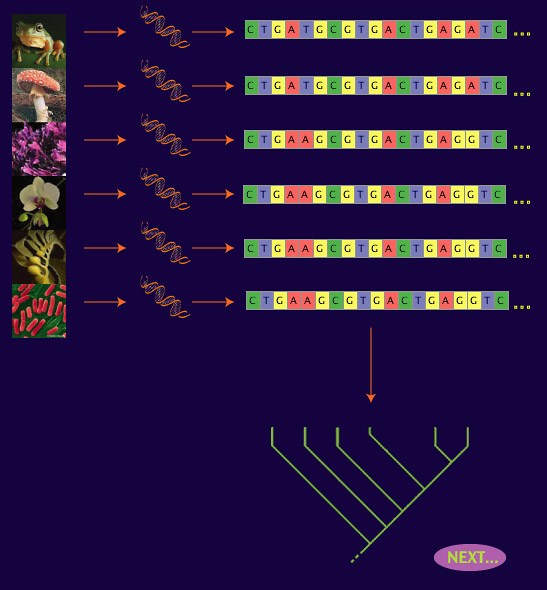
Two organisms that are closely related would have
a)
very similar DNA sequence
b)
exactly the same DNA sequences
c)
no proteins in common
d)
completely different DNA sequence
15.
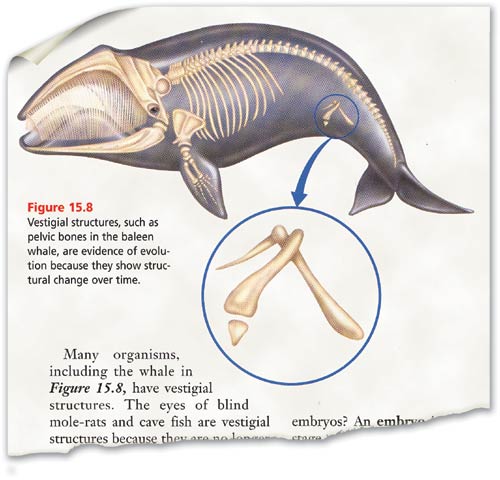
Which of the following is an example of a vestigial structure?
a)
the wings of a red-tailed hawk
b)
the hind limbs of a house cat
c)
the fins of sharks
d)
the tailbone of a human
16.
The biggest level of classification is called a...
a)
species
b)
class
c)
order
d)
kingdom
17.
Which isn't classified as an invertebrate?
a)
Reptile
b)
Echinoderm
c)
Crustacean
d)
Arthropod
18.
Which isn't classified as a vertebrate?
a)
Birds
b)
Mammals
c)
Mollusks
d)
Fish
19.
Vertebrates are animals without a backbone.
a)
True
b)
False
20.
Arthropods have a skeleton outside it's body.
a)
True
b)
False
21.

the scientific study of how living things are classified
a)
Taxonomy
b)
Linnaeus
c)
Binomial Nomenclature
d)
Dichotomous Key
22.

a two-part scientific name using the Genus and the Species name
a)
Binomial Nomenclature
b)
Dichotomous Key
c)
Taxonomy
d)
Linnaeus
23.

group of closely related species; the first part of the scientific name
a)
Genus
b)
Kingdom
c)
Domain
d)
Species
24.

a group of similar organisms that can breed and produce fertile offspring
a)
Species
b)
Domain
c)
Kingdom
d)
Kingdom
25.

an organized set of characteristics used to identify organisms. Each step contains two choices until the organism is correctly identified
a)
Dichotomous Key
b)
Binomial Nomenclature
c)
Taxonomy
d)
Linnaeus
26.

Largest taxonomic category.
a)
Domain
b)
Phylum
c)
Class
d)
Order
27.

Second largest group in taxonomic hierarchy
a)
Kingdom
b)
Domain
c)
Genus
d)
Species
28.

One cell
a)
Unicellular
b)
Multicellular
c)
Plantae
d)
Heterotroph
29.

More than one cell
a)
Multicellular
b)
Unicellular
c)
Heterotroph
d)
Bacteria
30.
A living thing
a)
Organism
b)
Domain
c)
Genus
d)
Taxonomy
31.
The basic unit of structure and function in living things
a)
Cell
b)
Unicellular
c)
Bacteria
d)
Archaea
32.
Father of Taxonomy; created binomial nomenclature
a)
Linnaeus
b)
Woes
c)
Darwin
d)
One Punch Man
33.
8 Levels of Taxonomy
a)
Domain, Kingdom, Phylum, Class, Order, Family, Genus,Species
b)
Domain, Kingdom, Phylum, Class, Structure, Family, Genus,Species
c)
Domain, Kingdom, Phylum, Class, Order, Family,Species, Race
d)
Domain, Kingdom, Phylum, Unit, Order, Family, Genus, Species
34.
The ____________ kingdom includes decomposers , such as mushrooms.
a)
kingdoms
b)
fungi
c)
archaebacteria
d)
nonvascular
35.
Multicellular organisms that use sunlight to create food are grouped into the _____________ kingdom.
a)
plant
b)
animal
c)
fungi
d)
protist
36.
____________________ are vertebrates that are warm-blooded, have hair, and give birth to live young.
a)
mammals
b)
animals
c)
amphibians
d)
protists
37.
The ________________ kingdom can be divided into two groups; those with backbones and those without.
a)
animal
b)
mammal
c)
vertebrates
d)
invertebrates
38.
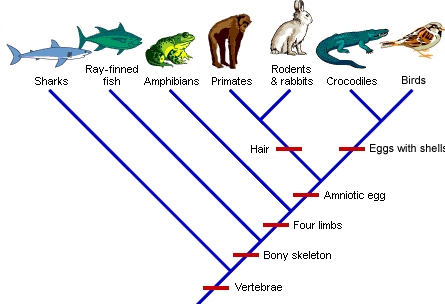
According to this cladogram, birds are LEAST related to:
a)
Amphibians
b)
Sharks
c)
Ray Finned Fish
d)
Crocodiles
39.
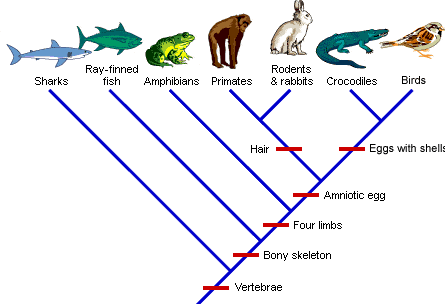
Which two orgainsms have hair?
a)
Sharks & Ray Finned Fish
b)
Primates & Rodents
c)
Birds & Crocodiles
d)
Rabbits & Birds
40.
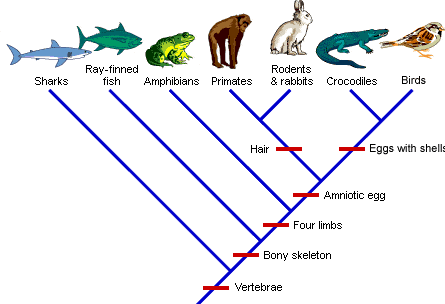
According to this cladogram, sharks are MOST closely related to which organism?
a)
Amphibians
b)
Ray finned fish
c)
Crocodiles
d)
Birds
41.
You look at two species and see very similar DNA. What does this likely tell you?
a)
These are the same animal.
b)
These animals have a common ancestor.
c)
These animals are not likely related.
d)
These animals are likely becoming one species.
42.
About 96% of the information in human DNA is found in gorilla DNA. This evidence supports which statement?
a)
Humans evolved from gorillas.
b)
Gorillas and humans diverged from a common ancestor.
c)
As gorillas evolve, they will become more similar to humans.
d)
Gorillas and humans are too different for meaningful genetic comparisons.
43.
Despite their differences in appearance, all bony fish have common ancestors. Their fins develop from similar structures and usually have a prescribed number of bones. Because of this, the large rudder-like dorsal fin of a sailfish, the poisonous dorsal fin of a catfish, and the tiny reduced dorsal fin of a puffer fish are said to be ________ structures.A)vestigial
a)
vestigial
b)
analagous
c)
homologous
d)
evolutionary
44.
What did Charles Darwin mean when he stated that some organisms were 'more fit' than other organisms?
a)
some organisms were heavier and stronger
b)
some organisms were more likely to reproduce
c)
not all organisms had the same natural life span
d)
not all organisms were equally suited to gathering food
45.
According to the theory of _____________, mitochondria in cells today are the descendents of aerobic prokaryotes that used oxygen to generate energy.
a)
endosymbiosis
b)
ingestion
c)
mutualism
d)
parasitism
46.

Which of the following is a term for a group of similar organisms that can reproduce fertile offspring?
a)
individual
b)
population
c)
species
d)
fossil
47.
Which of the following is a fossil?
a)
a plant that has recently died
b)
a group of organisms that can reproduce
c)
a structure or organ that no longer functions
d)
a trace of an organisms that existed in the past
48.
Over time, adaptions can lead populations to experience
a)
environmental changes
b)
genetic changes
c)
geological changes
d)
extinction
49.

All rabbits living in a particular area would be an example of a(n)
a)
population
b)
species
c)
fossil
d)
individual organism
50.

a bird that can easily outcompete other birds for food and that can produce many eggs has a high
a)
life expectancy
b)
mutation rate
c)
fitness
d)
adaptability
51.

Two organisms that are closely related would have
a)
very similar DNA sequence
b)
exactly the same DNA sequences
c)
no proteins in common
d)
completely different DNA sequence
100 %

