
 Worksheets
Science 7-12 Practice Test 2
Total questions: 56
Worksheet time: 1hrs 22mins
Given the chemical reaction 4Al(s) + 3O2(g) --> 2Al2O3(s), how many moles of O2(g) are needed to produce 100.0 moles of 2Al2O3(s)?
100.0
150.0
200.0
250.0
Given the equation 2KClO3 -> 2KCl + 3O2 , how many moles of O2 can be produced by letting 12.00 moles of KClO3 react?
4 moles
18 moles
24 moles
6 moles
How many water molecules are in 5.2 moles of water? (already given number in moles, so (multiply total moles x Avogadro's number)
6.02 x 10²³
5.2
3.1304 x 1024
8.638 x 10⁻²⁴
Zn + 2HCl --> ZnCl2 + H2
2H2O2 →2 H2O + O2
AgNO3 + NaCl → AgCl + NaNO3
2C3H7OH +9O2 -> 6CO2 + 8H2O
Which of the following is NOT true regarding exothermic and endothermic processes or reactions?
Exothermic reactions release heat energy
The melting of ice is an endothermic process
The burning of butane is an exothermic process
The change in enthalpy is positive for an exothermic reaction
Which of the following substances has a pH closest to 1?
Bleach
Vinegar
Water
Ammonia
Which of the following describes the correct procedure to prepare 100.0 ml of 3.00 M HCl solution from an 18.0 M HCl stock solution?
Dilute 16.7 ml of 18.0 M HCl to a total volume of 100.0 ml
Dilute 18.0 of 18.0 M HCl to a total volume of 100.0 ml
Dilute 54.0 of of 18.0 M HCl to a total volume of 100.0 ml
Dilute 14.3 of 18.0 M HCl to a total volume of 100.0 ml
If I have 340 mL of a 0.5 M NaBr solution, what will the concentration be if I add 560 mL more water to it?
.188 M
3.78 M
.389 M
1.76 M
If I dilute 250 mL of 0.10 M lithium acetate solution to a volume of 750 mL, what will the concentration of this solution be?
2 M
0.02 M
0.03 M
0.08 M
Which of the following is NOT true regarding solubility?
Increasing temperature increases the solubility of a solid in a liquid
Increasing temperature increases solubility of a gas in a liquid
Increasing the pressure has little effect on the solubility of solid in a liquid
Increasing partial pressure of a gas decreases the solubility of a gas in a liquid
Systems in nature tend to undergo changes toward
lower energy and less disorder
lower energy and more disorder
higher energy and less disorder
higher energy and more disorder
Which of the following would most likely dissolve in a nonpolar solvent?
AgNO3
NH3
CCl4
KI
Which of the following characteristics is consistent with an acid?
Turns litmus paper blue
Accepts protons
Reacts with zinc to produce hydrogen gas
Produces OH ions on aqueous solutions
Which of the following is a solute?
Salt in a mixture of salt and pepper
Air in mixture of ash and air
Water in a mixture of salt and water
Sugar in a mixture of sugar and water
Water can dissolve many things so it is called the .....
wonderful water
liquid
cohesion
universal solvent


The formula for pressure
Pressure = Force divided by Area
Pressure = Force times Area
Pressure = Area divided by Force
Pressure = Area times Force
The unit for pressure
Pascal
Newton
Gram
Miles
Which of the following is NOT true about the period of a simple pendulum?
As the mass of a pendulum increases, the period increases
For small amplitudes, the period of a pendulum is independent of amplitude
A pendulum swings more slowly at higher elevation
To double the period of a pendulum, the length must be quadrupled

At what point on the track does the car have the greatest potential energy? The greatest kinetic energy?
at the ending point; at the starting point
at the starting point; at the ending point
at the highest point on the track; at the lowest point on the track
at the lowest point on the track; at the highest point on the track
A worker applies a force of 500.0 N to a pulley for a distance of 1.5 m to move a crate that weighs 1000.0 N a distance of 0.5 m. What is the ideal mechanical advantage of this pulley?
4
2
3
5

What is the mechanical advantage for the inclined plane (slope 15 and height is 3)?
5
1/5
45
17
It's easier to lift heavy objects with a double-pulley system because:
The effort force is twice as much as the resistance force.
The effort force is one-half as much as the resistance force.
The effort force is three times as much as the resistance force.
The resistance force and effort force are equal.

Which of the following statements is true about Coulomb's law?
The force between 2 charged objects is directly related to the square of the distance between them
The force between 2 charged objects is inversely related to the square of the distance between them
What is the current through a resistor of 20.0 ohms if the voltage is 6.0 Volts? (V=IR)
0.30 Amps
120 Amp
3.3 Amps
0.20 Amps
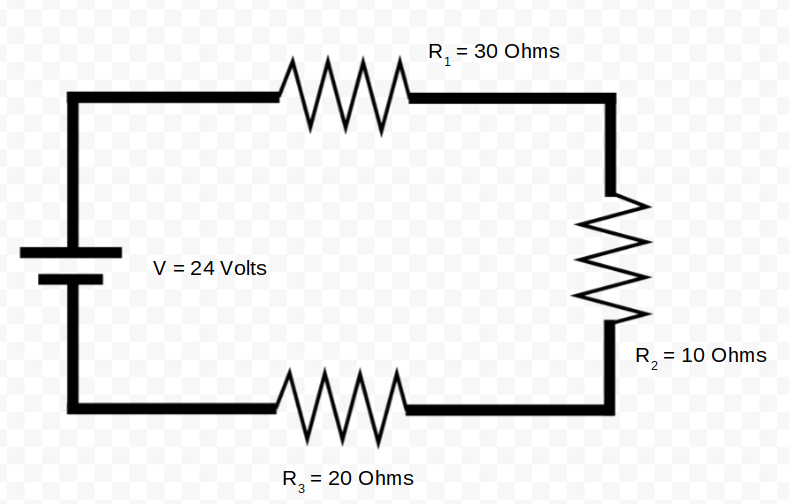
total current
and the voltage through resistor 3


Find the total resistance, total current and total voltage for the following circuit
VT = 9 V
I T = 3
RT = 14
VT = 9
I T = 0.64
RT = 14
VT = 9
I T = 6.3
RT = 1.4
VT = 9
I T = 0.64
RT = 1.4
An electromagnet has a lifting force of 5N. If the current through the coil is doubles, what is the lifting force?
2 N
5 N
10 N
20 N
On what does the energy of a photon depend? (E=hf)
Speed
Mass
Frequency
Amplitude

Under which conditions will light undergo total internal reflection?
When the angle of incidence is equal to the critical angle
When the angle of incidence is greater than the critical angle
When the angle of incidence is less than the critical angle
When the angle of incidence is zero

Convex lenses can produce...
Real, erect images
Virtual, inverted images
Real, inverted images
no images form

concave lens form
Upright, Virtual images
real images
Zeroth law of thermodynamics is:
Kinetic energy of molecules of a gas is zero
Ideal gas does not contain molecules
If two systems are thermal equilibrium third one is also in equilibrium
Absolute zero temperature cannot be obtained

