
Font size
 Worksheets
3rd Quarterly
Total questions: 90
Worksheet time: 2hrs 59mins

Pilot Smith has a ground speed of 90 miles/hr. How long will it take to fly 300 miles at that speed?
0.3 hr
1.5 hr
3.33 hr
27,000 hr
Which of the following correctly shows a vector quantity?
5 km/s S
5 km/s
5 kg
-5 kg
Displacement is a change in…
Speed
Distance
Position
Velocity

In which section is the object accelerating?
A
B
D
E
In which section does the object have a constant positive speed?
A
B
C
D
In which section is the object stationary?
A
B
C
E

During which interval is the object slowing down?
0-10 min
10-15 min
15-30 min
30-40 min

During which interval does the object have a constant positive speed?
0-10 min
10-15 min
15-30 min
40-55 min

At what time is the object stationary?
10 min
20 min
30 min
40 min


Define acceleration
ratio of velocity to time
rate of change in displacement
rate of change in velocity
ratio of force to mass

Which statement is false for the projectile when it is at the highest point Q of its path?
The vertical component of the projectile’s velocity is zero.
The momentum of the projectile is horizontal.
The kinetic energy of the projectile is minimum.
The vertical acceleration is zero.


How much time would it take for the sound of thunder to travel 8 kilometres if sound travels a speed of 330 metres per second?
0.0242 s
0.0413 s
24.2 s
41.3 s
A cheetah can accelerate from rest to a speed of 30.0 m/s in 7.00 s. What is its acceleration?
4.29 m/s3
4.29 m/s2
4.29 m/s1
4.29 m/s
From the same height (and at the same time), one ball is dropped and another ball is fired horizontally. Which one will hit the ground first?
the “dropped” ball
the “fired” ball
they both hit at the same time
it depends on how hard the ball was fired
it depends on the initial height
A projectile is launched from the ground at an angle of 30o. At what point in its trajectory does this projectile have the least speed?
just after it is launched
at the highest point in its flight
just before it hits the ground
halfway between the ground and the highest point
speed is always constant
What is the shape of the path of any projectile?
Hyperbola
Hypotenuse
Parabola
Diagonal
If a projectile is launched horizontally from a height of 12 m, how long will it take to hit the ground?
2.45 seconds
5.16 seconds
1.56 seconds
4.25 seconds
If a projectile is launched with an initial vertical velocity (Voy) of 60 m/s, how long will it take to reach its highest point?
5.98 seconds
6.12 seconds
6.58 seconds
6.92 seconds
A man wants to shoot an arrow so that it has the greatest range (horizontal distance). At what angle should he shoot the arrow?
10 degrees
45 degrees
60 degrees
90 degrees
When an object is launched horizontally, what is the initial vertical velocity?
0 m/s
It's always 9.8 m/s
It depends on the horizontal launch speed
It depends on the color of the object being launched
A 5 kg mass and a 10 kg mass are launched horizontally from the same height. Which hits the ground first? (Neglect air resistance)
The 5 kg mass
The 10 kg mass
They will hit at the same time
It depends on the launch velocity
A soccer ball is kicked with a 36 degree angle and a velocity of 23 m/s. Find the horizontal component of the balls velocity.
13.5 m/s
14.1 m/s
18.6 m/s
33.1 m/s
The formula for Weight.
F = ma
F = mv
F = mg
F = mt
A resistance to a change in motion.
Force
Friction
Inertia
acceleration
A magician pulls a table cloth out from under dishes, demonstrates which law of motion.
1st Law
2nd Law
3rd Law
4th Law
A car comes to a screeching halt and the passengers move forwards being restrained by their seat-belts is a good example of this.
force
inertia
velocity
acceleration
The type of friction you overcome to "start" and object to move.
inertia
static
kinetic
energy
A force that opposes motion.
inertia
friction
gravity
energy
A car has a mass of 2,000 kg, how much force is acting on it if it is being accelerated at 4 m/s2?
2,000 Kg
2,000 N
8,000 N
500 N
A leftward force is applied to a crate to push it across the floor at a constant speed. Which is the correct force diagram?


A downward-moving skydiver who has just opened the parachute is slowing down.


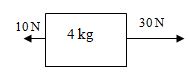
In this type of collision, objects deform and stick together
elastic
inelastic
momentum
impulse
In this type of collision, objects keep their shape and bounce off of each other
elastic
inelastic
momentum
impulse
units for momentum
m/s
m/s2
m
kg*m/s
units for velocity
m/s
m/s2
m
kg*m/s
When comparing the momentum of 2 moving objects, which of the following is correct?
the object with the higher velocity will have less momentum if the masses are equal
the more massive object will have less momentum if its velocity is greater.
the less massive object will have less momentum if the velocities are the same
the more massive object will have less momentum if the velocities are the same
a cannon recoils after shooting a cannon ball. the velocity of the cannon's recoil is small because the
impulse on the cannon is small
mass of the cannon is large
force on the cannon is small
mass of the cannon ball is large
If the impulse acting on two objects is the same then
the mass of both objects is the same
the change in velocity of both objects is the same
the change in momentum of both objects is the same
the amount of contact time is the same
the force exerted on both objects is the same
An 3000 kg truck going 25 m/s slams into a 1500 kg car that is sitting still, 2m from the curb. What is the total momentum before the collision?
3000 kg*m/s
4500 kg*m/s
75000 kg*m/s
78000 kg*m/s
What is the momentum of a 2000 kg car that is sitting still at a traffic light for 5 seconds?
5 kg*m/s
0 kg*m/s
400 kg*m/s
10000 kg*m/s
A ball with 5 kg*m/s of momentum hits another ball with 2 kg*m/s of momentum. What is the total momentum before the collision?
2 kg*m/s
5 kg*m/s
7 kg*m/s
10 kg*m/s


with the babies are 48kg. What is the Potential Energy of the twins and the carriage? PE=mgh

When an object gains electrons it becomes __________
Neutral
Positively charged
Negatively charged
Two like charges
neutralize each other.
repel each other.
must be neutrons.
attract each other.
Which of the following is not a good conductor of electricity?
copper
silver
Glass
aluminum
The force between two point charges is F when they are separated by a distance r. If the separation is increased to 3r what is the force between the charges?
F/3r
F/9r
F/3
F/9
Which is the value of the constant in Coulomb's equation?
k = 9·10-9
k = 9.8
k = 6.67·10-11
k = 9 ·109
Approximately how much force would be generated by two charged objects held 2 m apart, if q1 has a charge of 3.0 C and q2 has a charge of 4.0 C?
0.5 N
1.5 N
3 N
6 N
What is current measured in?
Ω (Ohms)
A (Amps)
V (Volts)
W (Watts)
A 10kg car travels at a constant speed of 20.0 m/s around a horizontal circular track. Which diagram correctly represent the direction of the car's velocity (v) and the direction of the centripetal force (Fc) acting on the car at a particular moment?


Centripetal force, created by swinging something in a circle, acts in a direction--
along the path of motion
away from the center of the circle
toward the center of the circle
tangent to the circle
What would the force between them be if one of the masses were doubled?
Two masses 8000 kg and 1500 kg are 1.5 m apart. Find their gravitational pull.
3 N
0.0003 N
3000 N
30 N

