wayground logo

Free Printable Worksheets

Font size

S
M
L
XL
Worksheets

6th grade review!

Total questions: 100

Worksheet time: 1hrs 11mins

Name
Class
Date
1.
The process by which rocks are broken down chemically or physically is known as:
a)
Weathering
b)
Erosion
c)
Deposition
d)
Transportation
2.
When wind, water, or ice leave materials in a location, this is known as:
a)
Weathering
b)
Erosion
c)
Deposition
d)
Transportation
3.
The most important factors in determining the rate of weathering are - 
a)
carbon dioxide and acid rain
b)
abrasion and acids from plant roots
c)
animal actions and oxygen
d)
rock type and climate
4.
What is erosion?
a)
The process by which
water, ice, wind or gravity
moves fragments of rock
and soil.
b)
The process by which
water, ice, wind or gravity
deposit rock sediments
and soil in a new place.
c)
The breaking down of
Earth’s crust into smaller
and smaller pieces.
5.
How do plants weather rocks?
a)
during photosynthesis
b)
when roots grow into cracks of rocks and expand the rock
c)
when the plant moves water from the roots to the leaves
6.
A piece of land surrounded by water.
a)
Island
b)
Peninsula
c)
Gulf
7.
What continues to shape canyons?
a)
fast moving water
b)
slow moving water
c)
rocks weathering
d)
rocks eroding
8.
How does a delta form?
a)
a river slowing down
b)
it's just a river that empties into an ocean or lake
c)
the current of the river speeds up at the mouth causing sediment to wash away
d)
the current of the river slows down causing sediment to deposit
9.
Large group or chain of islands
a)
archipelago
b)
atoll
atoll
c)
fjord
d)
key
10.
This is a low place in between two hills or mountains.
a)
Canyon
b)
Valley
c)
Desert
d)
Lake
11.
A landmass with an elevation higher than a hill.
a)
Ocean
b)
Gulf
c)
Mountain
d)
Valley
12.
This landform is a very flat area on Earth's surface.  The middle of the United States is a very large one.
a)
Valley
b)
Mountain
c)
Desert
d)
Plain
13.

A gigantic mass of moving ice

a)

glacial drift

b)

stratified drift

c)

till

d)

glacier

14.
What is a natural physical feature on Earth's surface?   
a)
river
b)
glacier
c)
mountain
d)
landform
15.
The outline or shape of a coast or the boundary between land and a lake or ocean is called a
a)
dune
b)
mountain
c)
coastline
d)
delta
16.
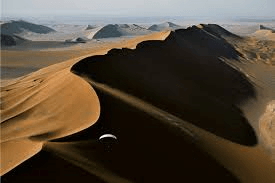
Hills formed by the wind blowing or depositing sand are called
a)
dunes
b)
rivers
c)
lakes
d)
mountains
17.
Sand dunes are mostly found in what landforms?
a)
rivers and oceans
b)
streams and lakes
c)
mountains and glaciers
d)
coastlines and deserts
18.
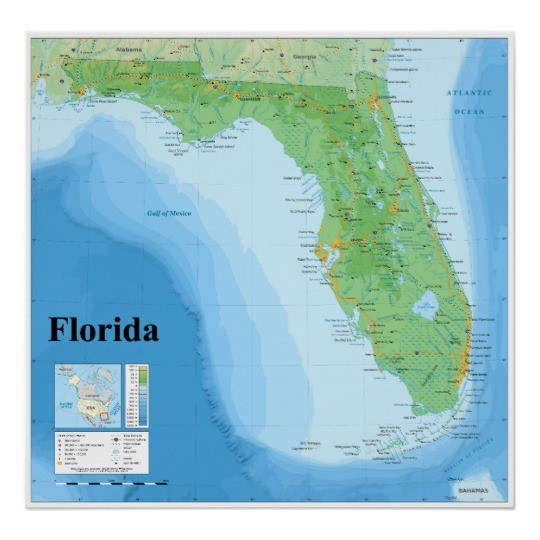
These landforms are NOT found in Florida
a)
mountains and glaciers
b)
coastlines and sand dunes
c)
rivers and lakes
d)
deltas
19.
Mountains and glaciers produce
a)
limestone
b)
sediment
c)
castles
d)
stone
20.
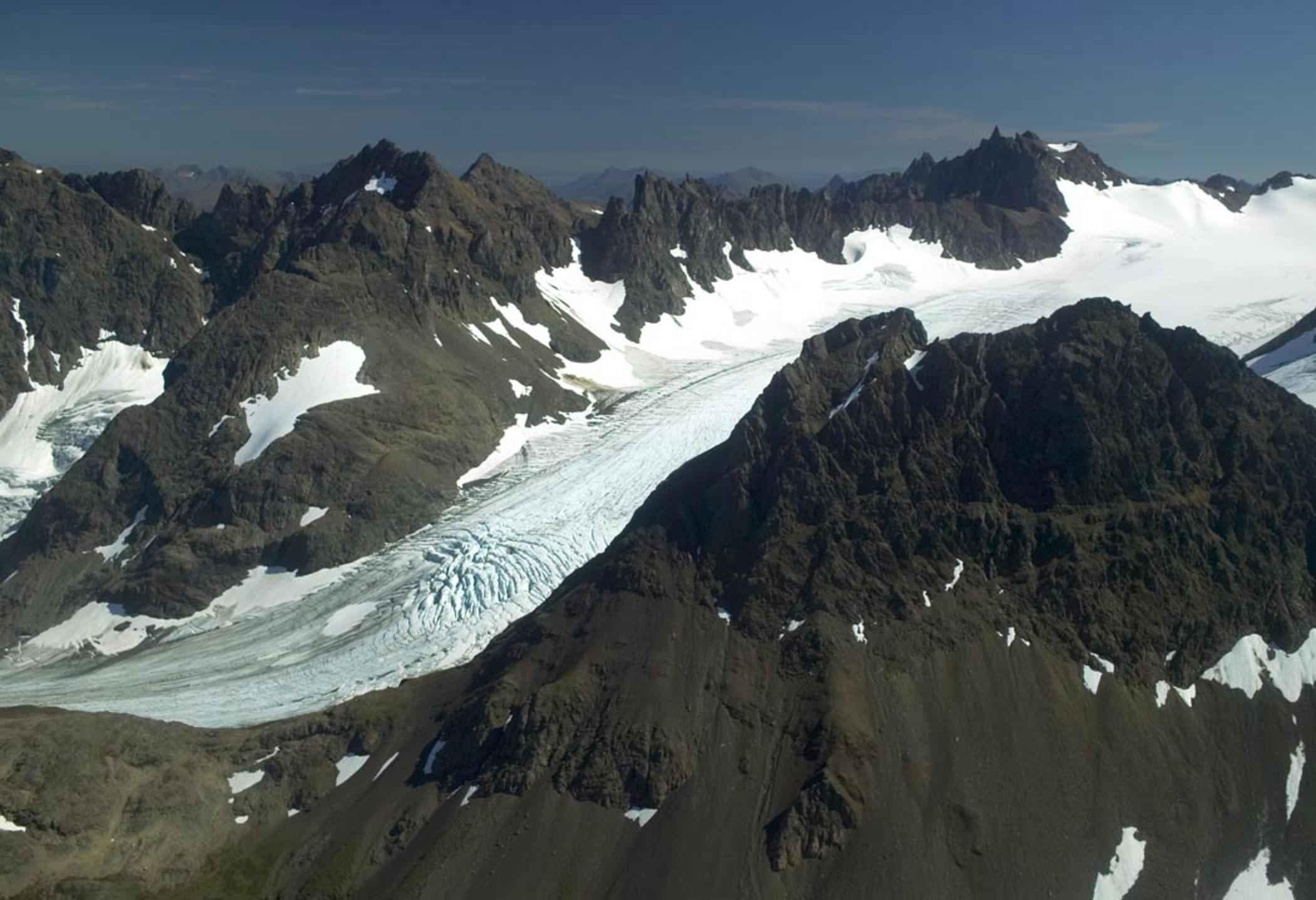
A mass of ice that covers a large area and moves slowly
a)
gravity
b)
glacier
c)
sediment
21.
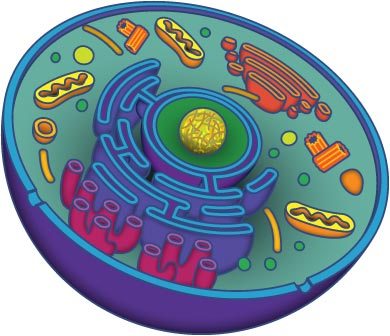
what is the control center in a cell
a)
mitochondria
b)
DNA
c)
nucleus
d)
movement
22.
also known as the "powerhouse" 
a)
cell membrane
b)
storage
c)
cytoskeleton
d)
mitochondria
23.
Robert Hooke, Anton van Leeuwenhoek, Theodor Schwann, Rudolf Virchow, and Matthias Schliden were all responsible for what theory?
a)
The Theory of Gravity
b)
The Theory of Relativity
c)
The Cell Theory
d)
The Theory of Continental Drift
24.

The first part of the Cell Theory states: "What happens in Cell Theory, stay in Cell Theory."

a)

True

b)

False

25.
All cells come from___________ cells.
a)
pregnant
b)
pre-existing
c)
paternal
d)
pin size
26.
What do all of these organisms have in common?
a)
They all have uniform offspring
b)
They are all made of cells
c)
They possess the same features
d)
They have the same internal and external structures
27.
What tool do you use to view the cells?
a)
metric ruler
b)
centrifuge
c)
microscope
d)
pipette
28.

Which of the following is NOT part of the cell theory.

a)

All non-living things are made of cells

b)

All cells come from pre-existing cells

c)

Cells are the basic unit of structure and function of all living things
29.
What is the basic structural and functional unit of all living things? 
a)
atom
b)
cell
c)
molecule
d)
human
30.
All living things are made up of...
a)
cells
b)
cell tissues
c)
organ
d)
organ systems
31.
An organism made of one cell is called
a)
unicellular
b)
multicellular
32.
Rocks are not living because
a)
they never move
b)
they aren't needed for humans
c)
they are not made of cells
d)
they don't break down
33.
Chloroplasts carry out...
a)
Phagocytocis
b)
Phylocytosis
c)
Photosynthesis
d)
Respiration
34.
Controls what enters and leaves the cell
a)
Mitochondria
b)
Cell Membrane
c)
Cell Wall
d)
Nucleus
35.
Stores food and water for the cell.
a)
Cytoplasm
b)
Cell Wall
c)
Vacuole
d)
Nucleus
36.
What is the fluid inside a cell called? 
a)
Endoplasimic Reticulum
b)
Orange Juice
c)
Water
d)
Cytoplasm
37.
This organelle helps plants keep their rigid structure. 
a)
Cell wall
b)
Cell membrane
c)
Chloroplast
d)
Nucleus
38.

What is known as the brain of a cell

a)

cell wall

b)

Cell membrane

c)

Nucleus

d)

mitochondria

39.
Which of the following are NOT found in animal cells
a)
chloroplasts and cytoplasm
b)
chloroplasts and cell wall
c)
cell wall and cell membrane
d)
mitochondria and nucleus
40.
Which organ holds the waste left over from food?
a)
stomach
b)
large intestines
c)
liver
d)
small intestines
41.
What does the stomach do to your food?
a)
Pulls the vitamins and minerals out.
b)
Helps move food to the back of your throat.
c)
Turns it into a liquid mixture.
d)
Collects the waste.
42.
Which organ releases digestive chemicals into the small intestine to help with digestion?
a)
gallbladder
b)
stomach
c)
liver
d)
pancreas
43.
Which of the following is NOT a job of the stomach?
a)
empty the liquid mixture of food into the small intestines
b)
to store food you've eaten
c)
to pull vitamins and minerals
d)
to break food down into a liquid mixture
44.
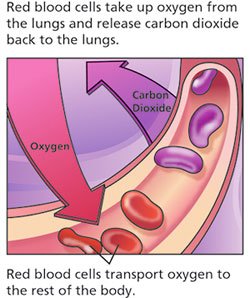
Which 2 substances are exchanged in the Respiratory System?
a)
oxygen and nitrogen
b)
carbon dioxide and oxygen
c)
oxygen and glucose
d)
glucose and carbon dioxide
45.
Tubes that move air from the trachea to the lungs.
a)
Alveoli
b)
Bronchi
c)
Veins
d)
Arteries
46.
The main organ of the Respiratory System where the gas exchange takes place.
a)
Heart
b)
Small Intestine
c)
Lungs
d)
Anus
47.
Which is a function of the cardiovascular system?
a)
to move water throughout the body
b)
to transport gases throughout the body 
c)
to eliminate waste from the body
d)
to provide structural support for the body 
48.
These cells, in the blood, carry oxygen and give the blood its color.
a)
white blood cells
b)
plasma
c)
platelets
d)
red blood cells
49.
This type of vessel carries blood TO the heart:
a)
vein
b)
nerve
c)
muscle
d)
artery
50.
When oxygen-rich blood is carried AWAY from the heart, it travels through an...
a)
artery
b)
neuron
c)
vein
d)
straw
51.
What is the main function of the excretory system?
a)
to collect and remove wastes from the body
b)
to strengthen skeletal muscles
c)
to protect the nervous system
d)
to bring oxygen to body cells
52.
Which organ of the excretory system stores urine until the body is ready to eliminate it?
a)
ureters
b)
urethra
c)
urinary bladder
d)
urea
53.
What function do the kidneys perform?
a)
eliminate carbon dioxide
b)
supply oxygen to body cells
c)
remove urea and excess water
d)
play a role in gas exchange
54.
The system of the body that carries information to all parts of the body.
a)
Nervous system
b)
Spinal Cord
c)
Neuron
d)
Brain
55.
A bundle of nerves that runs along the back of a vertebrate within the spinal column.
a)
Dendrites
b)
Stimulus
c)
Brain Stem
d)
Spinal cord
56.
The main control center in an animal body; part of the central nervous system.
a)
Brain
b)
Brain Stem
c)
Spinal Cord
d)
Nervous System
57.

What is the main purpose of the musculoskeletal system?

a)

remove waste from the body

b)

break down and process food into nutrients for the cells

c)

gas exchange - bring oxygen; take away carbon dioxide

d)

provide movement and support for the body

58.

These create support and some produce blood cells and others store minerals?

a)

joints

b)

bones

c)

muscles

d)

tendons

59.

What are soft tissues that have the ability to relax and contract in order to initiate movement within the body?

a)

joints

b)

tendons

c)

muscles

d)

bones

60.
What are the yearly conditions of temperature, precipitation and humidity?
a)
weather
b)
climate
61.

As you move towards the poles, what happens to temperature?

a)

temperature becomes hotter

b)

temperature becomes colder

62.

As altitude increases, what happens to temperature?

a)

temperature gets hotter

b)

temperature gets colder

63.
True or False?  Warm and cold ocean currents affect the land nearby.
a)
false
b)
true
64.
Which factor does not affect climate?
a)
longitude
b)
distance from large bodies of water
c)
latitude
d)
altitude
65.
A front is
a)
where warm air is cooling at earth's surface
b)
a boundary where hot and cold air are separating
c)
a boundary where two different air masses meet
d)
where cold air is rising and forming rain clouds
66.
What does this symbol on a weather map indicate? 
a)
High pressure system
b)
Low pressure system
c)
Cold front
d)
Warm front
67.
What does this symbol indicate on a weather map? 
a)
High pressure system
b)
Low pressure system
c)
Cold front
d)
Warm front
68.

Jet streams are

a)

Narrow belts of strong winds that blow near the top of the troposphere.

b)

Wide belts of strong winds that blow near the top of the troposphere.

c)

Narrow belts of strong winds that blow near the bottom of the troposphere.

d)

Wide belts of strong winds that blow near the bottom of the troposphere.

69.

______ causes surface currents.

a)

The Coriolis Effect

b)

gravity

c)

density differences

d)

wind

70.
Two types of water currents are
a)
local and global
b)
sea and land
c)
surface and deep
d)
warm and cold
71.
Ocean currents have an affect on which two things
a)
climate and weather
b)
temperature and density
c)
land and sea
d)
equator and poles
72.
Climate is
a)
the further you get from the equator
b)
the higher you go, the colder it gets
c)
the conditions of the atmosphere at a certain place and time.
d)
the average weather conditions of an area over a long period of time.
73.
What causes wind to blow?
a)
Differences in longitude
b)
Shock waves from clouds
c)
Differences in air temperature and pressure
d)
The rotation of earth
74.
What causes warm air to rise? 
a)
The fact that it's less dense than cold air
b)
The fact that it weighs more than cold air
c)
The fact that it has higher pressure than cold air
d)
The fact that it's more dense than cold air
75.
Movements of ocean water in a continuous flow are called?
a)
ocean currents
b)
global winds
c)
air mass
d)
front
76.
What is the day to day changes in the air?
a)
Weather
b)
Climate
c)
Storms
d)
Earth's Rotation
77.

The Gulf Stream is warm surface current because it starts at the _________________.

a)

north pole

b)

south pole

c)

equator

d)

European continent

78.
When surface currents meet continents they ___?
a)
Stop moving
b)
Are deflected (change paths)
c)
Continue in the direction they were going
79.

How does heat move?

a)

In many directions

b)

from warm places to cooler places

c)

from cold places to warm places

d)

Both B and C

80.

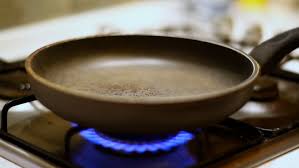
What type of heat transfer is occurring in the picture below? (the pan is touching the burner)

a)

conduction

b)

convection

c)

radiation

d)

insulation

81.

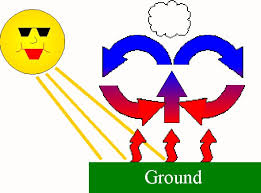
Energy from the Sun travels to Earth as

a)

Conduction

b)

Convection

c)

Insulation

d)

Radiation

82.

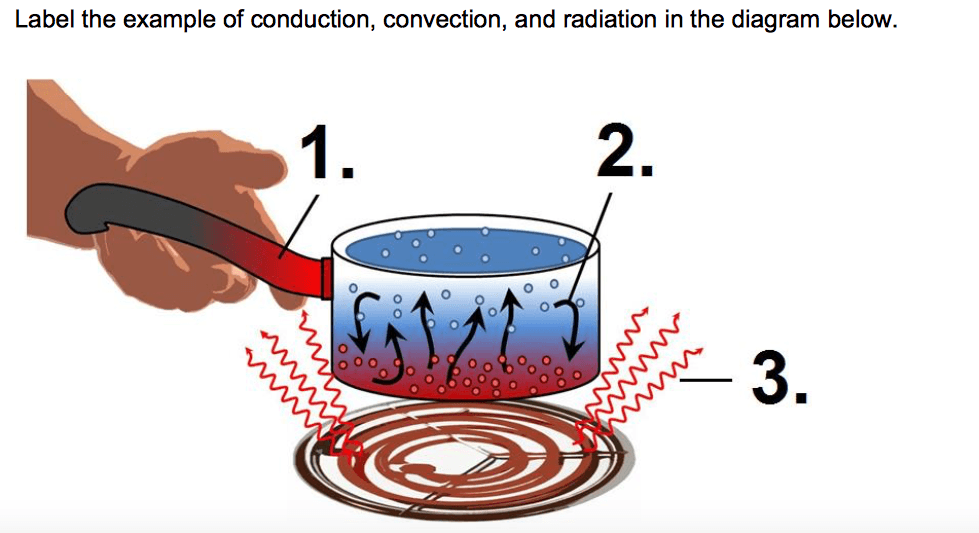
What type of thermal energy transfer is number 3 pointing to?

a)

Convection

b)

Conduction

c)

Radiation

d)

Insulation

83.

What type of thermal energy transfer is number 2 pointing to?

a)

Convection

b)

Conduction

c)

Radiation

d)

Insulation

84.

What type of thermal energy transfer is number 1 pointing to?

a)

Convection

b)

Conduction

c)

Radiation

d)

Insulation

85.
Which describes what can happen as a result of radiation?
a)
A piece of wood burns in a fire.
b)
A shirt is hot after having been ironed.
c)
A can of soup is heated in a pot on a stove.
d)
A car’s inside temperature rises to over 100 degrees on a sunny day.
86.
Warm air rises and the cool air sinks demonstrates this type of heat transfer. 
a)
conduction
b)
convection
c)
radiation
d)
Insolation 
87.
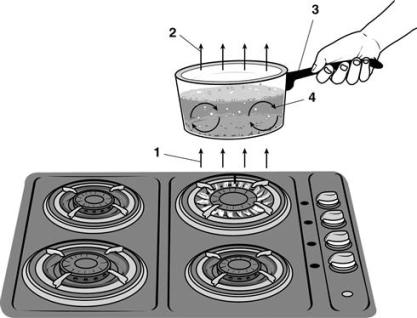
Which numbered part of the picture represents the way that energy from the sun reaches Earth?
a)
1
b)
2
c)
3
d)
4
88.
What causes the circulation of air in the atmosphere?
a)
Air in the atmosphere is heated by the sun and sinks to the ground.
b)
The ground is heated by the sun and then heats the air, causing the air to rise.
c)
Air loses heat to the ground and then rises upward to obtain more energy.
d)
The sun heats the clouds which forces the cooler air to move away and sink.
89.
What does the strength of gravity between two objects depend upon?
a)
Mass & distance
b)
Mass & weight
c)
Gravity & inertia
d)
Inertia & mass
90.
What force ultimately slows the roller coaster to a stop?
a)
Applied
b)
Normal
c)
Friction
d)
Magnetic
91.
An _______ force must act on an object for it to CHANGE it's motion
a)
balanced
b)
unbalanced
c)
gravitational
d)
electrical
92.

What is defined as a push or pull?

a)

force

b)

motion

c)

vector

d)

speed

93.

If the net force is equal to zero, the forces acting on the object are

a)

balanced

b)

unbalanced

94.
What is it called when the force of gravity is acting on an object?
a)
Weight
b)
Sliding Friction
c)
Momentum
d)
Projectile Motion
95.
With unbalanced forces, the object will move in the direction of the _______ force.
a)
larger 
b)
smaller 
c)
equal 
d)
cannot be determined
96.
Energy due to motion is ____________ energy. 
a)
Potential 
b)
Energy
c)
Kinetic
d)
Friction
97.
__________ is stored energy. 
a)
Potential
b)
Kinetic
c)
None of the above 
d)
All of the above 
98.
What is speed?
a)
how far you go
b)
how much distance is covered over a period of time
c)
how fast you accelerate
d)
the change in the location of a object
99.
When are you undergoing an acceleration in a car? 
a)
speed up
b)
slow down
c)
make turns
d)
All of the above 
100.
Acceleration only takes place when things speed up. 
a)
True
b)
False