wayground logo

Free Printable Worksheets

Font size

S
M
L
XL
Worksheets

Science: A.I.R. review 5th grade

Total questions: 110

Worksheet time: 3hrs 44mins

Name
Class
Date
1.
Which movement of Earth causes day and night?
a)
rotation
b)
revolution
2.

The Earth’s axis is _____________________, this is one of the reasons we have seasons.

a)

spinning

b)

rotating

c)

tilted

3.
An animal that eats other animals is a/an....
a)
carnivore
b)
omnivore
c)
herbivore
d)
decomposer
4.
If the grasshopper were to be removed completely from the food web, what organism would be most effected?
a)
The squirrel
b)
The shrew
c)
The deer
d)
The rabbit
5.
An organism that uses sunlight to create its own food is known as a:
a)
Producer
b)
Heterotroph
c)
Consumer
d)
Decomposer
6.
Which of the following is a herbivore?
a)
cricket
b)
frog
c)
hawk
d)
shrew
7.
Barnacles create home sites by attaching themselves to whales. This relationship neither harms nor benefits the whales. 
a)
parasitism
b)
commensalism
c)
mutualism
8.
Mistletoe extracts water and nutrients from a spruce tree. The spruce tree is harmed. 
a)
parasitism
b)
commensalism
c)
mutualism
9.

Identify the current season at location X

a)

Fall

b)

Spring

c)

Summer

d)

Winter

10.
Which of the following statements is most accurate about the Movement of Earth and the Sun?
a)
The Sun revolves around the Earth
b)
The Earth rotates around the Sun's axis.
c)
The Earth revolves on its axis around the Sun
d)
The Earth rotates on its axis and revolves around the Sun 
11.
_____?______ materials do not allow light waves to pass through.
a)
Opaque
b)
Transparent
c)
Translucent
12.
_____?_____ materials allow light waves to pass through easily.
a)
Opaque
b)
Transparent
c)
Translucent
13.
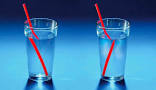
What is this called?
a)
refraction
b)
reflection
c)
reconstroction
d)
retraction
14.
We see the color _______ when a material absorbs all visible light.
a)
white
b)
black
15.
A prism separating white light is an example of...
a)
Refraction
b)
Reflection
16.
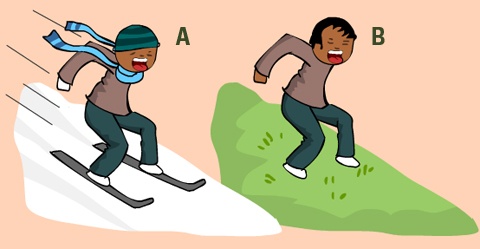
Why is it harder for the boy in Image B to get down the hill?
a)
Motion
b)
Friction
c)
Work
d)
Displacement
17.
Constellations are pictures formed in the night sky by 
a)
clouds
b)
planets
c)
stars
18.
A ________ magnifies objects that are far away in space.  
a)
binoculars
b)
telescope
c)
magnifying glass
d)
glasses
19.
Which of the following is closest to Earth?
a)
Moon
b)
Sun
c)
stars
d)
constellations
20.
____________ is the addition of harmful materials to the environment.
a)
pollution
b)
ecotourism
c)
conservation
d)
recycle
21.
To __________ means to collect old, used materials, and to process them and make them into new items.  
a)
compost
b)
decomposer
c)
litter
d)
recycle
22.
Conservation is the act of conserving, or protecting the environment, plants, and animals. Why is this so important? What are some things you can do to help conserve our environment? 
a)
leave water on, leave TV on, run dishwasher with 1 plate
b)
run the washing machine with 1 shirt
c)
leave the refrigerator door open
d)
turn off water, turn off lights, turn off TV
23.
Which is a producer?
a)
deer
b)
tall grass
c)
lion
d)
worm
24.
What is this called?
a)
Food Web
b)
Food Chain
c)
Abiotic Factors
25.
True or False. In this Food Web Pyramid the consumers on each level only get about 10 percent of energy that the plants have stored.
a)
True
b)
False
26.
An organism that lives by breaking apart dead organic matter into simpler parts is...
a)
scavenger
b)
consumer
c)
decomposer
d)
carnivore
27.
A third-level consumer has to be which type?
a)
Carnivore.
b)
Decomposer.
c)
Producer.
d)
Herbivore.
28.
An animal that eats other animals is a....
a)
carnivore
b)
omnivore
c)
herbivore
d)
decomposer
29.
1. What is an adaptation?
a)
A feature or behavior that helps an animal survie.
b)
The food that an animal eats.
c)
How energy moves in a food web.
30.
Lions often hide in the tall grass while stalking their prey.  This is an example of...
a)
camouflage
b)
warning coloration
c)
mimicry
d)
hibernation
31.
The force that causes a ball to fall to the ground is ____________________________
a)
gravity
b)
lubricant
c)
friction
d)
motion
32.
A _____________________ must be exerted on an object at rest to cause it to move.
a)
weight
b)
inertia
c)
force
d)
gravity
33.
The force that slows motion or prevents it is _______________
a)
force
b)
friction
c)
inertia
d)
lubricant
34.
The tendency of an object at rest to stay at rest unless it is acted upon by a force is ___________________
a)
inertia
b)
motion
c)
gravity
d)
lubricant
35.
A ______________________ eats only meat. 
a)
Carnivore
b)
Omnivore
c)
Herbivore
d)
Producer
36.
An animal that kills another animal for food is called
a)
prey
b)
predator
c)
producer
d)
herbivore
37.
Which of the following is a producer
a)
Blueberry Bush
b)
Tree
c)
Flower
d)
All of the above
38.
What type of symbiosis?
  * Hummingbirds feed on nectar from flowers.
 * 
Flowers are pollinated by hummingbirds as they move from flower to flower.
a)
commensalism
b)
mutualism
c)
parasitism
d)
predation
39.
What type of symbiosis?
*
Remora use suckers to attach temporarily to large marine animals such as sharks, manta rays, whales, turtles, or large fish.
*
The shark provides free transportation, protection, and dropped food and feces which the remora feeds on. The host is not injured.
a)
commensalism
b)
mutualism
c)
parasitism
d)
predation
40.
What type of symbiosis?
*
  Skunk Cabbage plants attract flies in cool weather by making heat and provide food to the flies that come. 
*
  Flies move from one Skunk Cabbage plant to   the next feeding and transferring pollen as they go.
a)
commensalism
b)
mutualism
c)
parasititsm
d)
predation
41.
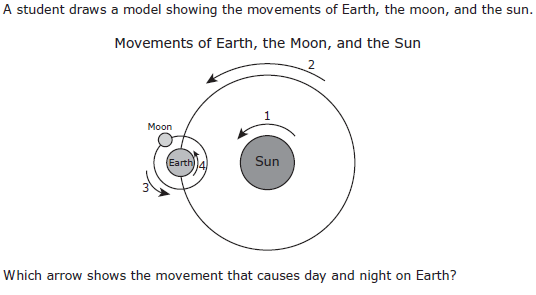
a)
Arrow 1, because it shows the rotation of the sun
b)
Arrow 2, because it shows the orbit of Earth around the sun
c)
Arrow 3, because it shows the orbit of the moon around Earth
d)
Arrow 4, because it shows the rotation of Earth
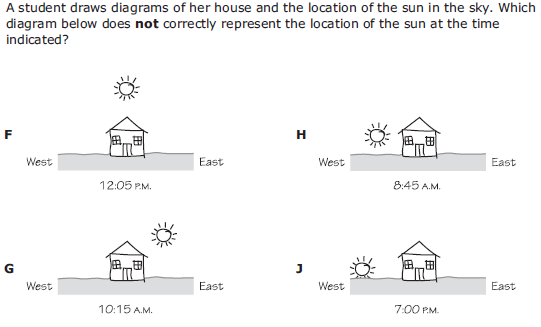
42.
a)
F
b)
G
c)
H
d)
J
43.
A student is looking for evidence that Earth is always rotating on its axis. Which of the following would provide the best evidence?
a)
The different amounts of rain that falls each day
b)
The appearance of shadows changing throughout the day
c)
The presence of other planets in the night sky
d)
The different phases of the moon in a month
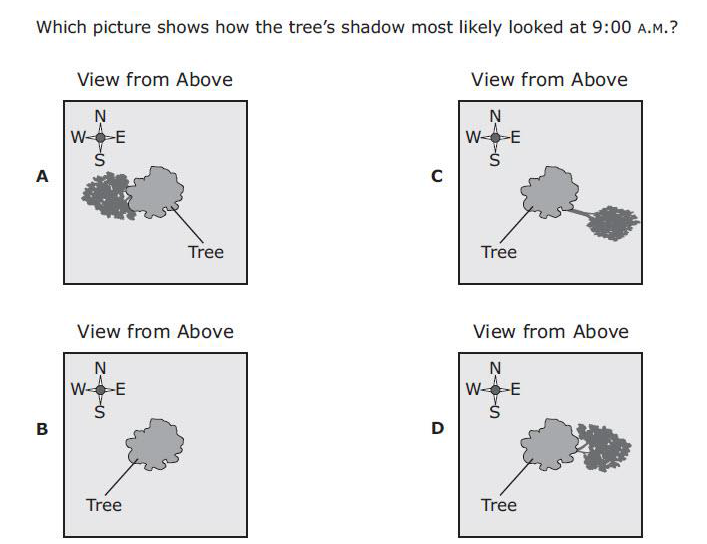
44.
a)
A
b)
B
c)
C
d)
D
45.
On which side of a house in Texas should a window be placed so that the people inside the house can see the sunrise each day through the window?
a)
North
b)
South
c)
East
d)
West
46.
a)
Day and Night
b)
Moon Phases
c)
Rainfall and evaporation
d)
Seasons
47.

What is the North Stars Scientific Name?

a)

Peleic

b)

Pallec

c)

Palles

d)

Polaris

48.

In order from Closest to the sun what Planets are in our Solar system

a)

Mercury,Venus,Earth,Mars,Jupiter,Saturn,Uranus, Neptune.

b)

Venus,Earth,Mercury,Jupiter,Earth,Neptune,Uranus,Mars

c)

Uranus,Neptune,Saturn,Jupiter,Mars,Earth,Venus,Mercury

d)

Mercury,Venus,Earth,Mars,Jupiter,Saturn,Neptune,Uranus.

49.

What is Ursa Major's Common Name?

a)

Big Bear

b)

Little bear

c)

Little dipper

d)

None of the above

50.

Is gravity a....

a)

Force that pulls things in a straight line.

b)

Force

c)

air and hydrogen

d)

Force that pulls things toward an object with bigger gravitational pull

51.

What is Inertia

a)

Another name for gravity.

b)

A star.

c)

A force that pulls things in a straight line.

d)

A force that pulls things toward a object

52.

What is a dwarf planet?

a)

An asteroid

b)

Pluto

c)

Ceres

d)

A object that orbits a star , but is too small to be classified as a planet.

53.

Stars Are _______________

a)

Balls of gas

b)

Balls of flame

c)

Stars

d)

1 and 2

54.

Ceres is a __________

a)

Star

b)

Asteroid

c)

Planet

d)

Dwarf planet

e)

2 and 4

55.

What is a asteroid

a)

A small rocky object orbiting in space.

b)

A meteoroid.

c)

A meteor.

d)

A comet.

56.

What is a comet

a)

Dust and ice orbiting in space.

b)

A small rocky body orbiting in space.

c)

A blown out meteroid

d)

A dwarf planet

57.

what is a meteor

a)

A meteoroid when it enters a planet's atmosphere.

b)

An asteroid in the suns gravity

c)

A rock

d)

A planet

58.

Where are many asteroids located.

a)

Mercurys surface

b)

Asteroid belt

c)

meteor belt

d)

asteroid ring

59.

what is our biggest planet in our solar system

a)

Saturn

b)

Venus

c)

Jupiter

d)

Uranus

60.

What is the oort cloud

a)

The known end of the solar system

b)

An asteroid belt

c)

Dust in space

d)

none of the above

61.

What is a light year?

a)

The time it takes light to travel in a year.

b)

A measurement of space

c)

An AU meter

d)

A and c

62.

A light year is a short distance

a)

True

b)

False

63.
This is the data that you get from your experiment.
a)
Results
b)
conclusion
c)
Hypothesis
d)
Experiment
64.
The possible answer to the problem.
a)
Hypothesis
b)
Conclusion
c)
Data
d)
Experiment
65.
What is the Scientific Method?
a)
The steps to making an experiment.
b)
The steps to making proving your hypothesis is right.
c)
Don't know.
d)
The six steps to making an experiment.
66.
A list of everything you will need to conduct an experiment..
a)
procedures
b)
materials
c)
observations
d)
question/problem
67.
The summary at the end of an experiment that explains the results. 
a)
conclusion
b)
procedures
c)
materials
d)
responding variable
68.
Should experiments be repeated over and over to see if the results are the same each time?
a)
yes
b)
no
69.
The scientific method often begins by forming a(n):
a)
question
b)
building
c)
experiment
d)
conclusion
70.
Scientists often play a big role in:
a)
controlling weather
b)
developing new things
c)
building houses
d)
teaching history
71.
Testing a hypothesis often involves a(n):
a)
answer
b)
experiment
c)
problem
d)
safety check
72.
The last step in the scientific method is to reach a:
a)
data
b)
hypothesis
c)
question
d)
conclusion
73.
The scientific method is made up of several:
a)
stones
b)
experiments
c)
problems
d)
steps
74.
How do scientists learn about the world around them?
a)
by ignoring observations 
b)
by studying plants
c)
by asking questions 
d)
by studying plants 
75.
What is the part of an experiment that will affect the results?
a)
an investigation
b)
an observation
c)
a variable
d)
a manipulation 
76.
What is a controlled variable? 
a)
parts of the experiment that change
b)
parts of the experiment that stays the same 
77.
Descriptions, models, and drawings are important for-
a)
communicating the way a scientist approached the problem
b)
communicating what has been done in the past
c)
communicating the design or solution 
d)
communicating the problem
78.
What are line graphs used to show?
a)
distance over time
b)
speed over time
c)
acceleration over time
d)
change over time 
79.
What should scientists do if the results of their investigation do not match their hypothesis?
a)
change their results to fit their investigation 
b)
change their hypothesis to fit their results 
c)
change their observations
d)
try to explain why their results were wrong
80.
What are made up of your observations and any measurements you take? 
a)
conclusions
b)
data
c)
results
d)
hypothesis
81.
Lab aprons are designed to protect your -
a)
eyes and nose 
b)
shoes and socks 
c)
hands and feet 
d)
clothes and skin 
82.
What tool would you use to measure Ms. Jones' foot?
a)
a ruler
b)
a meter stick
c)
a graduated cylinder
d)
a stopwatch
83.
Which of the following would be appropriate for measuring the distance around a ball?
a)
a graduated cylinder
b)
measuring tape
c)
a scale
d)
a graduated cylinder 
84.
What would you mainly use a hand lens and microscope for? 
a)
to make predictions 
b)
to analyze results 
c)
to measure distance and sizes
d)
to make observations
85.
In a line graph, the x- axis is....
a)
the vertical line
b)
the horizontal line
c)
the line that goes up and down
86.
Imagining and creating the best way to solve a problem or make a new product is called-
a)
modeling 
b)
design
c)
communicating
d)
technology 
87.
What is medical care given in an emergency called?
a)
Safety equipment
b)
First aid 
c)
Accident reports 
d)
First help 
88.
The things that may change or vary in an experiment are also known as what?
a)
hypothesis
b)
variables
c)
investigation
d)
conclusion 
89.

Which is the correct order of the food chain of the channel catfish?

a)

A,B,C,D

b)

B,C,D,A

c)

C,D,A,B

d)

D,B,A,C

90.
What causes sound?
a)
something vibrating
b)
a part of a car
c)
an object moving through the air
d)
light energy
91.
What happens to a sound if the frequency of the vibrations increases?
a)
the volume decreases
b)
the pitch increases
c)
the sound echoes
d)
the sound gets louder
92.
You pluck a guitar string. It makes a sound. What causes the sound?
a)
inertia
b)
gravitational pull 
c)
vibration
d)
pitch
93.
Reflection occurs when...
a)
light bends
b)
light shines in your eyes
c)
light goes through a surface
d)
light strikes a surface and bounces back
94.
Which of these processes does the picture illustrate?
a)
reflection
b)
refraction
c)
absorption
d)
scattering
95.
Which would describe a sheet of glass?
a)
Opaque
b)
Translucent
c)
Transparent
d)
Mirrored 
96.
Which type of lens bulges in the middle?
a)
Concave
b)
Convex
c)
Flat 
d)
Glass
97.
You look through a lens and notice that an object you are viewing looks smaller. The lens is ____
a)
convex
b)
connective
c)
concave
d)
concurrent
98.
What happens to light when it strikes a prism?
a)
It is heated. 
b)
It is absorbed.
c)
It is refracted. 
d)
It is straightened. 
99.
You stand in front of your friend. Why can't people see your friend behind you?
a)
You are transparent.
b)
You are translucent.
c)
You are opaque. 
d)
You are concave. 
100.
Why can you see light shining through a lampshade?
a)
Opaque
b)
Radiant
c)
Translucent
d)
Transparent
101.
The more_______ a sound has, the greater its _________ is. 
a)
pitch, volume
b)
energy, sound
c)
frequency, vibration
d)
energy, volume
102.
_________ is a form of energy that travels through the air. 
a)
sound
b)
volume
c)
energy
d)
wave
103.
The volume of a sound is measured in units called ________
a)
decibels
b)
liters
c)
sound waves
d)
inches per minute
104.
Sound travels through the air as waves.
a)
True
b)
False
105.
A sound with a high frequency has a _____ pitch. A sound with a ____ frequency has a low pitch.
a)
high, low
b)
low, high
c)
medium, high
d)
high, medium
106.
A sound that bounces off a surface is called an ________.
a)
loud sound
b)
echo
c)
repeat
d)
quiet sound
107.
Matter that carries sound waves is called a _________
a)
low
b)
high
c)
medium
d)
surface
108.
the number of vibrations per second
a)
vibration
b)
volume
c)
pitch
d)
frequency
109.
A back and forth movement of matter
a)
volume
b)
vibration
c)
pitch
d)
frequency
110.
how high or low a sound is
a)
frequency
b)
volume
c)
vibration
d)
pitch