wayground logo

Free Printable Worksheets

Font size

S
M
L
XL
Worksheets

Biology Mid-Quarter 4 Review

Total questions: 107

Worksheet time: 2hrs 42mins

Name
Class
Date
1.

In fruit flies, eye color is a sex linked trait. Red (R) is dominant to white (r). What is the sex and eye color of flies with the following genotype: X R X r ?

a)

male with white eyes

b)

female with red eyes

c)

male with red eyes

d)

female with white eyes

2.

H= normal blood clotting

h=hemophilia


XHXh x XHY


What is the probability that any of their offspring will have hemophilia?

a)

4/4

b)

3/4

c)

2/4

d)

1/4

3.

XB=Normal Allele

Xb=Colorblind Allele


Cross an XBXb mother with an XbY father.

What proportion/percent of the male children are colorblind?

a)

100%

b)

75%

c)

50%

d)

25%

4.
Why is the gene for a disease or disorder more likely to be found on the X chromosome than Y?
a)
The X chromosome has many more genes
b)
The Y chromosome has many more genes
5.
Looking at this pedigree, how many family members have the disease?
a)
4
b)
7
c)
All
d)
None
6.
Which of the following genotypes belongs in the red box in the Punnett square?
a)
XBXB
b)
XbXb
c)
XbY
d)
XBY
7.
A normal human has ___ pairs of autosomes and ___ pair(s) of sex chromosomes.
a)
23,1
b)
22,1
c)
1, 22
d)
1, 23
8.
____ are chromosomes that contain genes for characteristics unrelated to sex.
a)
autosomes
b)
microsomes
c)
cosmos
d)
inheritance 
9.
A person with extra 21st chromosome exhibits what genetic disorder?
a)
hemophilia
b)
heterogeneity 
c)
down syndrome
d)
dwarfism
10.
A homozygous dominant dog with brown fur is crossed with a heterozygous dog with brown fur. What are the percentages of the possible genotypes?
a)
100% BB
b)
75% BB and 25%Bb
c)
50 % BB and 50% Bb
d)
50% Bb and 50% bb
11.
The man who studied genetics and came up with genetics is
a)
Watson
b)
Crick
c)
Mendel
d)
Darwin
12.
Squidward has light blue skin, and his genotype for this trait is Bb. Would Squidward be considered a purebred or hybrid for light blue skin?
a)
Purebred
b)
Hybrid
13.
the passing of genetic traits from parent to offspring.
a)
heredity
b)
trait
c)
gene
d)
allele
14.
having two of the same genes for the trait (sometimes called purebred).
a)
homozygous
b)
hetrozygous
c)
protein
d)
chromosome
15.
having two different genes for a trait (sometimes called hybrid).
a)
protein
b)
homozygous
c)
heterozygous
d)
genotype
16.

When a nucleotide is lost or removed from DNA

a)

Insertion

b)

Removal

c)

Substitution

d)

Deletion

17.

When a nucleotide is added to DNA

a)

Insertion

b)

Removal

c)

Substitution

d)

Silent

18.
What mutation has occurred here? 
T-G-A-C-C-A
T-G-A-G-C-A
a)
Substitution
b)
Deletion
c)
Insertion
d)
Frameshift 
19.
Any change in the sequence of DNA is...
a)
transgenic shift
b)
Single Genotype
c)
Monohybrid Trait
d)
Mutation
20.

A mutation in which only one or very few nucleotides are altered is called a:

a)

Frameshift Mutation

b)

Deletion Mutation

c)

Point Mutation

d)

Insertion Mutation

21.

ATTTGAGCC- Original

ATTGAGCC - Mutated

The example above is an example of a

a)

Insertion- Frameshift

b)

Substitution

c)

Deletion -Frameshift

d)

All of the above

22.

The building blocks of DNA are:

a)

Proteins

b)

Sugars

c)

Fats

d)

Nucleotides

23.
Identify the mutation in the picture.
a)
Inversion
b)
Deletion
c)
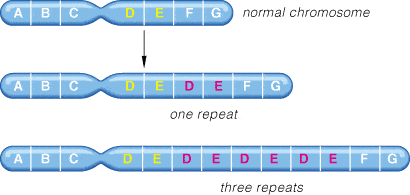
Duplication
d)
Translocation
24.
Identify the mutation in the picture.
a)
Inversion
b)
Duplication
c)
Deletion
d)
Translocation
25.
What are mutations called that occur in our reproductive cells?
a)
somatic mutations
b)
germ line mutations
c)
random mutations
d)
genetic mutations
26.

Turner Syndrome (monosomy X) is caused by what?

a)

nondisjunction

b)

chromosomal inversion mutation

c)

substitution mutation

d)

deletion-frameshift mutation

27.
A red flowered plant (RR) is crossed with a white flowered plant (WW). The gene for petal color in these plants expresses incomplete dominance.  What percentage of the offspring will have pink (RW) flowers?
a)
0%
b)
25%
c)
50%
d)
100%
28.
What type of inheritance do two alleles have if their traits blend together? 
a)
Incomplete Dominance
b)
Co-Dominance
29.
A tall plant (TT) is crossed with a short plant (SS) and a medium plant (TS) results. This is what type of inheritance pattern?
a)
Incomplete Dominance
b)
Codominance
30.
This is an example of ___________.
a)
 Incomplete Dominance
b)
 Codominance
31.
A calico cat shows both the traits for orange fur and black fur. What kind of allele expression is this?
a)
Incomplete Dominance
b)
Co dominance
32.
What do you call all of the genes in a population?
a)
Gene pool
b)
Relative Frequency
c)
Genetic Drift
d)
Allele pool
33.
The measure of how common an allele is in a population is known as ___________.
a)
Allele Combination
b)
Allele Frequency
c)
Gene Pool
d)
Genotypic Frequency
34.
Which of the three graphs shows directional selection?
a)
A
b)
B
c)
C
35.
A population of pigs with small, medium, and long snouts lives on an island together with burrowing termites. Pigs that have the longest snouts tend to survive better. Over time, most of the pig population is made up of individuals that have very long snouts. This is an example of which type of selection?
a)
directional selection
b)
disruptive selection
c)
stabilizing selection
d)
sexual selection
36.
In the past, individuals in a population of seed eating birds had a wide variety of beak sizes. After many generations, the birds either have small beaks or large beaks, but medium size beaks are absent. If the number of birds with each beak size was graphed which example would it look like?
a)
A
b)
B
c)
C
37.
If finches with large beaks and finches with small beaks increase in a population while finches with average sized beaks decreases, which pattern of natural selection has occurred?
a)
Directional selection
b)
Disruptive selection 
c)
Stabilizing selection
d)
Sexual Selection
38.
If finches with average sized beaks increase in a population while finches with large and small sized beaks decrease, which pattern of natural selection has occurred?
a)
Directional selection
b)
Disruptive selection 
c)
Stabilizing selection
d)
Sexual Selection
39.
Which is a mechanism that causes a change in allele frequency?
a)
gene flow
b)
genetic drift
c)
natural selection
d)
all answers are correct
40.
This mechanism of evolution occurs when populations migrate.
a)
Extinction
b)
Gene flow
c)
Genetic drift
d)
Natural Selection
41.

This term means "change over time"?

a)

Evolution

b)

Extinction

c)

Global Warming

d)

Selective Breeding

42.
What are sources of genetic variation?
a)
mutations
b)
genetic shuffling
c)
mutations and genetic shuffling
d)
mutations and migrations
43.

The flowers of pink tulips open in the morning, while the flowers of lavender tulips open in the early afternoon. The bees that pollinate these tulips cannot carry pollen back & forth between the two types of tulips because of their flowers being closed at different times of day. What type of reproductive barrier is this?

a)

behavioral isolation

b)

hybrid sterility

c)

temporal isolation

d)

reproductive isolation

44.
Which of the following is an example of the founder effect?
a)
Bald Eagles are hunted until near extinction, population recovers.
b)
Small group of iguanas floats to an island, starts a new population.
c)
Red fox pups are more likely to survive in a snowy environment if they are born white.
d)
Farmer chooses seeds from largest apples to plant next year.  This results in larger apples from year to year.
45.
Which of the following is NOT a characteristics of a stable, non-evolving population?
a)
the population is small
b)
there is no migration in or out of the population
c)
there is no natural selection in the population
d)
mating in the population is random
46.

The lava released by a volcanic eruption separates two populations of a species of monkey. What does this represent?

a)

biological isolation

b)

geographical isolation

c)

temporal isolation

d)

reproductive isolation

47.
If two species form a hybrid that is not viable it is what kind of reproductive barrier?
a)
Prezygotic
b)
Postzygotic
c)
Allopatric
d)
Sympatric
48.
What is genetic drift?
a)
The movement of genes in/out of a population
b)
A small, random change in the DNA
c)
Any change in the allelic frequencies in a population that is due to chance
d)
›The process in which humans select for or against particular features in organisms
49.
Which of the following must occur for speciation to happen?
a)
geographic isolation
b)
reproductive isolation
c)
temporal isolation
d)
behavioral isolation
50.
Gentoo penguins will present a mate with a pebble that they find to attract a mate. Emperor penguins have a specific call and movement that they make to attract a mate. Which type of isolation do these penguins demonstrate?
a)
temporal isolation 
b)
behavioral isolation
c)
geographical isolation
d)
anatomical isolation
51.

A reproductive barrier that prevents mating from ever taking place is a:

a)

Postzygotic Barrier

b)

Prezygotic Barrier

c)

Natural Selection

d)

Species-specific Barrier

52.
Genetic drift is likely to be seen in a population
a)
That has a low mutation rate
b)
In which natural selection is occurring
c)
That is very small
d)
For which environmental conditions are changing
53.

The bottleneck effect is caused by...

a)

Disasters

b)

Disease

c)

Migration

d)

Colonization

54.
Whose theory included "acquired traits" such as a giraffe needing a long neck so they stretch it over time?
a)
Darwin
b)
Lamarck
55.

Which of the following was the most significant stop on Charles Darwin's voyage?

a)

Australia

b)

Barbados

c)

Galapagos

d)

Trinidad

56.

Which scientist theorized that we can explain past geological events through erosion, volcanoes, etc.?

a)

Lyell

b)

Lamarck

c)

Malthus

d)

Darwin

57.
Thomas Malthus concluded that
a)
population increased arithmetically while food production increased geometrically.
b)
the world's rate of population increase was higher than the development of food supplies.
c)
moral restraint was producing lower crude birth rates.
d)
population growth was outpacing available resources in every country.
58.

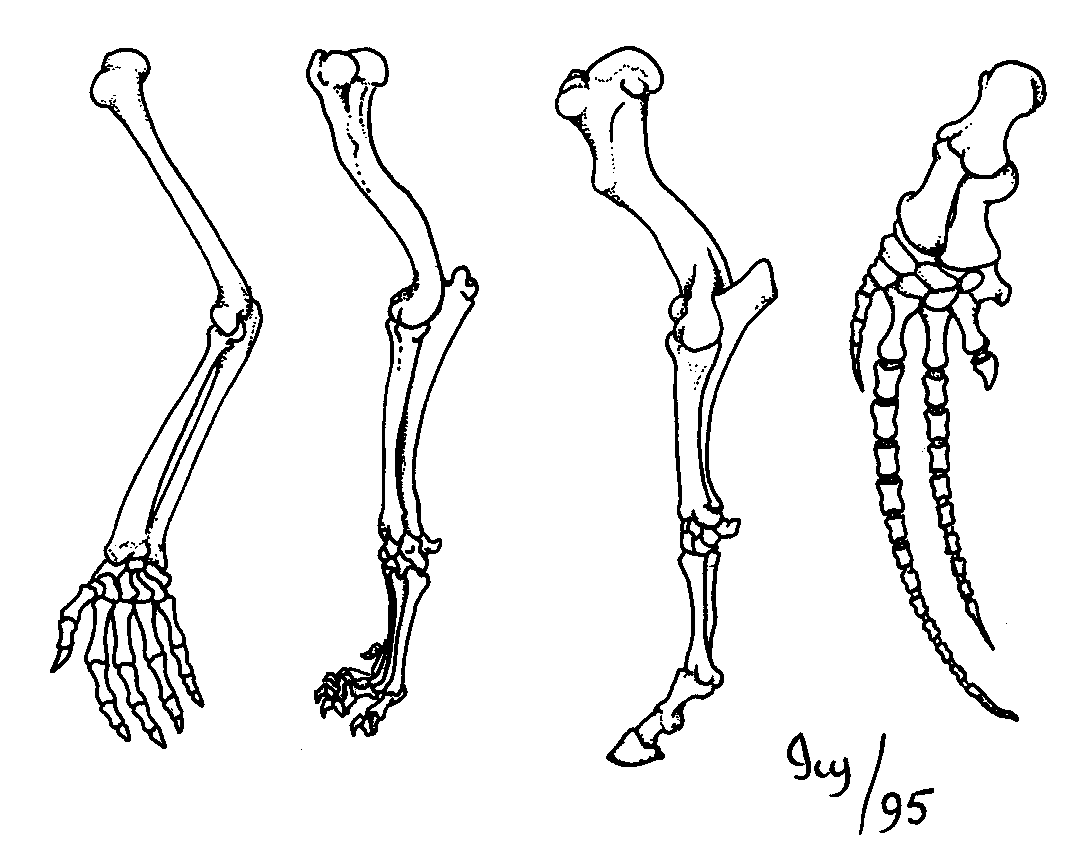
Various structures in different species that have the same function but have evolved separately are called ____________.

[no common ancestor]

a)

Convergent Evolution

b)

Homologous Structures

c)

Analogous Structures

d)

Vestigial Structures

59.
what are vestigial organs
a)
leftover organs that aren't used
b)
very useful organs that are needed for life
60.
Structures with the same parts have different functions; suggests that organisms share a common ancestry
a)
vestigial structures
b)
homologous structures
c)
adaptive radiation
d)
fossil
61.
Which organelle performs PHOTOSYNTHESIS?
a)
Chloroplast
b)
Mitochondria
62.
What is one of the reactants of cellular respiration?
a)
energy
b)
glucose
c)
carbon dioxide
d)
water
63.

______________ produces the most ATP.

a)

photosynthesis

b)

aerobic cellular respiration

c)

fermentation

d)

glycolysis

64.
What are the products of photosynthesis?
a)
Carbon dioxide and water
b)
Carbon dioxide and oxygen
c)
Glucose and oxygen
d)
Glucose and water
65.
Which of the following is the correct equation for PHOTOSYNTHESIS?
a)
6CO2 + 6H2O --> 6O+ C6H12O6
b)
6CO+ C6H12O6 + 6H2O --> O
c)
6O2 + 6H2O --> 6CO+ C6H12O6
d)
C6H12O6 + 6O2 ---> 6H2O + 6CO2 
66.
Which of the following structure is where cellular respiration occurs in the cell?
a)
nucleus
b)
cytoplasm
c)
mitochondria
d)
vacuoles
67.
What is cellular respiration?
a)
the breakdown of glucose  to release ATP
b)
the breakdown of glucose to release NADH
c)
the breakdown of glucose to release FADH
d)
the breakdown of glucose to release carbon
68.
This means that oxygen is needed
a)
anaerobic 
b)
aerobic
69.
This molecule contains three phosphate groups
a)
ADP
b)
ATP
c)
Mitochondria
d)
Nucleus
70.
This is referred to as the energy currency of the cell
a)
ADP
b)
ATP
c)
Mitochondria
d)
Nucleus
71.
This process releases chemical energy from sugars and other carbon-based molecules to make ATP when oxygen is present.
a)
photosynthesis
b)
light-independent reaction
c)
cellular respiration
d)
light-dependent reaction
72.
The main source of energy for all life comes from ____.
a)
the Earth
b)
the moon
c)
the sun
d)
the food we eat/make
73.
What are the reactants (what's needed) for photosynthesis?
a)
glucose and oxygen
b)
light, water, and carbon dioxide
74.
What is a disadvantage of fermentation as a process? 
a)
It produces too much ATP
b)
It only produces 2 ATP
c)
It occurs in the absence of oxygen
d)
It is only for quick bursts of energy
75.
Lactic acid fermentation occurs in your muscles after a workout because your cells are struggling to get
a)
Glucose
b)
Sunlight
c)
Oxygen
d)
Water
76.
As a population grows, it will most likely stop growing at what size?
a)
Growth limit
b)
Exponential limit
c)
Carrying Capacity
d)
It won't stop growing
77.
Which kind of growth does the human population follow? It is described as a J-shaped curve.
a)
Exponential Growth
b)
Logistic Growth
c)
Outstanding Growth
d)
Minimal Growth
78.
Which dispersion pattern usually is a result of resources not being evenly spread out in the environment?
a)
Uniform
b)
Random
c)
Clumped
d)
None of these
79.
What will happen to the population when the birth rate is larger than the death rate?
a)
grow
b)
shrink
c)
stay the same
80.
What type of growth is represented behind?
a)
exponential
b)
logistics
c)
a good kind
d)
representative
81.
What is the carrying capacity of the following graph?
a)
1000
b)
8000
c)
800
d)
600
82.
Which kind of dispersion is #1?
a)
clumped
b)
random
c)
uniform
83.
Which limiting factor is independent of the number of individuals in a population?
a)
competition
b)
parasitism/disease
c)
stress
d)
natural disasters
84.
Limiting factors which impact the size of a population based on the size of the population
a)
Density Independent Limiting Factors
b)
Density Dependent Limiting Factors
85.
A relationship between two organisms in which one organism benefits and the other is unharmed...
a)
Mutualism 
b)
Competition
c)
Parasitsm 
d)
Commensalism 
86.
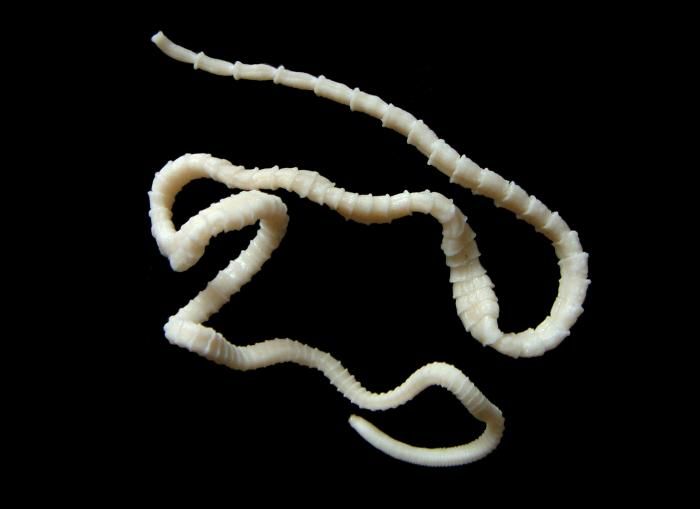
A tapeworm and a cat have this type of relationship.
a)
mutualism
b)
parasitism
c)
commensalism
d)
competition
87.
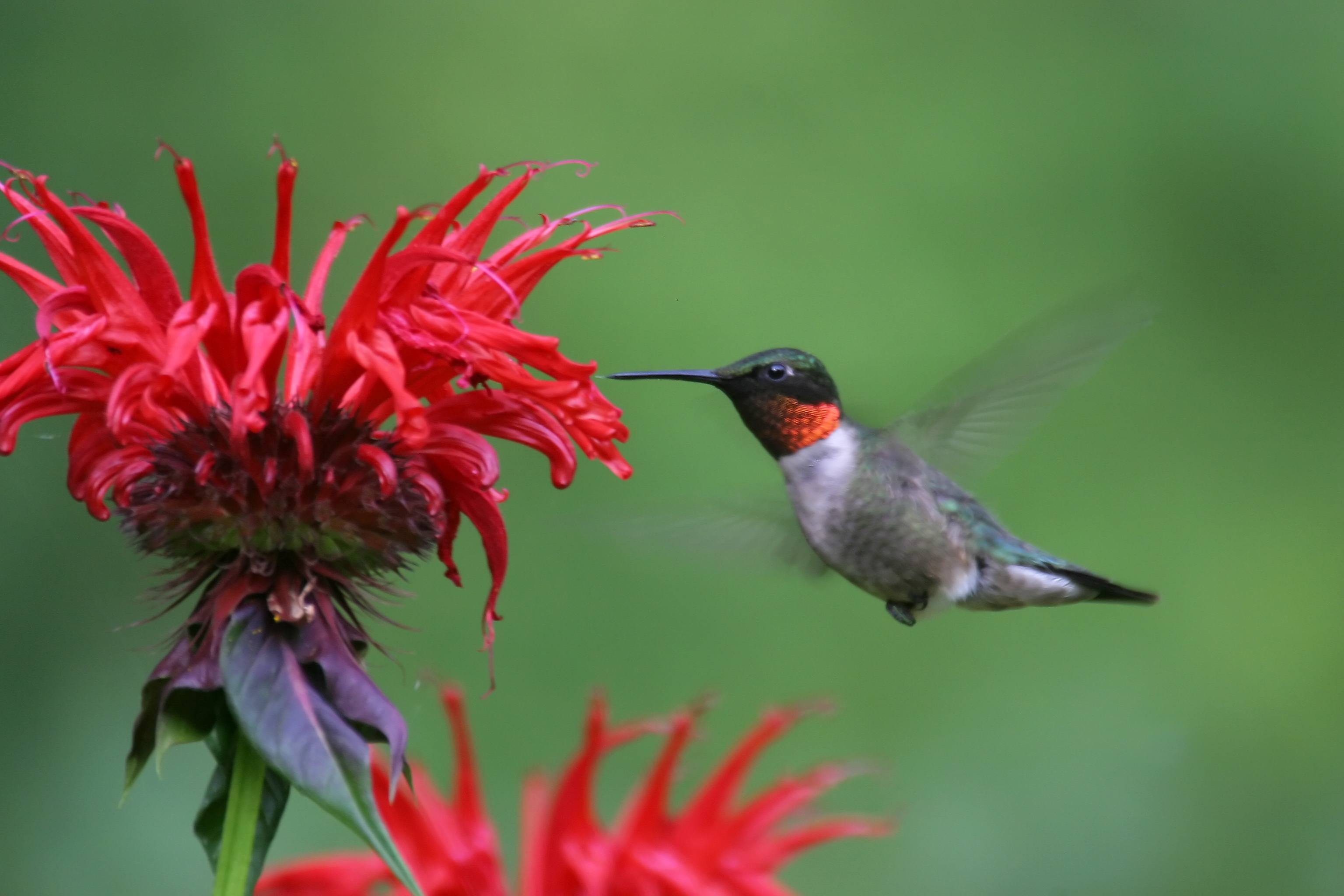
What type of symbiosis?  Hummingbirds feed on nectar from flowers.  The flowers are pollinated by hummingbirds as they move from flower to flower.
a)
commensalism
b)
mutualism
c)
parasitism
d)
predation
88.
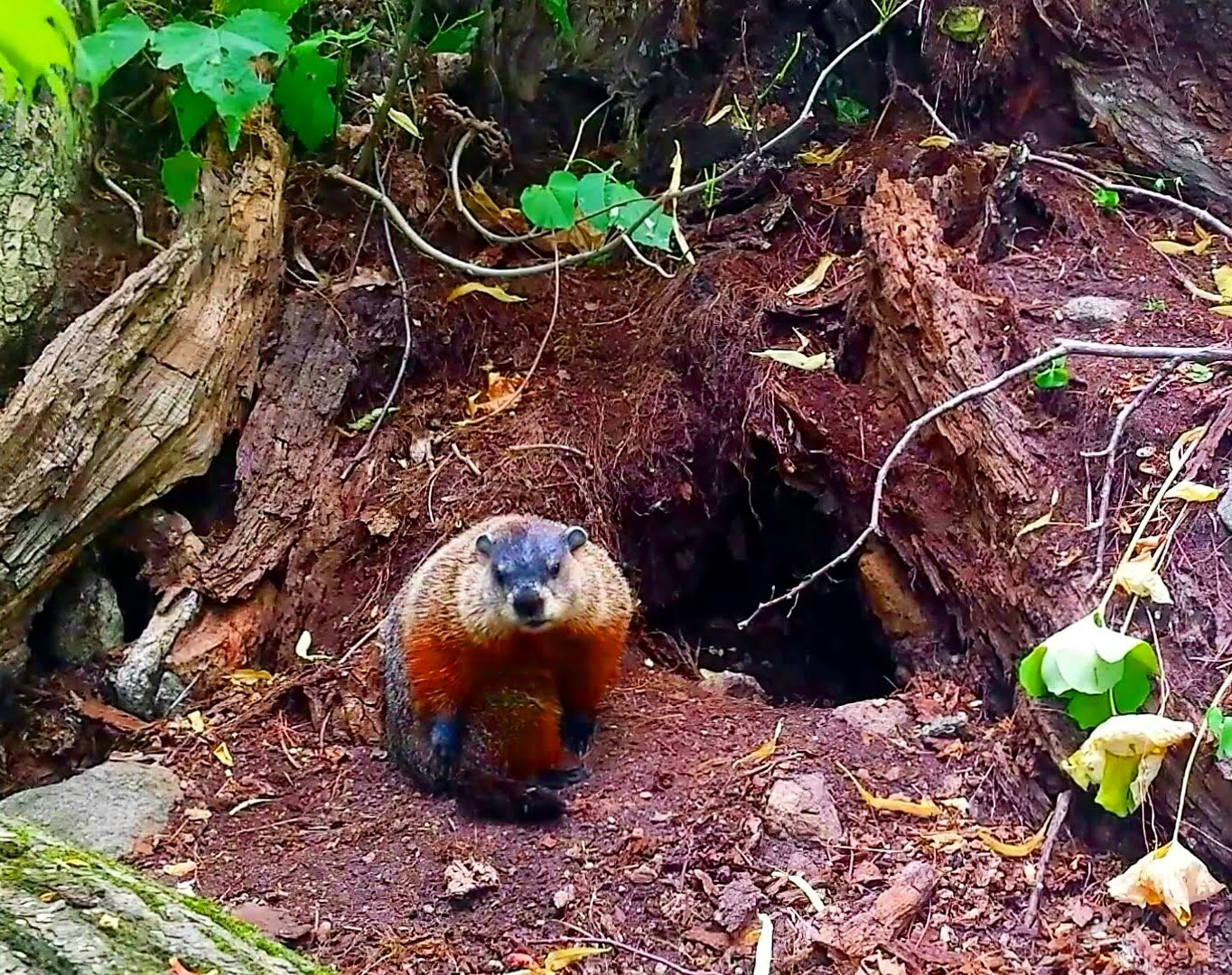
What type of symbiosis?  Skunks often live in burrows that have been dug and abandoned by woodchucks.  
a)
commensalism
b)
mutualism
c)
parasitism
d)
predation
89.
A relationship between two organisms in which both organisms benefit. 
a)
Mutualism 
b)
Competition
c)
Parasitsm 
d)
Commensalism 
90.
A frog eats a fly. The frog and fly are demonstrating ________.
a)
mutualism
b)
competition
c)
predator/prey
d)
parasitism
91.
Two male Giraffes are fighting over the last green leaf of a tree that is dying.  
a)
Competition
b)
Mutualsim
c)
Predation
d)
Commensalism
92.
A close, long-term relationship in which 2 different organisms live in close association with each other. 
a)
Carrying Capacity
b)
Coexistence
c)
Limiting Factor
d)
Symbiosis
93.

When a pine tree grows real tall and blocks sunlight to a birch tree it is _______ competition.

a)

Interference

b)

Intraspecific

c)

Interspecific

d)

Exploitative

94.
When two male lions fight over a lady lion this is _______ competition.
a)
Exploitative
b)
Intraspecific
c)
Interspecific
d)
Bullying
95.

What is species diversity?

a)

the different animals in an area

b)

the different habitats in an area

c)

the different plants in an area

d)

the different living things (plants and animals) in an area

96.

Why do the populations of invasive species grow so quickly?

a)

Invasive Species are native to an area.

b)

Invasive species are prey to many animals.

c)

Invasive species have no natural predators.

d)

Invasive species keep the ecosystems in equilibrium.

97.

What is an invasive species?

a)

an organism that IS native to an area and causes harm to the environment/humans

b)

an organism that is NOT native to an area and causes harm to the environment/humans

c)

an organism that is NOT native to an area and helps the environment/humans
d)

an organism that IS native to an area and helps the environment/humans

98.
A keystone species has...
a)
big impact on ecosystem, big population
b)
small impact on ecosystem, small population
c)
big impact on ecosystem, small population
d)
None of these
99.
An endangered species is
a)
One whose numbers are so small that it is at risk of extinction
b)
One whose not been spotted after many years.
c)
One whose numbers are abundant.
100.
What are the greatest problems facing plants, animals, and people?
a)
introducing new species that  can cause problems 
b)
habitat destruction
c)
illegal hunting 
d)
all of the above
101.
This category of species is very specific to one area: 
a)
invasive 
b)
indigenous
c)
endemic
d)
generalist 
102.
Which statement best summarizes the effect of human population growth on other species?
a)
The effect is always positive; other species thrive when humans do.
b)
The effect is mostly positive; most other species thrive when humans do.
c)
The effect is always negative; wherever there are humans, other species suffer.
d)
The effect is mostly negative; fewer resources are available for most other species when human populations grow.
103.

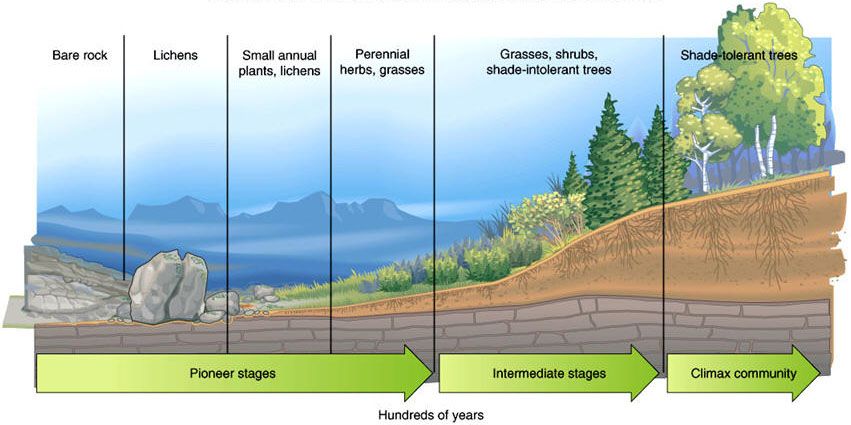
The picture shows what type of succession?

a)

primary

b)

secondary

c)

tertiary

d)

quadanary

104.

Succession type?

a)

primary succession

b)

secondary succession

c)

tertiary succession

d)

variable succession

105.
The practice of harvesting or hunting to such a degree that remaining individuals may not be able to replenish the population is called _____.
a)
biomagnification
b)
overexploitation
c)
edge effects
d)
natural resource
106.

Patches of suitable habitat surrounded by unsuitable habitat

a)

Fragmentation

b)

Extirpation

c)

Relocation

d)

Emigration

107.
Which of these describes what happened when buffaloes were almost hunted to extinction in United States?
a)
Biomagnification
b)
Eutrophication
c)
Pollution
d)
Overexploitation