
 Worksheets
Quizziz #23 (Due Sunday, 5/5 @ 11pm)
Total questions: 100
Worksheet time: 1hrs 14mins
Name
Class
Date
1.
2 energy rich molecules created by Light Dependent Reactions of Photosynthesis are:
a)
ATP and ADP
b)
ATP and NADPH
c)
ADP and FADH
d)
ADP and NADP
2.
Where does Photosystem II get its electrons?
a)
photosystem I
b)
splitting of water
c)
ATP
d)
NADPH
3.
During chemiosmosis
a)
Carbon is fixed.
b)
ATP is synthesized from ADP
c)
NADPH is synthesized from NADP+
d)
Electrons are removed from chlorophyll molecules.
4.
Where do the light-dependent reactions occur?
a)
thylakoid membrane
b)
stroma
c)
lumen
d)
mitochondria
5.
The monomer of a nucleic acid is
a)
Monosaccharide
b)
Amino Acid
c)
Nucleotide
d)
Triglyceride (3 Fatty Acids and 1 Glycerol)
6.

What type of transport is shown in the picture?
a)
Osmosis
b)
Diffusion
c)
Endocytosis
d)
Exocytosis
7.

The cell below is in a _________ solution.
a)
Hypotonic
b)
Hypertonic
c)
Isotonic
8.
If a molecule passes through a protein, but goes down a gradient, it is called
a)
active transport
b)
endocytosis
c)
facilitated diffusion
d)
exocytosis
9.
How many ATP molecules are created by fermentation?
a)
0
b)
2
c)
12
d)
36
10.
What are the reactants for cellular respiration?
a)
oxygen and lactic acid
b)
water and glucose
c)
carbon dioxide and water
d)
glucose and oxygen
11.
Which reactant is used as the final electron acceptor in cellular respiration?
a)
water
b)
carbon dioxide
c)
oxygen
d)
glucose
12.
Lipids are made up of which of the following?
a)
glycerol and fatty acids
b)
glycerol and monolipids
c)
fatty acids and phosolipids
d)
amino acids and nucleotides
13.

Identify the functional group:
a)
steroid
b)
phosphate
c)
carbonyl
d)
carboxyl
14.

Which macromolecule is shown?
a)
phospholipid
b)
protein
c)
steroid
d)
glucose (carbohydrate)
15.
A sugar, a phosphate group, and a nitrogen base form the building blocks of which organic compound?
a)
carbohydrates
b)
nucleic acids
c)
lipids
d)
proteins
16.
ATP synthesis
a)
chloroplast
b)
mitochondria
c)
lysosome
d)
ribosome
17.
All of the following are important characteristics of water in biology EXCEPT which?
a)
cohesion provides surface tension
b)
it is a nonpolar solvent
c)
it is a medium for complex chemical reactions in organisms
d)
it has a high specific heat that stabilizes ambient temperature
18.

Which letter represents the activation energy of a non-catalyzed reaction?
a)
a
b)
b
c)
c
d)
d
19.
Which of the following is the process used to bond the monomers together?
a)
Hydrolysis
b)
Water Removal
c)
Dehydration Synthesis
d)
Water Synthesis
20.
A liquid with a pH of 4 is _x more concentrated in H+ than a liquid with a pH of 6.
a)
10
b)
100
c)
1,000
d)
10,000
21.
Which of the following is correct about water?
a)
it is a polar molecule and contains polar bonds
b)
it is a polar molecule and contains non-polar bonds
c)
it is a non-polar molecule and contains polar bonds
d)
it is a non-polar molecule and contains non-polar bonds
22.
Which are enzymes?
a)
simple carbohydrates
b)
proteins that speed up chemical reactions
c)
lipids that make up the cell membrane
d)
a building block of DNA
23.
Which macromolecule stores energy, insulates us, and makes up the cell membrane?
a)
lipids
b)
proteins
c)
carbohydrates
d)
nucleic acids
24.
Which organelle is the site of protein synthesis?
a)
Ribosome
b)
Lysosome
c)
Vacuole
d)
Mitochondrion
25.
What is the name for the diffusion of water across a selectively permeable membrane?
a)
Facilitated diffusion
b)
Hydro-diffusion
c)
Endocytosis
d)
Osmosis
26.
This type of process requires oxygen.
a)
Aerobic
b)
Anaerobic
c)
Cell transport
d)
None of the above
27.
Two structures found in plant cells that are not found in animal cells
a)
cytoplasm, cell wall
b)
cytoplasm, cell membrane
c)
chloroplast, cell membrane
d)
chloroplast, cell wall
28.
Keeping your internal body temperature the same is called
a)
excretion
b)
homeostasis
c)
respiration
d)
metabolism
29.
What part of cellular respiration is the most efficient?
a)
Kreb's cycle
b)
ETC
c)
Glycolysis
d)
fermentation
30.

The part of the neuron that conducts action potentials is the:
a)
Axon
b)
Dendrite
c)
Axon Terminal
d)
Cell Body
31.
The macromolecule that provides short term energy and glucose is an example.
a)
carbohydrate
b)
lipid
c)
protein
d)
nucleic acid
32.

The part of the neuron that receives signals is the:
a)
Axon
b)
Dendrite
c)
Axon Terminal
d)
Cell Body
33.

Heartbeat would be accomplished by which branch of the nervous system?
a)
Sensory
b)
Autonomic
c)
Motor
d)
Pineal
34.

Z
a)
Dendrite
b)
Axon Terminal
c)
Neurotransmitters
d)
Synapse
35.
Which of the following is an example of a second messenger?
a)
cAMP
b)
GTP
c)
insulin
d)
epinephrine
36.
The step in the cell cycle following mitosis, in which the cytoplasm divides.
a)
cytokinesis
b)
telophase
c)
prophase
d)
metaphase
37.
The process of mitosis results in two genetically _________ daughter cells.
a)
engineered
b)
different
c)
mutated
d)
identical
38.
During this time the cell grows and makes copies of its organelles and DNA.
a)
interphase
b)
anaphase
c)
telophase
d)
metaphase
39.
if a cell has 24 chromosomes at the beginning of meiosis how many chromosomes will it have at the end of meiosis?
a)
6
b)
12
c)
24
d)
the number varies with the species.
40.
Disease-causing microorganism, such as a bacterium or virus.
a)
pathogen
b)
allergen
c)
toxin
d)
antigen
41.
A substance or part of a substance (living or nonliving) that the immune system recognizes as foreign and activates the immune system and reacts with immune cells or their products, such as antibodies.
a)
pathogen
b)
allergen
c)
antigen
d)
antibody
42.
What initiates an immune response?
a)
antibody
b)
antigen
c)
histamine
d)
antibiotic
43.
Antigens prepared in such a way that when injected or taken orally they induce active immunity without causing disease.
a)
antigen
b)
spleen
c)
B cell
d)
vaccine
44.
Types of lymphocytes
a)
B cells, Cytotoxic T cells, Helper T cells
b)
Macrophages and Neutrophils
c)
erythrocytes and leukocytes
d)
erythrocytes and B cells
45.
What produces the hormones insulin?
a)
Liver
b)
Ovary
c)
Pancreas
d)
Hormones
46.
Which plant hormone is a gas?
a)
auxin
b)
gibberellin
c)
ethylene
d)
cytokinin
47.
Which hormone promotes seed germination?
a)
abscisic acid
b)
ethylene
c)
gibberellin
d)
auxin
48.
What is glucagon's major role in the body?
a)
to raise blood sugar
b)
to lower blood sugar
c)
to receive signals from the pituitary
49.
When glucose levels in the blood rise, your brain sends a signal to your pancreas. The pancreas releases insulin, which opens channels in cell membranes to allow glucose to enter the cell, lowering blood sugar levels.
a)
Positive Feedback Response
b)
Negative Feedback Loop
50.
increase reabsorption of water by kidney
a)
ACTH
b)
ADH
c)
PTH
d)
glucagon
51.
The uncontrolled division of cells...
a)
meiosis
b)
cancer
c)
nondisjunction
d)
crossing over
52.
As a cell increases in size, the surface area to volume ratio _________________.
a)
increases
b)
decreases
c)
stays the same
53.
Definition of oogenisis
a)
the production or development of an ovum
b)
he production or development of mature spermatozoa
c)
the process in which cells undergo meiosis to form gametes
54.
"Programmed cell death."
a)
diffusion
b)
cancer
c)
apoptosis
d)
meiosis
55.
Which of the following binds to the active site of an enzyme?
a)
substrate
b)
product
c)
codon
d)
none of the above
56.
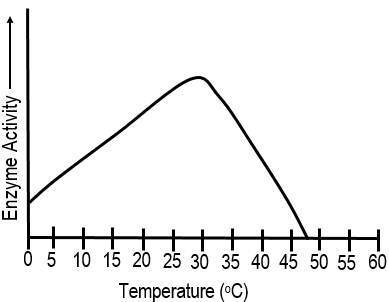
Based on the graph, what temperature does this enzyme work best?
a)
15 C
b)
40 C
c)
30 C
57.
What happens when enzymes are heated to a high temperature?
a)
The enzymes die.
b)
The shapes of the enzyme are altered or denatured
c)
The enzymes' amino acid sequence changes.
d)
The enzymes remain the same
58.
A water sample from a hot thermal vent contained a single-celled organism that had a cell wall but lacked a nucleus. What is its most likely classification?
a)
Archaea
b)
Animalia
c)
Fungi
d)
Eukarya
59.
Which ions are involved in an action potential?
a)
Na; Cl
b)
Na; K
c)
K; Cl
d)
Na; Ca
60.
What is the normal resting potential of a neuron cell membrane?
a)
+40mV
b)
-30mV
c)
+55mV
d)
-70mV
61.
Which is the correct order of events in depolarisation then repolarisation?
a)
Sodium channels close, potassium channels open
b)
Sodium channels open, potassium channels open,
c)
Sodium channels open, potassium channels close
d)
Potassium channels open, sodium channels open
62.

At which point on the diagram does depolarisation of the axon occur?
a)
A
b)
B
c)
C
d)
D
63.
What is the insulating membrane that surrounds parts of the axon that helps to protect & propagate action potential?
a)
Axon
b)
Dendrites
c)
Node of Ranvier
d)
Myelin Sheath
64.
In resting potential, neurons have more _________ on the outside of the cell membrane.
a)
K+
b)
NaCl
c)
Na+
d)
Cl-
65.
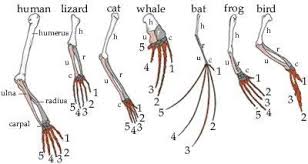
What is this an example of?
a)
vestigial structures
b)
embryology
c)
homologous structures
d)
fossil record
66.

Which of the following is a term for a group of similar organisms that can reproduce fertile offspring?
a)
individual
b)
population
c)
species
d)
fossil
67.

a measure of how commonly a particular allele occurs in a population is known as the
a)
gene pool
b)
allele frequency
c)
mutation rate
d)
phenotype
68.
Which of the following would an animal breeder use to increase the number of cows that give the most milk?
a)
overproduction
b)
genetic isolation
c)
acquired characteristics
d)
artificial selection
69.

Genetic variation can arise from a random change in the DNA of a gene. The change is called a(n)
a)
mutation
b)
gene flow
c)
gene pool
d)
allele
70.
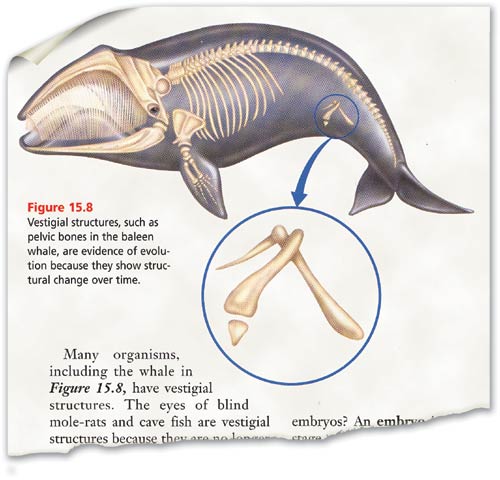
Which of the following is an example of a vestigial structure?
a)
the wings of a red-tailed hawk
b)
the hind limbs of a house cat
c)
the fins of sharks
d)
the tailbone of a human
71.
What type of speciation involves geographic isolation?
a)
Allopatric
b)
Sympatric
c)
Both
72.
What is genetic drift?
a)
The movement of genes in/out of a population
b)
A small, random change in the DNA
c)
Any change in the allelic frequencies in a population that is due to chance
d)
The process in which humans select for or against particular features in organisms
73.

What type of selection is this?
a)
Directional Selection
b)
Stabilizing Selection
c)
Disruptive Selection
d)
Natural Selection
74.

What type of selection is this?
a)
Directional Selection
b)
Stabilizing Selection
c)
Disruptive Selection
d)
Natural Selection
75.

What type of selection is this?
a)
Directional Selection
b)
Stabilizing Selection
c)
Disruptive Selection
d)
Natural Selection
76.
Different mating times
a)
temporal
b)
behavioral
c)
geographic
d)
other
77.
Reproductive isolating mechanism (RIM) that acts after fertilization of egg by sperm.
a)
Prezygotic
b)
Postzygotic
c)
Premating
d)
Postmating
78.
Reproductive isolating mechanism (RIM) that acts to prevent fertilization of egg by sperm.
a)
Prezygotic
b)
Postzygotic
c)
Premating
d)
Postmating
79.
Fruit flies are beginning to live & mate on different types of fruit on the floor of the Amazon. Bigger fruit flies prefer rotting mangos, while smaller fruit flies prefer rotting bananas. What type of reproductive barrier is this?
a)
habitat isolation
b)
temporal isolation
c)
gametic isolation
d)
mechanical isolation
80.
In the early 2000s, White Nose fungus caused a mass die-off of native American bat species. Those bats that survived will continue the population with their own allele frequencies. What type of genetic drift is this?
a)
Founder Effect
b)
Bottlenose Effect
c)
Bottleneck Effect
d)
Migration Effect
81.
A migratory bird unknowingly accumulates a few seeds of the hwagha plant in her feathers and drops them in an area where those plants did not live before. This is an example of
a)
Founder Effect
b)
Predation
c)
Bottleneck Effect
d)
Migration
82.
In Stanley Miller's and Harold Urey's experiment what chemical was intentionally left out?
a)
oxygen
b)
hydrogen
c)
methane
d)
ammonia
83.

An organism that needs to eat other organisms to obtain energy is known as a:
a)
Autotroph
b)
Producer
c)
Consumer
d)
Mutualist
84.
Consumer that eats plants
a)
heterotroph
b)
herbivore
c)
producer
d)
community
85.

What does a food web represent?
a)
All connections of energy flow throughout all organisms in a habitat.
b)
The specific ways that mutualism is carried out.
c)
A single pathway or energy flow between organisms.
d)
How carnivores get their food.
86.

relationship in which two species live closely together
a)
resource
b)
mutualism
c)
succession
d)
symbiosis
87.

The rabbit in this food web would be considered a:
a)
Decomposer
b)
Producer
c)
Secondary Consumer
d)
Primary Consumer
88.
What is the term for each step in the transfer of energy and matter within a biological community?
a)
energy path
b)
food web
c)
trophic level
d)
food pyramid
89.
The amount of energy that usually transfers from one trophic level to the next...
a)
10%
b)
20%
c)
80%
d)
50%
90.
As you move upward, from level to level, in an energy pyramid, energy _____.
a)
increases
b)
decreases
c)
stays the same
d)
increases exponentially
91.

A living relationship between two species in which one organism is harmed is called...
a)
mutualism
b)
commensalism
c)
parasitism
d)
niche
92.

Cattle egrets forage (feed) in fields among cattle. The egret gets easy access to flying insects stirred up by the cattle, and the cattle don't care if they are there or not.
a)
mutualism
b)
commensalism
c)
competition
d)
parasitism
93.
Introduced or invasive species are often difficult because:
a)
They contribute to habitat fragmentation
b)
They do not adapt well to new environments
c)
They increase biodiversity
d)
They often lack natural predators
94.
A population will most likely stop growing when it reaches its:
a)
Growth limit
b)
Exponential limit
c)
Carrying Capacity
d)
Metapopulation
95.
1. A bacterial colony that exists in an environment displaying idea conditions will display which of the following growth patterns?
a)
logistic
b)
intrinsic
c)
demographic
d)
exponential
96.
1. When one species was removed from a tide pool, the species richness became significantly reduced. The removed species was probably
a)
a. The species with the greatest biomass
b)
a. A potent parasite
c)
a. The species with the highest relative abundance
d)
a. A keystone species
97.
1. Which of the following would be not a density-dependent factor limiting a population’s growth?
a)
a. Increased predation by a predator
b)
a. A limited number of available nesting sites
c)
a. A stress syndrome that alters hormone levels
d)
a. A very early fall frost
98.
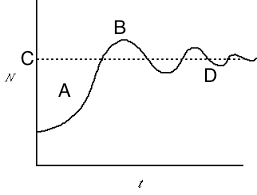
Which letter shows the the exponential growth of a population?
a)
A
b)
B
c)
C
d)
D
99.
Species that follow r-selection
a)
provide great maternal care
b)
have shorter life spans on average
c)
are larger in size
d)
do not have a changing growth rate
100.
Humans follow k-selection becasue
a)
they have very frequent reproductive episodes
b)
they have short life spans relative to other organism
c)
few young are produced at one time
d)
they reach carrying capacity
100 %

