
 Worksheets
CH:11 Groundwater
Total questions: 113
Worksheet time: 3hrs 35mins
Which of the following IS NOT true about groundwater?
Groundwater is the largest freshwater source on Earth.
Groundwater is freshwater beneath Earth’s surface.
Groundwater is the largest liquid freshwater source for humans.
Groundwater can maintain streamflow during times of drought.
Much of the water that flows in river systems is direct runoff from precipitation.
True
False
Groundwater is thus a form of _________that _______________ streams during periods when rain does not fall.
storage, sustains
precipitation, dehydrates
saltwater, dries up
mineral, lithifies
The zone of soil moisture is considered to be groundwater.
True
False
Which of the following implies the same thing as the word "aquifer"?
zone of saturation
zone of aeration
zone of soil moisture
zone of twilight
The top of an aquifer is known as:
the water table.
an artesian well.
the hydraulic gradient.
a geyser.

The two factors that influence the curved route of infiltrated water flow underground are:
gravity and hydraulic pressure.
gravity and electromagnetism.
the Coriolis Effect and the prevailing winds.
permeability and non-permeability.
Which of the following are wells used for? CHOOSE ALL THAT APPLY!
Wells are used to determine the height of the water table.
Wells are used to obtain water for crop irrigation.
Wells are used to obtain water for human consumption.
Wells are used to create barriers between aquifers, called aquatards.
What does the quantity of groundwater that can be stored depend upon?
It depends upon the porosity of the underground rock.
It depends upon the pH of the groundwater.
It depends upon the underground depth of the storage system.
It depends upon the temperature of the underground rock.
A place where the water table intersects the ground surface and where a natural flow of groundwater results is called:
a spring.
a geyser.
an aquatard.
a fissure.
What is the source of heat for hot springs?
It is provided by the cooling of igneous rock.
It is provided by the transformation of metamorphic rock to sedimentary rock.
It is provided by the warming process of soil moisture.
It is provided by plate subduction at convergent boundaries.
What is the most common method for removing groundwater?
a well bored into the zone of saturation
accessing the water table by use of low-grade explosives
building a water tower
damming up a river
Which of the following is a hydrological problem currently facing the High Plains of the United States?
over-pumping of the Ogallala aquifer
compaction of the San Joaquin valley
mass amounts of human contamination seeping into the aquifer
flooding of Lake Mead
Which of these images depict a Karst landscape? CHOOSE ALL THAT APPLY!


Identify which of the following are required to make a major cavern system. CHOOSE ALL THAT ARE NECESSARY.
Groundwater is often mildly acidic as it contains a weak solution of carbonic acid.
The acidic nature of groundwater will dissolve the calcite in limestone.
Caverns are formed by dissolving rock beneath the Earth’s surface.
Plate subduction can create caverns as one plate dives under another.
Which of the following IS NOT a dripstone feature?
sinkholes in Karst topography
stalactites hanging from the ceiling of caverns
stalagmites growing upward from the floor of caverns
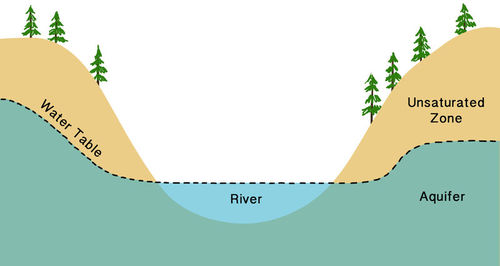
What is the best definition of a water table?
The level to which a river rises when it floods
The boundary between the land and the ocean
The top of the saturated zone in an aquifer
The bottom of the saturated zone in an aquifer
The top of the unsaturated zone in an aquifer

What would cause the water table to lower?
High rates of evaporation and transpiration
Low rates of evaporation and transpiration
Increasing amounts of runoff
A heavy rainstorm with a lot of precipitation
What is infiltration?
The process by which water sinks into the ground
The zone where there are still air spaces left between the particles.
The process by which water vapor turns into liquid water and forms fog or clouds.
The process by which water does not sink into the ground, but rather travels along the surface.

What process transforms the water vapor in the atmosphere to the liquid water in a cloud?
evaporation
infiltration
precipitation
transpiration
condensation

What process causes liquid water to evaporate from plant leaves and enter the atmosphere as water vapor?
evaporation
infiltration
precipitation
transpiration
condensation

Which soil would have the greatest permeability rate after a rainstorm?
sand (0.02 cm)
silt (0.002 cm)
clay (0.0002 cm)
Which soil would have the greatest capillarity?
sand (0.02 cm)
silt (0.002 cm)
clay (0.0002 cm)
What is capillarity?
When water cannot infiltrate a substance
Water being held onto by rock or sediment
The ability of water to move upward against gravity in a material
The percentage of empty space in a material

These containers have the same volume of beads which are representing soil particles. What is the relative porosity and permeability of each?
The container on the left has the higher permeability and porosity
The container on the right has the higher permeability and porosity
The container on the left has the higher permeability, but they both have the same porosity
The container on the right has the higher permeability, but they both have the same porosity

500 mL of water is added to each tube and allowed to drain out. Which container would have the highest retention of water after it drained? (particle size gets bigger as you move to the right)
A
B
C
D
They would all be the same in terms of retention

How would the porosity of the poorly sorted sediment compare to the well sorted sediment?
It would be greater in the poorly sorted sediment
It would be less in the poorly sorted sediment
It would be the same in both
How does the porosity of frozen soil compare with unfrozen soil?
It is less in the frozen soil
It is greater in the frozen soil
The porosity of both would be the same
Which surface would have the most runoff from it after a rainstorm?


Which surface would be impermeable?


What else could happen here?


Which of the following environments might become polluted as a result?
I. aquatic environments downstream of the watershed
II. land environments along the banks of the river
III. environments upstream

The picture shows a simple well that was dug down to the groundwater. What probably caused the lower level of groundwater, known as a "cone of depression," in the vicinity of the well?
The weight of the atmosphere presses down on the groundwater in the well.
The ground below the well acts as a vacuum sucking out the water.
Gravity pulls down the water beneath the well.
As water is drawn from the well, it takes time for the groundwater to percolate through the soil and restore the level.
Which of the following is a typical feature of karst topography?
landslides
moraines
dunes
sinkholes

In the diagram below, the area labeled X is called the __________.
zone of infiltration
recharge zone
zone of saturation
zone of permeability

According to the diagram, the water supply will be most consistent in well....
1
2
3
4
Organize best to hold water to least able to hold water.
Sample Porosity
A 30%
B 8%
C 16%
C, A, B
B, C, A
A, B, C
A, C, B
Sample A is most likely _____________.
Sample Porosity
A 30%
B 8%
C 16%
well-sorted small grains of sand
unsorted small grains of sand
well-sorted large grains of sand
unsorted large grains of sand

Which solution will NOT protect the water from contamination?
Build a well between the two wells that goes deeper into Earth.
Close the wells and use an alternative.
Build an impermeable barrier to stop oil flow.
Pump out water from the wells and treat it chemically to remove pollution.

Which two wells are at risk of being contaminated by the oil leak?
B and C
A and D
A and B
C and D
Groundwater flows through permeable layers called ____.
aquifers
aquicludes
Which term BEST links groundwater and the water cycle?
evaporation
condensation
infiltration
glaciers
Which of the following is the measure of space in the ground?
permability
porosity
viscosity
aquifer
How do we access groundwater?
recharge
wells
rivers
acid rain
Where is the water table the highest?
on a high mountain
in the sandy desert
in a soggy wetland
on a flat grassland
What would most likely make the water table's level change?
drought, with no rain for several weeks
condensation in the atmosphere
evaporation on a sunny day
a thirsty deer drinking in a lake


Why is groundwater so important?
Water is ancient and can't be replaced, only recycled
It's all the water we have
Desalination is expensive and can't be used in the central plains
Most water on earth isn't freshwater and most freshwater comes from groundwater sources
How old are the water molecules in your glass or bottle of water?
Several days
around 1,000 years
a million years
thousands of millions of years
Groundwater in the US is
found everywhere
is primarily found in the central plains
is found all across the nation, but some areas have little to none
is only found along the coastlines
Where is most of the freshwater on Earth found?
in underground aquifers
in low salt oceans
in groundwater
locked up in ice, snow, and glaciers



