wayground logo

Free Printable Worksheets

NEW

Font size

S
M
L
XL
Worksheets

Earth, Moon, & Sun Interactions

Total questions: 50

Worksheet time: 34mins

Name
Class
Date
1.
What moon phase is this picture?
a)
This is the full moon phase.
b)
This is the waxing gibbous moon phase.
c)
This is the waning gibbous moon phase.
d)
This is the first quarter moon phase.
2.
What is this moon phase?
a)
This is the waxing gibbous moon phase.
b)
This is the last quarter moon phase.
c)
This is the first quarter moon phase.
d)
This is the new moon phase.  
3.
What moon phase is this picture?
a)
This is the full moon phase.  
b)
This is the waxing crescent moon phase.
c)
This is the waning gibbous moon phase.
d)
This is the waning crescent moon phase.
4.
How many phases does the moon go through?
a)
4
b)
8
c)
10
d)
16
5.
What part of the moon do we see from Earth?
a)
all of it
b)
the same side
c)
none of it
d)
only one quarter
6.
The moon seems to change shape from day to day in a cycle that lasts about a month as it goes through _.
a)
revolutions
b)
phases
c)
rotations
d)
eclipses
7.
As the moon's shape appears to get smaller, we say that the moon is _.
a)
swelling
b)
waxing
c)
waning
d)
disappearing
8.
Phases of the moon in which the moon appears to be getting larger are referred to as _.
a)
waxing
b)
waning
c)
new
d)
eclipse
9.
The cycle of the moon lasts about a _.
a)
day
b)
year
c)
week
d)
month
10.
How long is a lunar month?  
a)
30
b)
29.5
c)
27
d)
27.3
11.
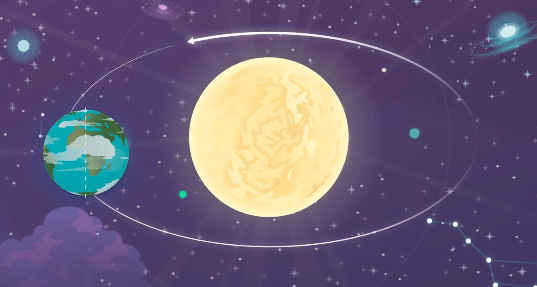
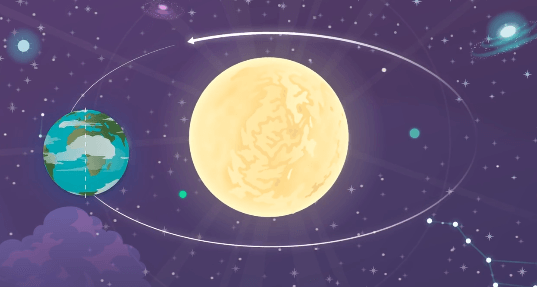
How long does it take for the Earth to make one full orbit around the Sun?
a)
one day
b)
one week
c)
one month
d)
one year
12.
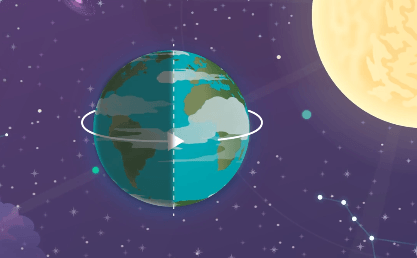
The Earth is rotating on its axis, creating _____
a)
the 12 months
b)
the years
c)
the seasons
d)
day and night
13.
As the Earth travels around the Sun, it creates a pattern that makes _____
a)
the months
b)
the years
c)
the seasons
d)
day and night
14.
When the Earth completes a full orbit around the Sun, it has completed _____ rotations or days
a)
7
b)
30
c)
91
d)
365
15.
The spinning movement of the Earth about its axis is called the Earth's _____
a)
revolution
b)
rotation
c)
precession
d)
orbit
16.
The movement of the Earth around the Sun is called its _____
a)
revolution
b)
rotation
c)
precession
d)
gyration
17.
When the part of the world that you're living in is leaning towards the Sun, its _____
a)
winter
b)
spring
c)
summer
d)
fall
18.
When the part of the world that you're living in is leaning away from the Sun, its _____
a)
winter
b)
spring
c)
summer
d)
autumn
19.
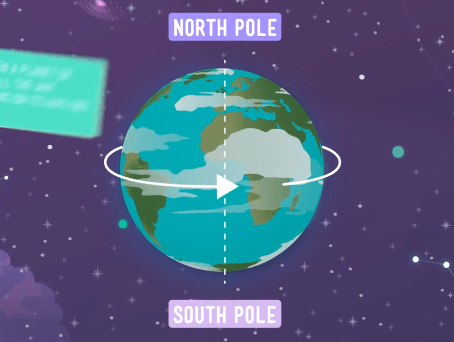
The invisible line that passes through the North Pole and the South Pole is called Earth's ____
a)
axis
b)
equator
c)
ecliptic
d)
prime meridian
20.

Which of the following correctly shows rotation?

a)
b)
c)
d)
21.

How many days are in a calendar year?

a)

362.1

b)

356 1/5

c)

635

d)

365 1/4

22.

To complete one year’s time, the Earth makes one complete _____.

a)

Revolution around the Moon.

b)

Rotation around the Moon.

c)

Revolution around the Sun.

d)

Revolution around Mars.

23.

A synonym for Earth spinning on its axis is:

a)

Revolution

b)

Indication

c)

Trapping

d)

Rotation

24.

What season is the Southern Hemisphere experiencing

during phase number 4?

a)

Winter

b)

Spring

c)

Fall

d)

Summer

25.

What season is the Southern Hemisphere experiencing during phase number 2?

a)

Fall

b)

Spring

c)

Winter

d)

Summer

26.

What season is being experienced in the Southern Hemisphere?

a)

Spring

b)

Fall

c)

Winter

d)

Summer

27.

The vernal equinox occurs during which season?

a)

Fall

b)

Spring

c)

Summer

d)

Winter

28.

Earth does a complete revolution every _________.

a)

10 years

b)

12 hours

c)

24 hours

d)

365 days

29.

The earth is tilted on its _____

a)

line

b)

axis

c)

equator

d)

core

30.

The earth rotates every _____________.

a)

24 hours

b)

15 hours

c)

365 days

d)

hour

31.

How many moons does earth have?

a)

2

b)

5

c)

9

d)

1

32.

What part of the earth gets the most direct sunlight all year?

a)

North pole

b)

Antarctica

c)

Equator

d)

Utah

33.

The earth is the only planet that ____________.

a)

supports life

b)

contains humans

c)

has water

d)

all of the above

34.

What does the tilt of the earth cause?

a)

heating

b)

seasons

c)

years

d)

atmosphere

35.

What causes day and night cycles?

a)

Mars

b)

seasons

c)

Earth's rotation

d)

moon phases

36.

What do we call Earth's path as it revolves around the sun?

a)

pathway

b)

rotation

c)

orbit

d)

revolution

37.
Differences in the moon's and sun's pull on different sides of the Earth cause _________.
a)
gravity
b)
lunar phases
c)
tides
d)
dabbing
38.
The bulge of water on the side of the Earth closest to the moon produces ___________.
a)
high tide
b)
low tide
c)
neap tide
d)
spring tide
39.
Which body has the greater effect on Earth's tides?
a)
Sun
b)
Saturn
c)
Moon 
d)
Venus
40.
What do we call a tide that has a large range?
a)
gravity
b)
wind
c)
spring
d)
neap
41.
What do we call tides that have a smaller range that happen when the sun and moon are at right angles to each other?
a)
Neap Tide
b)
Spring Tide
c)
Larger Change
d)
Smaller Change
42.
How many times per month does a spring tide occur?
a)
Once
b)
twice
c)
three times
d)
it changes every month
43.
What type of tides would this arrangement of earth-moon-sun create?
a)
neap tide
b)
spring tide
c)
new moon tide
d)
full moon tide
44.
What type of eclipse is this?
a)
Total lunar eclipse
b)
Total solar eclipse
c)
Partial lunar eclipse
d)
Partial solar eclipse
45.
This is a diagram of the moon phases Which moon phase would a lunar eclipse occur in?
a)
New Moon
b)
1st quarter
c)
Full moon
d)
3rd quarter
46.
What type of solar eclipse is this?
a)
Total
b)
partial
c)
annular
47.
What type of eclipse is this?
a)
total lunar eclipse
b)
partial lunar eclipse
c)
total solar eclipse
d)
partial solar eclipse
48.
What type of eclipse is down in the diagram?
a)
Total lunar eclipse
b)
Partial lunar eclipse
c)
total solar eclipse
d)
partial solar eclipse
49.
What type of eclipse is occuring inthe diagram?
a)
solar
b)
lunar
50.
What type of eclipse is being shown in the diagram?
a)
Total solar eclipse
b)
Total lunar eclipse
c)
partial solar eclipse
d)
partial lunar eclipse