wayground logo

Free Printable Worksheets

Font size

S
M
L
XL
Worksheets

Genetics #1

Total questions: 50

Worksheet time: 59mins

Name
Class
Date
1.

The variety of genes and alleles that exist in organisms

a)

independent assortment

b)

chromosomal abnormalities

c)

genetic diversity

d)

mutations

2.

Inherited traits are controlled by

a)

nucleus

b)

chromosomes

c)

genes

d)

cells

3.

Different genes allow for different ____________________.

a)

traits

b)

pants

c)

moods

d)

prey

4.

Genetic _________________ allow some organisms to be better adapted to the environment.

a)

variations

b)

domination

c)

repeats

d)

weakness

5.

What is a gene?

a)

Long strands of DNA that contain lots of genes.

b)

Different versions of a gene.

c)

The basic unit of heredity; controls a specific trait.

d)

A characteristic passed from parent to offspring

e)

The differences that occur from a mixture of genes

6.

What is genetic variation?

a)

Long strands of DNA that contain lots of genes.

b)

Different versions of a gene.

c)

The basic unit of heredity; controls a specific trait.

d)

A characteristic passed from parent to offspring

e)

The differences that occur from a mixture of genes

7.
Genetic differences between organisms of the same species
a)
Variation
b)
Adaptation
c)
Behavior
d)
Environment
8.

Environmental factors do affect genetic diversity

a)

True

b)

False

9.
An organism that survives longer is more likely to produce_______offspring
a)
less
b)
the same amount
c)
more
d)
no
10.
Species with ______variation are ______likely to survive.
a)
more, less
b)
less,less
c)
less,more
d)
more,more
11.

Differences in DNA between individuals or populations

a)

Environmental Variation

b)

Genetic Variation

c)

Adaptive Feature

d)

Genetic Engineering

12.

Why do scientists think the fossil record is incomplete?

a)

fossils decompose over time

b)

the formation of fossils is rare

c)

only organisms with hard parts become fossils

d)

there are no fossils before the Phonerozoic eon.

13.

Which is the source of variations in a population of organisms?

a)

changes in environment

b)

changes in genes

c)

the interaction of genes with an evnironment

d)

the interaction of individuals with an environment

14.

Which is an example of a sudden change that could lead to the extinction of species?

a)

a mountain range isolates a species

b)

Earth's tectonic plates move

c)

a volcano erupts

d)

sea level changes

15.

How does evidence from the fossil record and from living species suggest that Earth's species are related? Check all that apply.

a)

fossils

b)

comparative anatomy

c)

embryology

d)

DNA

16.
Which evidence of common ancestry is being studied in this visual?
a)

DNA

b)
fossil record
c)

anatomical similarities

17.
Scientists compare the limbs of organisms to look for evidence of common ancestry. These limbs provide evidence of common ancestry because they -
a)
perform the same function
b)
are the same size
c)
have the same basic structure
d)
are parts of the same animal
18.
Which evidence of common ancestry is being studied in this visual?
a)

Embryological Development

b)

DNA Pattern

c)

anatomical similarities

19.
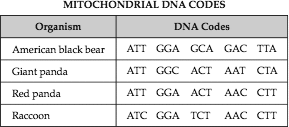
What conclusions can be made based on this table shown?
a)
the American black bear and the giant panda are most closely related
b)
the giant panda and the red panda are most closely related
c)
the red panda and the racoon are the most closely related
20.
Using Data Table 1, which organism shares a most recent common ancestor with rabbits?
a)
Fly
b)
Bat
c)
Tree
d)
Bacterium
21.
Using the Data Table 1, which organism is least related to rabbits?
a)
Fly
b)
Bat
c)
Tree
d)
Bacterium
22.

Using the tree diagram to the right, which organism(s) do not have jaws?

a)
Lancelet
b)
Leopard
c)
Turtle
d)
Tuna
23.

Which of the following describes an inherited trait?

a)

Bears have thick shaggy fur.

b)

Bears learn where the best berries grow.

c)

Baby bears figure out how to climb trees quickly.

d)

A bear is wet because he’s been catching salmon.

24.

Charlie’s nose looks just like his grandfather’s nose. This is an example of

a)

nurture.

b)

heredity.

c)

environment.

d)

learned behavior.

25.

The language you speak, how you wear your hair and what music you like to listen to are all examples of

a)

DNA

b)

heredity

c)

acquired traits

d)

inherited traits

26.

Why is a person’s height something that is both inherited and acquired?

a)

A person’s height is determined completely by DNA.

b)

Height is neither in a person’s DNA nor affected by the environment.

c)

Height is determined completely by what environment a person lives in.

d)

A person’s potential height is inherited, but they might not get enough nutrition to reach it.

27.

Scars

a)

Physical Inherited

b)

Physical Acquired

c)

Behavioral Inherited

d)

Behavioral Acquired

28.
Most adaptations that help an organism survive are passed on from parent to child as ___traits?
a)
adaptable
b)
physical
c)
more
d)
inherited
29.
Which is an example of an organism protecting themselves from another organism __?
a)
white color in the snow
b)
hibernation during winter
c)
thick fur in the winter time
30.
Differences that exist naturally among members of a population or species___?
a)
mutation
b)
adaptation
c)
variations
d)
evolution
31.
Almost all populations have some variation.
a)
true
b)
false
32.
Which layer is the oldest?
a)
1
b)
2
c)
3
d)
4
33.
Over time, adaptions can lead populations to experience 
a)
environmental changes
b)
genetic changes
c)
geological changes
d)
extinction
34.
Charles Darwin’s observation that finches of different species on the Galápagos Islands have many similar physical characteristics supports the hypothesis that these finches 
 
a)
have the ability to interbreed.
b)
acquired traits through use and disuse.
c)
all eat the same type of food.
d)
descended from a common ancestor.
35.

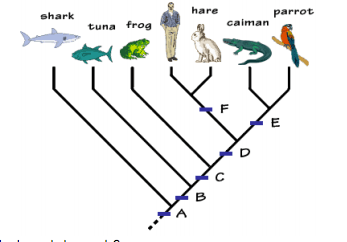
On the tree diagram, which organism is the closest relative of the parrot?

a)

Frog

b)

Hare

c)

Caiman

d)

Parrot

36.

Scientists can determine relatedness among organisms by comparing partial amino acid sequences. The table shows four partial amino acid sequences from four organisms. Which organism is the LEAST related to the other three organisms?

a)

Organism 1

b)

Organism 2

c)

Organism 3

d)

Organism 4

37.
In DNA, Adenine bonds with ______________.
a)
Guanine
b)
Thymine
c)
Cytosine
d)
Adenine
38.
Guanine bonds with ______________.
a)
Adenine
b)
Guanine
c)
Cytosine
d)
Thymine
39.
Which 2 molecules forms the sides (backbone) of the DNA ladder?
a)
deoxyribose and adenine
b)
deoxyribose and a hydrogen bond
c)
sugar and the nucleus
d)
deoxyribose (sugar) and phosphate
40.
What determines the code, or information, of a DNA molecule?
a)
the shape (structure) of the nitrogen bases
b)
the order (sequence) of the nitrogen bases
c)
the color of the nitrogen bases
d)
the frequency (number) of nitrogen bases
41.

Provided clear x-ray crystallography images of DNA

a)

Watson & Crick

b)

Franklin

c)

Wilkins

d)

Pauling

e)

Chargaff

42.
Which of the following best describes a DNA molecule?
a)
double helix
b)
contains ribose
c)
made of amino acids
d)
contains Uracil
43.
Why is DNA important?
a)
it is very small and very complicated
b)
it's in everything
c)
it serves as the blueprint for traits of all living things
d)
because we eat it every day for energy
44.
Which organelle is DNA usually found in?
a)
cell membrane
b)
vacuole
c)
ribosome
d)
nucleus
45.

Which of the following is a base pair?

a)

Adenine - Cytosine

b)

Cytosine - Thymine

c)

Deoxyribose - Cytosine

d)

Cytosine - Guanine

46.

The number of human chromosomes is

a)

23

b)

46

c)

92

d)

64

47.
How are similarities passed from parent to offspring?
a)
through teaching
b)
through learning
c)
through blood
d)
through genes
48.
Which statement about DNA is true?
a)
Different people can have the same copy of DNA in their cells.
b)
DNA is made up of genes that carry hereditary information.
c)
DNA controls the genotype but not the phenotype of an organism.
d)
DNA controls the genotype only in the second and third generations.
Question
49.
Why are your chromosomes arranged in pairs?
a)
Scientists have no idea
b)
Because you get one from your mom and one from your dad
c)
Because pairs can divide easier
d)
Because DNA is awesome
50.

From smallest to largest how would genetic information be organized?

a)

genes, cell, nucleus, chromosome, DNA

b)

chromosome, cell, gene, DNA, nucleus

c)

DNA, gene, chromosome, nucleus, cell

d)

nucleus, cell, gene, DNA, chromosome