
 Worksheets
Plate Tectonics
Total questions: 60
Worksheet time: 48mins
Name
Class
Date
1.
What causes tectonic plates to move along the Earth's surface?
a)
wind
b)
ocean currents
c)
convection in the mantle
d)
expansion of the Earth
2.
What type of boundary occurs when two plates move away from each other?
a)
transform
b)
subduction
c)
convergent
d)
divergent
3.
What forms at a divergent boundary between two oceanic plates?
a)
rift valley
b)
mountain
c)
mid-ocean ridge
d)
trench
4.
Which type of crust is more dense?
a)
oceanic
b)
continental
c)
divergent
d)
pizza
5.
What type of boundary occurs when two plates move toward each other?
a)
convergent
b)
divergent
c)
transform
d)
lateral
6.
What forms at a convergent boundary between a continental plate and an oceanic plate?
a)
volcanoes
b)
rift valleys
c)
faults
d)
mid-ocean ridges
7.
A rift valley occurs at a ____________ boundary.
a)
divergent
b)
convergent
c)
transform
d)
horizontal
8.
What is the process in which hot molten rock rises, then cools and sinks back to the core?
a)
plate tectonics
b)
continental drift
c)
convection
d)
divergence
9.
A trench forms at a _________ boundary.
a)
convergent
b)
divergent
c)
transform
d)
vertical
10.
Mountains form at a ___________ boundary.
a)
transform
b)
divergent
c)
convergent
d)
subduction
11.
What type of boundary occurs when two plates slide past each other?
a)
divergent
b)
transform
c)
lateral
d)
convergent
12.
A fault forms at a _________ boundary.
a)
transform
b)
divergent
c)
horizontal
d)
convergent
13.

What type of boundary is shown at A?
a)
transform
b)
convergent
c)
divergent
d)
subduction
14.

What is happening at point B?
a)
subduction
b)
a divergent boundary
c)
convection
d)
an earthquake
15.
What is the process in which two plates move toward each other but one sinks under the other?
a)
subduction
b)
convection
c)
divergence
d)
transformation
16.

The physical layer of Earth made of solid rock and soil is called the ___________.
a)
mesosphere
b)
lithosphere
c)
asthenosphere
d)
mantle
17.
The type of plate boundary where two plates come together is a .....
a)
Convergent Boundary
b)
Divergent Boundary
c)
Transform Boundary
d)
Plate Boundary
18.
Which of the following causes Earth's tectonic plates to move?
a)
Energy from the Sun
b)
Magnetic Pole Reversal
c)
Convection currents in the mantle
d)
Faults in Mountain Ranges
19.
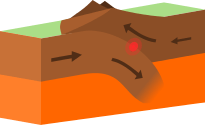
What type of plate boundary is this?
a)
Plate
b)
Divergent
c)
Convergent
d)
Transform
20.

What type of event will occur at this boundary?
a)
Earthquake
b)
Volcano Eruption
c)
Tornado
d)
Mountain Building
21.
A divergent boundary occurs when plates ....
a)
Pull apart
b)
Come together
c)
Slide past each other
d)
subducting
22.
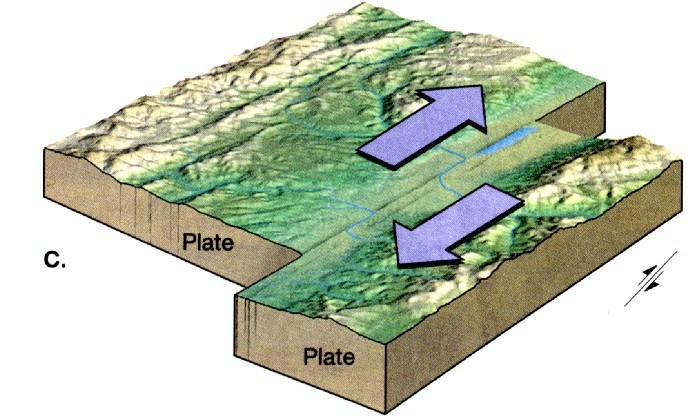
What type of plate boundary is this?
a)
Transform
b)
Convergent
c)
Divergent
d)
Plate
23.
A fault is formed by the movement of a __________ plate boundary
a)
Transform
b)
Convergent
c)
Divergent
24.
Islands can from from magma which is pushed up at a __________ plate boundary
a)
Divergent
b)
Convergent
c)
Transform
25.
How is it possible for new crust to be formed without increasing the surface area of the Earth?
a)
Crust is destroyed at the same time it is created
b)
New crust is underwater where it sinks
c)
New crust breaks more easily than old crust
26.
Mountains are created when....
a)
Two continental plates collide
b)
Two oceanic plates pull apart
c)
An Oceanic plate subducts under a Continental Plate
d)
Two continental plates pull apart
27.
The Great Rift Valley in Africa and the Mid-Ocean Ridge were all created by this boundary
a)
Divergent
b)
Convergent
c)
Reform
d)
Transform
28.
What are the two types of crust
a)
continental and oceanic
b)
ocean and upper
c)
lower and upper
d)
pizza and subway
29.
Transform boundaries are most likely to produce what phenomenon?
a)
volcanoes
b)
deep sea trenches
c)
underwater mountain ranges
d)
earthquakes
30.
When an oceanic plate and a continental plate collide, which one will subduct?
a)
oceanic
b)
continental
c)
neither
31.
The area where two tectonic plates meet.
a)
mantle
b)
focus
c)
plate boundary
d)
convection
32.
This landform can occur at a divergent plate boundary.
a)
ocean trench
b)
mid-ocean ridge
c)
tall mountains
d)
transform fault
33.
A subduction zone is formed...
a)
when one tectonic plate sinks below another
b)
at every type of convergent plate boundary
c)
at every type of divergent plate boundary
d)
at transform boundaries
34.
A ______ is a section of the lithosphere that slowly moves over the asthenosphere, carrying large slabs of continental and oceanic crust.
a)
wedge
b)
plate
c)
chunk
d)
fault
35.
A break in Earth's crust along which rocks move is called a ________.
a)
plate
b)
rift
c)
fault
d)
breach
36.
The movement of fluid, caused by differences in temperature, that transfers heat from one part of the fluid to another is _____________.
a)
Convection current
b)
Seismic waves
c)
Sea-floor spreading
d)
Conduction current
37.
The process by which molten material adds new oceanic crust to the ocean floor is called ___________.
a)
Divergent boundary
b)
Sea-floor spreading
c)
Convergent boundary
d)
Renovating
38.
What is an undersea mountain chain where new ocean floor is produced?
a)
Rift valley
b)
Deep-ocean trench
c)
Mid-ocean ridge
d)
Transform bounda
39.
A __________ is a deep valley along the ocean floor beneath which oceanic crust slowly sinks toward the mantle.
a)
deep-ocean trench
b)
rift valley
c)
sea-floor spreading
d)
mid-ocean ridge
40.
What is the process by which oceanic crust sinks beneath a deep-ocean trench and back into the mantle at a convergent plate boundary?
a)
Subduction
b)
Induction
c)
Abduction
d)
Reduction
41.
_____________ is a plate boundary where two plates move away from each other.
a)
Convergent boundary
b)
Transform boundary
c)
Divergent boundary
d)
Insurgent boundary
42.
_____________ is when two plates move toward each other.
a)
Convergent boundary
b)
Allegiant boundary
c)
Transform boundary
d)
Sliding boundary
43.
A _____________ is when two plates move past each other in opposite directions.
a)
emergent boundary
b)
divergent boundary
c)
transform boundary
d)
convergent boundary
44.
A _________ is a valley that forms where two plates move apart.
a)
Fissure
b)
Rift valley
c)
Sea-floor spreading
d)
Fault
45.
___________ is the theory that pieces of Earth's lithosphere are in constant motion, driven by convection currents in the mantle.
a)
Seismic waves
b)
Convection current
c)
Divergent boundary
d)
Plate tectonics
46.

What is the correct order (starting from the surface) of Earth’s layers?
a)
crust, outer core, inner core, mantle
b)
mantle, outer core, inner core, crust
c)
crust, mantle, outer core, inner core
d)
outer core, inner core, crust, mantle
47.
A place where two plates slip past each other, moving in opposite directions, is known as a _______
a)
transform boundary
b)
divergent boundary.
c)
convergent boundary.
d)
rift valley.
48.
Scientists think that convection currents flow in Earth’s
a)
continents.
b)
mantle.
c)
lithosphere.
d)
inner core.
49.

The place where two plates come together is known as a _______
a)
transform boundary.
b)
divergent boundary.
c)
convergent boundary.
d)
rift valley.
50.
This layer of Earth is the thickest part
a)
crust
b)
outer core
c)
mantle
d)
inner core
51.
The outermost solid layer of the Earth is called the
a)
mantle
b)
outer core
c)
inner core
d)
crust
52.
This layer of the Earth is found between the core and the crust.
a)
mantle
b)
outer core
c)
inner core
d)
crust
53.
The layer that lies beneath the mantle and surrounds the inner core.
a)
mantle
b)
outer core
c)
inner core
d)
crust
54.
Is a layer of week of soft mantle that is made of rock that flows slowly. Tectonic plates move on top of this layer.
a)
Inner Core
b)
Asthensophere
c)
Lithosphere
d)
Outer Core
55.
This is the outermost, rigid layer of the Earth, made up of two parts, is divided into pieces call tectonic plates.
a)
Inner Core
b)
Asthensophere
c)
Lithosphere
d)
Outer Core
56.
The solid, dense center of our planet that extends from the bottom of the outer core to the center of the Earth..
a)
mantle
b)
outer core
c)
inner core
d)
crust
57.
The driving force of the tectonic plates are convection currents, where can these be found?
a)
inner core
inner core
inner core
b)
crust
c)
mantle
d)
outer core
58.

What layer is the thinnest?
a)
Crust
b)
Mantle
c)
Core
d)
They are all the same size
59.

Which layer has the highest density?
a)
Crust
b)
Mantle
c)
Core
d)
All the same
60.
What are the three main layers of the Earth?
a)
Center, Middle, Outer
b)
Center, Mantle, Crush
c)
Core, Mantle, Crust
d)
Core, Middle, Crush
100 %

