wayground logo

Free Printable Worksheets

Font size

S
M
L
XL
Worksheets

Ultimate Chemistry Quizizz Challenge

Total questions: 120

Worksheet time: 1hrs 27mins

Name
Class
Date
1.
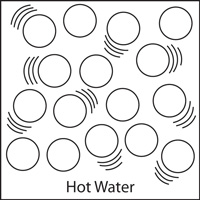
What happens to particles as they heat up?
a)
They slow down
b)
Nothing
c)
They don't move
d)
They speed up
2.
What happens to particles as they cool down?
a)
They slow down
b)
Nothing
c)
They don't move
d)
They speed up
3.
Which is more dense?
a)
Hot Liquid
b)
Cold Liquid
4.
Hot objects begin to cool as-
a)
cooler air is transferred to the hot object.
b)
thermal energy in the object is transferred to the surrounding air.
c)
atoms in the object react with the oxygen in the air.
d)
thermal energy in the object cancels out energy in the air
5.

Temperature is a measure of the average ____________________ of each particle within an object.

a)

kinetic energy

b)

state

c)

heat

d)

conduction

6.

The temperature at which a solid changes to a liquid is its ____________________.

a)

thermal energy

b)

convection point

c)

conduction point

d)

melting point

7.
Thermal energy stops moving when the objects have the same temperature.
a)
True
b)
False
8.
The Law of Conservation of Energy states:
a)
Energy can created or destroyed but not transformed 
b)
Energy cannot be created or destroyed, it can only transformed
c)
Energy can't be created, destroyed or transformed
9.
At higher temperatures
a)
particles in an object have less energy
b)
particles in an object move faster
c)
a gas contracts
10.
A gas
a)
has a definite shape but no definite volume
b)
has a definite volume but no definite shape
c)
has fast-moving particles
11.
Freezing
a)
Solid to gas
b)
Liquid to solid
c)
Gas to solid
d)
Liquid to gas
12.
Boiling
a)
liquid to gas
b)
gas to solid
c)
gas to liquid
d)
solid to liquid
13.
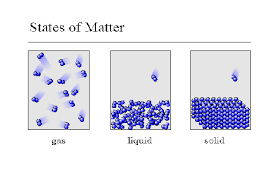
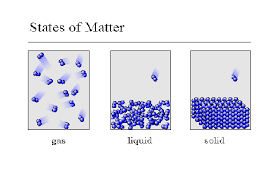
Which state of matter has tightly packed molecules?
a)
solid
b)
liquid
c)
gas
14.
What is happening when my ice cream changes from a solid to a liquid?
a)
freezing
b)
melting
c)
burning
d)
evaporation
15.
The state of matter that has no definite size or shape is
a)
Solid
b)
Liquid
c)
Gas
16.
Particles (molecules) in a ______________________ have more energy than the other states of matter.
a)
gas
b)
solid
c)
liquid
17.
Particles of a liquid
a)
are tightly packed together and stay in a fixed position.
b)
have no viscosity.
c)
decrease in volume with increasing temperature.
d)
are free to move around one another but still touch.
18.
What term describes a solid changing to a gas?
a)
Deposition
b)
Sublimation
c)
Evaporation
d)
Freezing
19.
Particles (molecules) in a ______________________ have more energy than the other states of matter.
a)
gas
b)
solid
c)
liquid
20.
What is condensation?
a)
gas to solid
b)
gas to liquid
c)
liquid to solid 
d)
solid to liquid 
21.
The speed of the molecules determines the _____.
a)
volume
b)
density
c)
pressure
d)
temperature
22.
Which has a greater distance between particles?
a)
Solid
b)
Liquid
23.
The slower the particles in a substance move,
a)
the colder it is.
b)
the warmer it is.
c)
the more energy it has.
d)
the less energy it has.
24.
Thermal energy is...
a)
heat energy.
b)
the energy of motion
c)
energy of nuclear processes.
d)
an indication of physical change.
25.
The amount of matter in an object is a measure of the object's ________________.
a)
volume
b)
density
c)
mass
d)
solubility
26.
In which state does matter completely fill its closed container?
a)
Gas
b)
Liquid
c)
Solid
d)
Ice
27.
Which state of matter has a fixed shape and volume and it's molecules move very slowly?
a)
Liquid
b)
Gas
c)
Solid
d)
Plasma
28.
The boiling point of water is ______________.
a)
0° C
b)
50° C
c)
200° C
d)
100° C
29.
When a gas turns into a liquid, it is called ___________________.
a)
Condensation
b)
Evaporation
c)
Melting
d)
Freezing
30.
Which states of matter have a definite volume?
a)
solid and gas
b)
solid and liquid
c)
gas and liquid
d)
solid, liquid, and gas
31.
Which of the following is a characteristic of liquids?
a)
molecules are tightly packed
b)
takes the shape of its container
c)
constantly keeps its shape
d)
molecules are spread far apart
32.
Molecules in a solid are
a)
close together
b)
glide past each other
c)
far apart
33.
The amount of space that a substance occupies
a)
Density
b)
Volume
c)
Mass
d)
Matter
34.

Platinum is a metal that can deform under tensile stress and therefore stretches into a wire easily. Which property of matter does this describe?

a)

malleability

b)

solubility

c)

ductility

d)

thermal conductivity

35.
Which is not an example of a physical property?
a)
melting point
b)
ability to burn
c)
hardness
d)
density
36.
An example of a physical property is 
a)
flammability
b)
acidic
c)
color
d)
ability to rust
37.
What subatomic particles would you find in the nucleus of an atom?
a)
Protons only
b)
Protons and Neutrons
c)
Neutrons and Electrons
d)
Protons and Electrons 
38.
Which subatomic particles contribute the most to the mass of an atom?
a)
Protons, Neutrons, Electrons
b)
Protons only
c)
Protons and Electrons
d)
Protons and Neutrons
39.
What is the number of protons that the element in this image contain?
a)
14
b)
7
c)
15
d)
18
40.
Protons and Electrons balance the charge of an atom.
a)
True
b)
False
41.
If an atom has 12 positively charged subatomic particles, which of the following must it also have to be considered a neutral atom?
a)
12 neutrons
b)
12 electrons
c)
12 protons
d)
24 protons and neutrons
42.
An element with a mass number of 11 and an atomic number of 5 has how many neutrons?
a)
11
b)
5
c)
6
d)
16
43.
The particles of the atom you can find by knowing the atomic number.
a)
neutrons
b)
protons and electrons
c)
protons and neutrons
d)
atomic mass
44.
Which letter represents a proton?
a)
A
b)
B
c)
C
d)
D
45.
Which letter represents a neutron?
a)
A
b)
B
c)
C
d)
D
46.
Which letter represents an electron?
a)
A
b)
B
c)
C
d)
D
47.
Which letter represents the nucleus?
a)
A
b)
B
c)
D
d)
E
48.
Which subatomic particle has a positive (+) charge?
a)
Neutron
b)
Proton
c)
Electron
49.
Which subatomic particle has a negative (-) charge?
a)
Proton
b)
Electron
c)
Neutron
50.
Which subatomic particle has a neutral or no charge?
a)
Proton
b)
Electron
c)
Neutron
51.
Where is the nucleus located in an atom?
a)
Near the electron shells/levels
b)
Near the center of an atom
52.
Where are the Electrons found in the structure of an atom?
a)
In the nucleus
b)
In spaces around the nucleus
53.
This particle determines what element you have - the elements identity.
a)
electron
b)
proton
c)
neutron
d)
valence shell
54.

What is the mass of a proton and the mass of a neutron?

a)

1 amu each

b)

2 grams each

c)

13 amu each

d)

10 grams each

55.
Describe an Electron Cloud?
a)
the mist outside of an atom
b)
home of the protons
c)
where electrons are located
d)
nucleus
56.
An atom has 10 protons, 15 neutrons and 10 electrons what is its mass number.
a)
20
b)
10
c)
5
d)
25
57.
Matter that cannot be broken down into a simpler substance – building blocks of life.
a)
neutron
b)
atom
c)
electron
d)
quarks
58.
Elements on the periodic table increase by...
a)
atomic mass
b)
size
c)
mass number
d)
atomic #
59.
What is the mass number of an element that has 8 protons and 8 neutrons?
a)
8
b)
0
c)
16
d)
64
60.
In an electrically neutral atom, the number of electrons is equal to the...
a)
atomic number
b)
mass number
c)
average atomic mass
d)
most common isotope
61.
In an electrically neutral atom, the number of electrons is equal to the...
a)
atomic number
b)
mass number
c)
average atomic mass
d)
most common isotope
62.

What is the atomic # of an element that has 4 protons, 4 electrons, and 5 neutrons?

a)

4

b)

5

c)

6

d)

9

63.
What is the atomic number of Boron?
a)
5
b)
11
c)
6
64.
What is the atomic mass of Boron?
a)
5
b)
11
c)
6
65.
How many protons does Boron have?
a)
5
b)
11
c)
6
66.
How many electrons does Boron have?
a)
5
b)
11
c)
6
67.
How many neutrons does Boron have?
a)
5
b)
11
c)
6
68.
Covalent bond forms between....
a)
Nonmetals
b)
Metals
c)
Nonmetal and a Metal
d)
Metal and a Nonmetal
69.

Ionic Bonding involves...

a)

The transfer of protons

b)

The transfer of neutrons

c)

The transfer of electrons

d)

None Of the above

70.
Covalent compounds
a)
Share electrons
b)
transfer electrons
c)
contain a sea of electrons
d)
conduct electricity
71.
Why do bonds form?
a)
To fill the valence shell of electrons for the elements involved
b)
to release energy stored in the bonds
c)
because whenever you mix two chemicals, there will be a reaction
d)
because of attraction
72.
What type of bond is illustrated above?
a)
Metallic
b)
Ionic
c)
Covalent
d)
Wiggly
73.

Bonds formed by transferring electrons from one atom to another are

a)

ionic

b)

metallic

c)

non polar covalent

d)

covalent

74.

Bonds formed by sharing electrons between atoms are

a)

ionic

b)

metallic

c)

covalent

d)

dipole-dipole

75.

A compound forms between a metal and a nonmetal. It is

a)

ionic

b)

metallic

c)

covalent

76.

What type of bond is shown in the image?

a)

Hydrogen

b)

Ionic

c)

Covalent

77.
What do the numbers down the side tell us about the atoms in each row?
a)
number of protons
b)
number of electrons
c)
number of energy levels
d)
absolutely nothing
78.
Name group 18 on the periodic table.
a)
alkali metals
b)
alkaline earth metals
c)
transition metals
d)
noble gases
79.
Where are the nonmetals located on the periodic table?
a)
top left corner
b)
bottom left corner
c)
top right corner
d)
bottom left corner
80.
________ are the COLUMNS on the periodic table and are organized by similar properties.
a)
Classifications
b)
Groups
c)
Periods
d)
Elements
81.

What are valence electrons?

a)

electrons on the first shell

b)

nucleus

c)

the outermost shell

d)

the electrons on the outermost shell (energy level)

82.
How many electron shells/levels does this atom have?
a)
1
b)
2
c)
3
d)
4
83.
a)
Metals
b)
Nonmetals
c)
Metalloids
84.
a)
Same group
b)
Same period
85.
a)
Metals
b)
Nonmetals
c)
Metalloids
86.
a)
Metals
b)
Nonmetals
c)
Metalloids
87.
a)
Metals
b)
Nonmetals
c)
Metalloids
88.
This class of elements are sometimes called "semiconductors."
a)
Metals
b)
Nonmetals
c)
Metalloids
d)
Groups
89.
Which of the following is not a property of metals?
a)
brittle
b)
malleable
c)
lustrous
d)
conductive
90.
a)
2
b)
3
c)
5
91.
a)
2
b)
6
c)
10
d)
16
92.
a)
2
b)
5
c)
10
d)
15
93.
a)
1
b)
2
c)
3
d)
4
94.
What determines the reactivity of an element?
a)
Size of its nucleus
b)
Number of total electrons
c)
Number of valence electrons
d)
Number of shells
95.
Metals appear to the _______ of the dark ziz-zag line on the periodic table. 
a)
A. right
b)
B. middle
c)
C. left
96.
Which of these is a property of metals?
a)
It's malleable
b)
It can't conduct electricity
c)
They are used in food
d)
It's very brittle
97.
Nonmetals occur to the ________of the dark zig-zag on the periodic table. 
a)
A. right
b)
B. middle
c)
C. left
98.
How would this element be classified?
a)
Metal
b)
Nonmetal
c)
Metalloid
d)
Metamorphic
99.
A student is given a sample of an unknown substance. He is asked to determine if it is classified as a metal, a metalloid, or a nonmetal. He discovered that the unknown element conducted some heat and electricity, had a shiny luster, and broke easily. This element is most likely a 
a)
metal
b)
nonmetal
c)
metalloid
d)
cannot be determined
100.
In a ___________change, a substance changes into a different substance.
a)
Physical
b)
Chemical
101.

Which of these is NOT a sign that a chemical change has occurred?

a)

A loss of transparency

b)

An unexpected color change

c)

An unexpected temperature change

d)

The formation of a precipitate

102.
In a chemical reaction, bonds are broken and new bonds are formed that create new substances. The bonds that are broken are called what?
a)
Reactants
b)
Products
c)
Atoms
d)
Catalysts
103.
The Law of Conservation of Mass states
a)
that matter exists in all states and reacts the same
b)
that matter can only be changed into new substances by introducing a catalyst
c)
that matter exists in the same state throughout any chemical change
d)
that matter cannot be created or destroyed and that the mass of the products must equal the mass of the reactants
104.
How many Al atoms are in this compound?         4Al2O3
a)
2
b)
8
c)
6
d)
4
105.
How many F atoms are in this compound?
6MgF2 
a)
2
b)
6
c)
8
d)
12
106.
a copper penny turning greenish after a few years.
a)
Chemical Change
b)
Physical Change
107.
Which of the following IS a physical change?
a)
Getting a haircut
b)
Rusty metal
c)
sour milk
d)
A compound
108.
When a scientist mixed two chemicals, an exothermic reaction takes place. Which of the following would be proof that the reaction was exothermic?
a)
a change of color
b)
a change of state
c)
a temperature decrease
d)
a temperature increase
109.
What types of reactions absorb and release heat?
a)
acidic and basic
b)
endothermic and exothermic
c)
endothermic and heat transfusion
d)
covalent and ionic
110.
A scientist combines chemicals and produces an exothermic reaction. What byproduct of this reaction would show that it is exothermic?
a)
heat
b)
coolness
c)
a precipitate
d)
gas bubbles
111.
Which of the following is a chemical change?
a)
water freezes to form ice
b)
sugar dissolves in water
c)
gasoline burns in a car engine
d)
a piece of metal expands when it is heated
112.
In the reaction methane + oxygen turns into carbon dioxide + water, the methane and oxygen are called _______________.
a)
reactants
b)
products
c)
neutrals
d)
energizers
113.
A change in the shape of an object is an example of _________________.
a)
a chemical change
b)
energy
c)
an endothermic change
d)
a physical change
114.
What type of change occurs when a new substance is formed that has different properties from the original substances?
a)
chemical change
b)
nuclear change
c)
physical change
d)
mutation
115.
Which of the following represents a chemical change?
a)
cutting a piece of paper with scissors
b)
cooling a mixture of air and kerosene vapor to obtain liquid kerosene
c)
burning a piece of notebook paper in the presence of oxygen
d)
heating water over a flame to its boiling point
116.
Which of the following is an example of a physical change?
a)
souring milk
b)
mixing baking soda and vinegar
c)
rusting metal
d)
mixing oil and vinegar
117.
Which of the following is an example of a physical change?
a)
souring milk
b)
mixing baking soda and vinegar
c)
rusting metal
d)
mixing oil and vinegar
118.
Which of the following is a chemical change?
a)
the rusting of iron
b)
dissolving salt in water
c)
melting an ice cube
d)
bending a copper wire
119.
What do we call a substance consisting of a single atom?
a)
coefficient
b)
element
c)
compound
d)
molecule
120.
What do we call a chemical substance made up of 2 or more different types atoms bonded together?
a)
formula
b)
atom
c)
subscript
d)
compound