wayground logo

Free Printable Worksheets

Font size

S
M
L
XL
Worksheets

Bio Sem 2 Review

Total questions: 120

Worksheet time: 2hrs 55mins

Name
Class
Date
1.
Which of the following is a phenotype?
a)
Aa
b)
red hair
c)
heterozygous
d)
DNA
2.
Dominant alleles are represented by a:
a)
Male gene
b)
lowercase letter
c)
recessive trait
d)
capital letter
3.
The genotypic ratio here is
a)
25% blue eye 75 % brown eye 
b)
BB = 25% Bb = 50% bb = 25%
c)
BB= 50 % bb = 50%
d)
All brown eye
4.
How many boxes would say BB?
a)
1
b)
2
c)
4
d)
0
5.
The dominant trait is
a)
yellow pea seeds
b)
green pea seeds
c)
there is no dominant seed
d)
Jolly green giant
6.
A Punnet Square will 
a)
tell you exactly what your offspring will look like
b)
increase the chance you pass on recessive traits
c)
predict genotypes and phenotypes in offspring
d)
have no purpose but for Taylor to give us extra assignments
7.
bb is a _________________ genotype
a)
Dominant
b)
Homozygous
c)
Genotype
d)
Phenotype
8.
Which of the following is heterozygous
a)
FF
b)
tt
c)
Gg
d)
RR
9.
What does the prefix homo- in homozygous mean?
a)
same
b)
different
c)
dating
d)
humans
10.
The cells produced via meiosis are called:
a)
sex cells
b)
somatic cells
c)
body cells
d)
skin cells
11.
Unlike mitosis, meiosis in male mammals results in the formation of
a)
one haploid gamete
b)
three diploid gametes
c)
four diploid gametes
d)
four haploid gametes
12.
If the Diploid number of Carrots is 18, the haploid number is
a)
18
b)
9
c)
27
d)
36
13.
If a body cell in a butterfly contains 24 chromosomes, a butterfly egg would contain
a)
3
b)
6
c)
12
d)
24
14.
How many daughter cells are produced from meiosis ?
a)
10
b)
6
c)
4
d)
2
15.
Name the growth phase of the cell cycle for both Mitosis and Meiosis.
a)
metaphase
b)
telophase
c)
interphase
d)
anaophase
16.
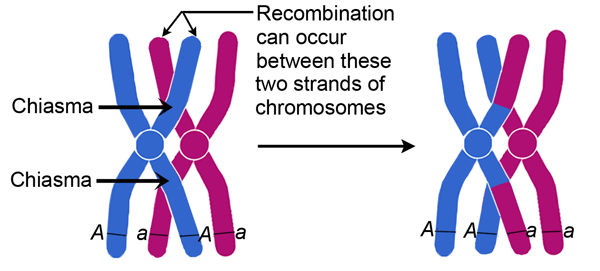
This image shows chromosomes during Prophase 1. Which of the following correctly describes the process shown?
a)
segregation of sister chromatids
b)
condensation and segregation of alleles
c)
mutationin which the DNA content of the gene is altered
d)
crossing - over in which alleles are exchanged
17.
Why do we need meiosis?
a)
To double the number of chromosomes going into sex cells
b)
To halve the number of chromosomes going into sex cells
c)
To triple the number of chromosomes going into sex cells
d)
To not change the number of chromosomes going into sex cells
18.
products of meiosis are genetically
a)
different
b)
identical
19.
This picture shows which process? 
a)
mitosis
b)
meiosis
c)
the cell cycle
20.
Human eggs and sperm are _____, and each has ____ chromosomes.
a)
diploid, 23
b)
diploid, 46
c)
haploid, 23
d)
haploid, 46
21.

a cell that has two complete sets of chromosomes and is designated as 2n

a)

Chromosome

b)

Diploid Cell

c)

Fertilization

d)

Gametes

e)

Haploid Cell

22.

different versions of the same gene

a)

Dominate Allele

b)

Genotype

c)

Phenotype

d)

Recessive Allele

e)

Allele

23.

the inheritance of one trait does not influence the inheritance of other traits

a)

Dyhybrid Cross

b)

Law of Segregation

c)

Law of Independent Assortment

d)

Purebred

e)

Test Cross

24.

two alleles of a gene must separate during meiosis when gametes form

a)

Dyhybrid Cross

b)

Law of Segregation

c)

Law of Independent Assortment

d)

Purebred

e)

Test Cross

25.

A plant that has purple flowers is crossed with one that has white flowers. The offspring were half white and half purple. What were the genotypes of the parents?

a)

Pp x pp

b)

Pp x Pp

c)

PP x pp

d)

PP x WW

26.
Purple is dominant to white. A heterozygous purple flower is crossed with a white flower. What are the genotypes and phenotypes of the offspring?
a)
100% Pp (purple)
b)
50% Pp (purple); 50% pp (white)
c)
75% Pp (purple); 25% pp (white)
d)
25% PP, 50% Pp, 25% pp
75% purple, 25% white
27.
A cross of a red cow with a white bull produces all road offspring. This type of inheritance is known as
a)
codominance
b)
incomplete dominance
c)
multiple alleles
d)
"breed time:
28.
How many chromosomes do humans have?
a)
46
b)
21
c)
10
29.
Fruit fly body cells have 8 chromosomes. After mitosis, you would expect a resulting fruit fly daughter cell to have -
a)
16 chromosomes.
b)
46 chromosomes.
c)
8 chromosomes.
d)
4 chromosomes.
30.
What is the first phase of Mitosis?
a)
Prophase
b)
Metaphase
c)
Anaphase
d)
Telophase
31.
Which sequence of DNA bases would pair with this partial strand
ATG TGA CAG
a)
ATG TGA CAG
b)
TAC ACT GTC
c)
GTA AGT GAC
d)
CAT TCA CTG
32.
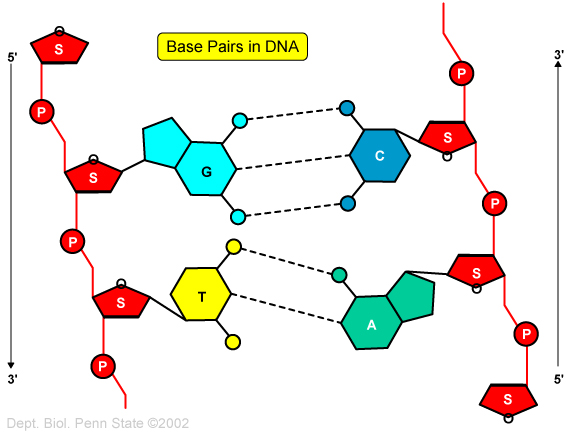
Which of the following best describes a DNA molecule?
a)
double helix
b)
contains ribose
c)
made of amino acids
d)
contains Uracil
33.
Which of the following units are repeatedly joined together to form a strand of DNA?
a)
amino acids
b)
nucleotides
c)
fatty acids
d)
polysaccharides
34.
In a molecule of double-stranded DNA, the amount of Adenine present is always equal to the amount of
a)
cytosine
b)
guanine
c)
thymine
d)
uracil
35.
Adenine bonds with ______________.
a)
Guanine
b)
Thymine
c)
Cytosine
d)
Adenine
36.
Guanine bonds with ______________.
a)
Adenine
b)
Guanine
c)
Cytosine
d)
Thymine
37.
Why is DNA important?
a)
it is very small and very complicated
b)
it's in everything
c)
it serves as the blueprint for traits of all living things
d)
because we eat it every day for energy
38.
Which 2 molecules form the sides (backbone) of the DNA ladder?
a)
deoxyribose sugar and adenine
b)
deoxyribose sugar and a hydrogen bond
c)
deoxyribose sugar and the nucleus
d)
deoxyribose sugar and phosphate
39.
Nitrogenous bases are joined by which type of bond?
a)
polar bonds
b)
ionic bonds
c)
covalent bonds
d)
hydrogen bonds
40.
Replicate the following strand of DNA: 
AATCATGGA
a)
AATCATGGA
b)
TTAGTACCT
c)
UUAGUACCU
d)
GGATAUCUA
41.
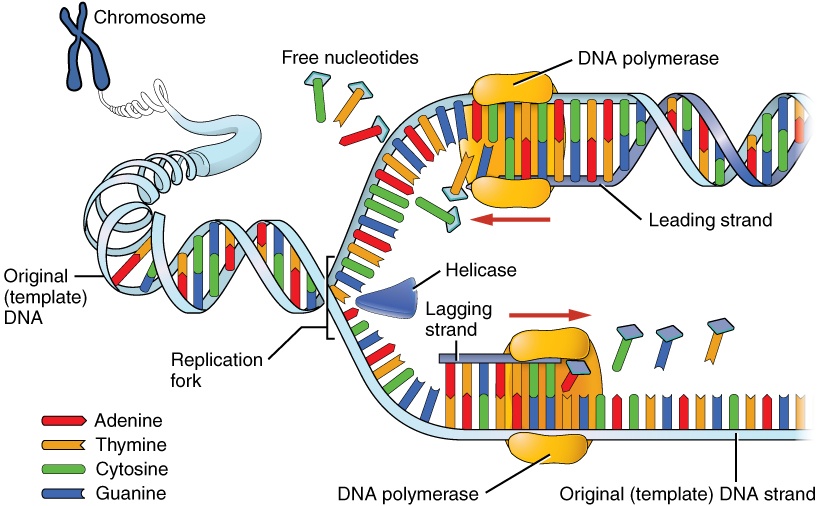
The enzyme that unzips the DNA to prepare for replication
a)
helicase
b)
replicase
c)
polymerase
d)
synthase
42.
DNA replication results in two DNA molecules,
a)
each one with two original strands
b)
each one with two new strands
c)
each one with one new strand and one original strand
d)
one with two new strands and the other with two original strands
43.
order of replication
a)
3, 2, 1, 4
b)
2, 1, 4, 3
c)
2, 3, 1, 4
d)
3, 4, 1, 2
44.
A process in which DNA has the unique ability to make an exact copy of itself.
a)
Replication
b)
Translation
c)
Transcription
45.
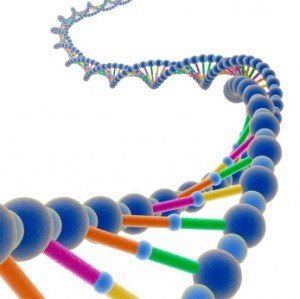
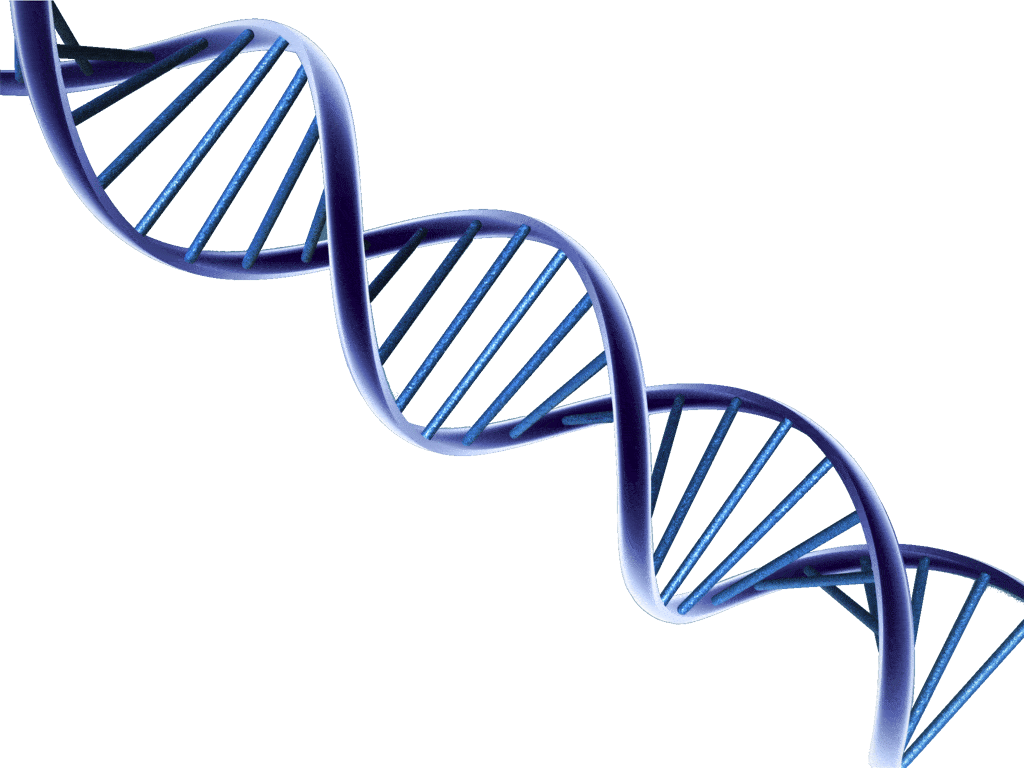
The drawing shows the structure of what molecule?
a)
A DNA molecule
b)
A lipid molecule
c)
A carbohydrate molecule
d)
A protein molecule
46.
In what phase of the cell cycle does DNA replication take place?
a)
G1
b)
S
c)
G2
d)
M
47.
What are the three components of a nucleotide?
a)
sugar, hydrogen, nitrogen base
b)
sugar, oxygen, nitrogen base
c)
sugar, phosphate, nitrogen base
d)
sugar, phosphate, protein
48.
Which enzyme is responsible for adding nucleotides?
a)
Topoisomerase
b)
DNA Polymerase
c)
Ligase
d)
Primase
49.
The term used to describe DNA Replication is:
a)
Semi-Conservative
b)
Conservative
c)
AntiParallel
d)
Dispersive
50.
What is the complement to the DNA strand below:
5'-ATGCCAT-3'
a)
5'-TACGGTA-3'
b)
3'-TACGGTA-5'
c)
3'-ATGGCAT-5'
d)
5'-ATGGCAT-3'
51.
If a DNA molecule is 18% Guanine which of the following is correct
a)
18% cytosine, 32% adenine, 32% thymine
b)
32% cytosine, 18% adenine, 32% thymine
c)
18% cytosine, 64% adenine, 64% thymine
d)
32% cytosine, 32% adenine, 18% thymine
52.

From his work with mice and pneumonia-causing bacteria, Frederick Griffin found that DNA could be transferred from one organism to another. This is called

a)

Replication

b)

Transcription

c)

Transformation

d)

Translation

53.
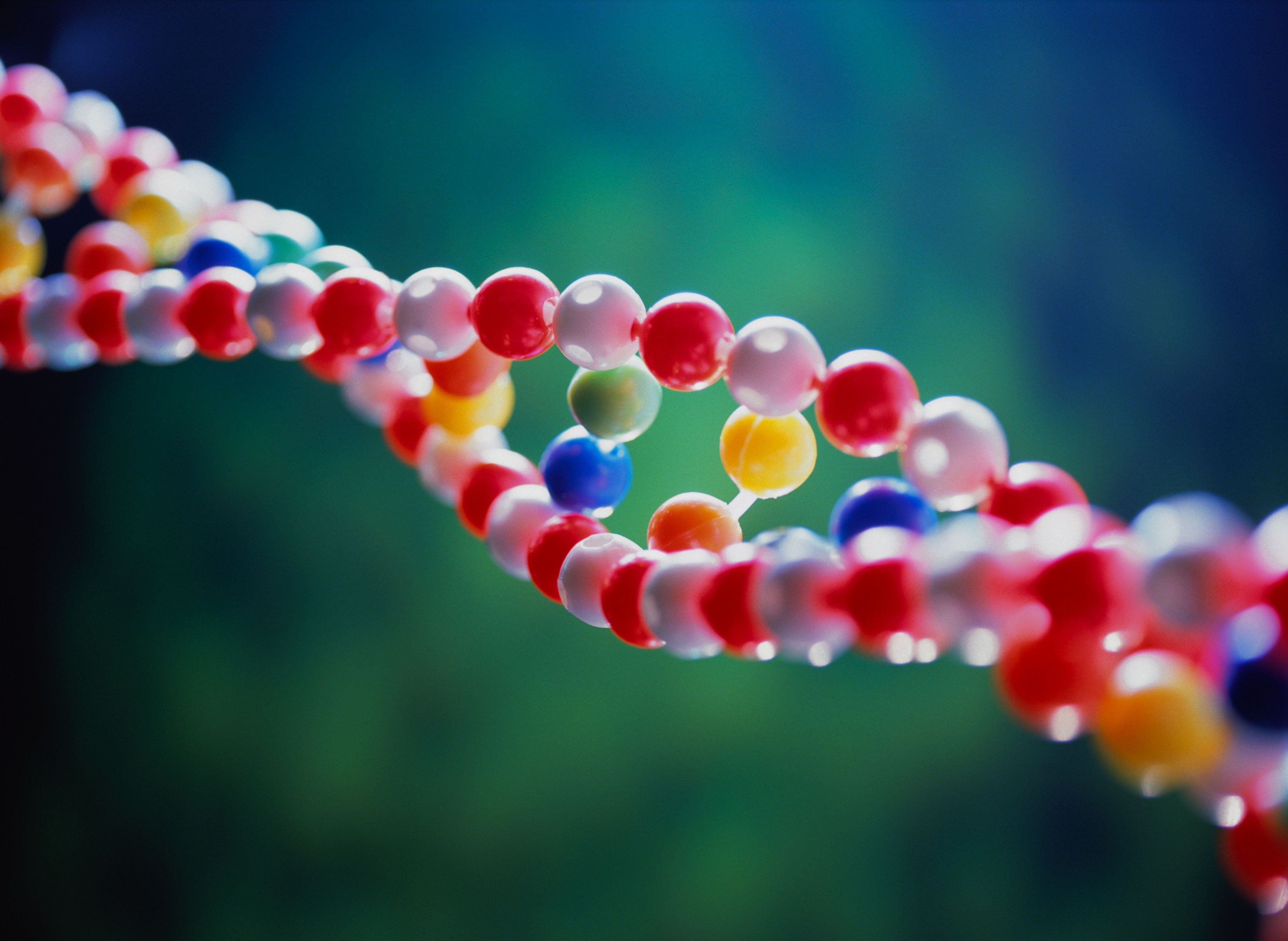
Who was responsible for the model shown?
a)
Oswald Avery, et. al.
b)
Watson and Crick
c)
Erwin Chargaff
d)
Linus Pauling
54.

Which enzyme makes the primer so that replication can begin?

a)

Helicase

b)

DNA polymerase

c)

Primase

d)

Ligase

55.

Where are Okazaki Fragments found?

a)

Attached to the ribosomes

b)

As part of a primer

c)

O the leading strand of DNA

d)

On the lagging strand of DNA

56.
The process to go from DNA to mRNA is _______
a)
translation
b)
transcription
c)
replication
57.
The process to go from mRNA to a protein is called ____
a)
transcription
b)
rRNA
c)
replication
d)
translation
58.
DNA holds the code for
a)
lipids
b)
carbohydrates
c)
protein
d)
sugar
59.
The main function of tRNA is to...
a)
carry a message that, when translated, forms proteins
b)
form a portion of ribosomes
c)
string together complementary RNA and DNA strands
d)
bring amino acids from the cytoplasm to the ribosomes
60.
What is the location in the cell for translation?
a)
nucleus
b)
mitochondria
c)
ribosome
d)
chloroplast
61.
What is the three base sequence of mRNA that codes for a single amino acid?
a)
Anticodon
b)
Codon
c)
Protein
62.
What is the location in the cell for transcription?
a)
nucleus
b)
cytoplasm
c)
ribosome
d)
mitochondria
63.
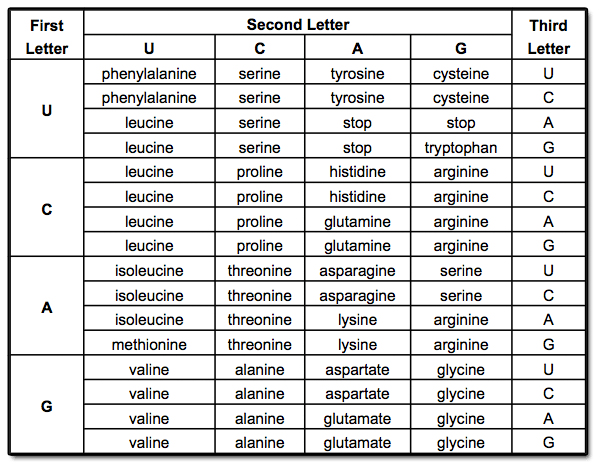
What amino acid is represented by the codon UUA?
a)
Phenylalanine
b)
Tyrosine
c)
Leucine
d)
Stop codon
64.
How many amino acids are coded for by this sequence of nucleotides:
ATG GGA ACT CCA
a)
4
b)
2
c)
6
d)
12
65.
Nucleotides are made up of a sugar, phosphate, and..?
a)
nitrogenous base
b)
nucleic acid
c)
cholesterol
d)
fatty acid
66.
What is cell differentiation?
a)
How cells become different
b)
How cells stay the same
67.
What molecule absorbs sunlight for photosynthesis?
a)
chloroplast
b)
thylakoid
c)
grana
d)
chlorophyll
68.
Use the diagram to answer the question. Between which parts of the molecule must the bonds be broken to form an ADP molecule?
a)
A and B
b)
A and C
c)
B and C
d)
C and D
69.
Plants need carbon dioxide from their environment to produce glucose during which stage of photosynthesis? 
a)
The light-dependent stage
b)
The light-independent stage (The Calvin Cycle)
c)
The electron transport chain
d)
ATP formation
70.
Most plants appear green because chlorophyll
a)
absorbs green light.
b)
absorbs violet light.
c)
does not absorb green light.
d)
does not absorb violet light.
71.
Where do the light-dependent reactions occur? 
a)
thylakoid membrane
b)
stroma
c)
mesophyll
d)
mitochondria
72.
Where does the Calvin Cycle occur?
a)
thylakoid
b)
stroma
c)
lumen
d)
mitochondria
73.
True or False.   The calvin cycle can happen at night.
a)
true
b)
false
74.
TRUE or FALSE.  The calvin cycle can happen during the day.
a)
True
b)
false
75.
What is the name of the simple sugar that is produced in photosynthesis?
a)
Sucrose
b)
Dextrose
c)
Glucose
d)
Lactose
76.
Which term is the part of photosynthesis when light energy is captured and transferred to a molecule, such as ATP?
a)
light- independent reactions
b)
cellular respiration
c)
light- dependent reactions
d)
 photosynthesis
77.
What supplies the electron that is lost in PS II?
a)
oxygen
b)
water
c)
glucose
d)
rubisco
78.
Chlorophyll is green because
a)
it absorbs green wavelengths of light
b)
it absorbs blue and yellow wavelengths of light
c)
it reflects green wavelengths of light
d)
it is an optical illusion caused by the transmission of light
79.
This molecule helps add a phosphate do a depleted energy molecule.
a)
PS 2
b)
PS 1
c)
Electron Transport Chain
d)
ATP Synthase
80.
After the electron leave PS II, where does it go next?
a)
Electron Transport Chain
b)
NADPH Reductase
c)
PS I
d)
Stroma
81.
What is the first stop in photosynthesis process?
a)
Photosystem I
b)
Photosystem II
c)
Electron Transport Chain
d)
stroma
82.
What are the products of photosynthesis?
a)
water and carbon dioxide
b)
oxygen and glucose
c)
oxygen and carbon dioxide
d)
oxygen and water
83.
All living things do which of the following?
a)
Chemosynthesis
b)
Respiration
c)
photosynthesis
d)
all of the answers
84.
What is one of the reactants of cellular respiration?
a)
energy
b)
glucose
c)
carbon dioxide
d)
water
85.
______________ produces the most ATP.
a)
photosnthesis
b)
aerobic respiration
c)
anaerobic respiration
d)
glycolysis
86.
What are the products of aerobic respiration?
a)
Glucose and oxygen
b)
Carbon dioxide and water
c)
Lactic acid
d)
Carbon monoxide
87.
Aerobic respiration is different from anaerobic respiration in that aerobic respiration needs...
a)
chlorophyll
b)
carbon dioxide
c)
glucose
d)
oxygen
88.

How many ATP are produced in aerobic respiration?

a)

2

b)

28

c)

4

d)

36

89.
What is the correct equation for cellular respiration?
a)
6O2 + C6H12O6 -> 6CO2 + 6H2O + Energy
b)
6O2 + C6H12O6 + Energy -> 6CO2 + 6H2O
c)
6CO2 + 6H2O -> 6O2 + C6H12O6 + Energy
d)
6CO2 + 6H2O + Energy -> 6O2 + C6H12O6
90.
Which molecule isn't an energy carrier?
a)
FADH2
b)
NADH
c)
oxygen
d)
ATP
91.
Glycolysis results in a net gain of how many ATP?
a)
0
b)
2
c)
4
d)
1
92.
 The expression "feel the burn" means that a person exercising is doing 
a)
lactic acid fermentation
b)
alcoholic fermentation
c)
photosynthesis
d)
aerobic respiration
93.

What is glucose converted to during glycolysis?

a)

Acetyl-Co A

b)

Coenzyme A

c)

Pyruvate

d)

Sucrose

94.

What comes next after glycolysis if oxygen is present

a)

Krebs cycle

b)

Electron transport chain

c)

Alcoholic Fermentation

d)

Lactic Acid Fermentation

95.
What is the name of the 1st step of cellular respiration?
a)
Glycolysis
b)
Kreb's Cycle
c)
ETC
d)
Anaerobic respiration
96.
Where does glycolysis take place?
a)
Cytoplasm
b)
Stroma
c)
Thylakoid
d)
Mitochondria
97.
Along with 2ATP, what is produced during glycolysis?
a)
6CO2
b)
6O2
c)
C6H12O6
d)
2 pyruvate
98.
What is the first stage of aerobic respiration called?
a)
Citric acid cycle
b)
Calvin cycle
c)
Glycolysis
d)
ETC
99.
What is the second stage of aerobic respiration?
a)
Calvin cycle
b)
Kreb's cycle
c)
Glycolysis
d)
ETC
100.
Which is a product of Kreb's Cycle?
a)
Carbon dioxide
b)
Glucose
c)
Pyruvate
d)
Water
101.
Which is a product of the ETC?
a)
Carbon dioxide
b)
Glucose
c)
Oxygen
d)
Water
102.
What is the name of the process that helps make beer and wine?
a)
Fermentation
b)
Alcoholic fermentation
c)
Lactic acid fermentation
d)
Glycolysis
103.

In alcoholic fermentation, ___ is produced from ___

a)

ethyl alcohol, pyruvic acid

b)

ethyl alcohol, lactic acid

c)

lactic acid, pyruvic acid

d)

pyruvic acid, lactic acid

104.
The study of the early stages of development that is one evidence of evolution is:
a)
Homologous Structures
b)
Embryology
c)
Vestigial Organs
105.
Some organisms have genes that improve their ability to survive and reproduce. If the gene also help their offspring survive and reproduce, then which of the following will most likely increase?
a)
The number of genes in a species
b)
The frequency of genes in a population
c)
The frequency of genes in one individual 
106.
The opossum and kangaroo both incubate their young in a pouch. This provides evidence that they---
a)
are descended from a common ancestor
b)
Have very similar skeletal structures
c)
belong to the same species
d)
must range great distances to eat
107.
The white feathers of a snowy owl allow it to blend in with its environment during the winter months (snow). This is an example of ________________
a)
Species
b)
Environmental Change
c)
Adaptation
d)
Variation
108.
The concept of gene flow is demonstrated when a cow is driven off from its herd, joins another herd, and reproduces. When the cow contributes to the gene pool of the new herd, which of these will most likely increase?
a)
Environmental fitness
b)
Reproductive mutations
c)
Natural selection
d)
Genetic variation
109.
Genetic drift is a process that causes---
a)
The genetic makeup of an entire population to disappear
b)
The genetic makeup of an entire population to be altered
c)
Organisms to better adapt to their environment
d)
Organisms to have the same DNA as their parents
110.
The DNA of an advanced species of grasshoppers contains---
a)
New types of bases, all formed from mutations in a primitive species of algae
b)
Different bases than the DNA of a primitive species of algae
c)
The same bases as the DNA of a primitive species of algae
111.
The similarities of the bones in the diagram provide evidence that---
a)
The organisms shown lived in the same natural envionrment
b)
The organisms shown may have developed from a common ancestor
c)
The organisms shown have the same genetic diseases
d)
All vertebrate species have identical forelimbs
112.
All genes present in a population is called:
a)
Genetic Drift
b)
Gene Flow
c)
Gene Pool
113.
Darwin referred to this as survival of the fittest. Over time, it results in changes in the inherited characteristics of a population. 
a)
Natural Selection
b)
Genetic Variation
c)
Survival of the Fittest
114.

Evolution is best defined as:

a)

the process which organisms die.

b)

the process which organisms change over time.

c)

the process which organisms that are extinct become revived.

d)

the process which non-living things fossilize.

115.

What type of evidence is represented in the picture above:

a)

Fossils

b)

Vestigial Structures

c)

DNA

d)

Homologous Structures

116.

What type of evidence is shown in this picture?

a)

Fossils

b)

Homologous Structures

c)

Vestigial Structures

d)

DNA

117.

Adaptations are:

a)

physical or behavioral tendencies.

b)

physical or behavioral characteristics that help an organisms survive and reproduce.

c)

physical or behavioral characteristics that do not help the organism in any way.

d)

genetic mutations that have gone wrong.

118.
What process is being shown in this image?
a)
Variation
b)
Natural Selection
c)
Selective Breeding
d)
Homeostasis
119.

Which scientist is known for his work that he did on the Galapagos Islands to develop his theory of natural selection?

a)

Gregor Mendel

b)

Charles Darwin

c)

Anton Van Leewenhoek

d)

Robert Brown

120.

A species is defined as:

a)

a group of organisms that are extremely different.

b)

a group of organisms that have similar characteristics and always live in the same place.

c)

a group of organisms with similar characteristics and can reproduce to make fertile offspring.

d)

any two organisms to make a hybrid.