wayground logo

Free Printable Worksheets

Font size

S
M
L
XL
Worksheets

AP Biology Final Exam

Total questions: 90

Worksheet time: 2hrs 49mins

Name
Class
Date
1.
Your teacher has asked you to explain the difference between quantitative and qualitative observations. Which statement is correct?
a)
Quantitative observations use numbers, qualitative uses the senses.
b)
Quantitative observations use the senses, qualitative uses numbers.
c)
Quantitative observations use measurement, qualitative uses numbers.
d)
Quantitative observations use colors, qualitative uses the senses.
2.
Biology is the study of
a)
Life
b)
Oceans
c)
Land
d)
Soil
3.
This variable in an experiment is the one being deliberately changed by the scientist. 
a)
dependent variable
b)
independent variable
c)
data
d)
control group
4.
A possible explanation to a problem that has not yet been tested. 
a)
data
b)
theory
c)
hypothesis
d)
fact
5.
This part of the experiment serves as a basis of comparison; the one variable being tested has been omitted. 
a)
experimental group
b)
control group
c)
data
d)
variables
6.
The basic unit of life is 
a)
the cell
b)
an atom
c)
DNA
d)
a species
7.
Which of the following is the strongest bond?
a)
covalent
b)
ionic
c)
van der Waals
d)
hydrogen
8.

All of the following are true about water EXCEPT

a)

Water has temperature stabilizing effects.

b)

Water is composed of two hydrogen atoms held to an oxygen atom by covalent bonds.

c)

Water is polar, due to the strong electronegative hydrogen atoms it contains.

d)

Water is a good solvent.

9.
Large bodies of water do not quickly fluctuate, or change, in temperature. Why?
a)
Water is a solvent.
b)
Water has a high heat capacity.
c)
Water acts as a buffer.
d)
Water is non-polar.
10.
All organic compounds contain the element
a)
carbon
b)
nitrogen
c)
phosphorus
d)
sulfur
11.
Large numbers of ribosomes are present in cells that specialize in producing which of the following molecules?
a)
glycogen
b)
cellulose
c)
proteins
d)
lipids
12.
Eukaryotic Cell
a)
a cell containing a nucleus and other membrane bound organelles
b)
a cell that lacks a nucleus and other membrane bound organelles; includes archaea and bacteria
c)
the idea that the mitochonria and chloroplasts were once free living and were engulfed by other prokaryotic cells.
d)
a part of the cell containing DNA and RNA and responsible for growth and reproduction
13.
Which organelle uses hydrolytic enzymes to digest substances?
a)
lysosome
b)
peroxisome
c)
smooth ER
d)
central vacuole
14.
What is the organelle used in cellular respiration and converts glucose sugar to ATP? 
a)
Golgi Apparatus
b)
ER
c)
Nucleus
d)
Mitochondria
15.
What is the boundary of the cell that is made of phosolipid?
a)
Cell Wall
b)
Chlroplast
c)
Nucleus
d)
Cell Membrane
16.
All cells have these parts.
a)
cell wall, genetic material, cytoplasm
b)
ribosomes, cell membrane, genetic material
c)
cytoplasm, cell membrane, genetic material
d)
cell membrane, genetic material, nucleoid
17.
The picture  is an example of _________________.
a)
isotonic
b)
diffusion
c)
osmosis
d)
active transport
18.
The sodium-potassium pumps requires energy to move ions across the cell membrane against their concentration gradient so it is a type of
a)
active transport
b)
osmosis
c)
diffusion
d)
facilitated diffusion
19.
Prokaryotes are classified as belonging to two different domains. What are they?
a)
Bacteria & Protista
b)
Bacteria & Archaea
c)
Bacteria & Eukarya
d)
Archaea & Protista
20.
The body's automatic tendency to maintain a constant and optimal internal environment is termed
a)
estivation.
b)
homeostasis.
c)
physiological chance.
d)
static equilibrium.
21.
What type of macromolecule are enzymes?
a)
Protein
b)
Carbohydrate
c)
Lipid
d)
Nucleic Acid
22.
The energy needed to start a reaction
a)
activation energy
b)
adhesion energy
c)
chemical energy
d)
cohesion energy
23.
What are the reactants in the equation for cellular respiration?
a)
oxygen and lactic acid
b)
carbon dioxide and water
c)
glucose and oxygen
d)
water and glucose
24.
Which process does not occur in aerobic conditions? 
a)
Fermentation
b)
Pyruvate Oxidation
c)
Citric Acid Cycle or Krebs cycle 
d)
Oxidative Phosphorylation 
25.
What is cellular respiration?
a)
the breakdown of glucose  to release ATP
b)
the breakdown of glucose to release NADH
c)
the breakdown of glucose to release FADH
d)
the breakdown of glucose to release carbon
26.
Where does the carbon come from that is used to form glucose?
a)
The soil
b)
CO2 in the air
c)
From other carbohydrates
d)
Calvin Cycle
27.
Which of the following is the correct equation for PHOTOSYNTHESIS?
a)
6CO2 + 6H2O --> 6O+ C6H12O6
b)
6CO+ C6H12O6 + 6H2O --> O
c)
6O2 + 6H2O --> 6CO+ C6H12O6
d)
C6H12O6 + 6O2 ---> 6H2O + 6CO2 
28.
The loss of H2O through stomata is referred to as:
a)
Transpiration
b)
Respiration
c)
Evaporation
d)
Photorespiration
29.
In which organelle (part of the cell) does photosynthesis take place?
a)
mitochondria
b)
chloroplast
c)
nucleus
d)
cell membrane
30.
Which plant structure is extremely necessary for photosynthesis to take place?
a)
leaves
b)
flower petals
c)
anthers
d)
pistils
31.
Why do cells go through cell division
a)
Growth
b)
Reproduction
c)
Repair
d)
All of the above
32.
Which of the following is not a part of interphase?
a)
G2
b)
M
c)
G1
d)
S
33.
DNA is replicated during ______ of the cell cycle.
a)
G1
b)
S
c)
G2
d)
G0
34.
Which of the following shows the correct sequence of the cell cycle?
a)
Mitosis-> G1->S->G2->cytokinesis
b)
S->G1-> G2-> mitosis-> cytokinesis
c)
cytokinesis->mitosis->G1->S->G2
d)
 G1->S->G2->mitosis->cytokinesis
35.
sequence
a)
C,D, B, A, F, E
b)
D,A,F,C,E,B
c)
B,E,C,F,A,D
d)
C,B,D,A E,F
36.
The phase of mitosis in which the sister chromatids separate from each other
a)
prophase
b)
metaphase
c)
anaphase
d)
telophase
37.
In which phase of mitosis do the sister chromatids line up on the equator of the cell?
a)
Prophase
b)
Metaphase
c)
Anaphase
d)
Telophase
38.
Cancer creates abnormal cells by disrupting
a)
the cell cycle
b)
red blood cell formation
c)
DNA replication
d)
ATP synthesis
39.

What is cancer?

a)

A group of diseases characterized by no cell growth

b)

A group of diseases caused by the failure of chromosomes to separate

c)

A group of diseases characterized by uncontrolled cell division

d)

A group of diseases caused by excessive replication of chromosomes

40.
Identify the Cell Cycle Stage.
a)
Interphase
b)
Anaphase
c)
Telophase
d)
Prophase
41.
What do viruses need to reproduce?
a)
they need genetic material
b)
They need a host cell
c)
They need  bacteria
d)
They need insulin
42.
What part of a virus is the protein capsule that houses the genetic material (DNA/RNA)?
a)
tail
b)
nucleus
c)
capsid
d)
glycoprotein
43.
Which viral life cycle kills its host cell by lysing?
a)
lytic
b)
mitosis
c)
lysogenic
d)
S phase
44.
Which viral life cycle allows viral genetic material to lay dormant while the host cell reproduces?
a)
lytic
b)
mitosis
c)
lysogenic
d)
S phase
45.
Reasons that viruses are considered to be nonliving is because
a)
They are not cellular
b)
They cannot reproduce on their own
c)
They cannot make proteins
d)
all of the above
46.
Viruses are _______.
a)
producers
b)
consumers
c)
parasites
d)
decomposers
47.
How do viruses reproduce?
a)
They copy their own genetic material inside a protein coat.
b)
They kill a cell and reproduce inside it
c)
They invade a living cell and use the cell's functions to replicate their genetic material
d)
They do not reproduce because they are not technically living things
48.
What does a vaccine do?
a)
Gives you immunity
b)
Gets you sick
c)
Cures you
d)
Kills you
49.
A syndrome caused by HIV. It is when a person's immune system is too weak to fight off many infections
a)
AIDS
b)
SARS
c)
Ebola
d)
Zika
50.
A type of medicine used to treat (cure) bacterial infections.
a)
ibuprofen
b)
vaccines
c)
antibiotics
d)
pills
51.
What kind of cells are made in MEIOSIS?
a)
Haploid Gametes
b)
Diploid Somatic Cells
c)
Skin Cells
d)
Liver Cells
52.
A male shark has 40 chromosomes in each of its sex cells. How many would be present in its body cells?
a)
20
b)
40
c)
80
d)
160
53.
Crossing over helps promote 
a)
male genotype
b)
genetic variation
c)
DNA replication
d)
mitosis
54.
Diploid Cells are represented by
a)
2n
b)
n
c)
4n
d)
1/2 n
55.
The process of crossing over occurs in what phase of meiosis?
a)
anaphase 1
b)
prophase 1
c)
prophase 2
d)
telophase 1
56.

Which of the following will only show if two alleles are present?

a)

a dominant trait

b)

heterozygous

c)

a recessive trait

d)

hybrid

57.
What is another name for heterozygous?
a)
Hybrid
b)
Purebred
c)
Codominant
d)
Mixed Breed
58.
Which of the following is an example of a GENOTYPE?
a)
25%
b)
Blue
c)
1:2:1
d)
Bb
59.
Which of the following is an example of a PHENOTYPE?
a)
25%
b)
Blue
c)
1:2:1
d)
Bb
60.

A man has blood type O. From this, we can infer that

a)

at least one of his parents must be type O.

b)

his daughters must be type O.

c)

his sons must be type O.

d)

none of his children can be type AB.

61.
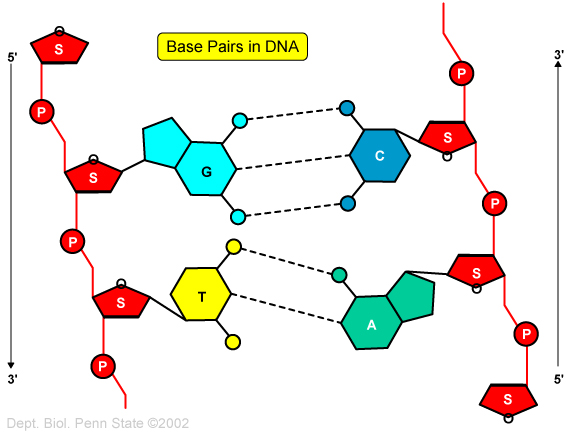
Adenine bonds with ______________.
a)
Guanine
b)
Thymine
c)
Cytosine
d)
Adenine
62.
Guanine bonds with ______________.
a)
Adenine
b)
Guanine
c)
Cytosine
d)
Thymine
63.
Which 2 molecules form the sides (backbone) of the DNA ladder?
a)
deoxyribose sugar and adenine
b)
deoxyribose sugar and a hydrogen bond
c)
deoxyribose sugar and the nucleus
d)
deoxyribose sugar and phosphate
64.
Nitrogenous bases are joined by which type of bond?
a)
polar bonds
b)
ionic bonds
c)
covalent bonds
d)
hydrogen bonds
65.
The enzyme that unzips the DNA to prepare for replication
a)
helicase
b)
replicase
c)
polymerase
d)
synthase
66.
A process in which DNA has the unique ability to make an exact copy of itself.
a)
Replication
b)
Translation
c)
Transcription
67.
What is the correct complimentary strand for the following DNA?ATCGAG
a)
TACGAG
b)
ATCGAG
c)
TAGCTG
d)
TAGCTC
68.
What are the nucleotides made of?
a)
Sugar, Phosphate, nitrogen base
b)
Phosphate, Adenine, nitrogen base
c)
Thymine, Adenine, Cytomine
d)
Phosphate, Nitrogen, Adenine
69.
What is the product of translation?
a)
DNA
b)
mRNA
c)
tRNA
d)
proteins
70.
What is the product of transcription?
a)
DNA
b)
mRNA
c)
tRNA
d)
proteins
71.
What evidence of evolution? Human embryos have tails
a)
comparative embryology
b)
comparative anatomy
c)
comparative biochemistry
d)
geographic distribution
72.
What is evolution
a)
change in technology over time
b)
change in species over time
c)
change in fur color over time
d)
change in humans over time
73.
If an organism has a vestigial structure, that structure likely once had a function in a(n)
a)
close relative
b)
early ancestor
c)
unrelated organism
d)
embryological stage
74.

A physical trait or behavior that helps an organism survive and reproduce in its environment.

a)

adaptation

b)

mutation

c)

evolution

d)

natural selection

75.
A hawk captures a black mouse in a desert, and leaves a tan mouse behind
a)
Natural Selection
b)
Mutation
c)
Genetic Drift
d)
Gene Flow
76.
 A lion gets chased off from his pride, then joins another pride. He mates with a lioness and make 6 lion cubs.
a)
Natural Selection
b)
Mutation
c)
Genetic Drift
d)
Gene Flow
77.
variations in a population are maintained by
a)
mutations
b)
genetic recombination
c)
gene flow
d)
all of the above
78.
The scientific name for an organism is made from the:
a)
class and family name
b)
genus and species name
c)
domain and kingdom name
d)
kingdom and phylum name
79.
The 8 levels of classification, most broad to most specific.
a)
Domain, Genus, Family, Order, Class, Phylum, Kingdom, Species
b)
Domain, Species, Kingdom, Genus, Phylum, Family, Class, Order
c)
Domain, Kingdom, Phylum, Class, Order, Family, Genus, Species
d)
Order, Kingdom, Species, Domain, Phylum, Family, Class, Genus
80.

What is taxonomy?

a)

The scientific study of how living things are classified.

b)

The name of Aristotle's classification system.

c)

The study of income tax.

d)

The process of observing an organism's behaviour.
81.
A herd of zebras would be considered a
a)
community
b)
species
c)
ecosystem
d)
population
82.
The maximum population size for a species based on the environmental factors is called
a)
ecological footprint
b)
carrying capacity 
c)
population growth
d)
environmental capacity
83.
Countries with high growth rates usually have an age structure that has
a)
an even distribution over all ages
b)
more older people than young people
c)
more younger people than older people.
d)
more middle-aged people than younger people.
84.
Nesting birds often space themselves evenly from other nests. This pattern is called
a)
clumped dispersion.
b)
uniform dispersion.
c)
random dispersion
d)
scatter dispersion
85.
A species that is NOT indigenous (native) to an area is called a/an: 
a)
native species
b)
natural species
c)
invasive species
d)
symbiotic species
86.
Why is only 10% of the energy passed along to the next trophic level?
a)
90% is lost through heat, reproduction, and movement
b)
90% is gained
c)
90% is lost in light energy
d)
because only 10% is lost
87.
What are examples of pioneer species in a primary succession?
a)
Bushes and Shrubs
b)
Oak trees
c)
Mossess and Lichens 
d)
A rose Bush
88.
What type of organism recycles energy back into an ecosystem?
a)
Herbivore
b)
Carnivore
c)
Autotroph
d)
Decomposer
89.
Which of the following is NOT an abiotic factor?
a)
air 
b)
water 
c)
decomposers 
d)
temperature
90.

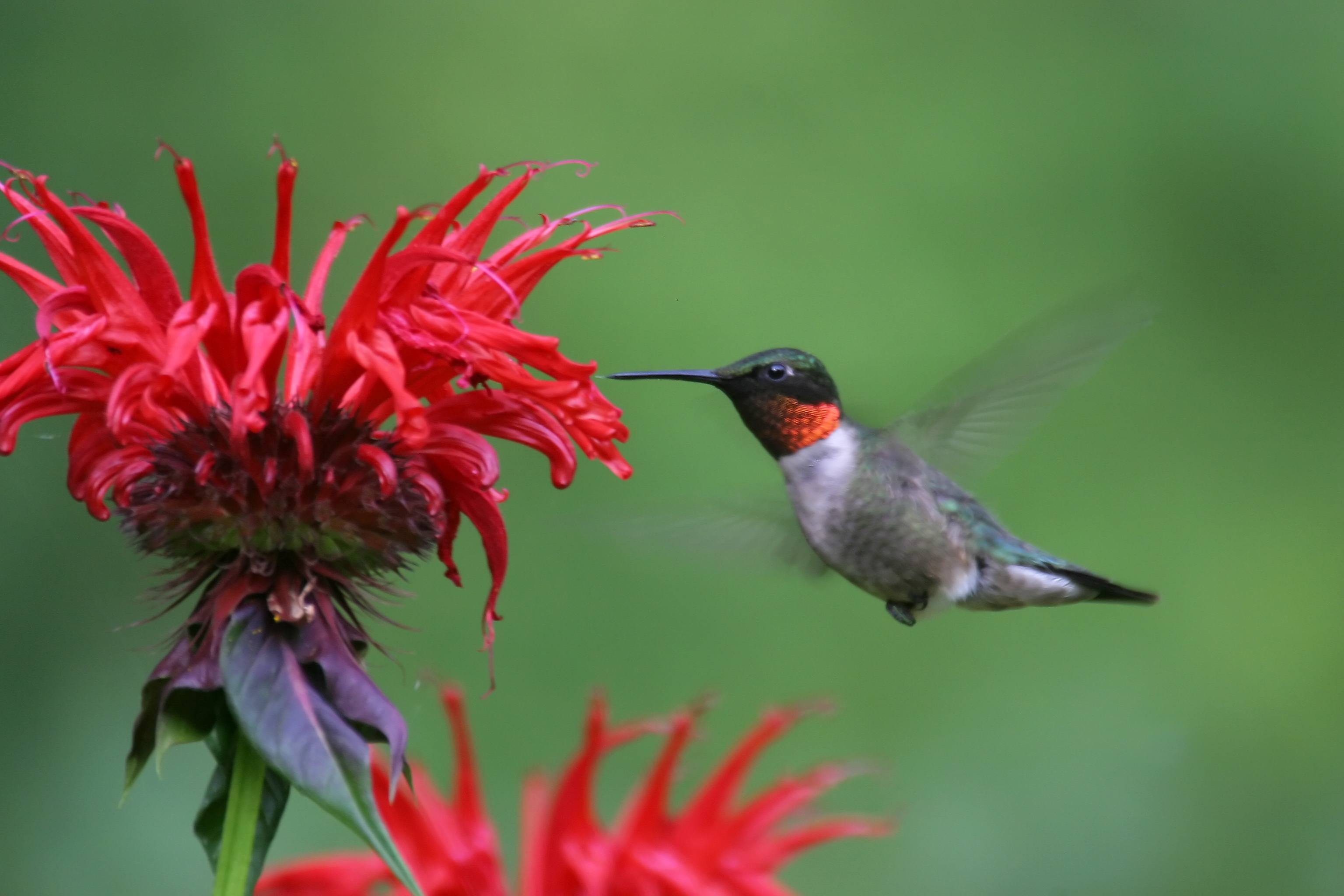
Type of symbiosis: Hummingbirds feed on nectar from flowers. The flowers are pollinated by hummingbirds as they move from flower to flower.

a)

commensalism

b)

mutualism

c)

parasitism

d)

predation