
 Worksheets
Ch: 12 Glaciation
Total questions: 101
Worksheet time: 2hrs 32mins


Poorly graded (unsorted) rock material deposited directly by a glacier.
glacial drift
stratified drift
till
glacier

The photograph shows both erosional and depositional features formed by an agent of erosion. Which agent of erosion produced the features shown in the photograph?
running water
glacial ice
ocean waves
prevailing wind

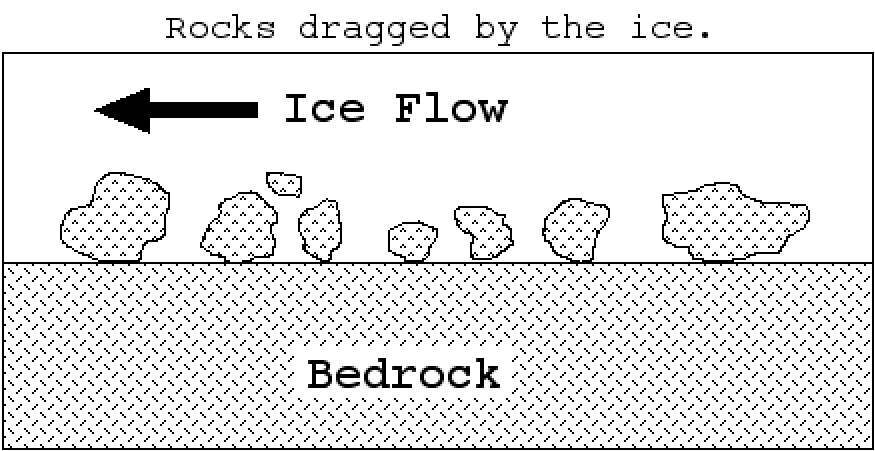
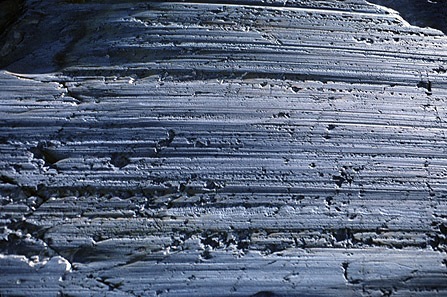
The photograph shows scratched and grooved
bedrock with boulders on its surface. The scratches and grooves were most likely created when
alternating thawing and freezing of water cracked the bedrock
flooding from a nearby lake covered the bedrock
a glacier dragged rocks over the bedrock
rocks from a landslide slid along the bedrock

The photograph shows a valley. Which agent of erosion most likely produced this valley's shape?
blowing wind
ocean waves
moving ice
running water

The cross sections show a three-stage sequence in the development of a glacial feature. Which glacial feature has formed by the end of stage 3?
kettle lake
finger lake
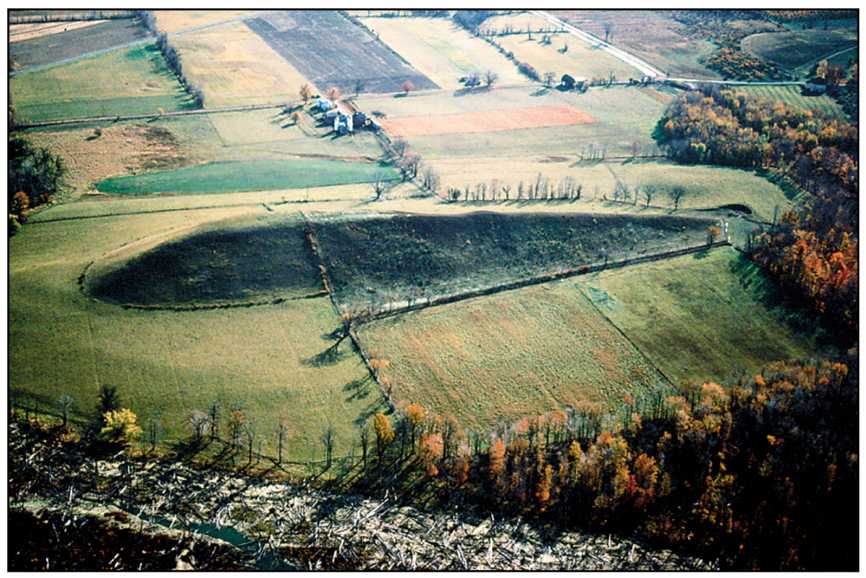
drumlin
parallel scratches

Base your answer to the following question on the map. Arrows on the map show the location and orientation of glacial striations on the surface bedrock. Dark shading shows the location of large moraines (glacial deposits). How were the striations made?
Frost action cracked the bedrock during the ice age.
Rocks at the bottom of the glaciers were dragged over the bedrock.
Particles carried by winds scratched the bedrock during the ice age.
Particles carried by glacial meltwater eroded the bedrock.
Which landscape feature was most likely formed by glacial activity?
an eroded plateau
a flat floodplain
a U-shaped valley
a V-shaped valley
The bedrock at a certain location is deeply scratched, and in some places is covered by a layer of unsorted sediment. Which erosional agent was probably responsible for these features?
ocean waves
wind
running water
glaciers

Base your answer to the following question on the diagram which represents a profile of a mountain glacier in the northern United States. Over a period of years, this glacier gains more snow mass than it loses. What will be the most likely result of this gain?
The glacier will decrease in size, and the ice front will retreat.
The glacier will decrease in size, and the ice front will advance.
The glacier will increase in size, and the ice front will retreat.
The glacier will increase in size, and the ice front will advance.

The diagram represents a stream valley. Which diagram below best shows how this valley might be modified after a glacier has moved through it?


The diagram shows the edge of a continental glacier that is receding. R indicates elongated hills. The ridge of sediments from X to Y represents a landscape feature. The elongated hills labeled R are most useful in determining the
age of the glacier
direction the glacier has moved
thickness of the glacier
rate at which the glacier is melting

What type of glacier forms in a mountainous area?
Alpine
continental
till
moraine

A gigantic mass of moving ice
glacial drift
stratified drift
till
glacier

What type of glacier covers huge areas of land?
alpine
continental
till
moraine

What are sharp pyramid shaped peaks formed by alpine glaciers called?
U-shaped valleys
cirques
aretes
horns

All material carried and deposited by glaciers
glacial drift
stratified drift
till
glacier

What are jagged ridges that form on mountains called?
U0shaped valleys
cirques
aretes
horns

which type of moraine forms along each side of a glacier?
medial moraine
lateral moraine
ground moraine
terminal moraine
Till deposited in the front of a glacier
ground moraine
lateral moraine
terminal/end moraine
medial moraine
Where do glaciers form?
a. Near the South Pole
b. Near the North Pole
c. High in the mountains
d. All of the above
e. None of the Above
a
b
c
d
e

Why are glaciers important?
They protect certain species
melting glaciers would increase sea level
melting glaciers would throw off the ecosystem of the oceans
all of the above

Where are ALPINE GLACIERS formed?
In mountains
On ice sheets
At the coast
Over the oceans

How do most ALPINE GLACIERS act?
Rivers of ice moving in wide valleys
Sheets of ice flattening the land
Layers of ice covering the oceans
Chunks of ice floating in the oceans
ALPINE GLACIERS erode mountainous regions, then melt.
What are the shapes of the valleys that remain behind after the ice melts?
U-Shape Valley
V-shape Valley
Slot Canyon Valley
Gorge
ALPINE GLACIERS erode mountainous regions, then melt.
What are the shapes of the valleys that remain behind after the ice melts?


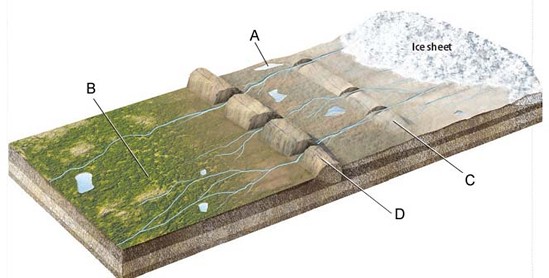
Look at the picture. Which feature is A?
Medial Moraine
Lateral Moraine
Terminal Moraine
Recessional Moraine
Look at the picture. Which feature is B?
Medial Moraine
Lateral Moraine
Terminal Moraine
Recessional Moraine
Look at the picture. Which feature is C?
Cirque glacier
Valley glacier
Continental glacier
Piedmont glacier

Look at the picture. Which feature is D?
Cirque glacier
Valley glacier
Continental glacier
Piedmont glacier

A valley glacier moves down slope through the valley. The valley glacier scrapes along and erodes the rocky sides of the valley.
What is the layer of till and rocky sediment that forms along the edges of the valley glacier because of the glacier's erosion of the sides of the valley?
Medial moraine
Lateral moraine
Ground moraine
Outwash

What is a very jagged and thin ridge of rock?
This forms when two valley glaciers or two cirque glaciers grind and erode the valley walls between them.
Arete
Col
Horn
Cirque

What is a very pointy and slender mountain peak?
This forms when two or more circque galciers or niche glaciers erode from different sides of mountain peak?
Arete
Col
Horn
Cirque

What is the bowl-shaped depressions that form near the summits of mountains?
They often contain the sources of glaciers. These are the zones of accumulation in alpine glacier systems?
Arete
Col
Horn
Cirque

The glacier inside the cirque melts.
What are the small shallow lakes that remain inside the cirques after the glaciers melted?
Tarn lakes
Paternoster lakes
Kettle lakes
Meltwater lakes

The alpine glacier system melts leaving a series of lakes inside an eroded valley. The lakes form behind many recessional moraines at different elevations. The lakes are connected by a single stream or small river.
What is this lake system called?
Tarn lakes
Paternoster lakes
Kettle lakes
Meltwater lakes
How long does it take for a glacier to move a day?
1 mile
A few meters to a few centimeters
Not at all
10 Miles
How long has Glaciers been present on earth?
1 decade
7 decades (Decade = 10 years)
100 years
Millions of years

Are you having fun?
Nah, Not really
YES!!!
Do I have to answer?
Sure I guess
Shrinking glaciers flow backwards because they are getting smaller in size.
True. The glacier will recede back up the mountain as it gets smaller.
True. The back of the glacier uphill will pull the ice up as it shrinks.
False. Glaciers only move downhill because of gravity.
False. Glaciers will flow backwards at times, but only when they are getting bigger in size.
Similarly to how glaciers move, glaciers are formed by the same force: ___________. Over many years of accumulating (building up) layers of snow, the layers _____________ into ice from the weight of all the layers pressing down.
Gravity, melt
Gravity, compact (like pressing to make a snowball)
Friction, melt
Friction, compact (like pressing to make a snowball)
Glaciers shaped our land...even in Ohio! How?
(may have more than one answer)
Glaciers sit on top of the landscape and freeze and thaw breaking rocks apart
Glaciers created landforms (moraine) made up of glacial deposits (till). Landforms can either be spread across an area like a blanket, or piled up at the edge of a glacier.
Glaciers deposited materials (till) directly to other areas.
Glaciers can pick up rocks (plucking) as they move. These rocks then act as sandpaper as they scrape across the landscape (abrasion).
You can drink glacial meltwater.
False. It has "rock flour" in it.
False. It's saltwater and you can't drink saltwater.
True. It is pure, freshwater.
The portion of Earth consisting of perennially frozen freshwater, saltwater, and the ground is known as the
biosphere.
atmosphere.
lithosphere.
cryosphere.
Approximately, what percentage of the Earth's freshwater is frozen?
10%
15%
50%
75%
The bulk of ice on Earth is in
North America, specifically Alaska.
European and Asian mountain ranges.
Greenland and Antarctica.
Argentina and Chile.
A snowline refers to
the latitude or elevation at which winter snow accumulates each year.
the latitude demarcating the extent of glacial ice during the last glacial maximum.
an isoline demarcating the extent of snow or ice on a weather map.
the elevation at which snow accumulation ceases, marking the uppermost point of a glacier.
Glacial ice is
essentially the same as snow.
produced over a period of many years.
composed primarily of sedimentary rock.
annually formed high altitudes and latitudes in fall and melts away by spring/early summer.
A general term for a mass of perennial ice, resting on land or floating in the sea attached to a landmass is
the snowline.
an iceberg.
a glacier.
a moraine.
The two main types of glaciers are
alpine glaciers and continental ice sheets.
moraine glaciers and alpine glaciers.
tidewater glaciers and continental glaciers.
cirque glaciers and alpine glaciers.
A glacier confined within a valley that originally was formed by stream action is called a(n)
ice cap.
cirque glacier.
valley glacier.
tidewater glacier.
Alpine glaciers include all of the following except a(n)
ice cap.
piedmont glacier.
cirque glacier.
valley glacier.
An extensive, continuous mass of ice covering a continental scale is known as a(n)
tidal glacier.
ice sheet.
piedmont glacier.
tidewater glacier.
In terms of areal extent, which of the following sequences is ordered from largest to smallest extent covered?
ice sheet, ice field, ice cap, alpine glacier
ice sheet, ice cap, ice field, alpine glacier
alpine glacier, ice field, ice cap, ice sheet
ice sheet, alpine glacier, ice field, ice cap
The ________ of a glacier is where snowfall and moisture collect and compact to ice in the winter, and ice persists throughout the summer.
ice field
accumulation zone
snow line
terminal moraine
The various processes that result in the loss of a glacier's mass are known collectively as
sublimation.
deflation.
ablation.
accumulation.
Which of the following is incorrect about glacial movement?
Glaciers move under the pressure of their own weight and the pull of gravity.
Glaciers move in streamlike patterns, merging as tributaries into large rivers of ice.
Glacial movement produces distinct landforms.
Glaciers are mostly stationary, only moving several centimeters over tens of years.
All of the following are related to glacial erosion except
V-shaped valleys.
abrasion.
plucking.
erratics.
________ are small mountain lakes formed in cirques.
Cols
Horns
Hanging valleys
Tarns
A(n) ________ is a valley carved by a small tributary glacier stranded high above the mail valley floor because the primary glacier eroded the main valley much deeper.
col
horn
hanging valley
tarns
A class of landforms formed by the accumulation of glacial till are known as
drift.
alluvium.
outwash.
moraines.
A deposition of till that forms behind a terminal moraine as the glacier retreats and is generally spread widely across the ground surface is called a(n)
outwash plain.
till plain.
drumlin swarm.
lateral moraine.
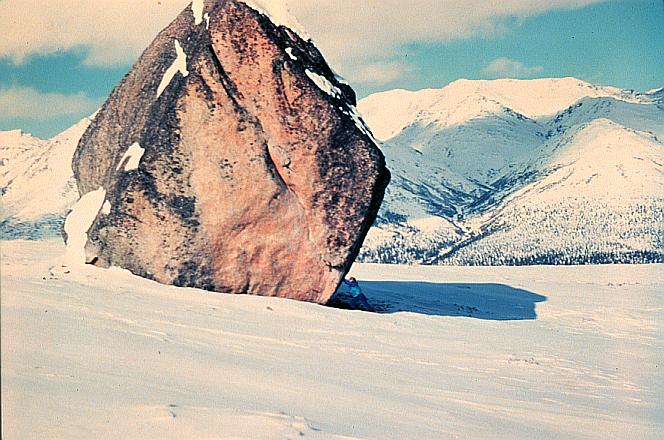
A large rock or boulder dropped by a glacier is called...
Cirque
Moraine
Erratic
Horns
A small scooped out pond left by a glacier is called...
Erratic
Moraine
Striation
Kettle

What feature is labeled A in Figure 7-1?
kame
esker
drumlin
end moraine
What feature is labeled C in Figure 7-1?
kame
esker
drumlin
terminal moraine
What feature is labeled G in Figure 7-1?
outwash plain
esker
drumlin
terminal moraine

In glacier terms, this is a picture of a(n) ______________________.
erratic
arete
horn
none of these are correct



