wayground logo

Free Printable Worksheets

Font size

S
M
L
XL
Worksheets

THS Unit 7: Mitosis, Meiosis, DNA, Cancer

Total questions: 87

Worksheet time: 1hrs 13mins

Name
Class
Date
1.
A process where one cell forms two identical daughter cells is called...
a)
cell cycle
b)
cell division (mitosis)
c)
interphase
d)
cytokinesis
2.
The cell cycle is ______________.
a)
the process of cells circling throughout the body
b)
the process of splitting the organelles
c)
a process where one cell gets energy
d)
the sequence of stages of growth and division that a cell undergoes
3.
What does DNA stand for?
a)
DeNatured Acid
b)
DomiNant Acid
c)
DeoxyriboNucleic Acid
d)
DiriboNucleic Acid
4.
Replication is when __________.
a)
the cell makes a copy of its DNA in nucleus 
b)
the cell forms 2 identical cells
c)
the cell produces 2 sets of organelles
d)
the cell continues to complete the same function
5.
Where does replication occur within the cell?
a)
in the cytoplasm
b)
in the nucleus 
c)
in the ribosome
d)
in the chromatin
6.
After interphase is completed the cell moves into the next stage of the cell cycle called _________.
a)
anaphase
b)
cytokinesis
c)
metaphase
d)
mitosis
7.
What is one half or one rod of the condensed chromatin called?
a)
DNA
b)
chromatin
c)
chromatid
d)
chromosome
8.
The following describes __________ during mitosis. The chromatin condenses and spindle fibers form at each side of the cell. The nuclear membrane breaks apart.
a)
prophase
b)
metaphase
c)
anaphase
d)
telophase
9.
The following describes ________  during mitosis. The chromosomes line up along the center of the cell and the spindle fibers attach to each chromosome at the centromere.
a)
prophase
b)
metaphase
c)
anaphase
d)
telophase
10.
The following describes _________ during mitosis. The spindle fiber splits the centromere and the chromatids move to opposite sides of the cell.
a)
prophase
b)
metaphase
c)
anaphase
d)
telophase
11.

What is the image above:

a)

Chromosome

b)

Chromotid

c)

Centromere

d)

Centriole

12.

What stage of mitosis is depicted here

a)

Prophase

b)

Anaphase

c)

Telophase

d)

Metaphase

13.

What stage of mitosis is depicted here

a)

Prophase

b)

Metaphase

c)

Anaphase

d)

Telophase

14.

What stage of mitosis is depicted here

a)

Prophase

b)

Metaphase

c)

Anaphase

d)

Telophase

15.

What stage of mitosis is depicted here

a)

Prophase

b)

Metaphase

c)

Anaphase

d)

Telophase

16.

The picture above represents what happens after mitosis which is

a)

Interphase

b)

Cytokinesis

c)

Metaphase

d)

G1

17.

Cell splits into two.

a)

Metaphase

b)

Cytokinesis

c)

Interphase

d)

Prophase

18.
Fruit fly body cells have 8 chromosomes. After mitosis, you would expect a resulting fruit fly daughter cell to have ...
a)
16 chromosomes.
b)
46 chromosomes.
c)
8 chromosomes.
d)
4 chromosomes.
19.
Structure (b) is a ____.
a)
chromosome
b)
chromatid
c)
centromere
20.
Structure (a) is a ____.
a)
chromosome
b)
chromatid
c)
centromere
21.
Structure (c) is a ____.
a)
chromosome
b)
chromatid
c)
centromere
22.
What is the next phase of mitosis?
a)
Prophase
b)
Metaphase
c)
Anaphase
d)
Telophase
23.
What is the next phase of mitosis?
a)
Prophase
b)
Metaphase
c)
Anaphase
d)
Telophase
24.
What is the next phase of mitosis?
a)
Prophase
b)
Metaphase
c)
Anaphase
d)
Telophase
25.
Name the previous phase.
a)
Prophase
b)
Metaphase
c)
Anaphase
d)
Telophase
26.
Name the previous phase.
a)
Prophase
b)
Metaphase
c)
Anaphase
d)
Telophase
27.
Name the previous phase.
a)
Prophase
b)
Metaphase
c)
Anaphase
d)
Telophase
28.
Name the previous phase.
a)
Prophase
b)
Metaphase
c)
Anaphase
d)
Telophase
29.
The stages of mitosis in order
a)
Metaphase, Anaphase, Prophase, Telophase
b)
Prophase, Anaphase, Metaphase, Telophase
c)
Prophase, Metaphase, Anaphase, Telophase
d)
Anaphase, Prophase, Telophase, Metaphase
30.
The cell cycle consists of the G!, S, G2, and the _____ phase.
a)
G3
b)
M
c)
G4
d)
A
31.
During the ___ phase, DNA is replicated.
a)
G1
b)
S
c)
G2
d)
M
32.
There are a TOTAL of ___ chromosomes in human body cells.
a)
23
b)
46
c)
92
d)
scientists don't know
33.

Select all stages of interphase?

a)

G1

b)

S

c)

G2

d)

Mitosis

34.

In which stage of the cell cycle does the cell grow in size?

a)

G1

b)

S

c)

G2

d)

Mitosis

35.

In which stage of the cell cycle is protein and organelle synthesis?

a)

G1

b)

G2

c)

S

d)

Cytokinesis

36.

_____ is the uncontrolled growth of cells, often resulting in a tumor or mass of abnormal cells

a)

Cancer

b)

Apoptosis

c)

Radiation

37.

Apoptosis is

a)

programmed cell death

b)

mysterious cell death

c)

programmed cellular mutation

d)

mysterious cellular mutation

38.
Cancer creates abnormal cells by disrupting
a)
the cell cycle
b)
red blood cell formation
c)
DNA replication
d)
ATP synthesis
39.
Any substance that is known to cause cancer is called a
a)
carcinogen
b)
nicolyte
c)
pathogen
d)
retrovirus
40.
Metastasis is
a)
the spread of cancer from one part of the body to another.
b)
the growth of tumors in the lungs
c)
cancer of the blood cells
d)
cancer that is found in connective tissues
41.

Which molecules act as gatekeepers for each checkpoint of the cell cycle?

a)

p53 gene

b)

cyclins and cycline-dependent kinases

c)

thyroid hormones

42.
Uncontrolled cell division is stopped by...
a)
tumor suppressor genes
b)
oncogenes
43.
Normal cell division is regulated by...
a)
Proto-oncogenes
b)
oncogenes
44.
Proto-oncogenes can mutate into...
a)
oncogenes
b)
tumor suppressor genes
c)
DNA repair proteins
45.
Oncogenes cause super-accelerated
a)
apoptosis
b)
mitosis
46.
The checkpoints that regulate the cell cycle can fail when ____ becomes damaged.
a)
DNA 
b)
Cell Membrane
c)
Mitochondria
d)
Ribosomes
47.
Cancer cells typically form a mass of tissue called a:
a)
biopsy.
b)
carcinogen.
c)
tumor.
d)
allergy.
48.
What does it mean for a tumor to metastasize?
a)
mass
b)
spread
c)
to get better
d)
to repair cells
49.
The cell cycle is regulated by...
a)
cyclins
b)
cyclin dependent kinases
c)
histones
d)
cyclin dependent kinases & cyclins
50.
If the Diploid number of Carrots is 18, the haploid number is
a)
18
b)
9
c)
27
d)
36
51.
The process of crossing over occurs in what phase of meiosis?
a)
anaphase 1
b)
prophase 1
c)
prophase 2
d)
telophase 1
52.
The chromosomes that pair up during meiosis, are called __________ chromosomes.  
a)
homozygous 
b)
asexual
c)
homologous
d)
genes
53.
When homologous chromosomes match up, they form a structure call a ___________.
a)
tetrad (pair of chromosomes, one from mom and one from dad)
b)
triad
c)
diploid
d)
quad (group of 4 replicated chromosomes, 2 from mom and 2 from dad)
54.
Crossing over creates
a)
male genotype
b)
genetic variation (differences)
c)
DNA replication
d)
mitosis
55.
Which of the following best describes meiosis?
a)
It is carried out in all tissues theat require cell replacement
b)
It occurs only in cells in the reproductive structures of an organism
c)
It happens in all of the tissues except the brain and spinal cord
d)
It is the first stage of mitosis
56.
Meiosis makes sperm and egg cells. In humans, sperm and egg cells each have _____ chromosomes. Therefore a fertilized human egg cell (sperm and egg cell combined) would create a cell with _____ chromosomes.
a)
23, 46
b)
46, 23
c)
2, 4
d)
50, 100
57.
How many daughter cells does Meiosis create?
a)
2
b)
4
c)
8
d)
1
58.
Which of the following produces identical nuclei in cells?
a)
fertilization
b)
osmosis
c)
mitosis
d)
pollution
59.
Which statement best describes the importance of sexual reproduction?
a)
sexual reproduction produces variation in offspring
b)
sexual reprosuction provides regeneration of body parts
c)
sexual reproduction occurs between individuals of the same species
d)
sexual reproduction produces offspring that are identical
60.

Any change in the sequence of DNA is a

a)

recombination

b)

mutation

c)

chromatin

d)

independent assortment

61.

Which process is shown in the image?

a)

crossing over

b)

independent assortment

c)

segregation

d)

mutation

62.

During which phase of meiosis does the process shown in the image occur?

a)

Prophase I

b)

Anaphase I

c)

Metaphase I

d)

Telophase I

63.

Besides crossing over _______ is another way for genetic variation to take place during meiosis.

a)

independent assortment

b)

segregation of alleles

c)

choosing a mate

d)

metastasis

64.

Independent assortment of chromosomes happens during

a)

metaphase 2 of meiosis

b)

prophase 1 of meiosis

c)

anaphase 3 of meiosis

d)

metaphase 1 of meiosis

65.
Which sequence of DNA bases would pair with this partial strand
CAT TCA CTG
a)
ATG TGA CAG
b)
TAC ACT GTC
c)
GTA AGT GAC
d)
CAT TCA CTG
66.
DNA replication results in two DNA molecules,
a)
each one with two original strands
b)
each one with two new strands
c)
each one with one new strand and one original strand
d)
one with two new strands and the other with two original strands
67.
A process in which DNA has the unique ability to make an exact copy of itself.
a)
Replication
b)
Translation
c)
Transcription
68.
In what phase of the cell cycle does DNA replication take place?
a)
G1
b)
S
c)
G2
d)
M
69.
The process of DNA replication is called semi conservative because it results in
a)
none of these
b)
Two DNA molecules.  One original molecule and one with two new strands
c)
two exact copies with new strands
d)
two identical molecules, each with 1 original strand and one new.
70.

What is the correct order to make a protein?

a)

Protein, DNA, RNA

b)

RNA, DNA, Protein

c)

DNA, RNA, Protein

d)

Protein, RNA, DNA

71.

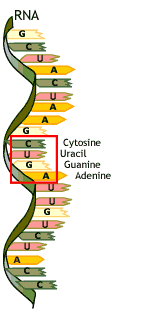
RNA has what base that is instead of thymine?

a)

guanine

b)

adenine

c)

thymine

d)

uracil

72.

Which RNA brings amino acids?

a)

rRNA

b)

tRNA

c)

mRNA

73.

Which RNA carries the message?

a)

mRNA

b)

rRNA

c)

tRNA

74.
Which of the following is not a base found in DNA?
a)
adenine
b)
thymine
c)
cytosine
d)
uracil
75.
What is the process that copies information from DNA into RNA?
a)
protein synthesis
b)
transcription
c)
translation
d)
DNA Polymerase
76.
Transcribe the following piece of DNA:
ATCGTA
a)
UAGCAU
b)
TAGCAT
c)
ATCGTA
d)
AUCGUA
77.
If an mRNA codon is AGU, which of the following would be the appropriate tRNA anticodon?
a)
TCA
b)
UGA
c)
AGU
d)
UCA
78.
In RNA, Uracil pairs with ______. 
a)
cytosine
b)
adenine
c)
guanine
d)
thymine
79.
The process to go from mRNA to a protein is called ____
a)
transcription
b)
rRNA
c)
replication
d)
translation
80.
DNA holds the code for
a)
lipids
b)
carbohydrates
c)
protein
d)
sugar
81.
What is the three base sequence of mRNA that codes for a single amino acid?
a)
Anticodon
b)
Codon
c)
Protein
82.
Does the order of amino acids in a protein matter?
a)
YES!
b)
NO!
83.
Where do mutations occur?
a)
DNA and RNA
b)
DNA 
c)
RNA
d)
mRNA and tRNA
84.
What are the building blocks of proteins called?
a)
DNA
b)
RNA
c)
Ribosomes
d)
Amino Acids
85.
In DNA, Adenine bonds with ______________.
a)
Guanine
b)
Thymine
c)
Cytosine
d)
Adenine
86.
Guanine bonds with ______________.
a)
Adenine
b)
Guanine
c)
Cytosine
d)
Thymine
87.
Any change in the sequence of DNA is...
a)
transgenic shift
b)
Single Genotype
c)
Monohybrid Trait
d)
Mutation