Wayground logo

Free Printable Worksheets

Font size

S
M
L
XL
Worksheets

Reporting Category 3

Total questions: 94

Worksheet time: 1hrs 22mins

Name
Class
Date
1.
What moon phase came right BEFORE this one?
a)
First Quarter
b)
Last Quarter
c)
New Moon
d)
Full Moon
2.

What moon would you expect to see on March 18th?

a)
b)
c)
d)
3.
Which model shows the positions of the sun, the moon, and Earth that have the greatest effect on ocean tides?
a)
F
b)
G
c)
H
d)
J
4.
The moon phase indicated by X is __.
a)
A
b)
B
c)
C
d)
D
5.
Which moon phase occurred on January 21, 2011?
a)
Full Moon
b)
Waning Gibbous
c)
Waxing Gibbous
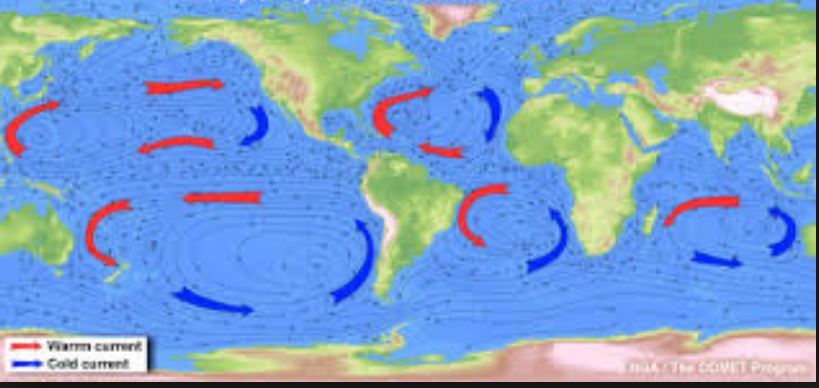
d)
First Quarter
6.
Which phases are waxing?
a)
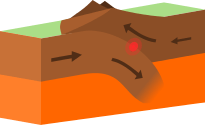
1 and 2
b)
2 and 3
c)
3 and 4
d)
4 and 5
7.
If there is a full moon on March 2, when would you expect the Third Quarter?
a)
March 5
b)
March 9
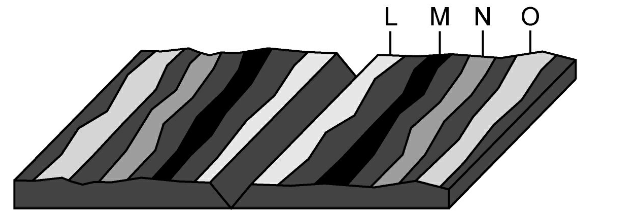
c)
March 16
d)
March 23
8.
What moon phase is shown in position 8
a)
waxing crescent
b)
waxing gibbous
c)
waning gibbous
d)
waning crescent
9.

What moon phase is shown and what special tide will occur?

a)

New moon; neap tide

b)

New moon; spring tide

c)

Full moon; neap tide

d)

Full moon; spring tide

10.

When the moon is located in the positions shown, what special tides can occur?

a)

Spring Tide

b)

Neap Tide

c)

High Tide

d)

Low Tide

11.

Where would the Sun need to be in this diagram to cause these phases of the moon?

a)

At the Bottom

b)

At the Left

c)

At the Top

d)

At The Right

12.

What phase comes right after this one?

a)

New Moon

b)

Waxing Crescent

c)

1st Quarter

d)

3rd Quarter

13.

What phase occurs on the designated part of this graph?

a)

New Moon

b)

Full Moon

c)

Waning Crescent

d)

Waxing Crescent

14.

A student shows a model of Earth and the moon to a class. Which picture shows how the moon appears from Earth when it is in the position shown in this model?

a)
b)
c)
d)
15.

The diagram shows four consecutive moon phases. Which of the following diagrams shows the next four moon phases in the correct order?

a)
b)
c)
d)
16.

A student must complete the column of the table that lists the dates of the full moons. What are the most likely dates of the full moons?

a)

February 5, March 7, April 5, May 4

b)

February 15, March 17, April 15, May 14

c)

February 25, March 27, April 25, May 24

d)

February 29, March 31, April 29, May 28

17.

What phase comes after

a)
b)
c)
18.
What is the longest day of the year?
a)
winter solstice
b)
summer solstice
c)
fall equinox
d)
spring equinox
19.
Why do we experience the changing of the season on the earth?
a)
distance from the sun
b)
rotation of the earth
c)
change in solar output
d)
tilt of the earth's axix
20.
Which season is taking place in the Northern Hemisphere in Position 4?
a)
Winter
b)
Spring
c)
Summer
d)
Fall
21.
Which season is taking place in the Northern Hemisphere in Position 1?
a)
Winter
b)
Spring
c)
Summer
d)
Fall
22.
The term equinox means....
a)
equal amount of day light and equal amount of night
b)
Equal amount of winter and summer
c)
Equal amounts of hot dogs for everyone
d)
The longest day of the year
23.
If its ____ in the Northern hemisphere, then its fall in the Southern hemisphere. 
a)
spring
b)
summer
c)
fall
d)
winter
24.
The spinning of the earth on its axis.
a)
orbit
b)
revolution
c)
day
d)
rotation
25.
Imaginary line that runs through the north & south poles of earth.
a)
axis
b)
equator
c)
latitude
d)
degrees
26.
The orbiting of earth around the sun.
a)
orbit
b)
revolution
c)
year
d)
rotation
27.

This is what Earth's axis is always pointed at.

a)

North Star (Polaris)

b)

Sun

c)

Moon

d)

Big Dipper

28.
The direction the earth rotates & revolves.
a)
north
b)
south
c)
clock-wise
d)
counter-clockwise
29.
What is this movement?
a)
axis 
b)
equator
c)
rotation
d)
revolution
30.
What is this movement?
a)
axis
b)
equator
c)
rotation
d)
revolution
31.
What are the reasons for the season?
a)
Earth's tilt & rotation
b)
Earth's tilt & revolution
c)
Earth's rotation & size
d)
Earth's tilt & resolution
32.
Why does the area around the equator stay the same temperature all year?
a)
The equator rotates slower than the poles.
b)
The equator remains the same distance from the sun.
c)
The equator always receives direct sunlight.
d)
The equator has 18 hour days.
33.
Why do globes lean sideways?
a)
To allow them to spin easier.
b)
To demonstrate the tilt of Earth's axis.
c)
To demonstrate the effects of gravity.
d)
To demonstrate day and night.
34.
Which season is taking place in the Northern Hemisphere in Position 3?
a)
Winter
b)
Spring
c)
Summer
d)
Fall
35.
Which season is taking place in the Northern Hemisphere in Position 2?
a)
Winter
b)
Spring
c)
Summer
d)
Fall
36.

Which type of galaxy is shaped like a pinwheel with spiral arms?

a)

spiral galaxy

b)

elliptical galaxy

c)

irregular galaxy

37.

Which type of galaxy has no definite shape?

a)

spiral galaxy

b)

elliptical galaxy

c)

irregular galaxy

38.

Which type of galaxy is shaped like an elongated sphere?

a)

spiral galaxy

b)

elliptical galaxy

c)

irregular galaxy

39.

What type of galaxy is the Milky Way Galaxy?

a)

spiral galaxy

b)

elliptical galaxy

c)

irregular galaxy

40.

What type of star are the majority of the known stars classified as?

a)

main sequence

b)

giants

c)

super giants

d)

white dwarfs

41.

Where are the hottest stars found on the H-R Diagram?

a)

Right Side

b)

Left Side

c)

Top

d)

Bottom

42.

According to the H-R Diagram the hottest stars are represented by which color?

a)

Blue

b)

Red

c)

Yellow

d)

Orange

43.

Where on the H-R Diagram are the coolest stars found?

a)

Right Side

b)

Left Side

c)

Top

d)

Bottom

44.

Where on the H-R Diagram are the brightest stars found?

a)

Right Side

b)

Left Side

c)

Top

d)

Bottom

45.

Where on the H-R Diagram are the dimmest stars found?

a)

Right Side

b)

Left Side

c)

Top

d)

Bottom

46.

Which of the following are in the correct order from smallest to largest?

a)

planets, nebulae, stars, galaxies

b)

planets, stars, nebulae, galaxies

c)

galaxies, nebulae, stars, planets

47.
A _____ is body made of gas, held together by gravity and generates light by nuclear fusion.
a)
star
b)
galaxy
c)
nebula
d)
black hole
48.
A _____ is the death of a large star by massive explosion.
a)
supernova
b)
black dwarf
c)
galaxy
d)
universe
49.

Which of the following components of the universe is best described as an interstellar cloud of dust and gases where stars can form?

a)

a nebula

b)

a planet

c)

a meteor

d)

a galaxy

50.

Which area of the diagram represents the white dwarfs?

a)

Area M

b)

Area X

c)

Area P

d)

Area Z

51.
Space and all the matter and energy in it is...
a)
Universe
b)
Galaxy
c)
Solar System
d)
Ecosystem
52.

Which is NOT a component of galaxies?

a)

Universe

b)

Stars

c)

Dust

d)

Planets

53.
A large body that does not produce its own light and orbits a star, such as the Sun, is called a(n) ___________________.
a)
solar system
b)
planet
c)
galaxy
d)
universe
54.
A(n) _______________ is a chunk of ice, dust, and frozen gases that orbits the Sun.
a)
asteroid
b)
meteor
c)
planet
d)
comet
55.
A natural satellite that orbits a planet...
a)
comet
b)
meteor
c)
moon
d)
asteroid
56.
What is the process by which stars give off heat?
a)
Blowy gas
b)
Helium conversion
c)
Convection
d)
Nuclear fusion 
57.
How many stars do we have in our solar system?
a)
1
b)
Millions
c)
it is impossible to know
d)
Billions
58.
What is the source for warming up ocean water?
a)
the sun
b)
water movement
c)
wind
d)
fish peeing in the ocean water
59.
In order for a hurricane to form, the water must be ________.
a)
Cool
b)
Warm
c)
Cold
d)
Hot
60.
What process brings the deep cold ocean currents up to the surface?
a)
Conduction
b)
Global Wind Patterns
c)
Convection Currents
d)
Temperature and salinity
61.
Analyze the image. What could explain why certain parts of the ocean have warmer temperatures?
a)
the uneven heating of the Earth's surface
b)
the rising of cold air and the sinking of warm air
c)
hurricanes
62.

What drives the convection currents in the atmosphere and oceans?

a)

The sun

b)

The crust

c)

The mantle

d)

The core

63.
Name the boundary
a)
convergent boundary
b)
divergent boundary
c)
transform boundary
d)
sergent boundary
64.
Name the boundary
a)
convergent boundary
b)
divergent boundary
c)
transform boundary
d)
sergent boundary
65.
Name the boundary
a)
convergent boundary
b)
divergent boundary
c)
transform boundary
d)
sergent boundary
66.
During sea floor spreading, molten material rises up from the mantle...
a)
along the continents
b)
at the mid ocean ridges
c)
deep ocean trenches
d)
at north and south poles
67.
Which of the following is where one plate slides under another plate?
a)
submarine zone
b)
divergence zone
c)
subduction zone
d)
lower zone
68.
Mountains form from ...
a)
plates sliding past one another
b)
collision of plates
c)
plates moving away from each other
69.
Oceanic crust is
a)
Younger and less dense than continental crust
b)
Thinner, younger and more dense than continental crust
c)
Older, thicker and less dense that continental crust
d)
Bigger and younger than continental crust
70.
Earth's plates are...
a)
constantly moving and changing the face of the earth
b)
Never moves
c)
Moves seldom and very fast
d)
Moves when it feels like it
71.
What type of plate boundary is this?
a)
Plate
b)
Divergent
c)
Convergent
d)
Transform
72.
Which of the following causes Earth's tectonic plates to move?
a)
Energy from the Sun
b)
Magnetic Pole Reversal
c)
Convection currents in the mantle
d)
Faults in Mountain Ranges
73.
Which of the following is the name of the ancient supercontinent formed 28 Million Years ago.
a)
Pangea
b)
Gondwanda
c)
Laurasia
d)
Neverland
74.
Which of the following is NOT evidence to support the theory of plate tectonics?
a)
Fossils
b)
Mountains
c)
Glaciers
d)
Sand Erosion
75.
Islands can from from magma which is pushed up at a __________ plate boundary
a)
Divergent
b)
Convergent
c)
Transform
76.
Where would the oldest rock be found?
a)
L
b)
M
c)
N
d)
O
77.
How is it possible for new crust to be formed without increasing the surface area of the Earth?
a)
Crust is destroyed at the same time it is created
b)
New crust is underwater where it sinks
c)
New crust breaks more easily than old crust
78.
Earthquakes and volcanoes are most likely found in which locations?
a)
At plate boundaries
b)
in oceans
c)
in the middle of continents
d)
in the middle of plates
79.
The Great Rift Valley in Africa and the Mid-Ocean Ridge were all created by this boundary
a)
Divergent
b)
Convergent
c)
Reform
d)
Transform
80.
Warm air rises and the cool air sinks demonstrates this type of heat transfer. 
a)
conduction
b)
convection
c)
radiation
d)
Insolation 
81.
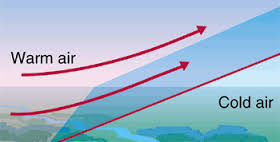
Which type of front is pictured?
a)
Cold front
b)
Warm front
c)
Occluded front
d)
Stationary front
82.
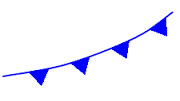
What symbol is this?
a)
warm front
b)
cold front
c)
stationary front
d)
occluded front
83.
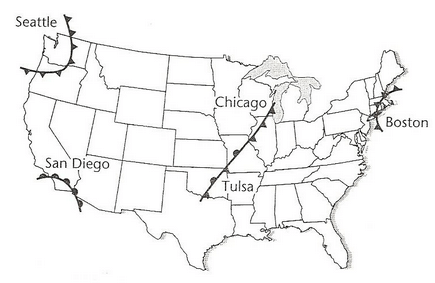
Which front is located near San Diego?
a)
cold front
b)
warm front
c)
occluded front
d)
stationary front
84.
Which type of front is located near Boston?
a)
warm front
b)
cold front
c)
stationary front
d)
occluded front
85.
What direction is the warm front moving on the map? 
a)
North
b)
South
c)
East
d)
West
86.
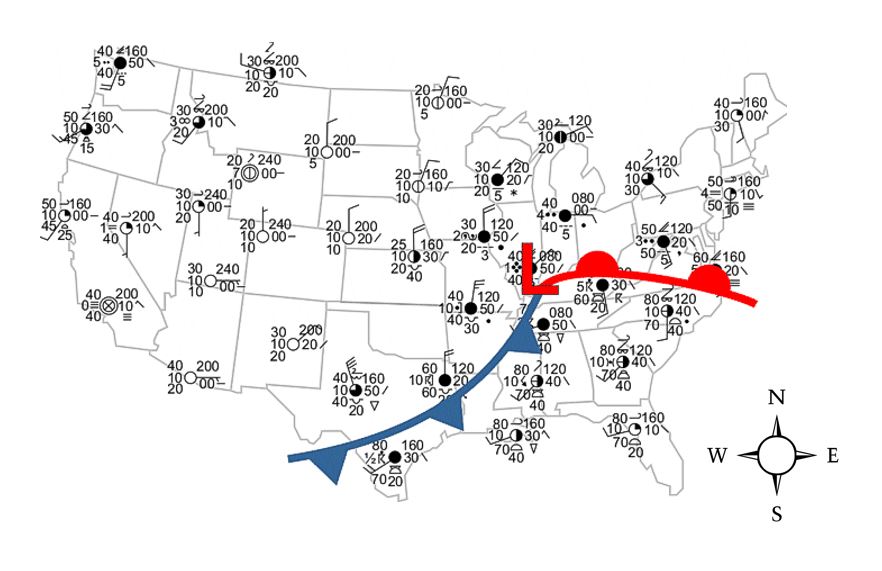
a)

A

b)

B

c)

C

d)

D

87.
a)

A

b)

B

c)

C

d)

D

88.
a)

A

b)

B

c)

C

d)

D

89.
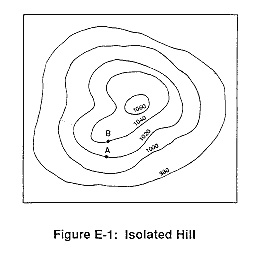
What is the highest elevation this hill could possibly have? (might not be labeled)
a)
1040
b)
1060
c)
1079
d)
1009
90.
What is the contour interval on this map?
a)
100
b)
10
c)
15
d)
20
91.
It is steep on a topographic map where __________.
a)
lines are closest together
b)
a river flows into a lake
c)
contours bend
d)
contours are far apart
92.

Which landform best matches the topographic map shown?

a)
b)
c)
d)
93.

Which landform best matches the topographic map shown?

a)
b)
c)
d)
94.
What is the difference in elevation between Point X and Point Y?
a)
120 m
b)
240 m
c)
360 m
d)
340 m