wayground logo

Free Printable Worksheets

Font size

S
M
L
XL
Worksheets

PBS sem 2 review

Total questions: 100

Worksheet time: 1hrs 1mins

Name
Class
Date
1.

What is the purpose of red blood cells?

a)

fight infections

b)

transport oxygen

c)

clean up damaged cells

d)

clot the blood

2.

What is the purpose of white blood cells?

a)

clot the blood

b)

transport oxygen

c)

fight infection

d)

bring fluids to the cells

3.

Sickle cell disease is an inherited disorder, specifically:

a)

heteroyzygous dominant

b)

homozygous recessive

c)

homozygous dominant

d)

heterozygous recessive

4.

mRNA copies the code from DNA in a process called:

a)

translation

b)

polymerase

c)

mitosis

d)

transcription

5.

_____ are 3 letter sequences found on mRNA.

a)

nucleotide

b)

anticodons

c)

codons

d)

polymerase

6.

A hydrophobic substance is one that _____ water.

a)

hates

b)

attracts

c)

absorbs

d)

sticks to

7.

What is the complementary mRNA strand to: GTCAAC

a)

CAGTTG

b)

GTCAAC

c)

CAGUUG

d)

GUCAAC

8.

_____ provide the code for the production of _____.

a)

proteins; genes

b)

genes; proteins

c)

anticodons; codons

d)

tRNA; mRNA

9.

The building blocks of proteins are called:

a)

nucleotides

b)

amino acids

c)

nucleic acids

d)

monosaccharides

10.

Translation takes place in the:

a)

cytoplasm

b)

DNA

c)

nucleus

d)

mitochondria

11.

Which type of RNA carries information from the DNA to the cytoplasm?

a)

tRNA

b)

rRNA

c)

mRNA

d)

RNA polymerase

12.

Unlike DNA, RNA contains:

a)

adenine

b)

uracil

c)

guanine

d)

thymine

13.

How many nucleotides represent a codon?

a)

3

b)

6

c)

9

d)

12

14.

Which is the correct sequence for protein synthesis?

a)

protein --> DNA --> RNA

b)

RNA --> DNA --> protein

c)

DNA --> RNA --> protein

d)

RNA --> protein --> DNA

15.

Sickle cell disease causes an abnormal shape in:

a)

white blood cells

b)

red blood cells

c)

platelets

d)

plasma

16.

What is the fluid portion of the blood that consists of water and dissolved molecules?

a)

platelets

b)

white blood cells

c)

red blood cells

d)

plasma

17.

The test used to diagnose anemia is called:

a)

gel electrophoresis

b)

hematocrit test

c)

ELISA test

d)

thrombocyte analysis

18.

Which type of mutation in DNA would be more damaging?

a)

substitution

b)

deletion

c)

both are equally damaging

d)

neither would cause problems

19.

tRNA carries the 3 nucleotide complement to mRNA and is called a(n):

a)

codon

b)

amino acid

c)

anticodon

d)

rRNA

20.

Two identical daughter cells are produced from a parent cell during:

a)

meiosis

b)

replication

c)

transcription

d)

mitosis

21.

A person inherits one mutated copy of an allele and expresses a disease. This disease must be:

a)

dominant

b)

recessive

c)

homozygous

d)

homologous

22.

_____ results in the production of sex cells, each with _____ number of chromosomes as the original.

a)

Mitosis; half the

b)

Mitosis; the same

c)

Meiosis; half the

d)

Meiosis; the same

23.

Meiosis results in the production of which type of cells?

a)

body cells

b)

egg or sperm cells

c)

skin cells

d)

chromosomes

24.

How many chromosomes are there in a human body cell?

a)

2

b)

44

c)

23

d)

46

25.

A diagram of a family tree showing inheritable traits over multiple generations is a _____.

a)

pedigree

b)

autosome

c)

gene

d)

heredity

26.

Two parents are carriers for sickle cell; their children have a ___ chance of having the disease.

a)

0%

b)

25%

c)

50%

d)

75%

27.

Which amino acid has the codon GAC?

a)

Glu

b)

Asp

c)

Ala

d)

Gly

28.
A condition in which the blood is deficient in red blood cells, in hemoglobin, or in total volume.
a)
Anemia
b)
Hematocrit
c)
Anticodon
d)
Nucleotide
29.
Any of the hemoglobin-containing cells that carry oxygen to the tissues and are responsible for the red color of vertebrate blood.
a)
Erythrocytes 
b)
Blood Plasma
c)
Leukocytes 
d)
Thrombocytes
30.
A minute colorless anucleate disklike body of mammalian blood that assists in blood clotting by adhering to other platelets and to damaged epithelium.  
a)
Thrombocytes 
b)
Leukocytes 
c)
Erythrocytes 
d)
Blood Plasma
31.
The percent of the volume of whole blood that is composed of red blood cells as determined by separation of red blood cells from the plasma usually by centrifugation.
a)
Hematocrit
b)
Sickle Cell Disease
c)
Hydrophilic
d)
Protein
32.
The synthesis of RNA from a DNA template.  
a)
Transcription
b)
Translation
c)
Chromosome
d)
Genotype
33.
The synthesis of a polypeptide (protein) chain using the genetic information encoded in an mRNA molecule. There is a change of language from nucleotides to amino acids.  
a)
Translation
b)
Autosome
c)
Gene
d)
Mutation
34.
Any of the alternative forms of a gene that may occur.  
a)
Allele
b)
Autosome
c)
Chromosome
d)
Gene
35.
A chromosome that is not directly involved in determining sex, as opposed to a sex chromosome.
a)
Autosome
b)
Chromosome
c)
Sex Chromosome
d)
Pedigree
36.
Any of the usually linear bodies in the cell nucleus that contain the genetic material.
a)
Chromosome
b)
Autosome
c)
Genotype
d)
Phenotype
37.
A discrete unit of hereditary information.  
a)
Gene
b)
Genotype
c)
Heredity
d)
Karyotype
38.
All or part of the genetic makeup of an individual or group.  
a)
Genotype
b)
Phenotype
c)
Pedigree
d)
Mutation
39.
The observable properties of an organism that are produced by the interaction of the genotype and the environment.
a)
Phenotype
b)
Genotype
c)
Mutation
d)
Pedigree
40.
How many cells are created at the end of meiosis?
a)
2
b)
4
c)
6
d)
8
41.
Which component is needed for clotting?
a)
white blood cells
b)
red blood cells
c)
platelets
d)
plasma
42.
This image represents ________________
a)
Mitosis
b)
Meiosis
c)
Apoptosis
d)
Cellular Respiration
43.
The following image represents
a)
Apoptosis
b)
Cellular Respiration
c)
Meiosis
d)
Mitosis
44.
Which of the following is homozygous dominant?
a)
Yy
b)
Y
c)
yy
d)
YY
45.
Which of the following is homozygous recessive?
a)
Tt
b)
tt
c)
TT
d)
T
46.
What gender has an X and a Y chromosome?
a)
male
b)
female
c)
transgender 
d)
all of the above
47.
A tall plant (TT) is crossed with a tall plant (Tt).  What is the genotype?
a)
2 TT: 2 Tt: 0 tt
b)
1 TT: 2 Tt: 1 tt
c)
2 TT: 1 Tt: 1 tt
d)
0 TT: 0 Tt: 4 tt
48.
An electrocardiogram measures what?
a)
The amount of pressure exerted on blood vessels.
b)
The electrical activity of the heart.
c)
How many times the heart contracts over time.
d)
The body's temperature caused by friction of blood in vessel.
49.
What do the letters EKG stand for?
a)
Electrocardiograph
b)
Electromagneticgraph
c)
Electrocardiogram 
d)
Electrolytes
50.
What letters are used to label the parts of an EKG?
a)
PQRST 
b)
ABCDE
c)
ACDC
d)
DNAI
51.
The p-wave correlates with which event?
a)
atrium contraction /signals moving from SA node to AV node
b)
ventricle contraction
c)
ventricle repolarization
d)
both atrial and ventricle contraction
52.
The t-wave correlates with which event?
a)
atrium contraction /signals moving from SA node to AV node
b)
ventricle contraction
c)
ventricle repolarization
d)
both atrial and ventricle contraction
53.
The AV node is located at...
a)
A
b)
B
c)
C
d)
D
54.
The Purkinje fibers are located at...
a)
F
b)
G
c)
H
d)
I
55.
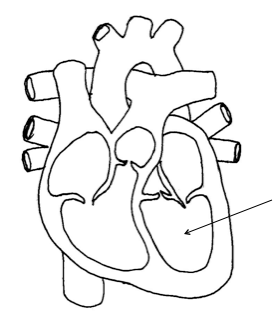
Name the part.
a)
Left ventricle
b)
Vena cava
c)
Right atrium
d)
Right ventricle
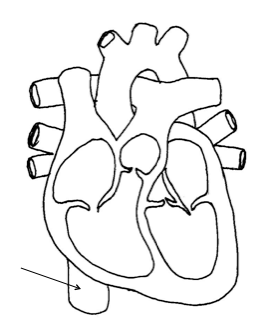
56.
Name this part.
a)
Superior vena cava
b)
Right ventricle
c)
Inferior vena cava
d)
Pulmonary vein
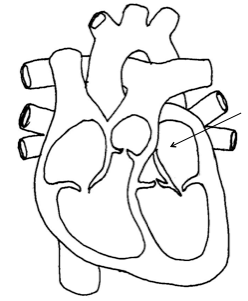
57.
Name this part.
a)
Right atrium
b)
Left ventricle
c)
Right ventricle
d)
Left atrium
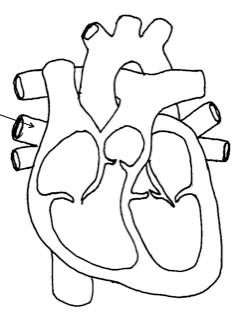
58.
Name this part.
a)
Right ventricle
b)
Pulmonary artery
c)
Left ventricle
d)
Right atrium
59.
_____ carries blood away from the heart.
a)
Blood cells
b)
Veins
c)
Capillaries
d)
Arteries
60.
Any of the tubular branching muscular and elastic-walled vessels that carry blood from the heart through the body.
a)
Vein
b)
Capillary
c)
Artery
d)
Atrium
61.
A valve in the heart that guards the opening between the left atrium and the left ventricle; prevents the blood in the ventricle from returning to the atrium. Alternative name is bicuspid valve.
a)
Tricuspid valve
b)
Aortic valve
c)
Pulmonary valve
d)
Mitral Valve
62.
A valve that is situated at the opening of the right atrium of the heart into the right ventricle and that resembles the mitral valve in structure but consists of three triangular membranous flaps.
a)
Tricuspid Valve
b)
Bicuspid Valve
c)
Mitral Valve
d)
Aortic Valve
63.
The large arterial trunk that carries blood from the heart to be distributed by branch arteries through the body.
a)
Aorta
b)
Artery
c)
Atrium
d)
Arteriole
64.
Name this part.
a)
Pulmonary veins
b)
Left atrium
c)
Aorta
d)
Pulmonary artery
65.
Which side of the heart pumps blood into the lungs?
a)
Right
b)
Left
c)
Bottom
d)
Top
66.
What is the job of HDL?
a)
Take cholesterol to the liver
b)
Take cholesterol to the cells
c)
Take cholesterol to the pancreas
d)
Take cholesterol to the blood
67.
What is a lipoprotein?
a)
a fat that carries protein in the blood
b)
a protein that carries cholesterol in the blood
c)
a cell that carries blood to the liver
d)
a cell that transforms cholesterol into protein
68.
Which lipoprotein decreases your chances of heart disease?
a)
HDL
b)
LDL
c)
PDL
d)
BDL
69.
Total cholesterol should be under _____ mg/dL
a)
100
b)
150
c)
200
d)
250
70.
LDL cholesterol levels should be under ____ mg/dL.
a)
50
b)
100
c)
150
d)
200
71.
HDL cholesterol levels should be over ___ mg/dL.
a)
30
b)
40
c)
50
d)
60
72.
DNA has an overall charge of __________.
a)
positive
b)
negative
c)
neutral
73.
What is the name of the “bands” we visually see and analyze in gel electrophoresis?
a)
Restriction Enzymes
b)
Double Helix
c)
Restriction Fragment Length Polymorphism
d)
Gel
74.
What is atherosclerosis?
a)
Plaque build up in the inner walls of arteries
b)
Plaque build up in the heart chambers
c)
Quivering contraction of the ventricles
d)
Quivering contraction of the atria
75.
What is the medical term for heart attack?
a)
Myocardial infarction
b)
Hypertrophic cardiomyopathy
c)
Commotio cordis
d)
Myocardial difibrilation
76.
What is the job of LDL?
a)
Take cholesterol to the liver
b)
Take cholesterol to the cells
c)
Take cholesterol to the pancreas
d)
Take cholesterol to the blood
77.

A student performed a gel electrophoresis experiment. The results are represented in the diagram

below. Compared to the fragments at the top of the gel, the fragments at the lower end are

a)

larger, and move slower

b)

larger, and move faster

c)

smaller, and move faster

d)

smaller, and move slower

78.

Gel electrophoresis is used to separate DNA fragments on the basis of which property?

a)

size

b)

color

c)

functions

d)

chromosomes

79.

What is the name of a spherical bacterium?

a)

Coccus

b)

Palisades

c)

Vibrio

d)

Filamentous

80.

What is a cell that engulfs and destroys antigens?

a)

phagocyte

b)

erythrocyte

c)

leukocyte

d)

virus

81.

What is the name of a rod-shaped bacterium?

a)

Bacillus

b)

Tetrad

c)

Diplococci

d)

Spirillum

82.

Any disease-causing agent

a)

pathogen

b)

fungus

c)

infection

d)

virus

83.

The condition of being able to resist a particular disease

a)

immunity

b)

invincibility

c)

immortality

d)

imperviousness

84.

Which infectious agent is capable of reproducing only inside other living cells?

a)

virus

b)

bacteria

c)

helminthes

d)

fungus

85.

This infectious agent is best treated with antibiotics.

a)

bacteria

b)

prions

c)

protozoans

d)

viruses

86.

The disease known as Athlete's Foot is caused by which infectious agent?

a)

fungus

b)

helminth

c)

virus

d)

bacteria

87.

Which category of infectious agent includes roundworms and can be transmitted through undercooked meat?

a)

helminthes

b)

fungus

c)

protozoans

d)

bacteria

88.

Aseptic technique is meant to:

a)

ensure that specimens are not contaminated

b)

ensure that fewer lab supplies are required

c)

ensure that the growth of specimens is limited

d)

All answers are correct

89.

A chemical reaction between these substances causes the purple color to remain in the cell wall during Gram staining.

a)

Crystal Violet dye and Ethyl alcohol

b)

Crystal Violet dye and distilled water

c)

Crystal Violet dye and Gram's iodine

d)

Crystal Violet dye and Safranin dye

90.

Which structure is responsible for the movement of many bacteria?

a)

flagella

b)

nucleoid

c)

capsule

d)

cell membrane

91.

This infectious agent transmits Creutzfeldt-Jakob disease and scrapie.

a)

prions

b)

viruses

c)

helminthes

d)

fungus

92.

Why is important to heat fix a slide when performing a Gram stain?

a)

so that the bacteria won't wash off of the slide

b)

so that the bacteria die before the staining

c)

to allow the cell walls to hold more dye

d)

to provide heat to speed up the chemical reaction

93.

Which is the primary non-specific defense used by the body?

a)

skin

b)

hair

c)

antibodies

d)

B cells

94.

Which microscopic infectious agent is a protein coat surrounding a DNA or RNA bundle?

a)

virus

b)

bacteria

c)

helminth

d)

protozoan

95.

Malaria is transmitted by which infectious agent?

a)

protozoa

b)

bacteria

c)

virus

d)

prion

96.
Viruses are not affected by antibiotics.
a)
True
b)
False
97.
What is used to treat someone with a bacterial infection such as strep throat
a)
aspirin
b)
radiation
c)
antibiotics
d)
ibuprophen
98.
Ringworm is caused by
a)
Virus
b)
Fungi
c)
protozoa
d)
helminth
99.
What pathogen causes the common cold?
a)
Virus
b)
Bacteria
c)
Fungi
d)
Protista
100.
Helminths example
a)
worms
b)
AIDS
c)
common cold
d)
gonorrhea