
 Worksheets
WJEC AS Biology Unit 2
Total questions: 102
Worksheet time: 50mins
Name
Class
Date
1.

Plants are...
a)
Photoautotrophs
b)
Chemoautotrophs
c)
Photoheterotrophs
d)
Chemoheteroptrophs
2.

How do saprophytes digest their food?
a)
Intracellularly
b)
Extracellularly
3.

A flea is an example of an
a)
Ectoparasite
b)
Endoparasite
c)
Host
4.

A tapeworm is an example of an
a)
Ectoparasite
b)
Endoparasite
c)
Host
5.

A parasite / host relationship is....
a)
+ / -
b)
- / +
c)
- / -
d)
+ / +
6.

A mutualistic relationship is....
a)
+ / -
b)
- / +
c)
- / -
d)
+ / +
7.

What is taking food molecules into the mouth?
a)
Ingestion
b)
Digestion
c)
Absorption
d)
Egestion
8.

What is breaking large, insoluble molecules into small, soluble molecules?
a)
Ingestion
b)
Digestion
c)
Absorption
d)
Egestion
9.

What is taking food molecules across the gut wall?
a)
Ingestion
b)
Digestion
c)
Absorption
d)
Egestion
10.

What is expelling undigested material and bacteria from the anus?
a)
Ingestion
b)
Digestion
c)
Absorption
d)
Egestion
11.

Which layer of the gut contains connective tissue for strength?
a)
Serosa
b)
Mucosa
c)
Sub mucosa
d)
Longitudinal muscle
12.

Which layer of the gut contains goblet cells?
a)
Serosa
b)
Mucosa
c)
Sub mucosa
d)
Longitudinal muscle
13.

Which muscle layer is just below the serosa?
a)
Longitudinal muscle
b)
Circular muscle
14.

What sort of circulatory system do insects have?
a)
Open circulatory system
b)
Closed circulatory system
15.

What sort of circulatory system do earthworms have?
a)
Open circulatory system
b)
Closed circulatory system
16.

What sort of closed circulatory system is this?
a)
Double circulatory system
b)
Single circulatory system
17.

What sort of closed circulatory system is this?
a)
Double circulatory system
b)
Single circulatory system
18.

What structural protein is found in the tunica external?
a)
Collagen
b)
Keratin
c)
Gelatin
d)
Amyloid
19.

Which type of blood vessel contains valves?
a)
Capillary
b)
Artery
c)
Vein
20.

Which valve prevents blood flowing backwards into the left atrium?
a)
Tricuspid valve
b)
Bicuspid valve
c)
Semi lunar valve
21.

Which valve prevents blood flowing backwards into the right atrium?
a)
Tricuspid valve
b)
Bicuspid valve
c)
Semi lunar valve
22.

Which valve prevents blood flowing backwards into the left ventricle?
a)
Tricuspid valve
b)
Bicuspid valve
c)
Semi lunar valve
23.

Which valve prevents blood flowing backwards into the right ventricle?
a)
Tricuspid valve
b)
Bicuspid valve
c)
Semi lunar valve
24.

Which letter is the left ventricle?
a)
A
b)
B
c)
C
d)
D
25.

Which letter is the right atrium?
a)
A
b)
B
c)
C
d)
D
26.

Which letter is the pulmonary vein?
a)
A
b)
B
c)
C
d)
D
27.

Which letter is the pulmonary artery?
a)
A
b)
B
c)
C
d)
D
28.

Which letter is the aorta?
a)
A
b)
B
c)
C
d)
D
29.

Which letter is the vena cava?
a)
A
b)
B
c)
C
d)
D
30.

Which letter shows the opening of the semi lunar valve?
a)
B
b)
C
c)
E
d)
F
31.

Which letter shows the closing of the semi lunar valve?
a)
B
b)
C
c)
E
d)
F
32.

Which letter shows the closing of the bicuspid valve?
a)
B
b)
C
c)
E
d)
F
33.

Which letter shows the opening of the bicuspid valve?
a)
B
b)
C
c)
E
d)
F
34.

Which letter shows blood flowing out of the heart?
a)
D
b)
C
c)
A
d)
B
35.

Which letter shows blood flowing into the left ventricle?
a)
D
b)
C
c)
A
d)
B
36.

Which region of the heart is commonly known as the pacemaker?
a)
Sino-atrial node
b)
Atrio-ventricular node
c)
Bundle of His
37.

Which region of the heart contains Purkinjé tissue?
a)
Sino-atrial node
b)
Atrio-ventricular node
c)
Bundle of His
38.

What is caused by the voltage change generated by the sion-atrial node?
a)
P wave
b)
PR interval
c)
QRS complex
d)
T wave
39.

What represents the time taken for the wave of excitation to travel from the atrioventricular node to the ventricles?
a)
P wave
b)
PR interval
c)
QRS complex
d)
T wave
40.

What is caused by the depolarisation of the ventricles?
a)
P wave
b)
PR interval
c)
QRS complex
d)
T wave
41.

What is caused by the repolarisation of the ventricles?
a)
P wave
b)
PR interval
c)
QRS complex
d)
T wave
42.

How many molecules of oxygen can a haemoglobin molecule carry?
a)
2
b)
4
c)
8
d)
16
43.

What is the advantage of the sigmoid oxygen dissociation curve at low oxygen tensions?
a)
A small change in oxygen tension leads to rapid loading / unloading of oxygen
b)
A large change in oxygen tension leads to rapid loading / unloading of oxygen
c)
The haemoglobin can be fully loaded with oxygen in the lungs
d)
The haemoglobin can fully unload its oxygen in the tissues
44.

What is the advantage of the sigmoid oxygen dissociation curve at high oxygen tensions?
a)
A small change in oxygen tension leads to rapid loading / unloading of oxygen
b)
A large change in oxygen tension leads to rapid loading / unloading of oxygen
c)
The haemoglobin can be fully loaded with oxygen in the lungs
d)
The haemoglobin can fully unload its oxygen in the tissues
45.

What causes a shift to the right of oxygen dissociation curves?
a)
Increased carbon dioxide levels
b)
Decreased carbon dioxide levels
46.

Why does llama haemoglobin have a higher affinity for oxygen?
a)
It allows the haemoglobin to fully load up with oxygen at altitude
b)
It allows haemoglobin to unload its oxygen at altitude
47.

Decreasing the affinity of haemoglobin for oxygen...
a)
Shifts the curve to the right
b)
Shifts the curve to the left
48.
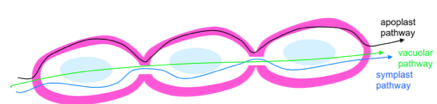
How does most water cross the root to the endodermis?
a)
By the apoplast pathway
b)
By the symplast pathway
c)
By the vacuolar pathway
49.
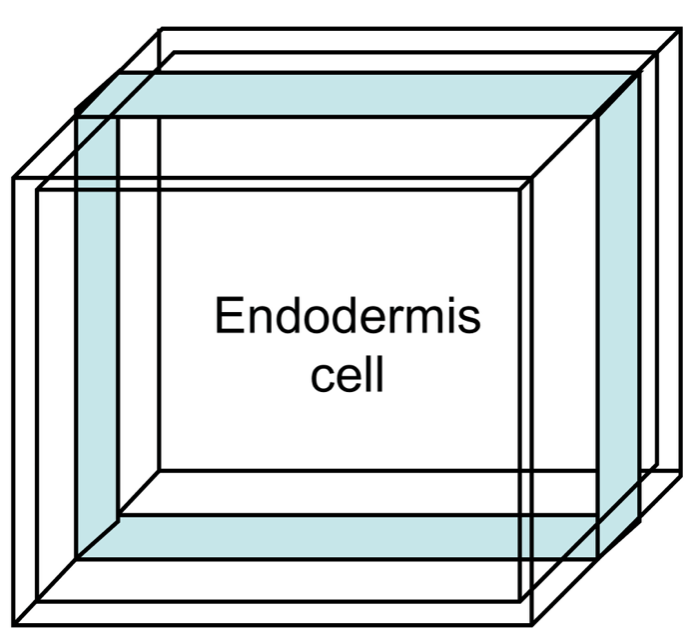
Which pathway is blocked by the Casparian strip in the endodermis?
a)
Apoplast pathway
b)
Symplast pathway
c)
Vacuolar pathway
50.
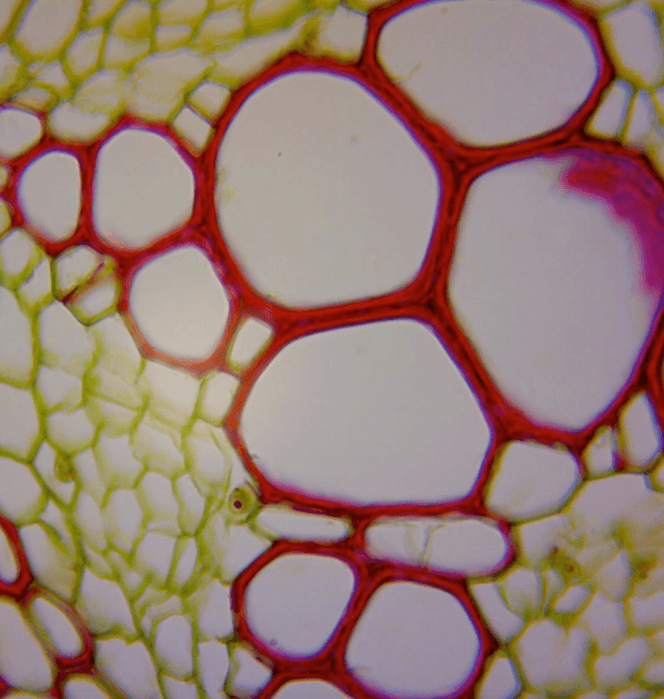
Which type of cell found in xylem contains pits?
a)
Vessels
b)
Tracheids
c)
Parenchyma
d)
Fibres
51.

What force between adjacent water molecules helps transpiration?
a)
Cohesion
b)
Adhesion
52.

What force between water molecules and lignin helps transpiration?
a)
Cohesion
b)
Adhesion
53.

What is actually measured by a potometer?
a)
Water loss from leaves
b)
Water used in photosynthesis
c)
Water uptake
54.

What is the effect of increasing leaf area on transpiration?
a)
It increases transpiration rate
b)
It decreases transpiration rate
55.

What is the effect of increasing wind speed on transpiration?
a)
It increases transpiration rate
b)
It decreases transpiration rate
56.

What is the effect of increasing humidity on transpiration?
a)
It increases transpiration rate
b)
It decreases transpiration rate
57.

What is the effect of increasing temperature on transpiration?
a)
It increases transpiration rate
b)
It decreases transpiration rate
58.

What is the effect of increasing light intensity on transpiration?
a)
It increases transpiration rate
b)
It decreases transpiration rate
59.

Which of these is an adaptation of hydrophytes?
a)
Stomata on underside of leaves
b)
Stomata on upper side of leaves
c)
Stomata in rolled leaves
d)
Stomata shielded by hairs
60.

Which phloem cells contain large numbers of mitochondria?
a)
Sieve tubes
b)
Companion cells
c)
Parenchyma
d)
Fibres
61.

Which of these is an adaptation of hydrophytes?
a)
Little lignification
b)
Large amounts of lignfication
62.

Rolled leaves are an adaptation of....
a)
Xerophytes
b)
Hydrophytes
c)
Mesophytes
63.

What are leaves referred to as when discussing translocation?
a)
Sources
b)
Sinks
64.

If the radioactivity was first detected 3 hours and 15 minutes after the radiolabelled carbon dioxide was introduced and the stem is 12cm from the leaf to the bud. What is the rate of movement?
a)
3.69cmh-1
b)
3.81cmh-1
c)
0.27cmh-1
d)
0.26cmh-1
65.

Which taxon is between Kingdom and Class?
a)
Phylum
b)
Order
c)
Family
d)
Genus
66.

Which taxon is between Class and Family?
a)
Phylum
b)
Order
c)
Family
d)
Genus
67.

Which is the more modern interpretation of Hallucigenia?
a)
A
b)
B
68.

What can we tell about Fucus serratus and Fucus vesiculosus? (Sorry not italics!)
a)
They share the same genus
b)
They share the same species
c)
They are in different families
d)
They are in different classes
69.

Which kingdom's members are multicellular, heterotrophic eukaryotes with nervous coordination?
a)
Animalia
b)
Plantae
c)
Fungi
d)
Protoctists
70.

Which kingdom's members are multicellular, autotrophic eukaryotes with cellulose cell walls?
a)
Animalia
b)
Plantae
c)
Fungi
d)
Protoctists
71.

Which kingdom's members are eukaryotes made up of a mycelium with chitin cell walls?
a)
Animalia
b)
Plantae
c)
Fungi
d)
Protoctists
72.

Which kingdom's members are small eukaryotes whose tissues show no differentiation?
a)
Animalia
b)
Plantae
c)
Fungi
d)
Protoctists
73.

Why did Carl Woese sequence the rRNA gene when proposing the 3 domain system?
a)
It is common to all forms of life
b)
It is transcribed into RNA
c)
It is found in the nucleus
d)
It is a short gene that is easy to sequence
74.

Which of these is a difference between archaebacteria and eubacteria?
a)
The composition of their cell walls
b)
The composition of their cell membranes
c)
Their method of DNA replication
d)
Their method of binary fission
75.

Are the limbs of seals, lizards and bats homologous structures or analogous structures?
a)
Homologous
b)
Analogous
76.

Are the wings of ducks and flies homologous or analogous?
a)
Homologous
b)
Analogous
77.

Which of these seres is a climax community?
a)
Algae and lichens
b)
Mosses and grasses
c)
Shrubs
d)
Forest
78.

Which of these seres is a pioneer species?
a)
Algae and lichens
b)
Mosses and grasses
c)
Shrubs
d)
Forest
79.

Which of these is a measure of low genetic biodiversity?
a)
A high number of alleles at a particular locus
b)
A low number of alleles at a particular locus
80.

Which term refers to the generation of biodiversity through the exploitation of available niches as seen in the Galapagos finches?
a)
Adaptive radiation
b)
Natural selection
c)
Survival of the fittest
d)
Evolutionary arms race
81.

What sort of adaptation is the specialisation of the beaks of the Galapagos finches?
a)
Anatomical
b)
Behavioural
c)
Physiological
82.

What sort of adaptation is the specialisation of the digestive systems of the Galapagos finches?
a)
Anatomical
b)
Behavioural
c)
Physiological
83.

What sort of adaptation is the use of cactus spines to find grubs under the bark of trees of the Carpenter Galapagos finch?
a)
Anatomical
b)
Behavioural
c)
Physiological
84.

Which of the following is a feature of exchange surfaces?
a)
High surface area
b)
Low surface area
85.

Which of the following is a feature of exchange surfaces?
a)
They are thin
b)
They are thick
86.

Which of the following is a feature of exchange surfaces?
a)
They are permeable
b)
They are impermeable
87.

Which of the following is a feature of exchange surfaces?
a)
They are moist
b)
They are desiccated
88.

Which of the following is a feature of exchange surfaces?
a)
They are ventilated
b)
They are unventilated
89.

What lines the tracheae of insects?
a)
Chitin
b)
Cartilage
c)
Lignin
d)
Collagen
90.

What does this graph show?
a)
Parallel flow in cartilaginous fish
b)
Counter current flow in bony fish
91.

What does this graph show?
a)
Parallel flow in cartilaginous fish
b)
Counter current flow in bony fish
92.

What is the principal exchange surface of larval amphibians?
a)
Skin
b)
Lungs
c)
Gills
93.

What is the gas exchange surface of mammals?
a)
Alveoli
b)
Bronchioles
c)
Trachea
d)
Pleural fluid
94.

What reduces friction between the lungs and the ribs in mammals?
a)
Diaphragm
b)
Bronchioles
c)
Trachea
d)
Pleural fluid
95.

Which statement correctly describes inspiration in mammals?
a)
Diaphragm contracts and flattens, intercostal muscles contract and lift ribs up and out
b)
Diaphragm contracts and flattens, intercostal muscles relax; ribs move down and in
c)
Diaphragm relaxes and is pushed up, intercostal muscles contract and lift ribs up and out
d)
Diaphragm relaxes and is pushed up, intercostal muscles relax; ribs move down and in
96.

What is the volume of air normally breathed in and out called?
a)
Residual volume
b)
Tidal volume
c)
Vital capacity
97.

What is the volume of air left in the lungs after a forced exhale called?
a)
Residual volume
b)
Tidal volume
c)
Vital capacity
98.

What is the exchange surface in leaves?
a)
Spongy mesophyll
b)
Palisade mesophyll
c)
Lower epidermis
d)
Upper epidermis
99.

What is the main photosynthetic layer in leaves?
a)
Spongy mesophyll
b)
Palisade mesophyll
c)
Lower epidermis
d)
Upper epidermis
100.

What layer contains the most stomata?
a)
Spongy mesophyll
b)
Palisade mesophyll
c)
Lower epidermis
d)
Upper epidermis
101.

What layer is transparent?
a)
Spongy mesophyll
b)
Palisade mesophyll
c)
Lower epidermis
d)
Upper epidermis
102.

What is the correct description of the cause of stomatal opening?
a)
K+ ions actively pumped into guard cells, water potential drops.
b)
K+ ions diffuse out of guard cells, water potential rises.
100 %

