
 Worksheets
Muscular and Skeletal Systems
Total questions: 100
Worksheet time: 28mins
Non-striated and under involuntary control
Skeletal Muscle
Smooth Muscle
Cardiac Muscle
Striated and under voluntary control
Skeletal Muscle
Smooth Muscle
Cardiac Muscle
Striated and under involuntary control
Skeletal Muscle
Smooth Muscle
Cardiac Muscle
This attaches your muscle to bone
Tendons
Ligaments
Aponeurosis
This attaches your bone to bone
Tendons
Ligaments
Aponeurosis
What does striated mean?
no visible markings
striped, banded appearance
long, thin
levels
The deltoid is a muscle in
the back
leg
chest
shoulder
The heart beating is an example of
a voluntary movement
slow-twitch muscles
fast-twitch muscles
an involuntary movement
The inside of the stomach is condsidered to be this type of muscle
cardiac
skeletal
smooth
voluntary
Babies are born with more bones than adults because some of their bones haven't _____________ yet
fused
calcified
ossified
developed

What are the 26 bones that make up your backbone called?
carpals
Tarsals
phalanges
vertebrae
What are the bones in the chest that protect your heart and lungs?
ribs
vertebrae
teeth
phalanges
Which of the following is NOT a function of the muscular system?
Stabilize joints and body position
Help the body cool down
Maintain posture
Produce heat
Produce movement
Which type of muscle control consists of conscious control of the muscles?
Voluntary
Involuntary
Which type of muscle control consists of non-conscious control of the muscles?
Voluntary
Involuntary

What would the antagonist pair of the Biceps brachii be?
Deltoid
Finger Extensors
Hamstrings
Triceps brachii
What would the antagonist pair of the Finger flexors be?
Deltoid
Finger Extensors
Hamstrings
Triceps brachii
Which of the following is NOT a function of the skeletal system?
Support
Movement
Storage
Nutrient transportation
Blood production

What type of joint is labeled letter A?
Hinge joint
Ball-and-socket joint
Fibrous-immovable joint
Gliding joint
Pivot joint
What type of joint is labeled letter B? (the neck, not the jaw)
Hinge joint
Ball-and-socket joint
Fibrous-immovable joint
Gliding joint
Pivot joint
What type of joint is labeled letter C?
Hinge joint
Ball-and-socket joint
Fibrous-immovable joint
Gliding joint
Pivot joint
What type of joint is labeled letter D?
Hinge joint
Ball-and-socket joint
Fibrous-immovable joint
Gliding joint
Pivot joint
What type of joint is labeled letter E?
Hinge joint
Ball-and-socket joint
Fibrous-immovable joint
Gliding joint
Pivot joint
What type of connective tissue acts like a cushion between joints?
Tendon
LIgament
Cartilage

What type of connector is letter A?
Tendon
LIgament
Cartilage
What type of connector is letter B?
Tendon
LIgament
Cartilage
What would the antagonist pair of the Hamstrings be?
Rectus abdominis
Pectoralis major
Quadriceps femoris
Trapezius
How many muscles are in the human body?
206
300-400
401-599
600+
How many bones are in the adult human body?
206
306
406
506
These muscles are only found in the heart
smooth
cardiac
marrow
cartilage
When skeletal muscles work in pairs at a joint, when one muscle contracts, the other ___________.
Get shorter
Stays the same length
Relaxes
Stabilizes
______________ is a tissue that is more flexible than bone and that protects the ends of bones and keeps them from rubbing together.
marrow
cartilage
joint
ligament
______________ found beneath the compact bone that has lots of little air pockets which makes the bones lighter.
compact bone
spongy bone
marrow
cartilage
Which system is responsible for creating red blood cells?
skeletal
nervous
muscular
circulatory
Smooth muscle also helps move food through
your digestive tract via the process...
propulsion
contraction
peristalsis
digestion
Bones are living tissue.
True
False
What are the functions of the muscular system. Select all correct answers. (more than 1)
Helps you see
Helps you move
Helps fight diseases
Creates heat
Helps your heart beat
What do tendons attach?
muscles to ligaments
muscles to organs
muscles to other muscles
muscles to bones
Muscles always work in _____
teams
group of three
pairs
alone


What is the function of marrow?
To make protein
To make red blood cells and store fat.
reduce friction
to hold bones together
What are the 4 types of bones?
Flat, Long, Irregular, Short
Flat, Irregular, Clumped, Long
Irregular, Raised, Long, Flat
Long, Flat, Irregular, Small
The tarsals is what type of bone?
Long Bone
Short Bone
Flat Bone
Irregular Bone
Sesamoid Bone
The sternum is what type of bone?
Long Bone
Short Bone
Flat Bone
Irregular Bone
Sesamoid Bone
The mandible is what type of bone?
Long Bone
Short Bone
Flat Bone
Irregular Bone
Sesamoid Bone
The knee and elbow are examples of which type of joint?
Hinge
Ball and Socket
Ellipsoid/Condyloid
Pivot
Saddle
The shoulder and hip are examples of which type of joint?
Hinge
Ball and Socket
Ellipsoid/Condyloid
Pivot
Saddle
Bones that have more than one shape (vertebrae) are called:
Long Bones
Short Bones
Irregular Bones
Flat Bones
Sesamoid Bones

These allow no movement between bones, they are interlocked and held together by connective tissue.
Slightly moveable joints
Fibrous joint
Ball and Socket Joint
Gliding Joint

These permit a small amount of movement, bones are further apart than immovable joints
Ball and Socket
Fibrous Joint
Pivot Joint
Hinge Joint
Where would you find smooth muscle?
lining the inside of digestive organs
covering the heart
your biceps and triceps
only in your legs

If you're bending your arm, which type of muscles are you using?
Extensors
Cardiac
Flexors
Passive movement

What is the function of extensors?
Bending a body part
Straightening a body part
Body heat production
Digestive processing

Your hamstrings bend your knee. What type of muscle is this?
Flexors
Extensors
Cardiac
Involuntary

Which one does NOT show an example of your muscular system's function?
Stability and posture
Moving about a room
Digestion
Blood circulation
They all are examples of muscular system functions!

Name the highlighted bone.
scapula
sternum
metatarsal
carpal

Name the highlighted bone.
scapula
sternum
metatarsal
clavicle

Name the highlighted bone.
scapula
sternum
metatarsal
clavicle

Name the highlighted bone.
metacarpals
sternum
carpals
clavicle

Name the highlighted bone.
metacarpals
sternum
carpals
clavicle

Name the highlighted bone.
metacarpals
sternum
carpals
metatarsals

Name the highlighted bone.
metacarpals
sternum
tarsals
calcaneus

Name the highlighted bone.
foot phalanges
cranium
tarsals
calcaneus

Name the entire structure.
femur
ulna
cranium
calcaneus

Name the highlighted bone.
humerus
tibia
tarsals
ulna

Name the highlighted bone.
humerus
tibia
radius
ulna

Name the highlighted bone.
humerus
tibia
radius
ulna

Name the highlighted bone.
femur
tibia
radius
ulna

Name the highlighted bone.
femur
tibia
radius
ulna

Name the highlighted bone.
femur
tibia
fibula
ulna

vertebrae
What are your phalanges? Check all that apply.
toes
ribs
spine
fingers
What is your jaw called?
mandible
ilium
metacarpals
ischium

Name the highlighted bone.
Femur
Fibula
Tibia
Patella


Name this muscle.
deltoids
latissimus dorsi
gluteus maximus
gastrocnemius


Identify this muscle.
Bicep
Gluteus Maximus
Trapezius
Erector spinae
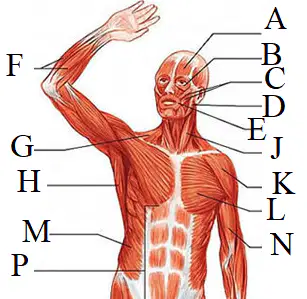
What is L?
Trapezius
Latissimus dorsi
Deltoid
Pectoralis Major
What is N?
Sternocleidomastoid
External Oblique
Rectus Abdominis
Biceps Brachii
What is M?
Sternocleidomastoid
External Oblique
Rectus Abdominis
Biceps Brachii
What is P?
Sternocleidomastoid
External Oblique
Rectus Abdominis
Biceps Brachii
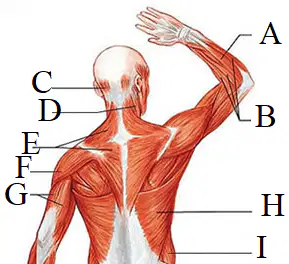
What is G?
Trapezius
Deltoid
Latissimus Dorsi
Triceps Brachii
What is H?
Trapezius
Deltoid
Latissimus Dorsi
Triceps Brachii
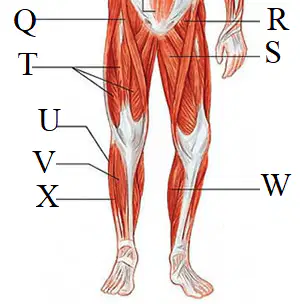
What is Q?
Abductor Longus
Tibialis Anterior
Sartorius
Gastrocnemius
What type of muscle tissue would be responsible for closing your airways in an allergic reaction?
Cardiac
Smooth
Skeletal
Vestibular
Which muscle tissue is located inside blood vessels?
Cardiac
Smooth
Skeletal
Vestibular

