wayground logo

Free Printable Worksheets

Font size

S
M
L
XL
Worksheets

Test Corrections 101

Total questions: 101

Worksheet time: 5hrs 36mins

Name
Class
Date
1.
The molecules needed for life are called...
a)
Atoms
b)
Biomolecules
c)
photosynthesis 
d)
elements
2.
This biomolecule is composed of carbon, hydrogen and oxygen. It can be found in foods such as bread, pasta, potatoes, and any other starchy food. 
a)
Protein
b)
lipids
c)
carbohydrates
d)
nucleic acid
3.
This biomolecule is a fancy word for fat. 
a)
lipid
b)
nucleic acid
c)
protein
d)
carbohydrate
4.
This biomolecule this biomolecule is composed of carbon, hydrogen, oxygen, and nitrogen. It is also made up of amino acids. 
a)
lipids
b)
nucleic acids
c)
protein
d)
carbohydrates
5.
This biomolecule is composed of carbon, hydrogen, oxygen, nitrogen, and phosphorous. It also stores and transfers genetic information.
a)
Lipids
b)
Carbohydrates
c)
Protein
d)
Nucleic Acid
6.
This is a type of protein that can speed up chemical reactions. 
a)
Nucleic Acid
b)
Organic
c)
Enzyme
d)
Chloroplast
7.
Which element must be present to make something organic?
a)
Carbon
b)
helium
c)
magnesium
d)
aluminum
8.
Fatty acids make up this biomolecule. This biomolecule is makes up fats, oils, and waxes. 
a)
lipids
b)
organic
c)
enzyme
d)
protein
9.
A large molecule formed by bonding smaller units is called...
a)
monomer
b)
organic
c)
polymer
d)
proteins
10.
A single molecule that can be formed to make a larger molecule. 
a)
Monomer
b)
polymer
c)
protein
d)
enzyme
11.
This biomolecule is hydrophobic (it does not like water)...
a)
enzyme
b)
biomolecule
c)
lipid
d)
amino acid
12.
The picture is of a biomolecule that is performs specific functions and is made up of amino acids...
a)
amino acid
b)
protein
c)
carbohydrates
d)
nucleic acid
13.
This biomolecule is made up of fatty acids and makes up fats, oils, and waxes... It also makes up the cellular membrane in a cell***important to know!
a)
Lipids
b)
enzymes
c)
biology
d)
proteins
14.
Which of these is not a biomolecule...
a)
Nucleic acid
b)
Lipid
c)
Carbohydrate
d)
monomer
15.
This organelle is a rigid outer layer that protects plant cells.
a)
Cell Membrane
b)
Cell Wall
c)
Nucleus
d)
Chloroplast 
16.
This organelle controls what goes in and out of plant and animal cells.
a)
Cell Wall
b)
Cell Membrane
c)
Cytoplasm
d)
Cytoplasm
17.
The _____________ stores food, water, wastes, and other materials in both plant and animal cells.
a)
Vacuole
b)
Mitochondria
c)
Ribosomes
d)
Chromatin
18.
An organelle that captures energy from the sunlight in order to use it to produce food in plant cells is ______________.
a)
Chromatin
b)
Chloroplast
c)
Cytoplasm
d)
Cell Membrane
19.
________________ create proteins for plant and animal cells.
a)
Ribosomes
b)
Endoplasmic Reticulum
c)
Golgi Bodies
d)
Lysosomes
20.
The organelles that clean plant and animal cells by using chemicals to break down food and worn out cell parts are ______________.
a)
Lysosomes
b)
Mitochondria
c)
Nucleolus
d)
Cell Wall
21.
This organelle is like a train station in a city.  It can be found in both plant and animal cells.  This organelle has passageways within the cell that carry proteins and other materials from one part of the cell to another.
a)
Endoplasmic Reticulum
b)
ET
c)
Golgi Bodies
d)
Nucleolus
22.
TRUE OR FALSE:  The Mitochondria produces energy for plant and animal cells.
a)
TRUE
b)
FALSE
23.
The _____________ holds the DNA, and controls the functions of plant and animal cells.
a)
Nucleus
b)
Nuclear Membrane
c)
Nucleolus
d)
New Moon
24.
This can be found in the nucleus, and are tiny strands that contain the instructions for directing the cell's functions.
a)
DNA/Chromatin
b)
Chloroplasts
c)
Golgi Bodies
d)
ER
25.
This can be found in the nucleus, and are tiny strands that contain the instructions for directing the cell's functions.
a)
DNA/Chromatin
b)
Chloroplasts
c)
Golgi Bodies
d)
ER
26.
The _________ ____________ can be found in plant and animal cells, and receive proteins and materials from the ER, packages them, and distributes them.
a)
ER
b)
Golgi Bodies
c)
Cell Membrane
27.
This organelle can be found inside the nucleus, and produces ribosomes.
a)
Nucleus
b)
Nucleolus
c)
New Moon
d)
New Balance Shoe
28.
Which of the following best describes a DNA molecule?
a)
double helix
b)
contains ribose
c)
made of amino acids
d)
contains Uracil
29.
Why is DNA important?
a)
it is very small and very complicated
b)
it's in everything
c)
it serves as the blueprint for traits of all living things
d)
because we eat it every day for energy
30.
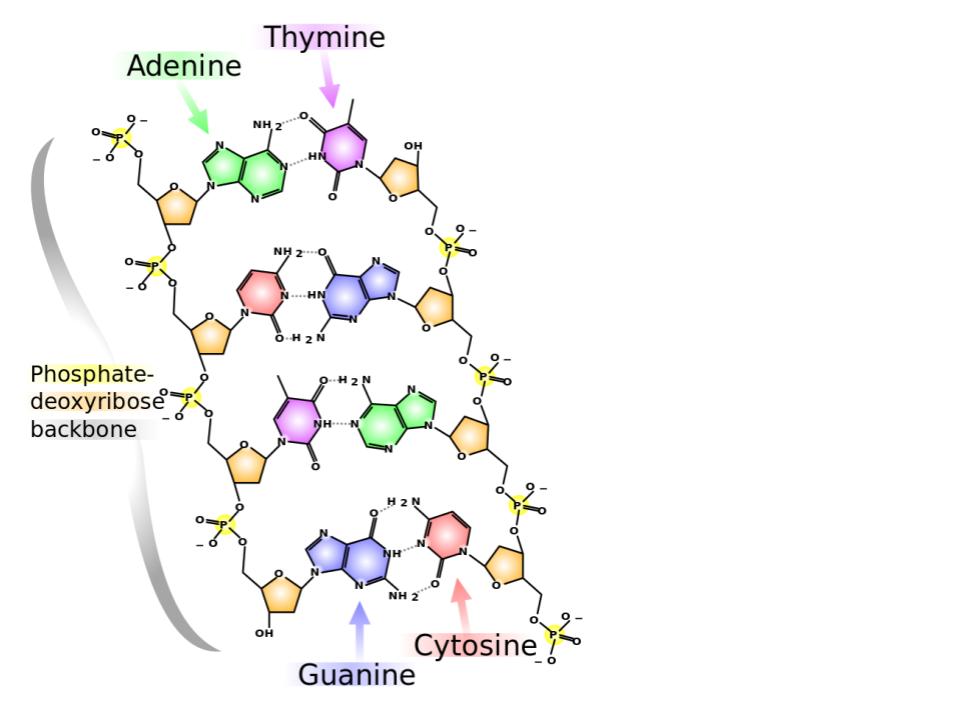
Which 2 molecules form the sides (backbone) of the DNA ladder?
a)
deoxyribose sugar and adenine
b)
deoxyribose sugar and a hydrogen bond
c)
deoxyribose sugar and the nucleus
d)
deoxyribose sugar and phosphate
31.
Nitrogenous bases are joined by which type of bond?
a)
polar bonds
b)
ionic bonds
c)
covalent bonds
d)
hydrogen bonds
32.
Which 2 molecules forms the sides (backbone) of the DNA ladder?
a)
deoxyribose and adenine
b)
deoxyribose and a hydrogen bond
c)
sugar and the nucleus
d)
deoxyribose (sugar) and phosphate
33.
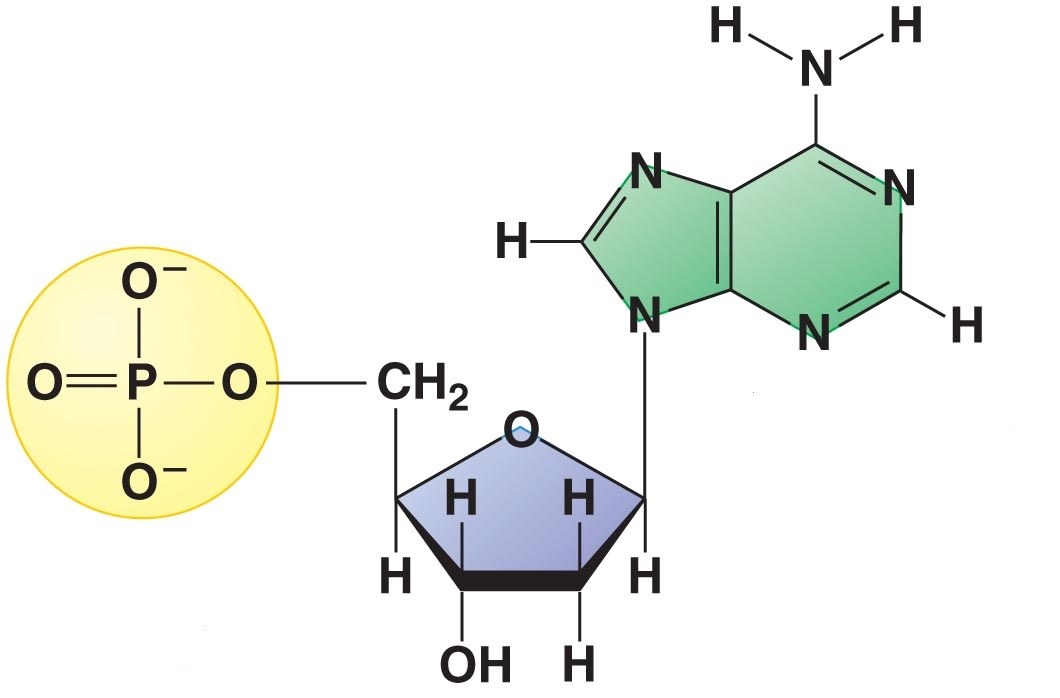
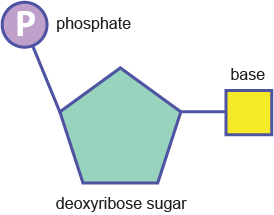
What are the three components of a nucleotide?
a)
sugar, hydrogen, nitrogen base
b)
sugar, oxygen, nitrogen base
c)
sugar, phosphate, nitrogen base
d)
sugar, phosphate, protein
34.
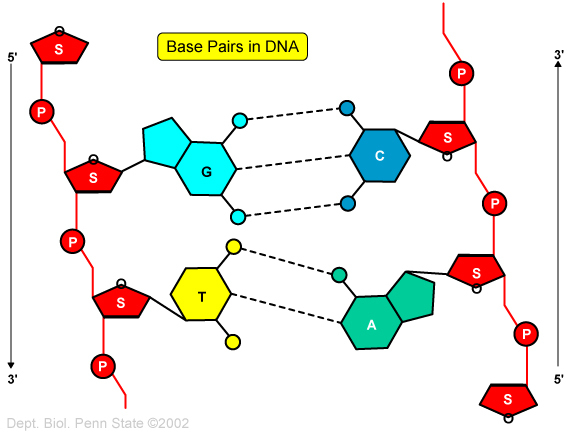
Cytosine always pairs with
a)
Adenine
b)
Thymine
c)
Uracil
d)
Guanine
35.
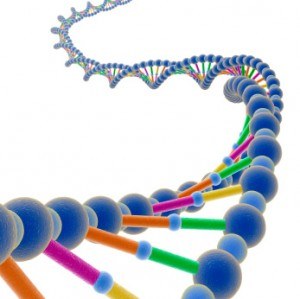
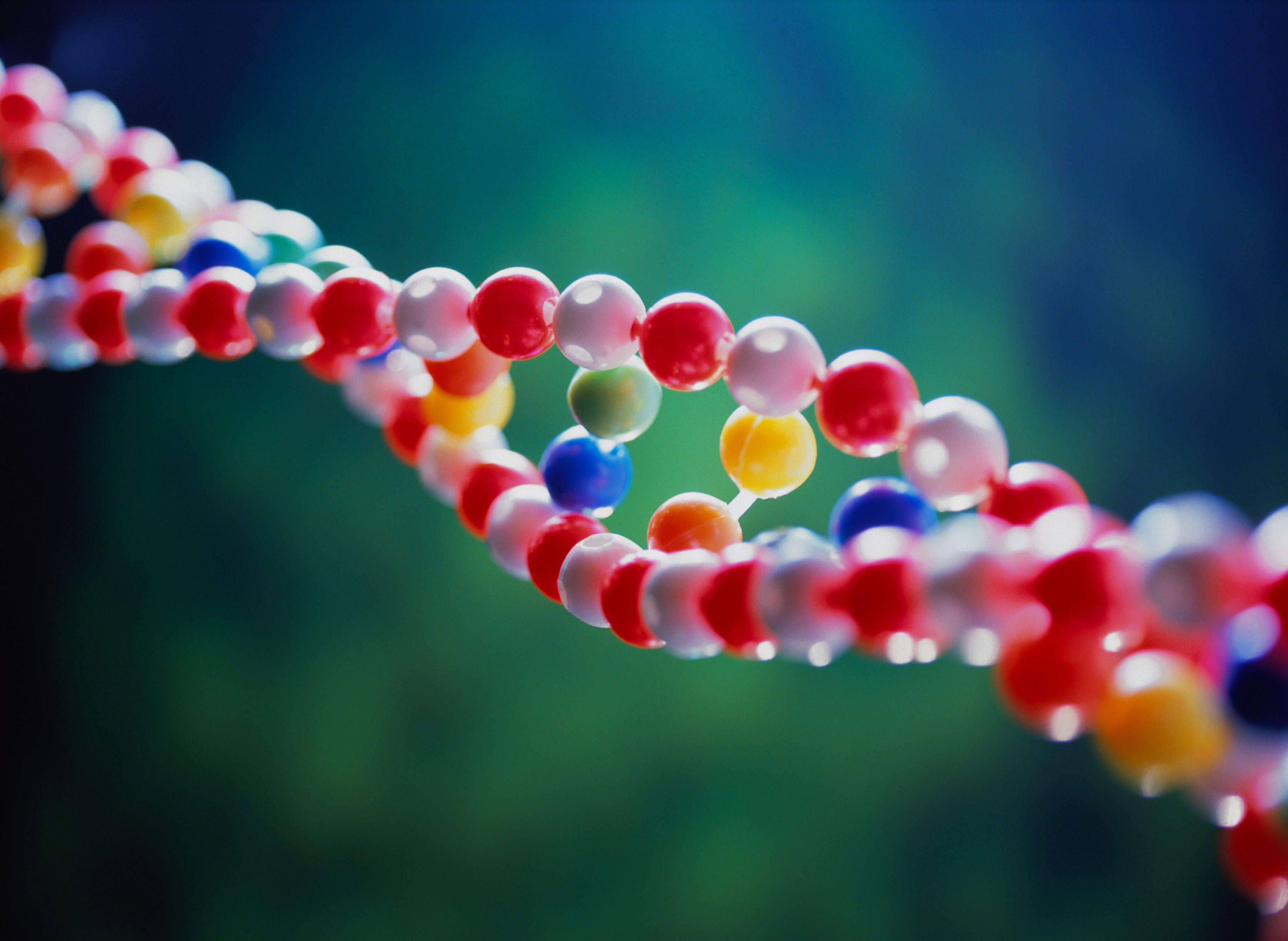
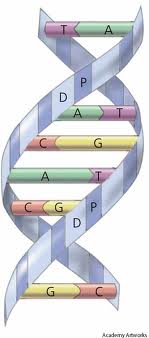
Name this structure
a)
double helix
b)
nucelotide
c)
twisted ladder
d)
hydrogen bond
36.
Which organelle is DNA usually found in?
a)
cell membrane
b)
vacuole
c)
ribosome
d)
nucleus
37.
Nucleotides are made up of a sugar, phosphate, and..?
a)
nitrogenous base
b)
nucleic acid
c)
cholesterol
d)
fatty acid
38.
Guanine bonds with ______________.
a)
Adenine
b)
Guanine
c)
Cytosine
d)
Thymine
39.
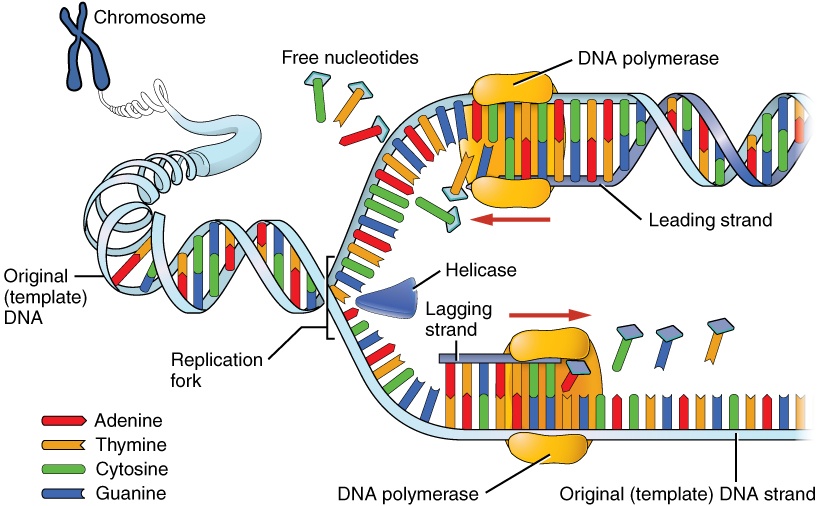
The two strands of DNA are held together by:
a)
Hydrogen Bonds
b)
Phosphodiester Bonds
c)
Glycolsyl Bonds
d)
Glycosidic Linkages
40.
What is the complement to the DNA strand below:
5'-ATGCCAT-3'
a)
5'-TACGGTA-3'
b)
3'-TACGGTA-5'
c)
3'-ATGGCAT-5'
d)
5'-ATGGCAT-3'
41.

Which of the following is a base pair?

a)

Adenine - Cytosine

b)

Cytosine - Thymine

c)

Deoxyribose - Cytosine

d)

Cytosine - Guanine

42.
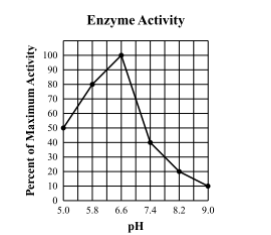
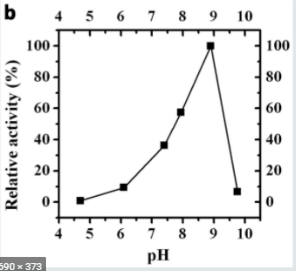
The graph below shows how the activity of an enzyme changes over a range of pH values. Which of the following conclusions can be drawn from this graph?
a)
The optimum pH of the enzyme is 6.6.
b)
The optimum pH of the enzyme is 5.8
c)
The enzyme’s activity continually increases as pH increases from 5.0 to 9.0
d)
The enzyme’s activity is greater around pH of 8.0 than around pH of 5.0.
43.
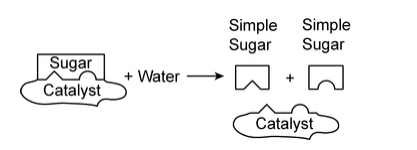
The diagram below illustrates a biochemical process that occurs in organisms. What is another name for the substance labeled "catalyst"?
a)
Enzyme
b)
inorganic compound
c)
Hormone
d)
Antibody
44.
Which of the following best explains why enzymes are necessary for many cellular reactions?
a)
Enzymes supply the oxygen necessary for the reactions
b)
 Enzymes change reactants from solid to liquids during the reactions.
c)
The reactions take up too much space in the cell if the enzymes are missing.
d)
The reactions are too slow to meet the needs of the cell if enzymes are missing. 
45.
What will most likely happen if an appropriate enzyme is added to a chemical reaction? 
a)
The reaction rate will increase.
b)
The equilibrium of the reaction will be maintained. 
c)
The reaction rate will decrease.
d)
The reaction will stop. 
46.
The human body maintains a temperature of around 98.6 degrees at all times. Enzymes are involved in almost every chemical reaction in the body. Which of the following describes the connection between these two statements? 
a)
 Enzymes function best at a specific temperature.
b)
The body needs to be warm to prevent hypothermia.
c)
The body is kept relatively warm to prevent too much enzyme action.
d)
 There is no connection between the two statements. 
47.
The enzyme lactase will break down the sugar lactose into which of the following components? 
a)
 monosaccharides
b)
nucleic acids
c)
amino acids
d)
phospholipids
48.
What is a substance called if it speeds up a chemical reaction?
a)
reusable
b)
catalyst
c)
specific
d)
fragile
49.
With what 3 letters do enzymes typically end?
a)
-ose
b)
-ase
c)
-ese
d)
-tic
50.
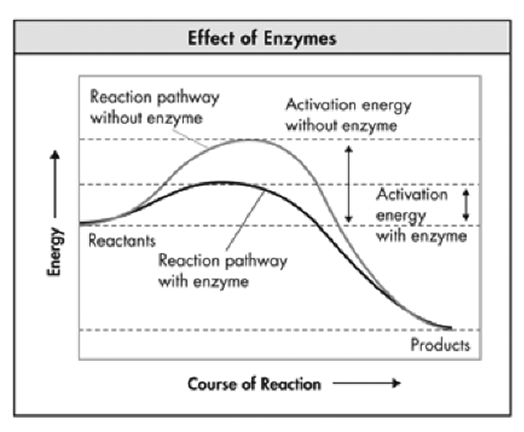
The graph shows how enzymes affect reactions in cells. Which statement best summarizes the information shown in the graph?
a)
Enzymes increase the energy of the reactants.
b)
Enzymes decrease the energy level of the products.
c)
Enzyme decrease the activation energy of the reaction.
d)
Enzymes reverse the direction of the reaction.
51.
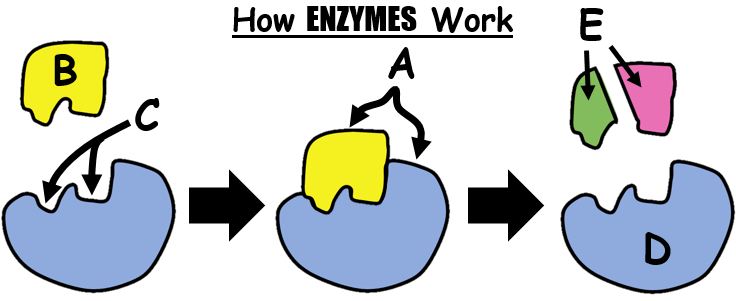
In the diagram, what is letter A? 
a)
product
b)
substrate
c)
enzyme-substrate complex
d)
active site
52.
Enzymes are...
a)
nucleic acids
b)
proteins
c)
lipids
d)
carbohydrates
53.
What happens when enzymes are heated to a high temperature?
a)
The enzymes die.
b)
The shapes of the enzyme are altered denature
c)
The enzymes' amino acid sequence changes.
d)
The enzymes remain the same
54.

Changes in pH and temperature can ___________________ an enzyme which causes it to lose its shape and affects its function.

a)

puncture

b)

denature

c)

double

d)

delete

55.

What is the optimal pH for this enzyme?

a)

6

b)

10

c)

9

d)

7

56.

Where do substrates bind to an enzyme?

a)

calcium channels

b)

active site

c)

receptor molecules

d)

voltage-gated channels

57.

All of the following affect the functioning of an enzyme EXCEPT:

a)

pH

b)

temperature

c)

metabolism

d)

enzyme concentration, substrate concentration, inhibitor molecules

58.
What is the purpose of photosynthesis?
a)
make glucose
b)
make ATP
c)
make light
d)
release carbon dioxide
59.
In which organelle (part of the cell) does photosynthesis take place?
a)
mitochondria
b)
chloroplast
c)
nucleus
d)
cell membrane
60.
Which of the following is the correct equation for PHOTOSYNTHESIS?
a)
CO+ light + H2O --> O+ Sugar
b)
CO+ sugar + H2O --> O+ light
c)
O2 + light + H2O --> CO+ Sugar
d)
CO+ O2 + H2O --> Light+ Sugar
61.
What are the products of photosynthesis?
a)
Carbon dioxide and water
b)
Carbon dioxide and oxygen
c)
Glucose and oxygen
d)
Glucose and water
62.
Cellular Respiration's goal is to
a)
make water
b)
make ATP
c)
make glucose
d)
make  oxygen
63.
Cellular respiration occurs in both plants and animals.
a)
true
b)
false
64.
The powerhouse of the cell is the...
a)
Mitochondrion
b)
Golgi body
c)
Nucleus
d)
Ribosomes
65.
Where are proteins made?
a)
Golgi body
b)
Mitoichondrion
c)
Chromosomes
d)
Ribosomes
66.
The ______________ is the brain of the cell.
a)
Vacuole
b)
Nucleus
c)
Chromosomes
d)
60 W light bulb
67.
The two kinds of cells are Prokaryotes and Eukaryotes. How are they different?
a)
Prokaryotes have a nucleus.
b)
Eukaryotes have a nucleus.
c)
Prokaryotes are plant cells.
d)
There is no difference.
68.
Complex cell. Can be plant or animal. Contains membrane bound organelles. 
a)
Eukaryotic Cell
b)
Prokaryotic Cell
c)
Bacteria
d)
Blood cell
69.
This cell part is in ALL cells. It is the gel-like substance that provides cell shape.
a)
Chloroplasts
b)
Chromosomes
c)
Cytoplasm
d)
Mitochondria
70.
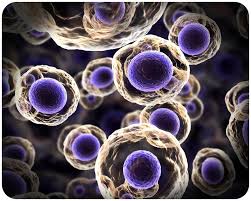
The image is an example of ..... 
a)
Animal Cell
b)
Plant Cell 
71.
The cellular process in which materials are moved across a membrane from an area of low concentration to an area of high concentration is called
a)
osmosis.
b)
simple diffusion.
c)
active transport.
d)
passive transport.
72.

What will be the effect of placing a plant cell in a hypotonic solution?

a)

The plant will wilt.

b)

The cell will shrink in size.

c)

The cell will remain unaffected.

d)

The cell will expand and become turgid.

73.
Cells use __________ to take in large molecules or other cells.
a)
passive transport by osmosis
b)
passive transport by diffusion
c)
active transport by endocytosis
d)
active transport by carrier proteins
74.
Examine the diagrams of plant cells.  Each cell has been placed in a different solution.
The cell in diagram 2 has been placed in a solution that contains __________ the interior of the cell.
a)
water that is warmer than
b)
a lower concentration of water than
c)
the same concentration of water as
d)
water that is cooler than
75.
Which of the following types of passive transport involves water molecules moving from a high concentration to a low concentration?
a)
osmosis
b)
simple diffusion
c)
filtration
d)
facilitated diffusion
76.
The fluid mosaic model shown above describes the structure and function of
a)
chloroplasts.
b)
chromosomes.
c)
nuclei.
d)
cell membranes.
77.
The cell membrane, or plasma membrane, is made up of a lipid bilayer in which hydrophilic heads face outward and hydrophobic tails face inward.
This arrangement within the cell membrane allows it to 
a)
fuse with ribosomes during DNA replication.
b)
absorb water from the cytoplasm whenever necessary.
c)
keep out all viral and bacterial infections.
d)
control the movement of substances in and out of the cell.
78.
Organisms must be able to adapt to a changing external and internal environment.  An organism's ability to maintain a stable internal environment is known as homeostasis.  How does a cell's membrane help an organism maintain homeostasis?
a)
Cell membranes directly control the temperature of the cell.
b)
Cell membranes control the substances that enter or leave cells.
c)
Cell membranes use a large portion of the cell's energy supply.
d)
Cell membranes protect the cell organelles from large doses of radiation.
79.
The cell membrane is a highly selective barrier that controls the movement of substances in and out of the cell.  In fact, polar molecules are unable to go across unless
a)
they are broken down into smaller pieces.
b)
they are enclosed in water-filled vesicles.
c)
they pass through channels in the cell membrane.
d)
they react with other substances to become nonpolar.
80.
Cells can function
a)
at any temperature and pH.
b)
only in a narrow range of temperature and pH.
c)
in rapidly changing temperatures and pHs.
d)
in a wide range of pHs and temperatures.
81.
How is homeostasis important to the survival of organisms?
a)
Homeostasis makes organisms grow bigger and taller.
b)
Homeostasis helps organisms locate food.
c)
Homeostasis allows organisms to regulate their temperature.
d)
Homeostasis makes all organisms hibernate.
82.
Movement of particles through the cell membrane from high to low concentrations
a)
diffusion
b)
photosynthesis
c)
mitochondria
d)
active transport
83.
Allows certain molecules or ions to pass through it by diffusion and doesn't allow others.
a)
protein
b)
semi-permeable membrane
c)
isotonic
d)
homeostasis
84.
Equal percentage of solutes inside and out. 
Concentration of substances is the same. 
a)
hypotonic
b)
isotonic
c)
nucleus
d)
hypertonic
85.

What are the two types of cells?

a)

Prokaryotic & Eukaryotic

b)

Bacteria & Eukaryotic

c)

Eukaryotic

d)

Animal & Plant

86.

Which of the following is not under the Cell Theory?

a)

Cells are the basic unit of life

b)

All organisms are made up of cells

c)

Cells came from other cells

d)

A cell is an indestructible particle

87.

Which of the following does a plant cell ONLY have?

a)

Vacuole

b)

Chloroplast

c)

Centrosome

d)

Nucleus

88.

Which organelle is responsible for the production of ribosomes?

a)

Nucleolus

b)

Nucleus

c)

Rough ER

d)

Golgi Apparatus

89.

What is the full name of DNA?

a)

Departmental Network Administrator

b)

Does Not Apply

c)

Deoxyribonucleic Acid

d)

Ribonucleic Acid

90.

Which organelle is responsible for the removal of waste and foreign particles?

a)

Plasma Membrane

b)

Lysosomes

c)

Peroxisomes

d)

Mitochondrion

91.

What is a unique characteristic of the plasma (cell) membrane?

a)

Semipermeable

b)

Rigid

c)

Jelly-like

d)

Orange

92.

What is the name of this organelle?

a)

Mentos

b)

Mitochondrion

c)

Chlorophyll

d)

Chloroplast

93.

ALL prokaryotes are unicellular, in nature.

a)

TRUE

b)

FALSE

94.
Plants and animal cells are examples of ___ cells 
a)
prokaryotic cells 
b)
eukaryotic cells 
95.

Which does only eukaryotic cells contain?

a)

nucleus

b)

DNA

c)

cell membrane

d)

ribosomes

96.

Which do BOTH prokaryotes and eukaryotes contain?

a)

nucleus

b)

mitochondria

c)

ribosomes

d)

cell wall

97.
Mitochondria function:
a)
Converts light energy to sugar
b)
In plant cell only
c)
Converts sugar to ATP (power for cell- cellular respiration)
d)
Photosynthesis
98.
The Golgi apparatus _____.
a)
packages cell products for export
b)
eliminates waste
c)
stores DNA
d)
makes energy
99.
What is the fluid inside a cell called? 
a)
Endoplasimic Reticulum
b)
Orange Juice
c)
Water
d)
Cytoplasm
100.
Where is DNA stored in a cell? 
a)
Lysosomes
b)
Golgi Complex
c)
Ribosomes
d)
Nucleus
101.
This organelle helps plants keep their rigid structure. 
a)
Cell wall
b)
Cell membrane
c)
Chloroplast
d)
Nucleus