wayground logo

Free Printable Worksheets

Font size

S
M
L
XL
Worksheets

8TH GRADE - SPRING SEMESTER REVIEW

Total questions: 130

Worksheet time: 2hrs 27mins

Name
Class
Date
1.
Peanut ran 50 meters in 10 seconds.  What was Peanut's average speed?
a)
2 m/s
b)
5 km/h
c)
5 m/s
d)
5 m/s North
2.
When an object has a net force of 0 N, it is an example of what kind of force?
a)
Balanced
b)
Unbalanced
c)
Acceleration
d)
Gravity
3.
A force is a ____________________
a)
push or pull
b)
motion
c)
speed
d)
net force
4.
Which of the options below is an example of velocity?
a)
20 m/s
b)
200 km/h
c)
20 m/s East
d)
20 East
5.

The greater the mass of an object,

a)

the easier the object starts moving.

b)

the greater its inertia.

c)

the more balanced it is.

d)

the more space it takes up.

6.

According to Newton’s third law of motion, when a hammer strikes and exerts force on a nail, the nail

a)

creates a friction with the hammer.

b)

disappears into the wood.

c)

exerts an equal and opposite force on the hammer.

d)

moves at a constant speed.

7.

The overall force on an object after all the forces are added together is called the

a)

balanced force

b)

unbalanced force

c)

net force

d)

centripetal force

8.

Velocity consists of both...

a)

Time & Distance

b)

Speed & Direction

c)

Time & Direction

d)

Speed & Distance

9.

To find average speed of an object, you must know...

a)

Distance & Time

b)

Distance & Velocity

c)

Time & Speed

d)

Distance & Acceleration

10.

One name for Newton's First Law of Motion is

a)

Inertia

b)

gravity

c)

momentum

11.

What is Newton's 1st Law of Motion?

a)

An object at rest stays at rest unless acted up by an outside force and an object in motion stays in motion unless acted upon by an outside force

b)

Force = mass x acceleration

c)

For every action, there is an equal and opposite reaction

d)

Inertia

12.

What is Newton's 2st Law of Motion?

a)

an object at rest stays at rest unless acted upon by an outside force and an object in motion will stay in motion unless acted upon by an outside force

b)

Force = mass x acceleration

c)

For every action there is an equal and opposite reaction

13.

What is Newton's 3rd Law?

a)

an object at rest stays at rest unless acted upon by an outside force and an object in motion will stay in motion unless acted upon by an outside force

b)

Force = mass x acceleration

c)

For every action there is an equal and opposite reaction

14.

Which law is this an example of: If a person throws a tennis ball and a balloon with the same amount of force, the tennis ball will go farther because it has more mass.

a)

1st

b)

2nd

c)

3rd

15.

Which law is this an example of: When the baseball hits the bat, the ball moves in the opposite direction. The harder you hit the ball, the harder it flies in the opposite direction.

a)

1st

b)

2nd

c)

3rd

16.

Which law is this an example of: A basketball is still until someone picks it up and throws it. The basketball is moving until it is stopped by someones hands.

a)

1st

b)

2nd

c)

3rd

17.

A roller coaster that is in motion is an example of

a)

Kinetic energy

b)

Potential energy

18.

A pencil balanced on the edge of a desk, that could fall at any moment is an example of

a)

Kinetic energy

b)

Potential energy

19.
Which of the following shows an energy transformation from chemical energy to electrical to light energy?
a)
A bolt of lightning lights the night sky.
b)
A candle glows brightly in the dark.
c)
A fire in a fireplace lights up a room.
d)
A battery causes a flashlight to shine.
20.
What energy transformations take place when a battery-operated radio is in use?
a)
Electrical to chemical to light
b)
Sound to chemical to mechanical
c)
Chemical to electrical to sound
d)
Light to electrical to thermal
21.
People get energy from the food that they eat and transform that energy as they move. Which energy transformations occur as a student rapidly rubs the palms of his hands together?
a)
mechanical to thermal to electrical
b)
chemical to mechanical to thermal
c)
mechanical to chemical to sound
d)
chemical to sound to electrical
22.
A television works by transforming electrical energy into what other kinds of energy?
a)
Light, thermal, and sound
b)
Thermal, chemical, and solar
c)
Sound, mechanical, and electrical
d)
Light, chemical, and mechanical
23.
Which of the following shows the correct order of the energy transformations that occur when green plants produce their food from the Sun’s energy?
a)
chemical to thermal
b)
light to chemical
c)
thermal to light
d)
chemical to electrical
24.
According to the Law of Conservation of Energy, energy cannot be _________ or ____________. 
a)
destroyed, destroyed
b)
created, saved
c)
created, destroyed
d)
lost, found
25.
All of the following are nonrenewable resources EXCEPT
a)
Coal
b)
animals
c)
petroleum (oil)
d)
natural gas
26.
Which of the following means of transportation uses a renewable resource for its energy source?
a)
solar powered car
b)
coal powered steam train
c)
natural gas car
d)
gasoline truck
27.
Oil comes from deep underground. When people have used all of the oil on Earth, it will be gone. What kind of resource is oil?
a)
a renewable resource
b)
an inexhaustible resource
c)
a nonrenewable resource
d)
a non-usable resource
28.
A resource that is not easily replaced...
a)
Renewable
b)
Nonrenewable
29.
Can be replaced within a human lifetime
a)
Nonrenewable resource
b)
Renewable resource
30.
Which group includes ALL renewable resources?
a)
Coal, trees, water, oil
b)
Water, wind, sun, plants
c)
Minerals, sun, natural gas, water
31.
Which of the following natural resources are nonrenewable?
a)
Water
b)
Animals
c)
Natural gas
d)
Wind
32.
The type of heat transfer that happens through direct contact of molecules or particles with each other is ___________________.
a)
Convection
b)
Conduction
c)
Radiation
d)
insulation.
33.
___________________ is the type of heat transfer that occurs in fluids, such as warm air rising and cold air sinking; creating wind.
a)
Convection
b)
Conduction
c)
Radiation
d)
insulation.
34.
What is the definition of CONDUCTION?
a)
When heat is transferred from objects like rays of light or electromagnetically.
b)
a  hot liquid or air that  expands, becomes less dense, and rises or becomes more dense, and sinks.
c)
When heat transfers from objects that are touching.
d)
When heat transfers through the heater or AC in your house.
35.
What is the definition of CONVECTION
a)
When heat transfers through waves.
b)
When heat transfers from objects that are touching.
c)
a  hot liquid or air that  expands, becomes less dense, and rises or becomes more dense, and sinks.
d)
Heat traveling from the sun
36.
The baby chickens are kept warm from the heat lamps demonstrates this type of heat transfer. 
a)
conduction
b)
convection
c)
radiation
37.
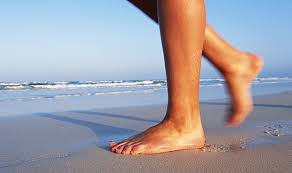
Walking on the warm sand sand with your bare feet demonstrates this type of heat transfer. 
a)
conduction
b)
convection
c)
radiation
38.
A group of friends gather around a fire to stay warm.
a)
conduction
b)
convection
c)
radiation
39.

The handle of a metal spoon warms up when it is placed in a hot bowl of soup because of

a)

Convection

b)

Conduction

c)

Radiation

d)

insulation.

40.

An iron is placed on your clothes to smooth out the wrinkles. The iron transfers heat to your clothes through

a)

conduction

b)

convection

c)

radiation

41.

A pot is placed directly on a stove. The pot gets hot due to

a)

conduction

b)

convection

c)

radiation

42.

78% of the Earth's atmosphere is ___________ and 21% of the Earth's atmosphere is _____________.

a)

Oxygen, Nitrogen

b)

Nitrogen, Oxygen

c)

Nitrogen, Carbon Dioxide

d)

Oxygen, Carbon Dioxide

43.

In what layer of the atmosphere do all weather events occur?

a)

Stratosphere

b)

Exosphere

c)

Mesosphere

d)

Troposphere

44.

The ozone layer is a sublayer of the ________ layer.

a)

Troposphere

b)

Stratosphere

c)

Exosphere

d)

Mesosphere

45.

Why is the ozone layer vital to life on Earth?

a)

Planes fly in the ozone layer

b)

It is made up of oxygen (O2)

c)

It shields the Earth from ultraviolet (UV) rays from the sun

d)

It causes clouds to be created

46.

In which layer of the atmosphere do meteors burn up?

a)

Troposphere

b)

Mesosphere

c)

Thermosphere

d)

Exosphere

47.

This layer is the outermost layer of the atmosphere. Satellites orbit the atmosphere in this layer.

a)

Exosphere

b)

Mesosphere

c)

Thermosphere

d)

Ozone Layer

48.

What is the order of the layers of the atmosphere, starting with the layer closest to Earth's surface?

a)

Stratosphere, Troposphere, Exosphere, Mesosphere, Thermosphere

b)

Troposphere, Stratosphere, Mesosphere, Thermosphere, Exosphere

c)

Troposphere, Stratosphere, Mesosphere, Exosphere, Thermosphere

d)

Troposphere, Stratosphere, Thermosphere, Exosphere, Mesosphere
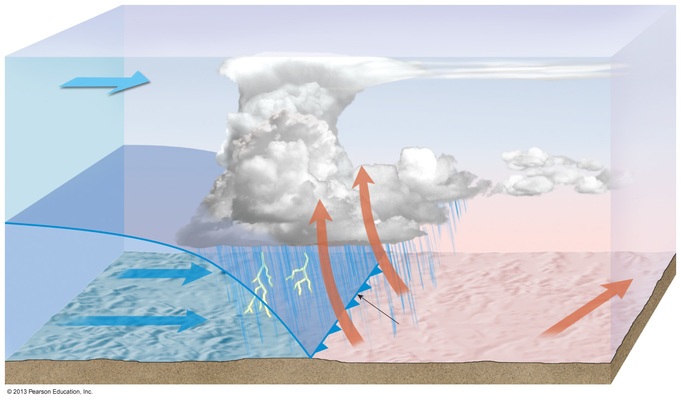
49.
This layer is where weather occurs.
a)
troposphere
b)
thermosphere
c)
exosphere
d)
stratosphere
50.
A front is
a)
where warm air is cooling at earth's surface
b)
a line where hot and cold air are separating
c)
a line where two different air masses meet
d)
where cold air is rising and forming rain clouds
51.
Which most likely produces clear, cool weather?
a)
zero air pressure
b)
stable air pressure
c)
a low pressure system
d)
a high pressure system
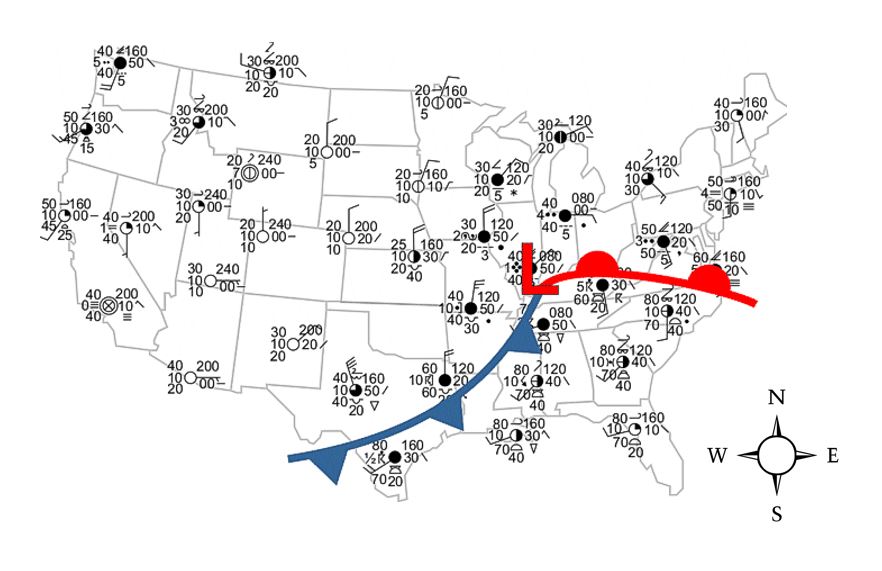
52.
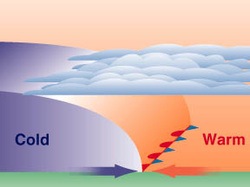
What type of storm front is this? 
a)
warm front
b)
cold front
c)
stationary front
d)
occluded front
53.
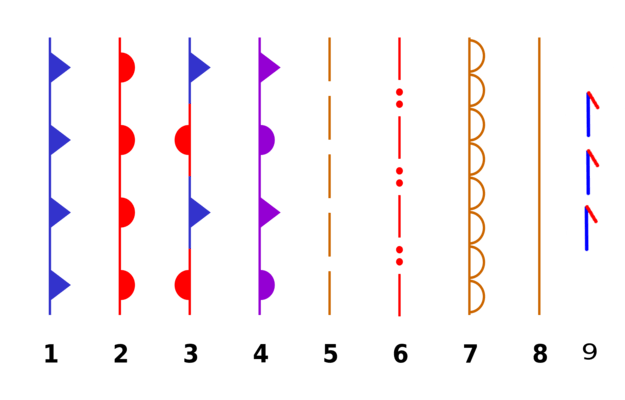
What does symbol # 3 mean?
a)
stationary front
b)
occluded front
c)
warm front
d)
cold front
54.
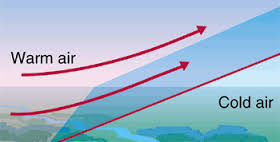
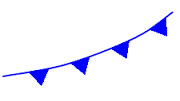
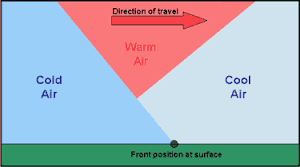
Which type of front is pictured?
a)
Cold front
b)
Warm front
c)
Occluded front
d)
Stationary front
55.
Which type of front is pictured?
a)
Cold front
b)
Warm front
c)
Occluded front
d)
Stationary front
56.
What symbol is this?
a)
warm front
b)
cold front
c)
stationary front
d)
occluded front
57.
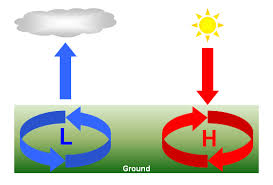
Which system results in rainy or stormy weather?
a)
high pressure
b)
low pressure
c)
hurricane
d)
weather system
58.
Which system results in drier, fairer weather?
a)
high pressure
b)
low pressure
c)
hurricane
d)
weather system
59.
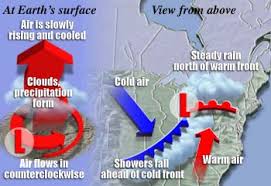
When a cold front is approaching, what happens?
a)
warm air is pushing under cold air causing humid weather and lower temperatures
b)
warm air is pushing under cold air causing humid weather and higher temperatures
c)
warm air rises, cools, and causes rain and thunderstorms
d)
cold air is pushed over warm air causing rain and thunderstorms
60.
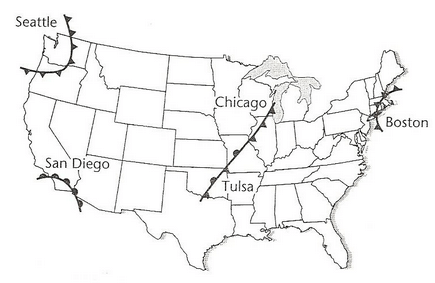
Which type of front is near Seattle?
a)
cold front
b)
warm front
c)
occluded front
d)
stationary front
61.
Which front is located near San Diego?
a)
cold front
b)
warm front
c)
occluded front
d)
stationary front
62.
Which type of front is located near Boston?
a)
warm front
b)
cold front
c)
stationary front
d)
occluded front
63.
What direction is the warm front moving on the map? 
a)
North
b)
South
c)
East
d)
West
64.
What direction is the cold front moving on the map? 
a)
Southwest
b)
Northwest
c)
Southeast
d)
Northeast
65.
Which front leads to steady rain for several days?
a)
warm front
b)
cold front
c)
stationary front
d)
occluded front
66.

Which one shows a warm front?

a)
b)
c)
d)
67.
Which type of front is pictured?
a)
Cold front
b)
Warm front
c)
Occluded front
d)
Stationary front
68.
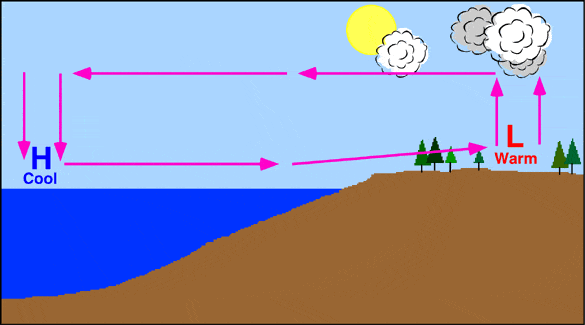
Do sea breezes typically happen during the day or night?
a)
Day
b)
Night
69.
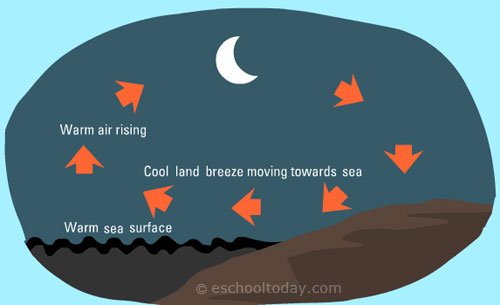
Do land breezes typically happen during the day or night?
a)
Day
b)
Night
70.
During a land breeze which way does the wind blow?
a)
from the sea to the land
b)
from the land to the sea
71.
During a sea breeze which way does the wind blow?
a)
from the land to the sea
b)
from the sea to the land
72.
Is this a land or a sea breeze?
a)
land breeze
b)
sea breeze
73.
Is this a land or a sea breeze?
a)
land breeze
b)
sea breeze
74.

The outermost layer is the ________.

a)

mantle

b)

crust

c)

inner core

d)

outer core

75.

The layer below the crust is the ____________.

a)

oceanic crust

b)

mantle

c)

inner core

d)

continental crust

76.

The core is made up mostly of _______________.

a)

oxygen

b)

magnesium

c)

iron

d)

carbon

77.
Tectonic plates are made up of continental crust and ________ crust.
a)
continental
b)
oceanic
c)
plates
d)
mantle
78.
Which layer(s) of the Earth make up the asthenosphere?
a)
Part of the mantle
b)
Crust, mantle, Core
c)
Crust and upper mantle
d)
Only the crust
79.
What is the correct order (starting from the surface) of Earth's layers?
a)
crust, outer core, inner core, mantle
b)
mantle, outer core, inner core, crust
c)
crust, mantle, outer core, inner core
d)
outer core, inner core, crust, mantle
80.
Which layer of Earth is made up of tectonic plates?
a)
outer core
b)
inner core
c)
asthenosphere
d)
lithosphere
81.
Includes the crust and upper mantle that is divided into several constant moving plates of solid rock that floats on the layer below it. 
a)
Asthenosphere 
b)
Mesosphere
c)
Lithosphere 
d)
Crust
82.
What causes tectonic plates to move along the Earth's surface?
a)
wind
b)
ocean currents
c)
convection in the mantle
d)
expansion of the Earth
83.
What type of boundary occurs when two plates move away from each other?
a)
transform
b)
subduction
c)
convergent
d)
divergent
84.
What forms at a divergent boundary between two oceanic plates?
a)
rift valley
b)
mountain
c)
mid-ocean ridge
d)
trench
85.
What type of boundary occurs when two plates move toward each other?
a)
convergent
b)
divergent
c)
transform
d)
lateral
86.
What forms at a convergent boundary between a continental plate and an oceanic plate?
a)
volcanoes
b)
rift valleys
c)
faults
d)
mid-ocean ridges
87.
A rift valley occurs at a ____________ boundary.
a)
divergent
b)
convergent
c)
transform
d)
horizontal
88.
What is the process in which hot molten rock rises, then cools and sinks back to the core?
a)
plate tectonics
b)
continental drift
c)
convection
d)
divergence
89.
A trench forms at a _________ boundary.
a)
convergent
b)
divergent
c)
transform
d)
vertical
90.
Mountains form at a ___________ boundary.
a)
transform
b)
divergent
c)
convergent
d)
subduction
91.
What type of boundary occurs when two plates slide past each other?
a)
divergent
b)
transform
c)
lateral
d)
convergent
92.
A fault forms at a _________ boundary.
a)
transform
b)
divergent
c)
horizontal
d)
convergent
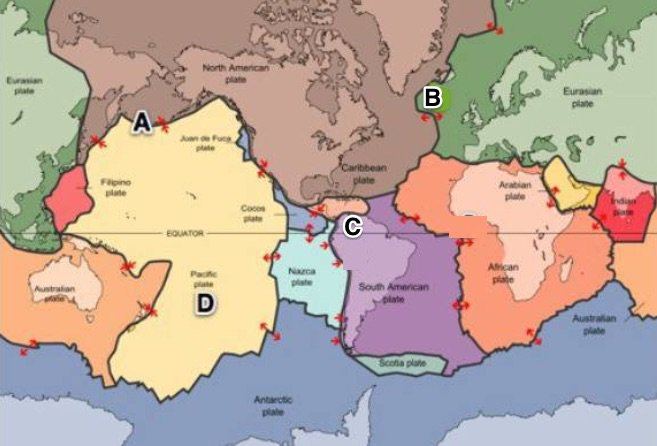
93.
What type of boundary is shown at A?
a)
transform
b)
convergent
c)
divergent
d)
subduction
94.
What is happening at point B?
a)
subduction
b)
a divergent boundary
c)
convection
d)
an earthquake
95.
What is the process in which two plates move toward each other but one sinks under the other?
a)
subduction
b)
convection
c)
divergence
d)
transformation
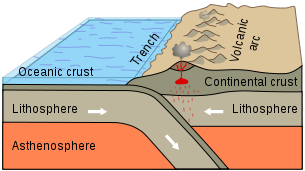
96.
What type of event will occur at this boundary?
a)
Earthquake
b)
Volcano Eruption
c)
Tornado
d)
Mountain Building
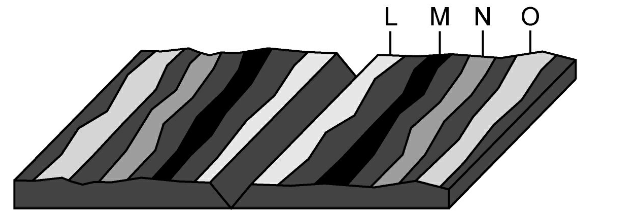
97.
Where would the oldest rock be found?
a)
L
b)
M
c)
N
d)
O
98.
How is it possible for new crust to be formed without increasing the surface area of the Earth?
a)
Crust is destroyed at the same time it is created
b)
New crust is underwater where it sinks
c)
New crust breaks more easily than old crust
99.
The Great Rift Valley in Africa and the Mid-Ocean Ridge were all created by this boundary
a)
Divergent
b)
Convergent
c)
Reform
d)
Transform
100.
What are the two types of crust
a)
continental and oceanic
b)
ocean and upper
c)
lower and upper
d)
pizza and subway
101.
The area where two tectonic plates meet.
a)
mantle
b)
focus
c)
plate boundary
d)
convection
102.
Identify the Major Plate labeled B
a)
African Plate
b)
Antarctic Plate
c)
Pacific Plate
d)
Eurasian Plate 
103.
Identify the Major Plate labeled I
a)
African Plate
b)
Antarctic Plate
c)
Pacific Plate
d)
Eurasian Plate 
104.
Identify the Major Plate labeled N
a)
African Plate
b)
Antarctic Plate
c)
Pacific Plate
d)
Eurasian Plate 
105.
Which explains that the continents were once joined together and over time they broke up and then drifted apart?
a)
Plate Tectonic Theory
b)
Continental Drift 
106.
Which of these explains that Earth's outer layer is broken into large slowly moving pieces? 
a)
Plate Tectonic Theory
b)
Continental Drift 
107.
New crust is created at this type of  boundary.
a)
Divergent
b)
Convergent, Subduction Zone
c)
Transform 
108.
Subduction zones occur on Earth where dense oceanic crust dives under more buoyant continental crust. These boundaries are characterized by a deep ocean trench next to a high continental mountain range, large numbers of earthquakes and volcanoes. All of this is further evidence for the
a)
big bang theory.
b)
theory of plate tectonics.
c)
origin of the species.
d)
theory of natural selection.
109.
Geologists have long recognized that earthquakes are not randomly distributed on Earth but occur in concentrated areas that coincide with __________ and provide evidence for the theory of ___________ .
a)
mountain ranges; fault zones.
b)
continental borders; supercontinents.
c)
plate boundaries; plate tectonics
d)
areas of liquid magma; sea floor spreading.
110.

Where would sea floor spreading most likely occur?

a)

At convergent boundaries (oceanic vs. oceanic)

b)

At convergent boundaries (oceanic vs. continental)

c)

At divergent plate boundaries (oceanic vs. oceanic)

d)

At transform plate boundaries
111.
Which of the following is the name of the ancient supercontinent formed 28 Million Years ago.
a)
Pangea
b)
Gondwanda
c)
Laurasia
d)
Neverland
112.
Fossils of a particular animal species have been found in both southern Africa and South America but nowhere else.  Which of the following is MOST LIKELY the reason why?
a)
The fossils evolved into different organisms
b)
The climate changed and became much colder.
c)
In the past, Africa and South America were part of the same continent
d)
In the future, Africa and South America will be part of the same continent.
113.
Who suggested the Continental Drift theory?
a)
Aldrin Weiner
b)
Alfred Wegener
c)
George Williams
d)
Dr Drift
114.
What landforms can form along convergent boundaries?
a)
volcanoes
b)
mountains
c)
ocean basins
d)
all
115.
The youngest rock in the ocean floor are located at the _______.
a)
magnetic field
b)
magma field
c)
mid-ocean ridge
d)
mid-land ridge
116.
What is the profile view to Topographic Map #1? 
a)
A
b)
B
c)
C
d)
D
117.
What is the profile view to Topographic Map #2?
a)
B
b)
C
c)
D
d)
E
118.
What is the elevation of point B? (Contour interval is 100m)
a)
800 ft
b)
850 ft
c)
900 ft
d)
1000 ft
119.
What is the elevation of Y?
a)
Between 120-140 meters
b)
Between 100-120 meters
c)
Between 140-160 meters
d)
Between 80-100 meters
120.
What do close contour lines represent on a map?
a)
waterfall
b)
steep area
c)
gradual area
d)
river
121.
A mountaineer is planning an expedition. He wants to follow the easiest possible path, which means he needs to find the most gentle slope up the mountain. Which route should the mountaineer choose?
a)
Route A
b)
Route B
c)
 Route C
d)
Route D
122.
How many mountain tops does this map have?
a)
one
b)
two
c)
three
d)
four
123.
In which direction is Mill River flowing?
a)
Southeast
b)
Southwest
c)
Northeast
d)
Northwest
124.
What feature is at the arrow?
a)
volcano
b)
mountain
c)
cliff
d)
river
125.
The shape of the land is shown by connecting points of the same elevation to form a ____________.
a)
relief line
b)
slope
c)
valley
d)
contour line
126.
Determine the contour interval:
a)
5 m
b)
10 m
c)
15 m
d)
20 m
127.
Determine the contour interval:
a)
5 m
b)
10 m
c)
15 m
d)
20 m
128.
What is the elevation of point B?
a)
800 ft
b)
850 ft
c)
900 ft
d)
1000 ft
129.
This the study and description of the shape of the land and surface features.
a)
Biology
b)
Topography
c)
Geology
d)
Oceanography
130.
The elevation from one contour line to the next:
a)
contour lines
b)
contour interval
c)
index contour
d)
contour loops