Wayground logo

Free Printable Worksheets

Font size

S
M
L
XL
Worksheets

Plate Tectonics Exam Review (H)

Total questions: 86

Worksheet time: 22hrs 30mins
Name
Class
Date
1.
Who is the German Scientist that came up with the theory of the Continental Drift? 
a)
Albert Einstein 
b)
Ms. Stukel 
c)
Galileo
d)
Alfred Wegener
2.
What are the three types of Evidence that supports Alfred Wegener's Theory? 
a)
Fossils, Fish, and Land
b)
Sedimentary, Magma, and Climate
c)
Fossils, Land forms, and Climate
d)
Climate, Land forms, and Metamorphic rock 
3.
Where did Wegener find plant fossils that today would not be able to survive on that type of land?
a)
North America
b)
Antarctica
c)
China 
d)
India
4.
What is the force that moves the continents? 
a)
Conduction 
b)
Convection 
c)
Radiation 
d)
Conveyor belts 
5.
Originally the Continental drift theory was not well received by other scientist.  Why? 
a)
There was a competing theory at the time that was more believable. 
b)
There was no data showing the continents ever moved. 
c)
The scientists did not know the force responsible for moving the continents. 
d)
The scientist presenting the data was unreliable.  
6.
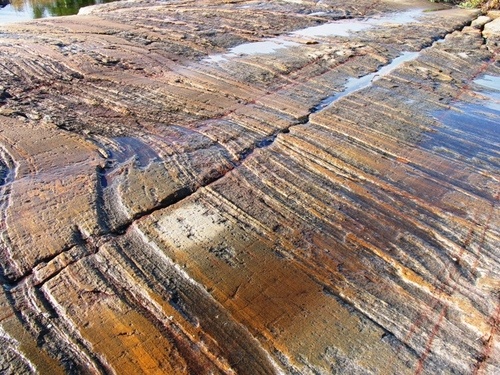
This is a picture of glacier scars found in Africa.  What are these evidence for?
a)
Africa has always been near the equator
b)
Africa was once in an area of the Earth that had a very cold climate
c)
The continents have not moved
d)
sea floor spreading
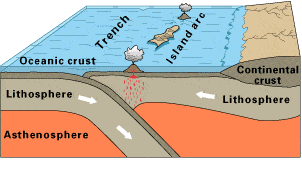
7.
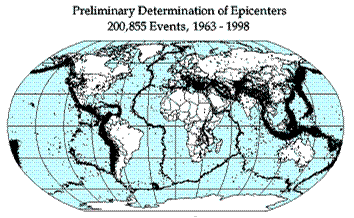
All of the continents were once part of one large continent called...
a)
Panacea
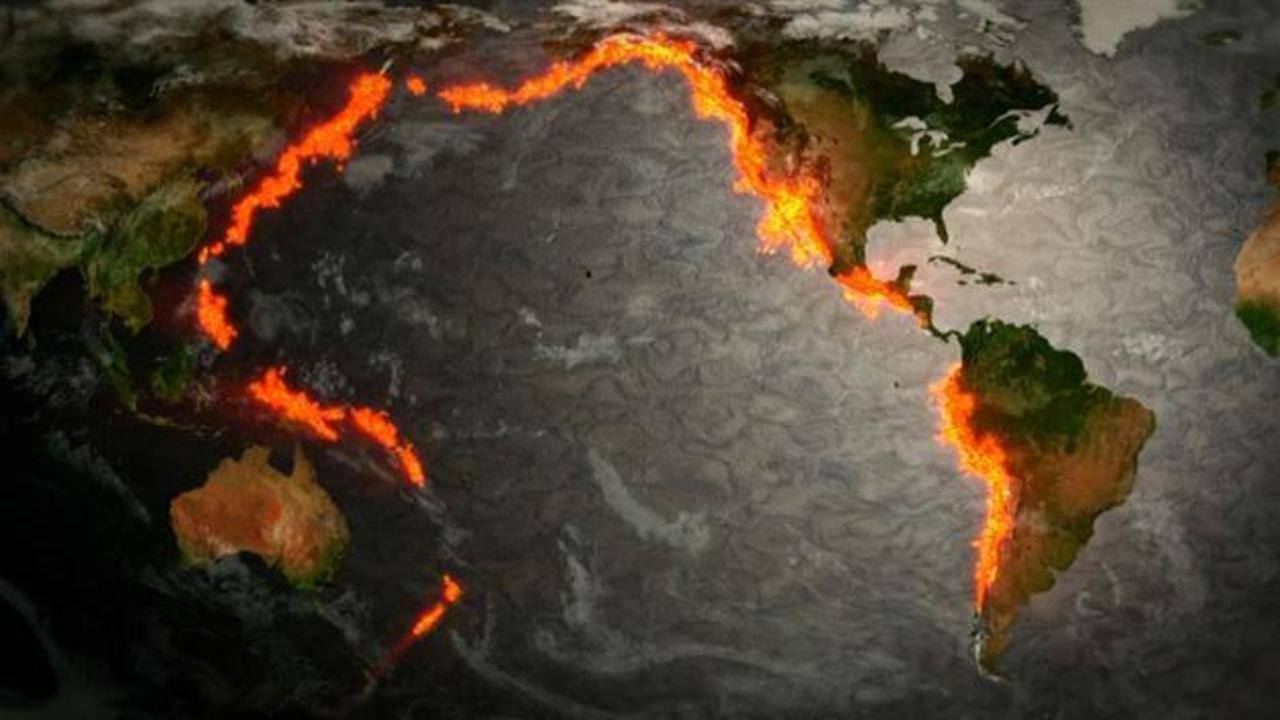
b)
Pangea
c)
North America
d)
Gondwana
8.
The continents move very slowly, only a few __________per year.
a)
meters
b)
kilometers
c)
centimeters
d)
miles
9.
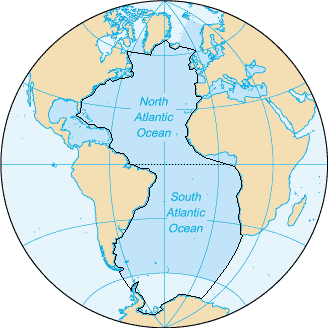
In the Atlantic ocean, where is the youngest seafloor located?
a)
Towards the edges, near the eastern and western continents
b)
Towards the middle of the ocean
c)
Towards the north and south poles
d)
Young seafloor is located randomly throughout the ocean
10.
How do scientists figure out the age of the seafloor?
a)
They research it from ancient sea maps that trading vessels would use in the 1700s
b)
They use the moon phases and eclipses to calculate the age
c)
They use seismographs and the depth as well as location of earthquakes to calculate the age
d)
They take drill ships to many locations in the oceans and collect, then date, rock samples. 
11.
True or False: The Mid-Atlantic ridge in the Atlantic ocean is the ONLY example of a divergent boundary (<---->)
a)
True
b)
False
12.
True or False: The continents on the eastern (the Americas) and western (Europe, Africa) side of the Atlantic Ocean are moving closer together. 
a)
True
b)
False
13.
What two words are BEST used to describe how the seafloor spreads?
a)
Magma and convection
b)
Earthquakes and convection
c)
Magma and convention
d)
Volcanoes and earthquakes
14.
True or False: Our continents will eventually become a supercontinent (like Pangaea) again, far in the future
a)
True
b)
False
15.
Which of the following supports the theory of seafloor spreading?
a)
Correlation of rock layers
b)
Crustal Age
c)
Magnetic Reversal
d)
Continuous Mountain Chains
16.
The zone where one plate slides under another is called the
a)
Convergent zone
b)
Subduction zone
c)
Transform zone
d)
Mantle zone
17.
The entire cycle of heating occurring in the mantle is called
a)
Convection currents
b)
Compound currents
c)
heat currents
d)
 subcurrents
18.
When looking at mid ocean ridges the oldest rocks are 
a)
In the middle
b)
Found close to the rift zone
c)
Found far from the mid ocean ridges
19.

What 3 kinds of evidence were used to prove that the seafloor spread?

a)

Rock formations, age of rocks, WWII shipwrecks

b)

Age of rocks, magnetic seafloor stripes, WWII ship logs

c)

Rock formations, magnetic seafloor stripes, age of rocks

20.
What technology was used during WWII to detect enemy submarines and produce the first map of the seafloor?
a)
Sonar
b)
Radar
c)
GPS
21.
Undersea mountain range.
a)
Rift
b)
Mid-ocean ridge
c)
seafloor spreading
d)
Continental drift
22.

Process by which new ocean crust forms.

a)

Seafloor spreading

b)

Continental drift

c)

Mid-ocean ridge

d)

Rift

23.
The OLDEST seafloor is located? 
a)
Closest to the mid-ocean ridge
b)
Farthest from the mid-ocean ridge
24.
What is label G
a)
Trench
b)
Mid ocean ridge
c)
abyssal plain
d)
sea mount
25.
True or False : Sea-floor Spreading adds new material to the ocean floor?
a)
True
b)
False
26.

Sea-floor spreading begins at the

a)

Deep ocean trench

b)

Mid-ocean ridge

c)

Continent's edge

27.
Which is NOT evidence of sea-floor spreading?
a)
Molten magma constantly erupting
b)
Drilling samples of rock
c)
Magnetic stripes
d)
Fossil evidence
28.
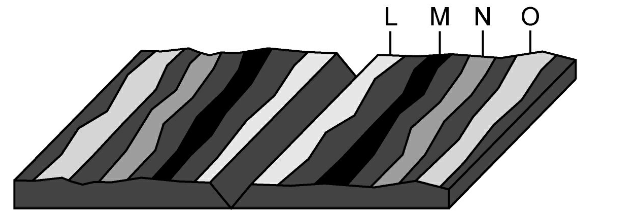
Where would the oldest rock be found?
a)
L
b)
M
c)
N
d)
O
29.

A divergent boundary occurs where plates ....

a)

Pull apart

b)

Come together

c)

Slide past each other

d)

subducting

30.

How is it possible for new crust to be formed without increasing the surface area of the Earth?

a)

Crust is recycled in subduction zones at the same time it is created at mid-ocean ridges

b)

New crust is underwater where it sinks

c)

New crust breaks more easily than old crust

d)

The oldest crust just breaks apart as the plates move

31.

The average density of continental crust is 2.8 g/cm3 and the average density of oceanic crusts is 3.2 g/cm3. If these two plates came together, what would happen?

a)

The two plates would push apart and form a rift zone.

b)

The oceanic plate would rise up over the continental plate.

c)

The oceanic plate would sink under the continental plate.

d)

The two plates would meet head on and rise up to form mountains.

32.
Which of the following objects best represents the movement that occurs during sea-floor spreading?
a)
Elevator
b)
Conveyor belt
c)
Rollercoaster
d)
Hot air balloon
33.

Seafloor spreading...

a)

creates new oceanic crust

b)

destroys or recycles crust

c)

creates new continental crust

d)

creates old crust

34.

Rock at the mid ocean ridges...

a)

is the oldest rock on the earth.

b)

is older than continental rock.

c)

is younger than continental rock.

35.

The magnetic pattern of ocean-floor rocks on one side of an ocean ridge is_____________.

a)

a mirror image of that on the other side

b)

younger than other side

c)

much different pattern

d)

at right angles to the ridge

36.

What type of plate activity is creating the Himalayas?

a)

divergence of the Indian Ocean and Asia

b)

convergence of India and Asia

c)

strike slip faulting

d)

subduction

37.

Mid-ocean ridges can be found in

a)

the Atlantic and Pacific Oceans

b)

the Pacific and the Indian Oceans

c)

all of Earth's oceans

d)

only the Atlantic Ocean

38.
What forms at a divergent boundary between two oceanic plates?
a)
rift valley
b)
mountain
c)
mid-ocean ridge
d)
trench
39.
What type of boundary occurs when two plates move away from each other?
a)
transform
b)
subduction
c)
convergent
d)
divergent
40.
Which type of crust is more dense?
a)
oceanic
b)
continental
c)
divergent
d)
pizza
41.
What type of boundary occurs when two plates move toward each other?
a)
convergent
b)
divergent
c)
transform
d)
lateral
42.
A rift valley occurs at a ____________ boundary.
a)
divergent
b)
convergent
c)
transform
d)
horizontal
43.
What is the process in which hot molten rock rises, then cools and sinks back to the core?
a)
plate tectonics
b)
continental drift
c)
convection
d)
divergence
44.
Mountains form at a ___________ boundary.
a)
transform
b)
divergent
c)
convergent
d)
subduction
45.
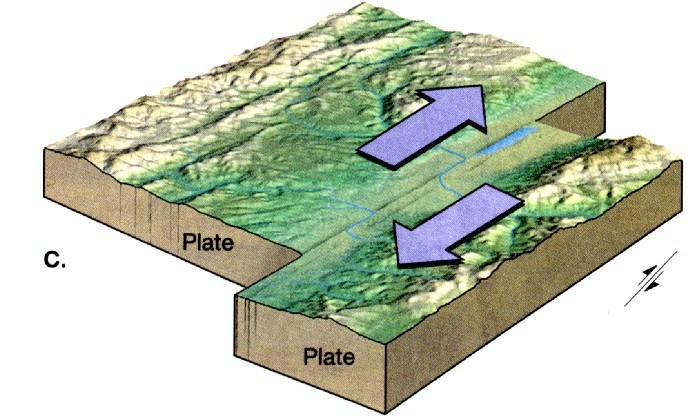
What type of boundary occurs when two plates slide past each other?
a)
divergent
b)
transform
c)
lateral
d)
convergent
46.
A fault forms at a _________ boundary.
a)
transform
b)
divergent
c)
horizontal
d)
convergent
47.
What type of boundary is shown at A?
a)
transform
b)
convergent
c)
divergent
d)
subduction
48.
What is happening at point B?
a)
subduction
b)
a divergent boundary
c)
convection
d)
an earthquake
49.
What is the process in which two plates move toward each other but one sinks under the other?
a)
subduction
b)
convection
c)
divergence
d)
transformation
50.
The physical layer of Earth made of solid rock and soil is called the ___________. 
a)
mesosphere
b)
lithosphere
c)
asthenosphere
d)
mantle
51.
Which of the following causes Earth's tectonic plates to move?
a)
Energy from the Sun
b)
Magnetic Pole Reversal
c)
Convection currents in the mantle
d)
Faults in Mountain Ranges
52.
The type of plate boundary where two plates come together is a .....
a)
Convergent Boundary
b)
Divergent Boundary
c)
Transform Boundary
d)
Plate Boundary
53.
What type of plate boundary is this?
a)
Plate
b)
Divergent
c)
Convergent
d)
Transform
54.
What type of event will occur at this boundary?
a)
Earthquake
b)
Volcano Eruption
c)
Tornado
d)
Mountain Building
55.
What type of plate boundary is this?
a)
Transform
b)
Convergent
c)
Divergent
d)
Plate
56.
How is it possible for new crust to be formed without increasing the surface area of the Earth?
a)
Crust is destroyed at the same time it is created
b)
New crust is underwater where it sinks
c)
New crust breaks more easily than old crust
57.
Mountains are created when....
a)
Two continental plates collide
b)
Two oceanic plates pull apart
c)
An Oceanic plate subducts under a Continental Plate
d)
Two continental plates pull apart
58.
The Great Rift Valley in Africa and the Mid-Ocean Ridge were all created by this boundary
a)
Divergent
b)
Convergent
c)
Reform
d)
Transform
59.
What are the two types of crust
a)
continental and oceanic
b)
ocean and upper
c)
lower and upper
d)
pizza and subway
60.
Transform boundaries are most likely to produce what phenomenon?
a)
volcanoes
b)
deep sea trenches
c)
underwater mountain ranges
d)
earthquakes
61.
When an oceanic plate and a continental plate collide, which one will subduct?
a)
oceanic
b)
continental
c)
neither
62.
The area where two tectonic plates meet.
a)
mantle
b)
focus
c)
plate boundary
d)
convection
63.
Identify the Major Plate labeled B
a)
African Plate
b)
Antarctic Plate
c)
Pacific Plate
d)
Eurasian Plate 
64.
Identify the Major Plate labeled I
a)
African Plate
b)
Antarctic Plate
c)
Pacific Plate
d)
Eurasian Plate 
65.
Identify the Major Plate labeled N
a)
African Plate
b)
Antarctic Plate
c)
Pacific Plate
d)
Eurasian Plate 
66.
Identify the Major Plate labeled J
a)
African Plate
b)
Antarctic Plate
c)
Pacific Plate
d)
Eurasian Plate 
67.
Identify the Major Plate labeled D
a)
Indo-Australian Plate
b)
North American Plate
c)
South Americana Plate
d)
Eurasian Plate 
68.
Identify the Major Plate labeled L
a)
Indo-Australian Plate
b)
North American Plate
c)
South Americana Plate
d)
Eurasian Plate 
69.
Identify the Major Plate labeled G
a)
Indo-Australian Plate
b)
North American Plate
c)
South Americana Plate
d)
Eurasian Plate 
70.
This boundary is described as two plates moving past eachother ALONG THE EDGES horizontally.  These boundaries will get stuck or lock against eachother causing earthquakes when they slip and release. 
a)
Convergent Boundary
b)
Divergent Boundary
c)
Transform Boundary
71.
This boundary is described as moving toward one another  When the plates are both continental plates the will crumple up and form a mountains. When they are continental and oceanic plates, subduction occurs  and earthquakes and volcanoes form. 
a)
Convergent Boundary
b)
Divergent Boundary
c)
Transform Boundary
72.

In some areas of the world, like California and Japan, earthquakes are a common occurrence. How can this best be explained?

a)

The strong ocean currents are undermining both areas causing earthquakes.

b)

Both areas are located near the edge of the Pacific Ocean, the unstable sand causes earthquakes.

c)

Both areas are subjected to strong ocean wind and waves that causes earthquakes.

d)

Both areas are on the boundary of active plates, the motion of the plates causes earthquakes.
73.
There are three types of plate boundaries. Which choice is NOT a type of plate boundary?
a)
convergent
b)
thrust
c)
divergent
d)
transform
74.

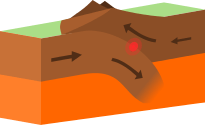
Observe this diagram of a plate boundary. One statement BEST describes what is happening. It is that

a)

the oceanic crust is melting.

b)

the denser ceanic crust is subducting under the less dense oceanic crust

c)

volcanic islands are forming.

d)

the tectonic plates are moving away from each other.
75.

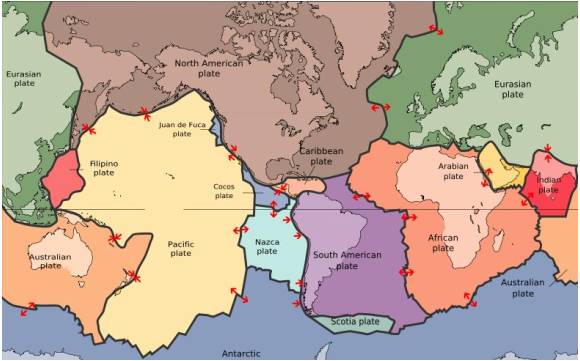
The map in the picture shows tectonic plate boundaries. This map would be useful in predicting the location of future

a)

droughts

b)

hurricanes

c)

earthquakes

d)

tornadoes

76.

Earthquake epicenters (center of where the earthquakes started) were mapped for a 35 year period in the diagram above. The black dots indicate these epicenters. The black dots appear along what feature on Earth?

a)

hot spots

b)

plate boundaries

c)

rift zones

d)

sea floor spreading

77.
Can volcanic eruptions effect the temperature of the ocean?
a)
yes 
b)
no
78.
The area around the pacific plate where boundaries form is called...
a)
death ring
b)
fire zone
c)
ring of fire
d)
zone of fire
79.
The vibration and shaking of the Earth...
a)
volcanism
b)
plateau
c)
earthquake
d)
richter scale
80.
This area contains over 70 percent of volcanoes and 90 percent of earthquakes in the world.
a)
North American plate
b)
ring of fire
c)
fiery rings 
d)
African plate
81.
What geographic features are produced by the subduction of the Pacific Plate?
a)
Mountains
b)
Volcanoes
c)
Trenches
d)
All of these features are produced
82.
What is the best explanation for the cause of volcanoes near the Ring of Fire?
a)
Tectonic plates are spreading and allowing magma to rise to the surface
b)
The oceanic plate is melting and rising to the surface
c)
Earthquakes tear tectonic plates and allow magma to rise.
d)
The heat from friction melts the continental plate.
83.
This plate is involved in all of the Ring of Fire Volcanoes.
a)
The Nazca Plate
b)
The North American Plate
c)
The Pacific Plate
d)
The Indian Plate
84.
The Ring of Fire is famous for
a)
deadly volcanoes
b)
terrible earthquakes
c)
terrifying tsunamis
d)
all of the above
85.
The huge pieces of the earth's crust are called ____________________________. 
a)
crust
b)
plates
c)
directions
d)
seismos
86.
Which ocean in the world is also known as the "Ring of Fire"
a)
Atlantic
b)
Indian
c)
Arctic
d)
Pacific