wayground logo

Free Printable Worksheets

Font size

S
M
L
XL
Worksheets

4th qtr EQT

Total questions: 98

Worksheet time: 59mins

Name
Class
Date
1.
What is a Force?
a)
A force is a speed
b)
A force causes motion
c)
only unbalanced
d)
only balanced
2.
Which term means speed with a direction?
a)
Speeding
b)
Acceleration
c)
Velocity
d)
Gravity
3.
The formula for momentum is p = m/v
a)
True
b)
False
4.
What are the two variables that determine momentum?
a)
speed and height
b)
mass and velocity
c)
car and truck
d)
momentum and distance
5.
If an object decreases its speed each second it moves before stopping, it is...
a)
conserving momentum
b)
insane
c)
accelerating
d)
conserving energy
6.
This driver just experienced which one of newton's laws?
a)
First law
b)
Second law
c)
Third law
d)
Fourth law
7.
Before his unfortunate accident, the kid on the trampoline was experiencing which one of Newton's laws?
a)
Second Law (f = ma)
b)
First Law (Inertia)
c)
Third Law (Action-Reaction)
d)
Fourth Law ( THERE IS NO 4TH LAW BRO!)
8.
Acceleration occurs when an object changes its speed or ______.
a)
direction
b)
force
c)
inertia
d)
mass
9.
A car driving at 50 miles per hour drives for 2 hours. What distance did it cover?
a)
50 miles
b)
25 miles
c)
100 miles
d)
75 miles
10.
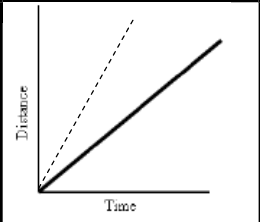
What does this graph represent?
a)
Constant Speed
b)
Acceleration
c)
Not moving
11.
The SI unit for acceleration is
a)
mph
b)
m/s
c)
m/s2
12.
Acceleration: is the rate of change in ___________.
a)
speed
b)
distance
c)
velocity 
d)
displacement 
13.

True or false

You do work when you mannequin pose with an object in your hand.

a)

true

b)

false

14.

Two factors that determine work are

a)

force

b)

acceleration

c)

mass

d)

distance

e)

velocity

15.

units of force are

a)

newtons

b)

grams

c)

joules

d)

meters

16.

units for work are

a)

newtons

b)

joules

c)

meters

d)

seconds

17.
work transfers
a)
sweat
b)
energy
c)
velocity
d)
effort
18.
What is the formula for work?
a)
Force = work x distance
b)
Distance = force x work
c)
Work = force x distance
d)
Work = force x mass
19.
When you stretch a rubber band, you are storing __________ energy. 
a)
kinetic 
b)
potential
c)
none of the above
d)
all of the above 
20.

When a pendulum swings, at which point is potential energy at its greatest?

a)

1

b)

2

c)

3

d)

4

21.
Energy due to motion is ____________ energy. 
a)
Potential 
b)
Energy
c)
Kinetic
d)
Friction
22.
The faster an object moves, the ________ kinetic energy it has. 
a)
more
b)
less
c)
none of the above
d)
all of the above 
23.
Energy can not be created or destroyed, only converted from one form to another.
a)
true
b)
false
24.
At which point is kinetic energy greatest? 
a)
W
b)
X
c)
Y
d)
Z
25.
In order for Work to happen, what 2 things must occur?
a)
Mass and Displacement
b)
Force and Mass
c)
Force and Work
d)
Force and displacement
26.
What is the Force equation?
W= 
a)
F * d * cos(θ)
b)
m * a
c)
d / V
d)
F/ d * cos(θ)
27.
Energy of motion is which type of energy?
a)
Potential
b)
Kinetic
c)
Sound
d)
Gravitational
28.
What kind of energy is represented in this picture?
a)
Thermal
b)
Potential
c)
Nuclear
d)
Mechanical
29.
What kind of energy does this device use?
a)
Chemical
b)
Electrical
c)
Thermal
d)
Chemical
30.
What kind of energy is represented in the picture?
a)
Thermal
b)
Chemical
c)
Sound
d)
Nuclear
31.
On a roller coaster, where is maximum potential energy?
a)
At the bottom of a big hill
b)
When going around a corner
c)
When going upside down
d)
At the top of a big hill
32.
On a roller coaster, where is maximum kinetic energy?
a)
At the bottom of a big hill
b)
When going around a corner
c)
When going upside down
d)
At the top of a big hill
33.
Energy that is stored in bonds between atoms is:
a)
Mechanical energy
b)
Chemical energy
c)
Kinetic energy
d)
Nuclear energy
34.
According to which law of energy, energy can't be created or destroyed?
a)
First law of motion
b)
The law of tacos
c)
Laws of Energy
d)
law of conservation of energy
35.
The ability to do work is
a)
power
b)
energy
c)
thermal
d)
kinetic
36.
Heat energy is also called
a)
electrical energy
b)
chemical energy
c)
light energy
d)
thermal energy
37.
Sound energy needs a
a)
medium
b)
vacuum
c)
chemical
d)
light
38.
What type of energy includes both kinetic and potential energy?
a)
mechanical energy
b)
chemical energy
c)
heat energy
d)
sound energy
39.

Potential energy depends on ____________ & ______________.

a)

mass, speed

b)

mass, position

c)

speed, position

d)

mass, weight

40.

Kinetic energy depends on _____________ & _____________.

a)

mass, speed

b)

mass, position

c)

mass, weight

d)

speed, distance

41.
What is a closed path for electrons to flow through?
a)
static electricity
b)
circuit
c)
amperes
42.
Lightning is an example of _________.
a)
static electricity
b)
current electricity
c)
watts
d)
voltage
43.
Identify the conductor below.
a)
cloth rag
b)
plastic bottle
c)
gold ring
44.
Identify the insulator below.
a)
aluminum foil
b)
paperclip
c)
rubber eraser
45.
Thicker wires have _______ resistance than thinner wires.
a)
more
b)
less
c)
the same
46.
Electric current is measured in ______.
a)
Watts
b)
Volts
c)
Amperes
47.
As the resistance in a circuit increases, the electric current __________.
a)
increases
b)
decreases
c)
stays the same
48.
Which formulas represents Ohm's law?
a)
V=IR
b)
R=IV
c)
I=RV
49.
Which subatomic particles have a positive charge?
a)
neutrons
b)
electrons
c)
protons
50.
An accumulation of electrons on an object is known as ___________.
a)
current
b)
AC
c)
static electricity
51.
What is the unit for resistance?
a)
Volts
b)
Amperes
c)
Ohms
52.
Electricity is the flow of _________.
a)
protons
b)
neutrons
c)
electrons
53.
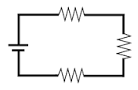
What type of circuit is pictured?
a)
series
b)
parallel
54.
Which type of current comes from a battery?
a)
alternating current (AC)
b)
direct current (DC)
55.
A material in which electrons are able to move easily is called
a)
Insulators
b)
Conductors
56.
Which on the following is NOT an example of an insulator.
a)
Rubber
b)
Glass
c)
Penny 
d)
Wood
57.
The flow of electric charges is 
a)
voltage
b)
current 
c)
resistance
d)
electricity 
58.
Which way do electrons flow?
a)
Positive to Negative
b)
Negative to Positive
59.
What does a resistor do? 
a)
Reduces the flow of electrons
b)
Reduce the flow of the current
c)
Increase flow of electrons
d)
Decreases the flow of electrons 
60.
Where do electrons pick up their energy from? 
a)
Battery
b)
wire
c)
Lightbulb
61.
Which of the following is not a source of electricity 
a)
Windmills
b)
Batteries
c)
wires
d)
Hydroelectric dams
62.
What is the unit of measurement for current
a)
Ohm's
b)
Amperes
c)
Volts
63.
The job of the electron is to ...?
a)
Control which way the current flows.
b)
Use electricity in a circuit
c)
Carry electricity around a circuit
64.
What it the formula to find voltage. 
a)
I= V/R
b)
R=V/I
c)
V= I x R 
65.
In a parallel circuit with 2 lightbulbs, if you take out one lightbulb what will happen to the rest?
a)
They will all go out.
b)
The other one will stay on 
66.
What kind of picture does the picture show? 
a)
Closed/Complete
b)
Open/Incomplete
67.
In an electrical circuit, what does this symbol represent?
a)
wire
b)
resistor
c)
lightbulb
d)
switch
68.
What is static electricity?
a)
the flow of electric charges
b)
the build-up of an electrical charge on a surface.
c)
the opposition of current flow. 
69.

In a series circuit what happens when you add another bulb?

a)

The bulbs gets brighter

b)

The bulbs gets dimmer

c)

Nothing changes

70.
Voltage difference is related to the force that causes electric charges to flow. 
a)
True
b)
False
71.
The potential difference that causes charges to move in a circuit is ___.
a)
voltage
b)
resistance
c)
current
d)
electric discharge
72.
An example of a voltage source is a _____.
a)
voltmeter
b)
battery
c)
resistance
d)
switch
73.
A circuit that is connected to Earth is said to be _____.
a)
series
b)
parallel
c)
grounded
d)
discharged
74.
Your hair might be attracted to your comb as your hair and the combe become oppositely charged.
a)
true
b)
false
75.
A neutral object becomes negatively charged when it loses electrons.
a)
true
b)
false
76.
Conduction is the process of charging an object without touching it.
a)
true
b)
false
77.
Electrical resistance is low in a good conductor.
a)
true
b)
false
78.

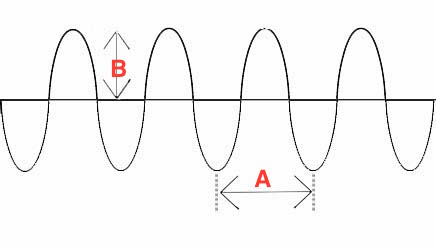
What property of the wave is represented by the letter "A"?

a)

amplitude

b)

crest

c)

trough

d)

wavelength

79.
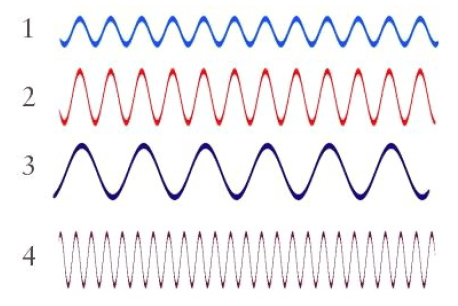
Which wave in the diagram has the greatest frequency?
a)
1
b)
2
c)
3
d)
4
80.

The highest point on a wave is:

a)

the crest

b)

the trough

c)

the top

d)

the coast

81.

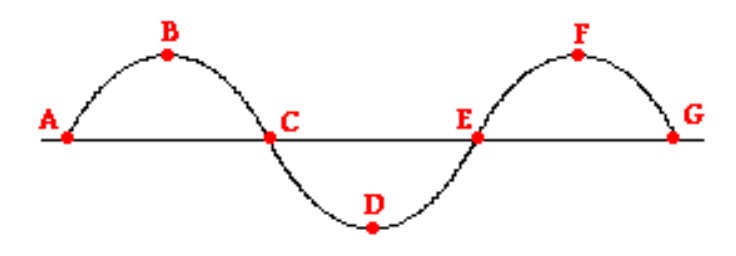
Which letter(s) represent the trough of the wave?

a)

A

b)

B & D

c)

D

d)

C & G

82.
Which wave has a greater frequency?
a)
A
b)
B
83.
What kind of wave is pictured below?
a)
compressional wave
b)
transverse wave
c)
sound wave
d)
mechanical wave
84.
How would a person measure the wavelength on this sound wave?
a)
dense to less dense
b)
trough to crest
c)
compression to compression
d)
beginning of illustration to the end
85.

You can't hear sounds in outer space because there is no

a)

medium

b)

light

c)

energy

d)

heat

86.

All waves carry ________ as they travel from one place to another.

a)

matter

b)

space

c)

energy

d)

water

87.

What property of the wave is represented by the letter "B"?

a)

amplitude

b)

crest

c)

trough

d)

wavelength

88.
Waves move ___ through vibrations
a)
Energy
b)
Matter
c)
Mass
d)
Weight
89.
Longitudinal waves are ______.
a)
Parallel
b)
Perpendicular
c)
Crazy
90.
Transverse waves are ___.
a)
Parallel
b)
Perpendicular
c)
Weird
91.
If the frequency gets higher, the wavelength gets 
a)
longer
b)
shorter
92.
If the wavelength gets longer, the frequency gets 
a)
higher
b)
lower
93.
The pitch of the sound depends on
a)
frequency
b)
amplitude
c)
wavelength
94.
The loudness of the sound depends on
a)
wavelength
b)
amplitude
c)
frequency
95.
Which electromagnetic wave is responsible for cell phones?
a)
gamma
b)
xray
c)
microwaves
d)
radio
96.
Is refracting light bending or bouncing?
a)
bending
b)
bouncing
97.
A blue tshirt looks blue because of ___.
a)
reflection
b)
refraction
c)
diffraction
98.
Rainbows are ______ light.
a)
Refracting
b)
Reflecting
c)
Diffracting
d)
Absorbing