wayground logo

Free Printable Worksheets

NEW

Font size

S
M
L
XL
Worksheets

Mega MAP Review

Total questions: 75

Worksheet time: 3hrs 39mins

Name
Class
Date
1.
Look at the picture of a man strumming a guitar. Which of these best describes the sound coming from the guitar?

a)
a form of energy
b)
a type of force
c)
a form of matter
d)
a type of work
2.
Which form of energy is stored in flashlight batteries?
a)
chemical
b)
electrical
c)
kinetic
d)
light
3.
Which of these includes three different forms of energy?
a)
air, wind, water
b)
heat, light, force
c)
light, sound, heat
d)
solar, wind, water
4.
Where is genetic information located in a human cell?
a)
vacuole
b)
nucleus
c)
ribosome
d)
cytoplasm
5.
Which process allows plants to make sugar using energy from the sun?
a)
respiration
b)
germination
c)
photosynthesis
d)
decomposition
6.
Which statement about cells is correct?
a)
Cells have miniature organs within them, such as intestines.
b)
Cells are the smallest unit of structure and function of living things.
c)
Cells are the smallest particle of matter and make up all substances.
d)
Cells make up tissues, but are not found in organs or organ systems.
7.
How do the molecules of water change as water changes from a liquid to a gas?
a)
The molecules move farther apart and have more freedom of motion.
b)
The molecules enter the air and leave all the water behind.
c)
The molecules break apart to form hydrogen and oxygen gases.
d)
The molecules expand greatly as they change from liquid to gas.
8.
Which of these best describes ice molecules?
a)
They are separated by air.
b)
They are very cold and hard.
c)
They cannot move around easily.
d)
They are visible under a microscope.
9.
Which of these most accurately describes what happens to water molecules when liquid water evaporates?
a)
The tightly packed water particles begin to move.
b)
The particles of water grow larger and take up more room.
c)
The water particles stay the same distance apart, but become softer.
d)
Water particles that had been close together move apart and travel freely.
10.
Every living organism is made up of one or more cells
a)
True
b)
False
11.
A cell is...
a)
the basic unit of structure and function in living organism
b)
an organism
c)
a basic part of everything that we see
d)
found only in animals, not plants
12.

Which organelle contains DNA and controls the cell?

a)

Endoplasmic Reticulum

b)

Golgi Apparatus

c)

Nucleus

d)

Vesicles

13.
Hot coffee is stirred with a spoon; the spoon gets hot due to
a)
conduction
b)
convection
c)
radiation
14.
Some cook pans have cooper on the bottom to heat evenly.
Copper transfers heat to the pan by
a)
conduction
b)
convection
c)
radiation
15.
In a swimming pool, water near the surface is slightly warmer. The warm water rises because of
a)
conduction
b)
convection
c)
radiation
16.
Warm air over the beach rises while cooler, dense air from the ocean rushes in due to
a)
conduction
b)
convection
c)
radiation
17.
You lay on the same hot rock at night and keep warm from the rock by
a)
conduction
b)
convection
c)
radiation
18.
Calculate the net force of the object in the image shown.
a)
20N
b)
35N
c)
5N
d)
25N
19.
Weather systems in the Earth's atmosphere are due to
a)
conduction
b)
convection
c)
radiation
20.
Is this a balanced or unbalance force?
a)
Balanced
b)
Unbalanced
c)
Neither one
d)
Both
21.
Which direction will the object move?
a)
Right
b)
Left
c)
Up
d)
Down
22.
This model shows the forces applied to a box.  However, this model DOES NOT show ________________________.
a)
the forces acting in opposite directions
b)
that the forces are unequal
c)
that student B is pushing harder
d)
the actual amount of the forces
23.
An object and rest will stay at rest and an object in motion will stay in motion unless acted on by a force, is which one of Newton's Laws of Motion?
a)
4th Law of Motion
b)
1st Law of Motion
c)
3rd Law of Motion
d)
2nd Law of Motion
24.
a push and/or a pull.
a)
force
b)
net force
c)
normal force
d)
drag force
25.
 What is the unit called that measures force?
a)
Isaac
b)
Yee
c)
Newton
d)
kilogram
26.

What city will experience decreasing temperatures in the next day?

a)

Denver

b)

El Paso

c)

Memphis

d)

Los Angeles

27.

What city is most likely going to see temperatures rise?

a)

San Jose

b)

El Paso

c)

Jacksonville

d)

Chicago

28.

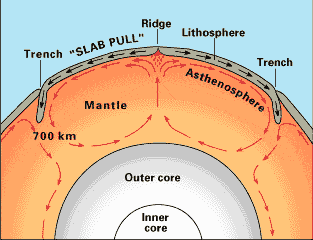
The movement of the tectonic plates is caused by

a)

the rotation of the Earth.

b)

convection currents in the Asthenosphere

c)

the gravity of the iron-nickel core.

d)

the Moho discontinuity.

29.
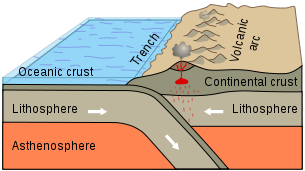
Subduction zones occur on Earth where dense oceanic crust dives under more buoyant continental crust. These boundaries are characterized by a deep ocean trench next to a high continental mountain range, large numbers of earthquakes and volcanoes. All of this is further evidence for the
a)
big bang theory.
b)
theory of plate tectonics.
c)
origin of the species.
d)
theory of natural selection.
30.

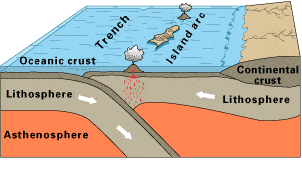
Observe this diagram of a plate boundary. One statement BEST describes what is happening. It is that

a)

the oceanic crust is melting.

b)

the denser ceanic crust is subducting under the less dense oceanic crust

c)

volcanic islands are forming.

d)

the tectonic plates are moving away from each other.
31.
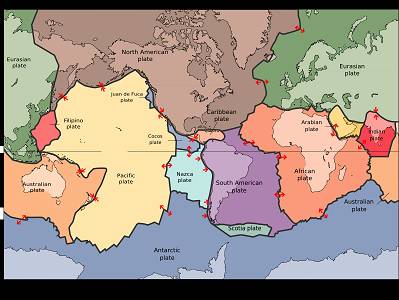
The Earth’s surface is not a solid surface but is divided into
a)
several oceanic plates.
b)
continental and crustal plates.
c)
seven continental plates.
d)
continental and oceanic plates.
32.
Geologists have long recognized that earthquakes are not randomly distributed on Earth but occur in concentrated areas that coincide with __________ and provide evidence for the theory of ___________ .
a)
mountain ranges; fault zones.
b)
continental borders; supercontinents.
c)
plate boundaries; plate tectonics
d)
areas of liquid magma; sea floor spreading.
33.

What is the source of energy that drives plate movement?

a)

the subducton of the sea floor

b)

the different densities of the oceanic and crustal plates

c)

convection currents in the asthenosphere

d)

the friction force between the plates that move past each other

34.
This is the largest planet in the solar system.
a)
Saturn
b)
Jupiter
c)
Uranus
d)
Venus
35.
The motion of a body orbiting another body in space is called _____.
a)
revolution 
b)
period of revolution
c)
rotation
d)
period of rotation
36.
When the temperature of matter decreases the particles ...
a)
speed up and move farther apart
b)
speed up and move closer together
c)
slow down and move farther apart
d)
slow down and move closer together
37.
The slower the particles in a substance move,
a)
the colder it is.
b)
the warmer it is.
c)
the more energy it has.
d)
the less energy it has.
38.
A chemical change
a)
doesn't really change much.
b)
creates a new substance
c)
is a change in the state of matter
39.
What are the types of precipitation?
a)
rain, snow, sleet, hail
b)
dew, rain, snow, fog
c)
fog, dew, sleet, hail
d)
rain, snow, sleet, fog
40.
Luna and Blue notice that our plants are looking weak. They wonder if it has to do with the low temperatures we have experienced. They decide to take 3 of the same plant and put them in different temperatures. They will monitor the height the plant grows. The first plant goes in the boiler room where it is very hot. The second goes in a classroom where it is room temperature. The third goes in the freezer. What is the D.V. in this experiment?
a)
highest temperature
b)
how fast they grow
c)
darkest leaves
d)
height the plant grows
41.
Luna and Blue notice that our plants are looking pale. They wonder if it has to do with the low temperatures we have experienced. They decide to take 3 of the same plant and put them in different temperatures. The first plant goes in the boiler room where it is very hot. The second goes in a classroom where it is room temperature. The third goes in the freezer. What is the I.V. in this experiment? 
a)
type of plant
b)
location/temp
c)
type of dirt
d)
type of seed
42.
When I rub my hands together, they get hot. Why?
a)
I'm that hot!
b)
dirty skin
c)
friction
d)
sun shine
43.
Which movement of the Earth determines the length of our year?
a)
revolution
b)
rotation
c)
gravity
d)
push and pull
44.
Which of the following statements best explains why it is warmer at the equator than at the North Pole?
a)
The equator has a larger area than the North Pole.
b)
The equator is closer to the Sun than the North Pole.
c)
The equator receives more direct sunlight than the North Pole.
d)
The equator has more hours of daylight per year than the North Pole.
45.
The Sun appears larger than the others stars because of
a)
its yellow color
b)
its high temperature
c)
its distance from Earth
d)
the greater amount of light it gives off
46.
How is Earth different from the other planets in the solar system?
a)
It has an atmosphere
b)
It has a solid surface
c)
It has warm temperatures
d)
It has liquid water on its surface
47.
Kennedy and her mother observed the constellation Orion high in the night sky. Four hours later, they noticed that the constellation had moved to another part of the sky. Why?
a)
Earth’s axis is tilted.
b)
Earth rotates on its axis.
c)
The stars in the constellation Orion changed positions.
d)
The stars in the constellation Orion moved across the sky.
48.
The length of one day on Earth is determined by how long it takes
a)
the Moon to revolve once
b)
the Moon to rotate once
c)
Earth to rotate once
d)
Earth to revolve once
49.
Identify the phase of the Moon in the drawing...
a)
Crescent
b)
Gibbous
c)
Full
d)
New
50.
Which planet should take longer to orbit the sun:
a)
Mercury
b)
Earth
c)
Venus
d)
Saturn
51.
Competition within a pack of wolves may increase if there is an increase in the
a)
amount of food available
b)
amount of oxygen available
c)
size of their population
d)
size of the area they inhabit
52.
A fox with thick fur would have a survival advantage over other foxes if
a)
there is more competition for food in the fox population
b)
the air temperature significantly decreases in winter
c)
a drought occurs, limiting the amount of water available
d)
a new disease appears that infects the foxes
53.
Which human activity is correctly paired with its likely future consequence?
a)
Overfishing in the Atlantic — increase in supply of flounder and salmon as food for people
b)
Development of electric cars or hybrid vehicles — increased rate of global warming
c)
Use of fossil fuels — depletion of underground coal, oil, and natural gas supplies
d)
Genetically engineering animals — less food available to feed the world’s population
54.
Harmful effects of microorganisms in food include
a)
antibiotics
b)
fermentation
c)
spoilage
d)
providing protein
55.
Which gas produced by a tree do animals need to survive?
a)
carbon dioxide
b)
nitrogen
c)
oxygen
d)
hydrogen dioxide
56.
What is the process that produces the carbon dioxide needed to help plants survive?
a)
cellular respiration
b)
photosynthesis
c)
digestion
d)
osmosis
57.
The changes that make an organism better suited to their environments is developed through a process called
a)
adaptation
b)
symmetry
c)
predation
d)
camouflage
58.
How are humans making greenhouse gases that are affecting all of the organisms in the ecosystem?
a)
Burning fossil fuels in our cars
b)
Burning forests
c)
Large-scale agriculture
d)
All of the above
59.
Identify the two animals in this food web that obtain nutrients directly from producers.
a)
Snakes & Hawks
b)
Trout & Frogs
c)
Foxes & Decomposers
d)
Rabbits & Caterpillars
60.
Name two organisms in this food web that are in competition with one another for food.
a)
Rabbits & Caterpillars
b)
Foxes & Decomposers
c)
Frogs & Snakes
d)
Hawks & Trout
61.
Identify one function of decomposers in a food web...
a)
Producing its own food
b)
Consuming the most herbivores
c)
Breakdown dead organisms
d)
Eating the top predator
62.
What process must occur for clouds to form?
a)
erosion
b)
conduction
c)
condensation
d)
precipitation
63.
Limestone is a sedimentary rock and marble is a metamorphic rock. Even though limestone and marble have the same chemical makeup, they are classified as different rocks because they
a)
were formed from different fossils.
b)
took different amounts of time to form.
c)
formed at different times.
d)
formed by different methods.
64.
Which energy source is considered nonrenewable?
a)
oil
b)
moving water
c)
sunlight
d)
biomass
65.
Which temperature and moisture conditions describe an airmass that originates over the Atlantic Ocean near the equator?
a)
warm and dry
b)
warm and humid
c)
cool and dry
d)
cool and humid
66.
Which Earth layer is most dense?
a)
crust
b)
mantle
c)
outer core
d)
inner core
67.
Convection currents, which scientists believe to be the driving force for the movement of tectonic plates, are mostly found in Earth’s
a)
crust
b)
mantle
c)
outer core
d)
inner core
68.
The diagram shows a natural process that occurs in rocks. Which of the terms below identifies that process?
a)
conduction
b)
convections
c)
erosion
d)
weathering
69.
Erosion and weathering can both cause changes to the surface of Earth. Which of the following happens only because of erosion and NOT because of weathering?
a)
Rocks form deep underground.
b)
Rocks become smooth and round.
c)
Rocks are broken apart into small pieces.
d)
Rocks are moved from one place to another.
70.
Which process changed the shape of the rock layers over time?
a)
condensation
b)
evaporation
c)
erosion
d)
magnetism
71.
Which fossil would be considered to be the oldest?
a)
Early Horses
b)
Dinosaurs
c)
Armored Fish
d)
Trilobites
72.
What process would scientists use to determine the approximate age of rocks and fossils?
a)
Relative Dating
b)
Continuity
c)
Lateral Conformity
d)
Radioactive Dating
73.
The most active earthquake areas are associated with the boundaries of tectonic plates. What happens at the plate boundaries to cause an earthquake.
a)
Plates moving
b)
Plates not moving
c)
Plates switching places
d)
Plates eroding
74.
What geological event, other than an earthquake, may also occur at tectonic plate boundaries.
a)
Sublimation
b)
Evaporation
c)
Volcanoes
d)
Deposition
75.
What is the correct order of the processes occurring at points, C, D, and E.
a)
Precipitation, Infiltration, Evaporation
b)
Precipitation, Run-off, Infiltration
c)
Evaporation, Run-Off, Condensation
d)
Condensation, Run-off, Infiltration