wayground logo

Free Printable Worksheets

Font size

S
M
L
XL
Worksheets

Survivor Challenge

Total questions: 138

Worksheet time: 2hrs 30mins

Name
Class
Date
1.
The parts of an ecosystem that are currently living or that have once lived.
a)
Biotic Factor
b)
Abiotic Factor
c)
Species
d)
Biome
2.
The study of relationships between biotic and abiotic factors interacting in the same area.
a)
Ecology
b)
Biology
c)
Zoology
d)
Botany
3.
Which of the following is NOT a level of organization in ecosystems?
a)
community
b)
species
c)
population
d)
organism
4.
The prefix a- in abiotic means 
a)
life
b)
science
c)
not or without
d)
one
5.
The prefix bio means
a)
life
b)
science
c)
story
d)
not
6.
Which level of organization within an ecosystem includes abiotic and biotic factors?
a)
Organism
b)
Ecosystem
c)
Community
d)
Population
7.
Biodiversity is the variety of ________ in a community.
a)
genes
b)
population
c)
species
d)
community
8.
The largest number of individuals of the same species that an area can support is its 
a)
limiting factor
b)
organisms
c)
carrying capacity
d)
community
9.
At what level of organization in an ecosystem is an individual plant or animal?
a)
Population
b)
Organism
c)
Community
d)
Ecosystem
10.
Community is the level of organization which is best described as all -
a)
members of a certain species in a given area.
b)
members of a species regardless of where they live.
c)
living things, regardless of species, in an area.
d)
living and non-living components of an area.
11.
Which of the following describes an interaction between a biotic factor and an abiotic factor?
a)
A pair of birds build a nest in a tree
b)
A black bear uses a cave for a winter home
c)
A squirrel gathers nuts to store for winter
d)
A vulture eats the remains of a wild pig
12.
The table lists levels of organization in an ecosystem from least complex to most complex. Which of the following belongs in the table where the question mark is?
a)
Population
b)
Class
c)
Species
d)
Society
13.
Which of the following best describes a population?
a)
All the organisms of a certain species in a given area
b)
All the organisms in a habitat that compete for resources
c)
One individual and all the organisms on which it depends
d)
All of the living organisms which can be found in an area
14.
Which of the following lists includes only abiotic factors?
a)
Plants, animals, average daily temperature
b)
Rainfall amounts, average daily temperature, minerals in soil
c)
Minerals in soil, plants, rainfall amounts
d)
Animals, rainfall amounts, soil composition
15.
Which of the following correctly lists the levels of organization from least complex to most complex?
a)
Community, Organism, Population, Ecosystem
b)
Population, Community, Ecosystem, Organism
c)
Organism, Population, Community, Ecosystem
d)
Ecosystem, Population, Organism, Community 
16.
What are the Abiotic factors in this image? 
a)
water, sunlight, dirt, air
b)
birds and plants
c)
birds, water, dirt
d)
plants, water
17.
Starts with BARE ROCK followed by lichen
a)
primary succession 
b)
secondary succession
c)
both types of succession
18.
Natural disasters such as flooding and tornadoes are linked to ________________.
a)
primary
b)
secondary
c)
old field
d)
ecosystem
19.
What is the order of succession shown in this figure?
a)
A, B, C, D
b)
B, A, D, C
c)
C, D, A, B
d)
D, A, B, C
20.
What type of succession is shown going from figure A to figure B?
a)
primary succession
b)
eutrophication
c)
secondary succession
d)
intermediate
21.
The first organisms that appear in an ecological community
a)
ecological succession 
b)
primary succession 
c)
secondary succession
d)
pioneer species
22.
What is the first species you will see after a primary succession? (in picture)
a)
lichens
b)
mosses
c)
small plants
d)
insects
23.
What is the difference between a primary vs. secondary succession?
a)
secondary occurs where there was no previous community
b)
they are the same
c)
secondary occurs in an area that was only partially destroyed
d)
primary ocurs in an area that was only partially destroyed
24.
How do lichens contribute to primary succession?
a)
Lichens decompose organic matter from animals and plants
b)
Lichens begin to break down rock to form soil
c)
Lichens are nitrogen fixing bacteria
25.
Succession that occurs in an area with NO SOIL
a)
ecological succession 
b)
primary succession 
c)
secondary succession
d)
pioneer speciles
26.

Which of the following would cause primary succession to begin?

a)

wildfire that destroys 2000 acres of land

b)

a tornado that destroys half of a town

c)

an new island is formed from underground volcano eruptions

d)

a hurricane that floods a coastal town

27.

The moon is Earth’s only natural

a)

zodiac

b)

meteor

c)

satellite

d)

asteroid

28.

A planet is large enough to have been rounded by its own

a)

rotation

b)

gravity

c)

moon

d)

orbit

29.

You can match constellations to your location and the season using a

a)

GPS receiver

b)

star chart

c)

horoscope

d)

telescope

30.

Stars are made up mainly of hydrogen and oxygen.

a)

true

b)

false

31.

You can see five planets from Earth without a telescope

a)

true

b)

false

32.

You can see Neptune without a telescope

a)

true

b)

false

33.

A streak of light produced when a small object burns

up entering Earth’s atmosphere is called a...

a)

satellite

b)

asteroid

c)

meteor

d)

comet

34.

You can see Jupiter without a telescope

a)

true

b)

false

35.

A group of stars that people imagine to represent a

figure or object is called a...

a)

start chart

b)

constellation

c)

galaxy

d)

star art

36.

Stars generally appear to move from east to west because...

a)

they are moving east to west

b)

they are actually moving west to east

c)

the Earth is turning from west to east

d)

the Earth is turning from east to west

37.

True or false: The sun moves steadily across the sky throughout the day.

a)

true

b)

false

38.

True or False: On most nights, The North Star is the brightest object in the night sky.

a)

true

b)

false

39.

The apparent motion of objects in the sky depends on...

a)

the motions of the Earth

b)

the sun's gravitational pull

c)

how fast each object is moving

d)

how large the object is

40.
​Which​ ​motion​ ​of​ ​earth​ ​could​ ​be​ ​best​ ​demonstrated​ ​by​ ​Lebron​ ​James​ ​spinning​ ​a​ ​basketball​ ​on​ ​his​ ​finger?
a)
rotation
b)
revolution
c)
tilting
d)
leap year
41.
Because the earth spins on its axis, we experience:
a)
seasons
b)
weather
c)
day and night
d)
revolution
42.
How long does it take earth to make on complete revolution of the sun?
a)
24 hours
b)
1 day
c)
365 days
d)
365.25 days
43.
The tilt of the earths axis:
a)
5 degrees
b)
10.2 degrees
c)
23.5 degrees
d)
365.25 degrees
44.
The shape of the earth's orbit around the sun:
a)
oval
b)
circle
c)
semicircle
d)
ellipse
45.
A word used to describe a moon that is "getting larger"
a)
gibbous
b)
crescent
c)
waxing 
d)
waning
46.
The imaginary line that passes through earth and the north and south poles.
a)
axis
b)
graviy
c)
equator
d)
prime meridian
47.
A push or a pull is called a _______
a)
force
b)
motion
c)
action
d)
reaction
48.
"Every object in the universe attracts every other object"  This is known as
a)
the law of universal gravitation
b)
Newton's law of gravity
c)
Newton's law of gravitational force
d)
the e-harmony law
49.

Which of these is NOT a limiting factor in population growth?

a)
b)
c)
50.

___ is largest number of individuals of one species that an environment can support

a)

Limiting factor

b)

biotic potential

c)

carrying capacity

51.

Natural disaster, disease, and predators are examples of ____.

a)

limiting factors

b)

resources

c)

competition

52.

This group of Meerkats in the Kalahari Desert is an example of:

a)

biosphere

b)

population

c)

community

53.
All of the living and nonliving things in an area that interact with each other are called a/an ______.
a)
community
b)
habitat
c)
population
d)
ecosystem
54.

is the number of births in a population during a

certain amount of time

a)

birth rate

b)

death rate

c)

emmigration

55.

is the number of deaths in a population during a

certain period.

a)

immigration

b)

birth rate

c)

death rate

56.

is the movement of individuals into an area

a)

moving

b)

immigration

c)

emigration

57.

is the movement of individuals out of an area.

a)

death rate

b)

immigration

c)

emigration

58.

The size of a population compared to the amount of space available is _____

a)

population density

b)

limiting factor

c)

biotic potential

59.
Is a fern an abiotic or biotic factor? 
a)
abiotic
b)
biotic
60.
Is a weather an abiotic or biotic factor? 
a)
abiotic
b)
biotic
61.
When a population grows past the ecosystem's carrying capacity, what happens to the population?
a)
Continues to grow
b)
The population starts to die off to return to carrying capcity
c)
The population will go extinct due to lack of resources
d)
The population grows then finds a new carrying capacity
62.
A certain plant needs moisture, carbon dioxide, oxygen, light, and minerals to survive. This scenario shows that this particular living organism depends on .
a)
Biotic and Abiotc Factors
b)
Biotic Factors 
c)
Abiotic Factors 
d)
None of the Above
63.
If there is more food than usual in an ecosystem, then the population will mostly likely...
a)
stay the same
b)
decrease
c)
increase
d)
reach carrying capacity
64.
How will competition affect the carrying capacity of an ecosystem for the animal in competition?
a)
Decrease
b)
Increase
c)
Will show not affect
d)
Competition does not exist in nature
65.
Food, water, sunlight, shelter, and space are resources that are often __________.
a)
limiting factors
b)
not found in ecosystems
c)
non-limiting factors
d)
Biotic
66.
Behavioral changes of individuals of a species that allow for better survival. (Acquired traits)
a)
Variation
b)
Adaptation
c)
Behavior
d)
Environment
67.
When every organism of a species has died.
a)
Evolution
b)
Natural Selection
c)
Extinction
d)
Artificial Selection
68.
Where the better adapted organisms survive to pass traits along to offspring.
a)
Evolution
b)
Natural Selection
c)
Extinction
d)
Artifical Selection
69.
Why are advantageous traits more likely to be passed onto offspring?
a)
Because they are more likely to survive and reproduce.
b)
Because they come from dominant alleles.
c)
Because they come from recessive alleles.
d)
Because the trait is an acquired phenotype.
70.
A plover bird eats parasites off a crocodile’s skin.  The crocodile provides the plover protection from predators. 
a)
Mutualism
b)
Commensalism
c)
Parasitism
d)
Not Symbiosis
71.

A remora fish attaches itself to the underside of a shark and eats leftover bits of food from the shark’s meals. The remora helps to clean the shark and remove parasites.

a)

Mutualism

b)

Commensalism

c)

Parasitism

d)

Not Symbiosis

72.

Ostriches and gazelles feed next to each other. They both watch for predators and alert each other to danger.

a)

Mutualism

b)

Commensalism

c)

Parasitism

d)

Not Symbiosis

73.

A barn owl kills and eats a field mouse.

a)

Mutualism

b)

Commensalism

c)

Parasitism

d)

Not Symbiosis

74.

Barnacles create a home by attaching themselves to the skin of a whale. The barnacle is a filter feeder and obtains food as it rides on the whale. The whale is not affected.

a)

Mutualism

b)

Commensalism

c)

Parasitism

d)

Not Symbiosis

75.

Fleas obtain nutrients by feeding on the blood of a dog.

a)

Mutualism

b)

Commensalism

c)

Parasitism

d)

Not Symbiosis

76.

Oxpecker birds feed on ticks and other insects found on the rhino’s skin. The rhino provides protection for the oxpecker.

a)

Mutualism

b)

Commensalism

c)

Parasitism

d)

Not Symbiosis

77.

Bacteria living in a cow’s stomach help the cow digest cellulose in the grass. The bacteria are protected in the cow’s stomach and are provided with food (cellulose).

a)

Mutualism

b)

Commensalism

c)

Parasitism

d)

Not Symbiosis

78.

A bird builds a nest on a tree branch.

a)

Mutualism

b)

Commensalism

c)

Parasitism

d)

Not Symbiosis

79.

A deer tick feeds on the blood of a human host.

a)

Mutualism

b)

Commensalism

c)

Parasitism

d)

Not Symbiosis

80.

A woodpecker eats the moths preying on a saguaro cactus. The cactus provides a protected habitat for the bird.

a)

Mutualism

b)

Commensalism

c)

Parasitism

d)

Not Symbiosis

81.

A honey bird leads a honey badger to a bee hive. The badger rips open the bee hive and eats the honey and bee larvae, while the bird eats the leftovers.

a)

Mutualism

b)

Commensalism

c)

Parasitism

d)

Not Symbiosis

82.

A tree uses energy from the sun to make sugar.

a)

Mutualism

b)

Commensalism

c)

Parasitism

d)

Not Symbiosis

83.

Mistletoe vines wrap around a tree, robbing the tree of water and nutrients.

a)

Mutualism

b)

Commensalism

c)

Parasitism

d)

Not Symbiosis

84.

Moss gains exposure to sunlight by growing on the branches of trees. The moss does not harm the trees.

a)

Mutualism

b)

Commensalism

c)

Parasitism

d)

Not Symbiosis

85.

Sandpiper birds fight over food.

a)

Mutualism

b)

Commensalism

c)

Parasitism

d)

Not Symbiosis

86.

A leech attaches to the skin of a boy swimming in a lake, and feeds on his blood.

a)

Mutualism

b)

Commensalism

c)

Parasitism

d)

Not Symbiosis

87.

A monkey picks fleas and ticks off of a dog and eats them as a tasty snack. The dog and monkey are also friends.

a)

Mutualism

b)

Commensalism

c)

Parasitism

d)

Not Symbiosis

88.
Energy causes ___________ to occur.
a)
change
b)
motion
c)
age
89.
What type of energy is in this picture?
a)
Kinetic
b)
Potential
c)
Electromagnetic
90.
What form of energy?
a)
Mechanical (kinetic) energy
b)
Chemical (kinetic) energy
c)
Sound (potential) energy
d)
Sound (kinetic) energy
91.
What kind of energy?
a)
Radiant
b)
Electrical
c)
Thermal
d)
Chemical
92.
What kind of energy?
a)
Thermal (kinetic) energy
b)
Chemical (kinetic) energy
c)
Chemical (potential) energy
d)
Mechanical (kinetic) energy
93.
What form of energy do plants use to make sugar in the photosynthetic process?
a)
heat energy
b)
chemical energy
c)
solar energy
d)
kinetic energy
94.
What form of energy is stored in the bonds between molecules of matter?
a)
chemical energy
b)
heat energy
c)
kinetic energy
d)
mechanical energy
95.
the ability to do work
a)
energy
b)
Matter
c)
photons
d)
potential energy
96.
Stored energy that results from the position or shape of an object is called...
a)
Thermal
b)
Potential
c)
Kinetic
d)
Gravitational
97.
Lightning during a thunderstorm is an example of what form of energy?
a)
Radiant (potential) energy
b)
Radiant (kinetic) energy
c)
Electrical (potential) energy
d)
Electrical (kinetic) energy
98.
A baseball held by a pitcher has _____________energy.
a)
Kinetic
b)
Chemical 
c)
Potential
d)
Thermal
99.
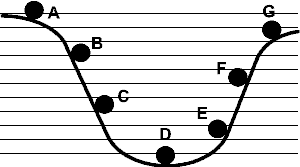
At what position does the rock have the greatest kinetic energy?
a)
A
b)
B
c)
D
d)
E
100.
This would be
a)
Nuclear (kinetic) energy
b)
Nuclear (potential) energy
c)
Chemical (kinetic) energy
d)
Chemical (potential) energy
101.
This would be
a)
Nuclear (kinetic) energy
b)
Nuclear (potential) energy
c)
Chemical (kinetic) energy
d)
Chemical (potential) energy
102.
What kind of energy is in a moving skateboard?
a)
Potential
b)
Kinetic
103.
Which is the best example that something has kinetic energy?
a)
a. a car parked on a steep hill 
b)
b. a tennis ball rolling across the court
c)
c. a picture hanging on the wall 
d)
d. a piece of coal before it's burned 
104.
When a pendulum swings, at which point is kinetic energy highest?
a)
1
b)
2
c)
3
d)
4
105.
Which point has the most potential energy?
a)
G
b)
f
c)
b
d)
a
106.
Gravitational potential energy depends on the ________ and ________ of the object. 
a)
Height and mass
b)
Friction and movement
c)
Mass and Movement
d)
Height and Friction 
107.
When you stretch a rubber band, you are storing __________ energy. 
a)
kinetic 
b)
potential
c)
none of the above
d)
all of the above 
108.
Which would have the greatest gravitational potential energy?
a)
A 4lb rat on a school desk
b)
A 45lb dog in an oak tree
c)
A 14 pound platypus on a swing
d)
A 45lb child on a bike
109.
As a pendulum swings from its highest to lowest position, what happens to its kinetic and potential energy? 
a)
Both the potential energy and kinetic energy decrease
b)
The potential energy decreases while the kinetic energy increases 
c)
The kinetic energy decreases while the potential energy increases 
d)
Bothe the potential energy and kinetic energy increase 
110.
At which point is potential energy greatest?
a)
W
b)
X
c)
Y
d)
Z
111.
Which 2 letters have the most kinetic energy
a)
W & Y
b)
X & Z
112.
How much potential energy is at the top of a hill on a rollar coaster ride
a)
100%
b)
50%
c)
0%
d)
20%
113.
The tool used to measure the mass of a substance or object is a ______________.
a)
balance
b)
graduated cylinder
c)
ruler
d)
thermometer
114.
Jack has a rock. The rock has a mass of 14g and a volume of 2cm3. What is the density of the rock?
a)
7 mL
b)
7 g/cm3
c)
28 g/cm3
d)
1/7 g/cm3
115.
What is the volume of Object X?
a)
10.0 cm3
b)
15.0 cm3
c)
20.0 cm3
d)
25.0 cm3
116.
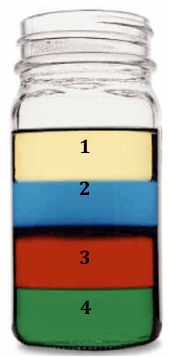
Put the liquids in order from most dense to least dense?
a)
4, 3, 2, 1
b)
1, 2, 3, 4
c)
3, 4, 2, 1, 
d)
4, 3, 1, 2
117.
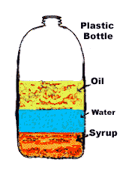
Which liquid is the least dense?
a)
oil
b)
water
c)
syrup 
d)
plastic bottle
118.
Which box has a higher density?  
a)
Box A
b)
Box B
c)
cannot be determined
d)
they are the same
119.
Which box has a higher density?  
a)
Box A
b)
Box B
c)
cannot be determined
d)
they are the same
120.
In general what is the most dense form of matter?
a)
solid
b)
liquid
c)
gas
d)
plasmas
121.
What is the formula for density?
a)
density = mass x volume
b)
density = mass / volume
c)
density = mass + volume
d)
density = mass - volume
122.
Frank has an eraser. It has a mass of 4g, and a volume of 2cm3. What is its density?
a)
8 g/cm3
b)
2 g/cm3
c)
1/2 g/cm3
d)
24 g/cm3
123.
Frank has a paper clip. It has a mass of 9g and a volume of 3cm3. What is its density?
a)
3 g/cm3
b)
1/3 g/cm3
c)
27 g/cm3
d)
39 g/cm3
124.
If the mass of an unknown substance is 5.3 grams and the volume is 2 cm3. What would be its density? (round)
a)
2.7
b)
2.5
c)
2.4
d)
2.2
125.
If the mass of an unknown substance is 5.3 grams and the volume is 2 cm3. What would be its density? (round)
a)
2.7
b)
2.5
c)
2.4
d)
2.2
126.
Calculate the density of the cube.
a)
2 g/cm3
b)
4 g/cm3
c)
6 g/cm3
d)
8 g/cm3
127.
Calculate the density of the cube.
a)
2 g/cm3
b)
4 g/cm3
c)
6 g/cm3
d)
8 g/cm3
128.
Calculate the density of the cube.
a)
.33 g/cm3
b)
.4 g/cm3
c)
.6 g/cm3
d)
.5 g/cm3
129.
Calculate the density of the cube.
a)
3 g/cm3
b)
4 g/cm3
c)
2 g/cm3
d)
5 g/cm3
130.
Who created the first telescope and is known as the "Father of Modern Astronomy?"
a)
Neil Armstrong
b)
Wilbur Wright 
c)
Galileo
d)
Robert Fulton
131.
Who was an American astronaut and the first person to walk on the moon?
a)
Galileo
b)
Neil Armstrong
c)
Andre Ampere
d)
Wilbur Wright
132.
Who studied the Amps in electricity and found the science of electrodynamics?
a)
Albert Einstein
b)
Andrew Ampere
c)
Alexander Graham Bell
d)
Sir Isaac Newton
133.
Who is famous for his three laws of motion? He said, "For ever action there is an equal and opposite reaction"
a)
Albert Einstein
b)
Alexander Graham Bell
c)
Andre Ampere
d)
Sir Isaac Newton
134.
Who invented the Cotton Gin?
a)
Alexander Graham Belle
b)
James Watt
c)
Eli Whitney
d)
Thomas Edison
135.
Who created and flew the first aircraft?
a)
Thomas Edison
b)
Wilbur Wright
c)
Eli Whitney
d)
Thomas Edison
136.
Who improved the microscope?
a)
Anton Van Leeuwenhoek
b)
Galileo
c)
Neil Armstong
d)
Alexander Graham Bell
137.
Who invented the telephone in 1876 and helped with research on hearing and speech?
a)
Thomas Edison
b)
Alexander Graham Bell
c)
Robert Bunsen
d)
Rachel Carson
138.
Who studied a radioactive substance called radium?
a)
Madame Marie Curie
b)
Charles Darwin
c)
Thomas Edison
d)
Albert Einstein