
 Worksheets
EQT Review
Total questions: 40
Worksheet time: 23mins
Name
Class
Date
1.

The light bulb in the circuit is an example of _______.
a)
Load
b)
Battery source
c)
Energy pathway
d)
All of them
2.

A wire is an example of _____.
a)
Battery source
b)
Energy pathway
c)
Load
d)
All of them
3.
What is a conductor?
a)
A material that allows electricity to flow through it. The circuit is complete.
b)
A material that does not allow electricity to flow through. It stops the flow of electricity.
c)
A light switch.
4.
The circuit that has only one path for electricity to travel around.
a)
parallel circuit
b)
series circuit
c)
no circuit
5.
Which will light a bulb?
a)
A battery and a paper clip
b)
A battery and a wire
c)
A paper clip and a wire
d)
A switch and a wire
6.
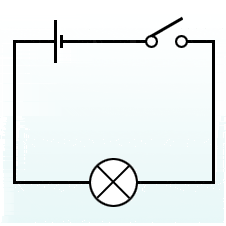
this circuit is .....?
a)
open
b)
parallel
c)
closed
d)
The cutest little circuit evah!
7.
An object through which electrons can easily flow is called a(n) ___________.
a)
Conductor
b)
Insulator
8.
A circuit in which energy can freely flow.
a)
Closed Circuit
b)
Free Circuit
c)
Open Circuit
d)
Energy Circuit
9.

Choose the correct sentence.
a)
This circuit will work because it is an open circuit.
b)
This circuit will work because it is a closed circuit.
c)
This circuit will NOT work because it is an open circuit.
d)
This circuit will NOT work because it is a closed circuit.
10.
What subject is attracted to a magnet?
a)
Silver
b)
Water
c)
Metal
d)
Iron
11.
What happens when two north poles of a magnet are placed together?
a)
they repel
b)
they attract
c)
they cancel each other out
d)
the strength of the magnet is doubled
12.
The force of magnetism is stronger when magnets are ________________
a)
cold
b)
round
c)
closer together
d)
farther apart
13.

Once a paperclip touches a magnet and becomes a magnet itself, does a paperclip STAY that way? Or does it stop being a magnet?
a)
stay that way forever
b)
stop being a magnet
c)
stay that way for a short time
14.

Materials that can be turned into a magnet are called _____. These include iron, nickel, cobalt, or mixtures of these materials.
a)
domains
b)
rocks
c)
ferromagnets
d)
solids
15.
Materials which can be made into magnets for a short period of time when placed in a strong magnetic field are called _
a)
gas
b)
temporary magnets
c)
plastic
d)
conductors
16.

An iron core is wrapped in electrical wire. When the electric current is turned on, a strong magnet is created called a ______
a)
cobalt magnet
b)
rock
c)
electromagnet
d)
domain
17.

The area around a magnet which is affected by its magnetism is the
a)
magnetic curtain
b)
magnetic gas
c)
sum of 5 + 3
d)
magnetic field
18.
In a magnet the ______________________ line up in the same direction.
a)
leaders
b)
domains
c)
nails
d)
wires
19.
What three things did we need to make an electromagnet?
a)
iron core, wire, power source
b)
wire, swtich, water
c)
iron core, lemon, wire
d)
power source, Olympic gold medal, wire
20.
An electromagnet can be made stronger by
a)
more power and an insulator
b)
more coils and more power
c)
a longer wire and more water
d)
a green wire and a switch
21.

What is represented by the blue lines?
a)
Trough
b)
Crest
c)
Wavelength
d)
Amplitude
22.

What part is represented by the blue lines?
a)
Crest
b)
Resting Point
c)
Wavelength
d)
Amplitude
23.

What part is the arrow pointing to?
a)
Crest
b)
Trough
c)
Amplitude
d)
Wavelength
24.

What part is the arrow pointing to?
a)
Crest
b)
Trough
c)
Amplitude
d)
Wavelength
25.
What two factors effect the amount of energy a wave has?
a)
Frequency and wavelength
b)
Frequency and amplitude
c)
Amplitude and rest
d)
Wavelength and crest
26.
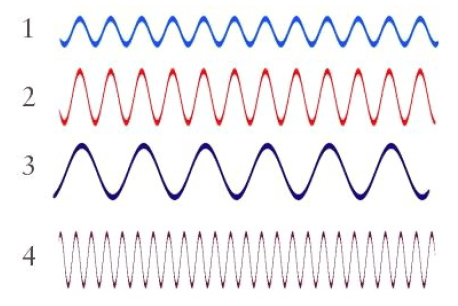
Which wave in the diagram has the greatest frequency?
a)
1
b)
2
c)
3
d)
4
27.

What is the amplitude of this wave?
a)
4
b)
8
c)
2
d)
6.3
28.
What happens to frequency when the energy increases?
a)
it increases
b)
it decreases
c)
it stays the same
29.
When wavelength increases, what happens to the frequency?
a)
it increases
b)
it decreases
c)
it stays the same
30.
If the wavelength gets longer, the frequency gets
a)
higher
b)
lower
31.

Which EM wave has the lowest frequency?
a)
radio
b)
xray
c)
gamma
d)
infrared
32.

Which EM wave has the longest wavelength?
a)
light
b)
radio
c)
ultraviolet
d)
red
33.

Which color has the lowest frequency?
a)
red
b)
green
c)
blue
d)
violet
34.

Which color has the highest frequency?
a)
blue
b)
yellow
c)
orange
d)
violet
35.

Which type of light has the lowest energy of this group?
a)
Radio
b)
Microwave
c)
Infrared
d)
Ultraviolet
36.
Which type of light has the largest wavelength of this group?
a)
X-rays
b)
Microwave
c)
Infrared
d)
Ultraviolet
37.

This color in the visible part of the spectrum has the lowest energy.
a)
Blue
b)
Green
c)
Red
d)
Violet
38.

This color in the visible part of the spectrum has the highest energy.
a)
Blue
b)
Red
c)
Violet
d)
Yellow
39.
This color in the visible part of the spectrum has the smallest wavelength.
a)
Blue
b)
Red
c)
Violet
d)
Yellow
40.
This color in the visible part of the spectrum has the largest frequency.
a)
Orange
b)
Yellow
c)
Blue
d)
Green
100 %

