wayground logo

Free Printable Worksheets

NEW

Font size

S
M
L
XL
Worksheets

6th Grade EOY Review

Total questions: 67

Worksheet time: 48mins

Name
Class
Date
1.
A can of Coke will sink in a bowl of water.  A can of Diet Coke will float in a bowl of water.  What does this tell you about the density of the Diet Coke?
a)
it is bigger than 1
b)
it is smaller than 1
c)
it is equal to 1
d)
it is equal to -1
2.
Why do ice cubes float in a  glass of water?
a)
the ice cubes are more dense than the water
b)
the water is more dense than the ice cubes
c)
the water is more dense than the glass
d)
the ice is more dense than the glass
3.
What is the density of water?
a)
0 g/ml
b)
1 g/ml
c)
10 g/ml
d)
100 g/ml
4.
Which lab tool might you use to measure the volume of a liquid?
a)
electric scale
b)
bunsen burner
c)
test tube
d)
graduated cylinder
5.
What is the volume of the fish?
a)
18.0 cm3
b)
6.0 cm
c)
38.0 cm3
6.
Which box has a higher density and why?  
a)
Box A, because it has more mass
b)
Box B, because it has less mass
c)
Box A, because the volume  is greater
d)
Box B, because the volume is less
7.
Mrs Lane first folds a piece of paper, then rips it, then burns it.  What is the order of these changes.
a)
Physical, Chemical, Physical
b)
Chemical, Physical, Physical
c)
Chemical, Physical, Chemical
d)
Physical, Physical, Chemical
8.
A substance made by mixing other substances together and being able to then separate is the definition of a
a)
Combination
b)
Solution
c)
Mixture
9.

Which model best represents a chemical compound?

a)

A

b)

B

c)

C

d)

D

10.
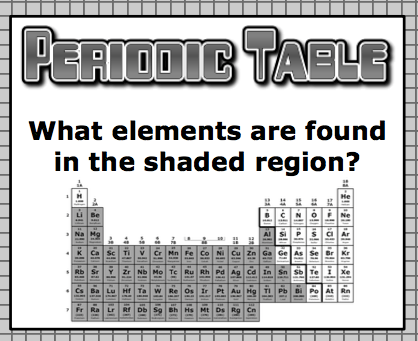
a)
Metals
b)
Nonmetals
c)
Metalloids
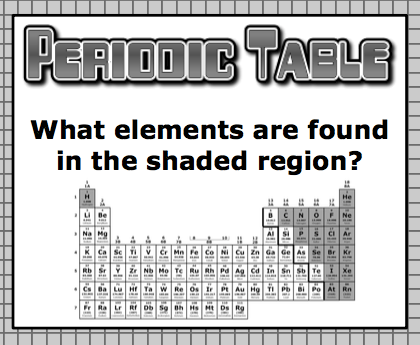
11.
a)
Metals
b)
Nonmetals
c)
Metalloids
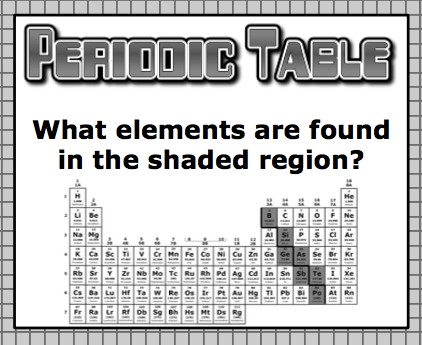
12.
a)
Metals
b)
Nonmetals
c)
Metalloids
13.
a)
Plastic conducts heat well and metal doesn't.
b)
Metal conducts heat well and plastic doesn't. 
c)
Shiny objects conduct heat well.
d)
Black objects do not conduct heat. 
14.
Which of the following IS a physical change?
a)
Getting a haircut
b)
Rusty metal
c)
Bleaching hair
d)
A compound
15.
What is formed when two liquids make a solid that settles do the bottom of he container
a)
Bubbles
b)
Odor
c)
Precipitate
d)
Unexpected color change
16.

Which best describes the density of Earth’s layers?

a)

The crust is the most dense because it is the top layer.

b)

The mantle is the most dense because it is the thickest layer.

c)

The outer core is the most dense because it is the only liquid layer.

d)

The inner core is the most dense because it is under the most pressure.

17.

Which choice describes Earth's Crust?

a)

a thick layer of rock floating on liquid metal

b)

a group of continents floating on a large ocean

c)

a warm layer of rock floating on a cold layer of rock

d)

a thin layer of rock floating on a solid but fluid-like layer

18.

Which of the following answer choices correctly lists the shown layers of Earth from MOST dense to LEAST dense?

a)

lithosphere – asthenosphere – inner core – outer core

b)

lithosphere – asthenosphere – outer core – inner core

c)

asthenosphere – inner core – outer core – lithosphere

d)

inner core – outer core – asthenosphere – lithosphere

19.

Describe the most likely relationship between these mountains and nearby tectonic plates.

a)

The mountains are probably formed by earthquakes

b)

The mountains are probably formed by the movement of glaciers

c)

The mountains are probably located near the edge of 2 tectonic plates.

d)

The mountains are probably formed by running water.

20.

Is there a pattern to the locations of earthquakes and volcanoes around the globe?

a)

No, earthquakes and volcanoes are random.

b)

Yes, earthquakes and volcanoes usually occur near the boundaries of tectonic plates.

c)

yes, earthquakes and volcanoes usually occur in the middle of tectonic plates.

d)

No, earthquakes and volcanoes usually occur under water.

21.
What are Mid-Ocean Ridges?
a)
A chain of underwater waterfalls 
b)
A chain of underwater volcanos
c)
A chain of underwater mountains
d)
A chain of underwater rocks
22.
What are the 3 major types of rocks?
a)
Igneous, Metamorphic, Sedimentary
b)
Metamorphic, Igneous, Cementation
c)
Brown, Red, Gray
d)
Streak, Hardness, Breakage
23.

Each rock type can follow only one pathway of the rock cycle.

a)

True

b)

False

24.
What kind of energy is in a rock at the edge of a cliff?
a)
Potential
b)
Kinetic
25.
Which is the best example that something has kinetic energy?
a)
a. a car parked on a steep hill 
b)
b. a tennis ball rolling across the court
c)
c. a picture hanging on the wall 
d)
d. a piece of coal before it's burned 
26.
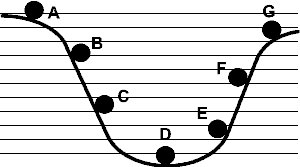
Which point has the most potential energy?
a)
G
b)
f
c)
b
d)
a
27.
Which 2 letters have the most kinetic energy
a)
W & Y
b)
X & Z
28.
A metal spoon heating up in a bowl of hot soup
a)
Conduction
b)
Convection
c)
Radiation
29.
Getting a sunburn on while spending the day on the beach
a)
Conduction
b)
Convection
c)
Radiation
30.
Water boiling in a pot
a)
Conduction
b)
Convection
c)
Radiation
31.
Magma creating a current in the mantle to move tectonic plates
a)
Conduction
b)
Convection
c)
Radiation
32.
__________ is an energy resource that WILL NOT run out in the next several hundred years.
a)
Renewable Energy Resource
b)
Nonrenewable Energy Resource
33.
__________ is an energy resource that WILL run out in the next several hundred years.
a)
Renewable Energy Resource
b)
Nonrenewable Energy Resource
34.

Oil/petroleum are a renewable resource.

a)

True

b)

False

35.
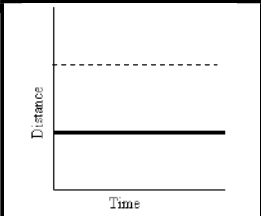
What does this graph represent?
a)
Constant speed
b)
Acceleration
c)
Not moving
36.
What is this graph showing?
a)
Constant Speed
b)
Acceleration (speeding up)
c)
Deceleration (slowing down)
d)
No motion
37.
Ms. Pittman went to the movies. She drove at a constant speed the whole way there, and after the movie was over she drove back home at the same constant speed.
What graph is represented by Ms. Pittman's journey?
a)
Top Left
b)
Top Right
c)
Bottom Left
d)
Bottom Right
38.

Two football linemen push against each other in practice. At first, they do not move, but then lineman B moves forward and lineman A moves backward. Why does this happen?

a)

Lineman A pushes with a greater force, causing a net force that acts in his direction.

b)

When the lineman push on each other, they cause action-reaction forces that are unequal.

c)

The forces are balanced, but then lineman B exerts a greater force, causing unbalanced forces.

d)

Because the lineman push in different directions, the net force is zero.

39.
What kind(s) of objects have inertia?
a)
all objects with mass
b)
only objects at rest
c)
only objects in motion
d)
only objects whose motion is being changed
40.
What is Newton's First Law
a)
F=ma
b)
Every action has an equal and opposite reaction
c)
An object at rest stays at rest, an object in motion stays in motion. 
d)
Friction 
41.
According to Newton’s first law of motion, a moving object that is not acted on by an unbalanced force will
a)
remain in motion.
b)
eventually come to a stop.
c)
change its momentum.
d)
accelerate.
42.
Why does an 18-wheeler have more inertia than a bicycle?
a)
it has more mass
b)
it has more volume
c)
it is not as aerodynamic
43.
Acceleration changes and object's...
a)
speed, direction or both
b)
speed, gravity or both
c)
gravity, direction or both
d)
inertia, speed or both
44.
As the acceleration of an object increases, what happens to the force of the object? 
a)
force increases
b)
force decreases
c)
force remain the same
d)
mass increases
45.
If you push the ping pong ball & the basketball with the same amount of force, which one will go a greater distance?
a)
The ping pong ball
b)
The basketball
c)
They will both travel the same distance
46.
The larger the mass you have the _____ force you need to change its motion.
a)
more
b)
less
47.
The stronger the force, the ________ the acceletation
a)
Stronger
b)
Weaker
c)
Both
48.

For every action, there is an equal and opposite reaction

a)

Newton's 3rd Law of Motion

b)

Law of Conservation of Mass

c)

Law of Science

d)

Law of Conservation of Motion

49.
According to Newton's _____ Law of Motion, when a hammer strikes and exerts force on a nail, the nail exerts an equal force back on the hammer.
a)
First
b)
Second
c)
Third
d)
Fourth
50.
When a heavy football player and a light one run into each other, who exerts more force?
a)
The heavy one
b)
The light one
c)
They are equal
d)
there is no such thing as force
51.
What is a comet?
a)
Composed of iron and stone
b)
It orbits the Earth
c)
Larger than the moon
d)
It has a tail of gas and dust
52.
Which two factors determine the gravitational force between two objects?
a)
Time and temperature
b)
Color and Hardness
c)
Mass and Distance apart
d)
Shape and orbital speed
53.
If scientists wanted to study an unknown planet, what type of equipment would they need?
a)
Space shuttle
b)
Satellite
c)
Probe with instruments
d)
Spacecraft
54.
What is a natural satellite?
a)
Natural satellites orbit planets
b)
Planets orbit natural satellites
c)
Natural satellites have life on them
d)
Natural satellites are larger than planets
55.
Which object in space would be our next logical place to visit?
a)
Earth
b)
Venus
c)
Mars
d)
Jupiter
56.
Which object is closer to Earth?
a)
Mars
b)
Venus
c)
Jupiter
d)
Saturn
57.

The asteroid belt is located between which 2 planets?

a)

Mercury and Venus

b)

Jupiter and Saturn

c)

Uranus and Neptune

d)

Mars and Jupiter

58.

Which of the following is NOT living?

a)

Water

b)

Mushroom

c)

Cactus

d)

Bacteria

59.
Which mineral property is being shown here?
a)
luster
b)
hardness
c)
cleavage
d)
streak
60.
When testing a mineral you can scratch it with your fingernail.  This means...
a)
It is softer than your nail
b)
It is not a mineral
c)
It is harder than your nail
d)
It has a hardness greater than 2.5
61.
The way light reflects off of a mineral is it's _________.
a)
streak
b)
fracture
c)
luster
d)
cleavage
62.
The rock cycle 
a)
ends with igneous rock
b)
begins with igneous rocks
c)
ends with metamorphic rocks
d)
has no beginning or end
63.

Can energy be created or destroyed?

a)

It can be created, but not destroyed.

b)

It can be destroyed, but not created.

c)

No, energy is always transferred or conserved.

d)

None of these.

64.
How many different elements are in this chemical formula: C2H2ClK3
a)
6
b)
8
c)
2
d)
4
65.
Which of the following is a pure substance?
a)
CO
b)
C02
c)
Co
d)
H2O
66.
Can be found on the periodic table
a)
Element
b)
Compound
c)
MIxture
67.
What is water?
a)
element
b)
compound
c)
mixture