wayground logo

Free Printable Worksheets

Font size

S
M
L
XL
Worksheets

Spring Final review

Total questions: 94

Worksheet time: 3hrs 16mins

Name
Class
Date
1.
What is the symbol for heat?
a)
q
b)
H
c)
J
d)
∘C
2.
Chemical reactions where both q and H are negative are considered
a)
spontaneous
b)
nonspontaneous
c)
exothermic
d)
endothermic
3.
Formula for solving specific heat problems
a)
q = mcΔT
b)
H = ΔH x moles
c)
H = ΔH x grams
d)
products - reactants
4.
Convert 6 cal into joules
a)
1.43 J
b)
6000 J
c)
25.10 J
d)
0.006 J
5.
The following graph shows a(n)
a)
endothermic reaction
b)
exothermic reaction
c)
increase in entropy
d)
decrease in entropy
6.

When temperature decreases, particles...

a)

go faster and move apart.

b)

speed up and move closer.

c)

slow down and move apart.

d)

slow down and move closer.

7.
25 °C = _____ K
a)
-298
b)
-248
c)
298
d)
248
8.
How does heat always transfer?
a)
from cold to hot
b)
from hot to cold
c)
from liquid to solid
d)
from gas to liquid
9.

What layer of earth changes because of the convection cycle?

a)

Crust

b)

Core

c)

Mantle

10.
This particle is found in the nucleus and has no charge
a)
Neutron
b)
Proton
c)
Electron
11.
J.J. Thomson provided evidence that an atom...
a)
is the smallest particle of matter
b)
contains negatively charged particles
c)
has an overall negative charge
d)
has an overall positive charge
12.
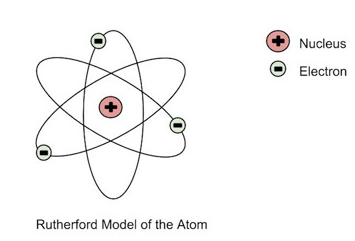
Rutherford's gold foil experiment provided evidence that...
a)
negative and positive charges are spread evenly throughout the atom.
b)
alpha particles have a positive charge.
c)
gold is not a dense as previously thought.
d)
there is a dense positively charged nucleus at the center of an atom.
13.
What does the nucleus of an atom contain?
a)
Electrons and neutrons
b)
Protons and neutrons
c)
Neutrinos and positrons
d)
DNA and RN
14.
Neon has an atomic number of 10 and an atomic mass of 20.180.  How many protons, electrons, and neutrons will it have?
a)
P=10 E=10 N=11
b)
P=5  E=5  N=10
c)
P=10  E=10  N=10
d)
P=10  E=5  N=5
15.
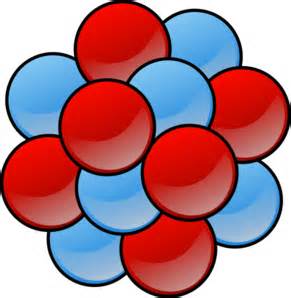
What element is pictured?
a)
Hydorgen
b)
Boron
c)
Beryllium
d)
Arsenic
16.
The particles of the atom you can find by knowing the atomic number.
a)
neutrons
b)
protons and electrons
c)
protons and neutrons
d)
atomic mass
17.
What is the mass number and name of an element with 8 protons and 8 neutrons?
a)
16 - Carbon
b)
16 - Oxygen
c)
24 - Oxygen
d)
8 - Neon
18.
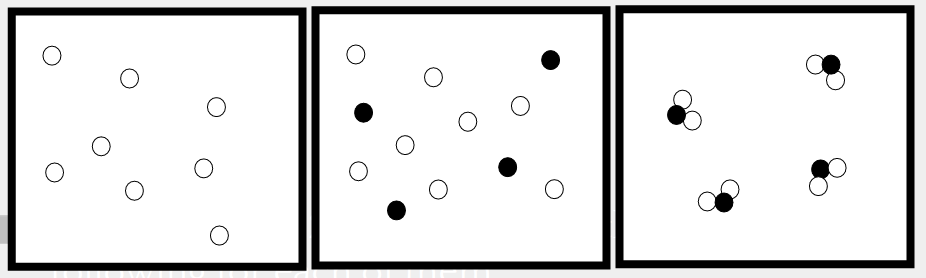
Which one of these pictures represents a pure substance? 
a)
1 and 2
b)
1 and 3
c)
2 and 3
d)
1, 2 and 3
19.
Which one of these pictures represents a mixture? 
a)
1
b)
2
c)
3
d)
1, 2 and 3
20.
How many atoms of iodine are in a mole of iodine?
a)
53
b)
63.55g
c)
126.9
d)
6.02 x 10²³
21.
What is the molar mass of NaCl?
a)
58.45g/mol
b)
28g/mol
c)
12g/mol
d)
6.02 x 10²³
22.
How do we get mass from moles?
a)
multiply by avogadro's number
b)
multiply by molar mass
c)
divide by avogadro's number
d)
divide by molar mass
23.
Which has more molecules?
a)
1 mole H2O
b)
1 mole Al(OH)3
c)
1 mole NaCl
d)
There are all the same
24.
How many liters would 2 moles of any gas take up at STP?
a)
22.4 L
b)
44.8 L
c)
11.2 L
d)
2 L
25.
What is the molar mass of Gold (III) chloride?
a)
196.967 g
b)
626.354 g
c)
232.42 g
d)
303.326 g
26.
N2 + 3H2 → 2NH3
How many moles of N2 is needed to react with 6 moles of H2?
a)
6.7
b)
2.0
c)
3.0
d)
15.0
27.
H2+Cl→ 2HCl
What is the total number of moles of HCl produced when 3 moles of H2 is completely consumed?
a)
5
b)
2
c)
3
d)
6
28.
How many covalent bonds does carbon need to form in order to have a full octet?
a)
2
b)
3
c)
4
d)
5
29.
Which of the following is the correct Lewis dot structure for the molecule fluorine (F2)?
a)
A
b)
B
c)
C
d)
D
30.
Which of the following is the correct Lewis structure for CH2O?
a)
Option A
b)
Option B
c)
Option C
d)
Option D
31.

Which of the following is an ionic bond?

a)

H3N

b)

CaCl2

c)

NO2

d)

SCl

32.

How many valence electrons do elements in Group 2A have?

a)

12

b)

4

c)

1

d)

2

33.

How many valence electrons are in Phosphorus?

a)

15

b)

4

c)

5

d)

31

34.

The chemical formula for an ionic compound of potassium and oxygen is

a)

KO.

b)

K2O.

c)

K2O2.

d)

KO2.

35.

Which is most likely to form a negative ion?

a)

an element from group 7

b)

a metal

c)

an element from group 1

d)

an element with atoms that have eight valence electrons

36.

Which of the following would produce an cation?

a)

O

b)

N

c)

K

d)

F

37.

Ions are:

a)

atoms with a positive or negative charge

b)

atoms with no charge

c)

atoms with ONLY a positive charge

d)

atoms with ONLY a negative charge

38.

This causes the mass of the nucleus to increase.

a)

adding an electron

b)

adding a neutron

c)

more orbitals

d)

adding negatively charged particles

39.
Which chemical reaction breaks down into 2 substances?
a)
Double Replacement
b)
Single Replacement
c)
Synthesis
d)
Decomposition
40.
Which chemical reaction switches 2 elements?
a)
Double Replacement
b)
Single Replacement
c)
Combustion
d)
Decomposition
41.

Balance the following reaction: _P4+_O2 → _P2O3

a)

3 P4+1 O2 → 2 P2O3

b)

1 P4+1 O2 → 2 P2O3

c)

1 P4+ 3 O2 → 2 P2O3

d)

1 P4+ 2 O2 → 3 P2O3

42.

Balance the following chemical reaction: _BaS + _PtF2 → _BaF2 + _PtS

a)

1 BaS + 1 PtF2 → 1 BaF2 + 1 PtS

b)

4 BaS + 2 PtF2 → 1 BaF2 + 1 PtS

c)

1 BaS + 2 PtF2→ 2 BaF2 + 2 PtS

d)

1 BaS + 3 PtF2 →1 BaF2 + 2 PtS

43.
Electronegativity is...
a)
how good an atom is at attracting electrons
b)
the ability of an atom to lose electrons
c)
the energy required to remove an electron from a specific atom
d)
how easy it is to make friends. 
44.
Name the following compound:
  BF3
a)
boron fluoride
b)
boron difluoride
c)
monoboron trifluoride
d)
boron trifluoride
45.
The chemical formula of dinitrogen textroxide is
a)
Ni₂O₄
b)
NiO
c)
N₂O₄
d)
NiO₂
46.
A ______________ is a substance that increases the rate of a reaction without being used up during the reaction. 
a)
catalyst
b)
product
c)
reactant
d)
solute
47.

Increasing the ____ causes the particles (atoms or molecules) of the reactants to move more quickly so that

they collide with each other more frequently and with more

energy.

a)

Catalyst

b)

Surface Area

c)

Temperature

d)

Concentration

48.

Which of the following will lower the rate

of reaction?

a)

adding an enzyme to the reaction

b)

decreasing the temperature from 40°C to

10°C

c)

breaking a chunk of calcium up into

smaller pieces

d)

increasing the amount of solute

dissolved in a solution

49.

What is a limiting reactant?

a)

the reactant that determines how much product can be made

b)

the reactant that is in excess

c)

the product that you can make the most of

d)

the amount of reactants that react with each other

50.

You need 2 pieces of bread, 1 tablespoon of peanut butter and 2 tablespoons of jelly to make a sandwich. If you have 10 pieces of bread, 4 tablespoons of peanut butter and 20 tablespoons of jelly, what is the limiting reactant?

a)

bread

b)

jelly

c)

peanut butter

d)

sandwich

51.

When 12 moles of O2 reacts with 1.5 mole of C10H8 what is the limiting reactant? C10H8 + 12 O2 →10 CO2 + 4 H2O

a)

O2

b)

C10H8

c)

H2O

d)

CO2

52.

Gas is the only state of matter that...

a)

spreads out to fill all available space

b)

takes the shape of their container

c)

can't be compressed

d)

All of these

53.
If you increase the pressure of a constant volume of gas, what will happen to the temperature?
a)
Increase
b)
Decrease
c)
Stay the same
d)
It will Blow Up
54.

How are pressure and volume related?

a)

Directly

b)

Inversely

c)

They aren't related

d)

Second cousins once removed

55.
Pressure is caused by ______.
a)
gravity.
b)
gas molecules colliding with each other.
c)
gas molecules colliding with surfaces of the container.
d)
gas molecules reacting with each other.
56.

The higher the average kinetic energy...

a)

the higher the volume

b)

the higher the mass

c)

the higher the temperature

d)

the higher the density

57.
Absolute zero is 
a)
0 K
b)
where there is no molecular movement
c)
the coldest temperature possible
d)
all of these
58.
You forgot to bring your basketball inside after playing a game with your friends. When the sun went down, the temperature dropped and it got cold outside. What do you think happened to the volume of the ball?
a)
It increased
b)
It decreased
c)
It stayed the same
59.

If a nitrogen gas occupies a volume of 500 mL at a pressure of 0.971 atm. What volume will the gas occupy at a pressure of 1.50 atm, assuming the temperature remains constant?

a)

323.6 ml

b)

728.25 ml

c)

772.39 ml

d)

None of the above

60.

If the pressure exerted by a gas at 25 degrees C in a volume of 0.044 L is 3.81 atm, how many moles of gas are present?

a)

.002766 mol

b)

.0069 mol

c)

2.766 mol

d)

9.887 mol

61.

If the pressure exerted by a gas at 25 degrees C in a volume of 0.044 L is 3.81 atm, how many moles of gas are present?

a)

.002766 mol

b)

.0069 mol

c)

2.766 mol

d)

9.887 mol

62.

Climate change includes major changes of long periods of time in

a)

Precipitation

b)

Wind Patterns

c)

Temperature

d)

Earthquakes

63.

Greenhouse gases include:

a)

CO2

b)

O2

c)

CH4

d)

N2

64.

The greenhouse effect is caused by gases in the atmosphere...

a)

allowing more of the suns energy to reach the earth

b)

causing more of the suns energy to be reflected back into space

c)

trapping the heat being released by the earth from escaping to space

d)

allowing more of the heat being released by the earth to escape to space

65.

The greenhouse effect is caused by gases in the atmosphere...

a)

allowing more of the suns energy to reach the earth

b)

causing more of the suns energy to be reflected back into space

c)

trapping the heat being released by the earth from escaping to space

d)

allowing more of the heat being released by the earth to escape to space

66.

Most of the electromagnetic energy that reaches the earth from the sun comes is

a)

Microwaves and Infrared

b)

Visible Light and Infrared

c)

Visible Light and UV

d)

Infrared and UV

67.

Most of the electromagnetic energy that reaches the earth from the sun comes is

a)

Microwaves and Infrared

b)

Visible Light and Infrared

c)

Visible Light and UV

d)

Infrared and UV

68.

Volcanoes primarily affect global climate by...

a)

Releasing CO2 which tends to warm the planet by contributing to the greenhouse effect.

b)

Releasing heat which tends to warm the planet.

c)

Releasing ash and aerosols which tend to cool the planet by absorbing light.

d)

Releasing ash that makes the air more polluted.

69.

The percentage of energy that reaches and is absorbed by the earth's surface in typically about

a)

25%

b)

75%

c)

45%

d)

15%

70.

Which earth surface would have the smallest albedo effect?

a)

A glacier

b)

A sandy desert

c)

A grassy plain

d)

An evergreen forest

71.

Which earth surface would have the smallest albedo effect?

a)

A glacier

b)

A sandy desert

c)

A grassy plain

d)

An evergreen forest

72.
It is a chemical reaction where the reactants form products that, in turn, react together to give the reactants back.
a)
reversible reaction
b)
irreversible reaction
c)
decomposition reaction
d)
synthesis
73.
It is a chemical reaction where the reactants form products that, in turn, react together to give the reactants back.
a)
reversible reaction
b)
irreversible reaction
c)
decomposition reaction
d)
synthesis
74.
For the reaction...
SO2 + O2  <−>  SO3
If the concentration of SOis increased, the equilibrium of the reaction will shift ___________.
a)
left
b)
right
c)
left and right 
d)
neither left nor right
75.
For the reaction...
SO2 + O2  <−>  SO3
If the concentration of SOis increased, the equilibrium of the reaction will shift ___________.
a)
left
b)
right
c)
left and right 
d)
neither left nor right
76.
2SO2(g)+O2(g)⇌2SO3(g)
Removing O2(g) will
a)
shift equilibrium right
b)
shift equilibrium left
c)
increase pressure
d)
have no change
77.
2SO2(g)+O2(g)⇌2SO3(g)
Removing O2(g) will
a)
shift equilibrium right
b)
shift equilibrium left
c)
increase pressure
d)
have no change
78.
Changes in pressure will only affect substances that are in the __________ state.
a)
gaseous
b)
liquid
c)
solid
79.
For the reaction...
H2 (g)  + Cl2 (g) <=>  2HCl (g)  +  heat
If the pressure in the system is increased, the equilibrium position will _______.
a)
shift to the left
b)
shift to the right
c)
not shift position at all as 2 mol gas <=> 2 mol gas
80.
For the reaction...
H2 (g)  + Cl2 (g) <=>  2HCl (g)  +  heat
If the pressure in the system is increased, the equilibrium position will _______.
a)
shift to the left
b)
shift to the right
c)
not shift position at all as 2 mol gas <=> 2 mol gas
81.
What is the activation energy?
a)
The quantity of heat absorbed in a reaction
b)
The minimum energy needed to begin a reaction
c)
The energy given off after reactants collide.
d)
The energy difference between reactants and products
82.
What are the two factors to look for when determining if the reaction is at equilibrium?
a)
Forward reaction rate is faster than the reverse and concentrations are equal
b)
Forward and reverse reaction rates are equal and concentration is constant
c)
Forward and revers reaction rates are equal and concentration is equal
d)
Forward reaction rate is faster than the reverse and concentration is equal
83.
For the reaction...
heat  +  N2  +  O2  ↔  2NO
If the heat is added to the chemical system, the equilibrium will shift _______.
a)
left
b)
right
c)
left and right
d)
neither left nor right
84.
For the reaction...
heat  +  N2  +  O2  ↔  2NO
If the heat is added to the chemical system, the equilibrium will shift _______.
a)
left
b)
right
c)
left and right
d)
neither left nor right
85.

Which of the following statements is true concerning acids and bases?

a)

acids and bases don't react with each other

b)

acids mixed with bases neutralize each other

c)

acids mixed with bases make stronger bases

d)

acids mixed with bases make stronger acids

86.

Which is the correct set of acid properties:

a)

sour taste, corrosive, change litmus from red to blue

b)

sour taste, corrosive, change litmus from blue to red

c)

sweet taste, slippery, change litmus from blue to red
d)

sour taste, slippery, change litmus from blue to red

87.

Which is the correct set of acid properties:

a)

sour taste, corrosive, change litmus from red to blue

b)

sour taste, corrosive, change litmus from blue to red

c)

sweet taste, slippery, change litmus from blue to red

d)

sour taste, slippery, change litmus from blue to red

88.

True or false: a neutral solution has equal amounts of H+ and OH-.

a)

True

b)

False

89.

True or false: a neutral solution has equal amounts of H+ and OH-.

a)

True

b)

False

90.

NaOH may be found in drain cleaners and as a component of soaps. Is NaOH an acid or a base?

a)

Acid

b)

Base

c)

Neither (Neutral)

91.

NaOH may be found in drain cleaners and as a component of soaps. Is NaOH an acid or a base?

a)

Acid

b)

Base

c)

Neither (Neutral)

92.

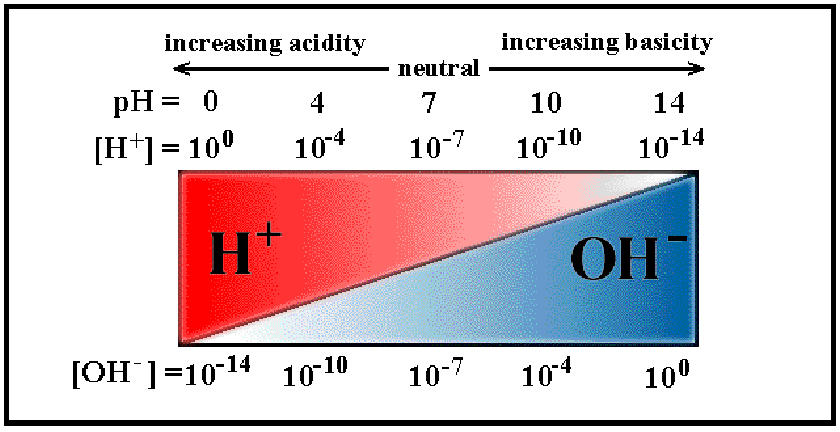
Neutral solutions have a pH of:

a)

0

b)

1

c)

7

d)

14

93.

Neutral solutions have a pH of:

a)

0

b)

1

c)

7

d)

14

94.

Vinegar is an example of:

a)

An acid.

b)

A base.

c)

Neither an acid nor a base.