wayground logo

Free Printable Worksheets

Font size

S
M
L
XL
Worksheets

Weather and Climate Part 2 Review

Total questions: 110

Worksheet time: 2hrs 37mins
Name
Class
Date
1.
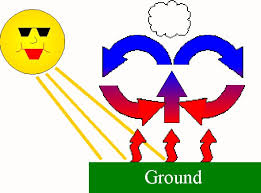
Warm air rises and the cool air sinks demonstrates this type of heat transfer. 
a)
conduction
b)
convection
c)
radiation
d)
Insolation 
2.
Warm air is __________ dense than cold air and rises creating convection currents.
a)
more
b)
less
3.
Which statement is true?
a)
The quicker a molecule moves, the colder it is.
b)
The slower a molecule moves, the warmer it is.
c)
The quicker a molecule moves, the warmer it is
d)
The movement on molecule don�t affect its temperature
4.
___________is the result of the weight of a column of air pushing on an area.
a)
air pressure
b)
density
c)
volume
d)
none of the above
5.
In what direction(s) does air exert pressure?
a)
everywhere
b)
no where
c)
there is no pressure
d)
downward
6.
As you climb up a mountain what happens to the air pressure?
a)
decreases
b)
increases
c)
stays the same
7.
What happens to the amount of oxygen molecules as altitude increases?
a)
fewer molecules
b)
more molecules
c)
same amount of molecules
d)
nothing happens to the molecules
8.
Cold air exerts _____________ pressure than warm air.
a)
the same
b)
more
c)
less
9.
Air pressure does not crush objects on earth
a)
because more air pushes down than up
b)
because gravity keeps air pressure away
c)
because air pressure pushes in all directions
d)
because the Earth has an opposing force of gravity
10.
The amount of mass in a unit volume of a substance
a)
mass
b)
pressure
c)
volume
d)
density
11.
If density of air is high, pressure is:
a)
high
b)
low
12.
If density of air is low, pressure is:
a)
high
b)
low
13.

What causes differences in air pressure?

a)

wind

b)

rain

c)

snow

d)

solar radiation

14.

Which of the following questions about air pressure is FALSE?

a)

The atmosphere is held to Earth by gravity.

b)

Air pressure is caused by gravity and the collision of air molecules.

c)

Air pressure only pushes down.

d)

Air pressure changes through the day due to temperature changes.

15.
High Pressure Systems on Earth's surface are caused by...
a)
air rising away from Earth's surface.
b)
air sinking towards Earth's surface.
c)
air not moving.
d)
air moving horizontally.
16.
Which book is under the greatest pressure?
a)
yellow book
b)
red book
c)
green book
d)
dark blue book
17.
Which book is under the least pressure?
a)
yellow book
b)
red book
c)
green book
d)
dark blue book
18.
What causes the pattern in air density throughout Earth's atmosphere?
a)
Gravity pulls air towards the center of Earth.
b)
Gravity pushes air towards the center of Earth.
c)
Wind blows air towards Earth's surface.
d)
Air is attracted to Earth's surface like a magnet.
19.
Which container shows air particles experiencing higher pressure?
a)
Left Container
b)
Right Container
c)
Both Containers
d)
Neither Containers
20.
Which container shows air particles experiencing lower pressure?
a)
Left Container
b)
Right Container
c)
Both Containers
d)
Neither Containers
21.
Hot air ___________ and cold air __________
a)
Sinks, Rises
b)
Rises, Sink
c)
is fun, is lazy
22.

Air mattresses, balloons and bubbles are all examples of which property of air?

a)

Air takes up space

b)

Warm air expands

c)

Air has weight

d)

Air is a mixture of gases

23.
Cold air exerts _____________ pressure than warm air
a)
the same
b)
more
c)
less
24.

Why does air move out of an inflated balloon?

a)

air moves from high pressure to low pressure

b)

air moves from warm air to cold air

c)

air moves from low pressure to high pressure

d)

air moves from dry air to moist air
25.
How do we characterize an air mass that forms over the ocean?
a)
Dry
b)
Wet
c)
Cold
d)
Warm
26.
How do we characterize an air mass that forms over land?
a)
Dry
b)
Wet
c)
Cold
d)
Warm
27.
How do we characterize an air mass that forms over near the equator?
a)
Dry
b)
Wet
c)
Cold
d)
Warm
28.
How do we characterize an air mass that forms near the poles?
a)
Dry
b)
Wet
c)
Warm
d)
Cold
29.
What types of air masses form over oceans?
a)
Maritime
b)
Continental
c)
Polar
d)
Tropical
30.
What's the humidity and temperature of a continental tropical air mass?
a)
Wet and cold
b)
Dry and warm
c)
Wet and warm
d)
Dry and cold
31.
What's the humidity and temperature of a maritime tropical air mass?
a)
Wet and cold
b)
Dry and warm
c)
Wet and warm
d)
Dry and cold
32.
A wet and cold air mass would be a...
a)
Maritime polar
b)
Continental polar
c)
Maritime tropical
d)
Continental tropical
33.
A dry and cold air mass would be...
a)
Maritime polar
b)
Continental polar
c)
Maritime tropical
d)
Continental tropical
34.
A dry and hot air mass would be...
a)
Maritime arctic
b)
Maritime tropical
c)
Continental tropical
d)
Continental polar
35.
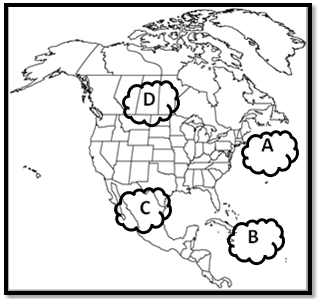
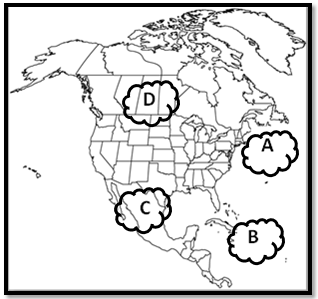
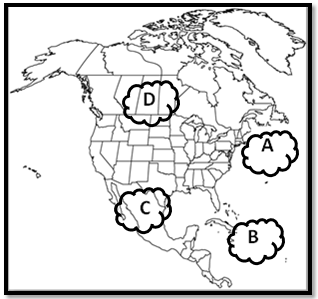
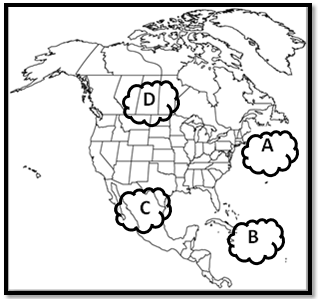
Which type of air would you find at air mass A?
a)
cold, dry
b)
warm, humid
c)
warm, dry
d)
cold, humid
36.
Which type of air would you find at air mass B?
a)
cold, dry
b)
warm, humid
c)
warm, dry
d)
cold, humid
37.
Which type of air would you find at air mass C?
a)
cold, dry
b)
warm, humid
c)
warm, dry
d)
cold, humid
38.
Which type of air would you find at air mass D?
a)
cold, dry
b)
warm, humid
c)
warm, dry
d)
cold, humid
39.
Where would you find a tropical maritime air mass?
a)
over the ocean, near the equator
b)
over the ocean, near the poles
c)
over a continent, near the equator
d)
over a continent, near the poles
40.
Air travels
a)
from high pressure to low pressure
b)
from low pressure to high pressue
41.
What kind of breeze is this & what time of day/night would it form?
a)
Land breeze - daytime
b)
Land breeze - nighttime
c)
Sea breeze - daytime
d)
Sea breeze - nighttime
42.
A _______________ is formed when a warm and cold air mass meet
a)
front
b)
air mass
43.
True or False = When a large and a small air mass meet, they form a front 
a)
True
b)
False
44.
What color is the symbol for a warm front?
a)
red
b)
blue
45.
What color is the symbol for a cold front ?
a)
red
b)
blue
46.
When a cold air mass crashes into and pushes a warm air mass up, which kind of front is formed?
a)
warm front 
b)
cold front
47.
When a warm air mass stretches over a cold air mass, which kind of front is formed?
a)
cold front
b)
warm front 
48.
Which type of weather is associated with a cold front?
a)
heavy rain, snow, thunderstorms, and snow for short periods of time 
b)
Steady, light rain or snow can occur for longer periods of time 
49.
what is an air mass?
a)
a large body of air that is made of the same temperature and moisuture
b)
when two air masses meet 
50.
What type of storm front is this?
a)
Warm Front
b)
Cold Front
c)
Occluded Front
d)
Stationary Front
51.
What type of storm front if this?
a)
Warm Front
b)
Cold Front
c)
Stationary Front
d)
Occluded Front
52.
What does symbol # 3 mean?
a)
Cold Front
b)
Warm Front
c)
Stationary Front
d)
Occluded Front
53.
What does symbol # 1 mean?
a)
Occluded Front
b)
Stationary Front
c)
Warm Front
d)
Cold Front
54.
When a warm air mass and a cold air mass meet, but they push at each other and neither one can move, it is called a/an - 
a)
warm front
b)
cold front
c)
occluded front
d)
stationary front
55.
The boundary between two air masses is called a/an - 
a)
flood
b)
front
c)
climate
d)
storm
56.
When a cold air mass moves into a warm air mass, it will get colder and we will have severe weather. What type of front is this?
a)
warm front
b)
cold front
c)
occluded front
d)
stationary front
57.
When a warm air mass gently slides on top of a cold air mass, and you have drizzly rain and then warmer weather, what type of front is it?
a)
warm front
b)
cold front
c)
occluded front
d)
stationary front
58.
A/An ____ is a large body of air that has the same properties as the Earth's surface over which it develops.
a)
front
b)
air mass
c)
cloud
d)
tornado 
59.
7. Which of the following would be an area that would most likely lead to a warm or hot air mass to develop?
a)
The North pole
b)
The South pole
c)
The Equator
60.
8. Which of the following would be an area where a cold air mass would most likely develop?
a)
Over Mexico
b)
Over Canada
c)
Over the Equator area
61.
What type of air mass is the highlighted arrow?
a)
cold/dry
b)
cold/humid
c)
warm/humid
d)
warm/dry
62.
What type of front moves quickly and can produce severe thunderstorms?
a)
Stationary
b)
Warm
c)
Cold
d)
Occluded
63.
What type of front may be rainy or foggy for several days?
a)
Cold
b)
Stationary
c)
Occluded
d)
Warm
64.
What type of air mass is the highlighted arrow?
a)
cold/dry
b)
cold/humid
c)
warm/dry
d)
warm/humid
65.
What type of air mass is the highlighted arrow?
a)
cold/dry
b)
cold/humid
c)
warm/dry
d)
warm/humid
66.
What type of air mass is the highlighted arrow?
a)
cold/dry
b)
cold/humid
c)
warm/dry
d)
warm/humid
67.
What type of front is this?
a)
Warm Front
b)
Cold Front
c)
Stationary Front
68.
a)
Warm Front
b)
High Air Pressure
c)
Cold Front
d)
High Temperatures
69.
a)
High Pressure
b)
Warm Front
c)
Cold Front
d)
Mountains
70.
High Pressure is associated with this type of weather...
a)
Cloudy/Overcast Weather
b)
Cold Weather
c)
Warm Weather
d)
Fair Weather
71.
Low Pressure is associated with this type of weather...
a)
Cloudy/Overcast Weather
b)
Cold Weather
c)
Warm Weather
d)
Fair Weather
72.
Our weather generally moves in this direction...
a)
West to East
b)
East to West
c)
North to South
d)
South to North
73.
A cold front moving into an area can bring this type of weather...
a)
Warmer Temperatures, Clear Skies
b)
Colder Temperatures, Clear Skies
c)
Warmer Temperatures, Clouds
d)
Colder Temperatures, Clouds, and Precipitation
74.
A warm front moving into an area can bring this type of weather...
a)
Warmer Temperatures, Clear Skies
b)
Colder Temperatures, Clear Skies
c)
Warmer Temperatures, Clouds, and steady precipitation
d)
Colder Temperatures, Clouds, and Precipitation
75.
Warm air mass that does not carry water:
a)
continental tropical
b)
continental polar
c)
maritime tropical
d)
maritime polar
76.
Warm air moving upwards from the Gulf of Mexico is:
a)
continental tropical
b)
continental polar
c)
maritime tropical
d)
maritime polar
77.
____________ air sinks/falls because it is ____________dense.
a)
Cold, More
b)
Warm, Less
c)
Cold, Less
d)
Warm, More
78.
This Symbol is associated with a _____________________Front.
a)
Warm
b)
Occluded
c)
Cold
d)
Stationary
79.
This picture represents the symbol for a __________________________Front.
a)
Warm
b)
Occluded
c)
Cold
d)
Stationary
80.
The picture represents the symbol for a _______________________Front.
a)
Cold
b)
Warm
c)
Occluded
d)
Stationary
81.
Which city is experiencing thunderstorms?
a)
Denver
b)
New York 
c)
Miami 
d)
Boise
82.
Which city is currently experiencing a snow storm?
a)
Seattle
b)
Los Angeles
c)
Chicago
d)
New York
83.
Which city has the highest the highest temperature?
a)
Dallas
b)
Chicago
c)
Los Angeles
d)
Miami
84.
Which city has the lowest temperature on the map?
a)
Minneapolis
b)
Seattle
c)
New York
d)
Denver
85.
Which city has partly cloudy skies?
a)
Boise
b)
New York
c)
Atlanta 
d)
Dallas
86.
Which city is closest to a high pressure system?
a)
New York
b)
Miami
c)
Minneapolis
d)
Boise
87.
Which city is close to a warm front?
a)
Chicago
b)
New York
c)
Boise
d)
Denver
88.
Which city is experiencing cloudy skies and rain?
a)
New York 
b)
Seattle
c)
Dallas
d)
Boise
89.
Choose the best forecast for New York on Saturday. 
a)
sunny skies
b)
warmer temperatures
c)
snow
d)
sleet
90.
Choose the best forecast for Los Angeles on Saturday.
a)
cooler temperatures
b)
warmer temperatures 
c)
low pressure
d)
snow
91.
Choose the best forecast for Dallas on Saturday.
a)
thunderstorms
b)
snow
c)
warmer temperatures
d)
clear skies
92.
Choose the best forecast for Minneapolis on Saturday.
a)
snow
b)
cloudy skies
c)
hail
d)
sunny skies
93.
Choose the best forecast for Boise on Saturday.
a)
cloudy 
b)
cooler temperatures
c)
snow
d)
rain
94.
Choose the best forecast for Miami on Saturday. 
a)
sunny skies
b)
warmer temperatures
c)
rain
d)
snow
95.
Choose the best forecast for Chicago on Saturday.
a)
rain
b)
warmer temperatures
c)
snow
d)
sunny skies
96.
Choose the best forecast for Seattle on Saturday.
a)
rain
b)
sunny skies
c)
warmer temperatures
d)
snow
97.

What is the sun responsible for on Earth?

a)

Volcanoes

b)

Earthquakes

c)

Ocean waves

d)

Landslides

98.

What is the sun NOT responsible for on Earth?

a)

Ocean Waves

b)

Wind

c)

Thunderstorms

d)

Earthquakes

99.

Which of the following is true only of LOCAL winds?

a)

Earth's rotation causes winds to appear to bend.

b)

Created by the uneven heating of Earth's surface

c)

Created by convection currents along coastlines

d)

Moves horizontally across Earth's surface

100.

Objects in the NORTHERN Hemisphere deflect to which direction due to the Coriolis Effect?

a)

Left

b)

Up

c)

Down

d)

Right

101.

Objects in the SOUTHERN Hemisphere deflect to which direction due to the Coriolis Effect?

a)

Left

b)

Up

c)

Down

d)

Right

102.

Which winds were crucial to sailors because it helped them get their items across the ocean to sell?

a)

Trade Winds

b)

Prevailing winds

c)

Westerlies

d)

Jet Stream

103.

Westerlies blow in which direction?

a)

West to East

b)

North to South

c)

South to North

d)

East to West

104.

Easterlies blow in which direction?

a)

East to West

b)

North to South

c)

South to North

d)

West to East

105.

The windless, rainy zone near the equator is called the what?

a)

Doldrums

b)

Easterlies

c)

Tropics

d)

Jet Stream

106.
Wind is caused by what?
a)
Sun
b)
Earth
c)
Moon
d)
Wind
107.
The curving path of a moving object from an otherwise straight path due to Earth's rotation is called what?
a)
Sublimation
b)
Continental Deflection
c)
Transpiration
d)
Coriolis Effect
108.
How does the Coriolis Effect influence hurricanes and cyclones
a)
determines how powerful they will be
b)
determines where they will go
c)
determines where they form
d)
determines the direction of the wind rotation
109.
If the Earth did not rotate, air at the Equator would simply
a)
Sink and move toward the poles.
b)
Rise and move toward the poles.
c)
Stay stationary.
d)
None of the above.
110.
Uneven heating of Earth's surface by the sun causes which of these?
a)
wind patterns
b)
cloud formation
c)
volcanic activity
d)
nutrient cycling