wayground logo

Free Printable Worksheets

Font size

S
M
L
XL
Worksheets

Comprehensive Biology Review

Total questions: 88

Worksheet time: 2hrs 40mins

Name
Class
Date
1.
Which organic molecule is primarily used by cells as a source of energy?
a)
Amino Acid
b)
Fatty Acid
c)
Glucose
d)
Protein
2.
Which organic molecule serves as a catalyst?
a)
lipids
b)
proteins
c)
nucleic acid
d)
carbohydrates
3.
In organisms, macromolecules are made up of subunits. Which of these pairs correctly describes
how a macromolecule is constructed?
a)
DNA is made up of nucleic acids.
b)
Protein is made up of amino acids.
c)
Nucleic acids are made up of DNA.
d)
Amino acids are made up of protein.
4.
Which best explains how the structure of enzymes is related to their
function?
a)
Enzyme structures release the energy in their substrates.
b)
Enzyme structures react with their substrates.
c)
Enzymes’ unique active site allows it to fit with only one substrate
molecule.
d)
Enzymes interact with their substrates like welders building a steel
skyscraper.
5.
Which type of substances serves as a catalyst for reactions that break large food molecules into
smaller useful molecules?
a)
enzymes
b)
vitamins
c)
lipids
d)
nucleotides
6.
Uses light energy to make a sugar (photosynthesis). It is green.
a)
cytoplasm
b)
mitochondria
c)
chloroplasts
d)
ribosomes
7.
A storage area for food, water and waste.
a)
vacuole
b)
chloroplasts
c)
cell wall
d)
cell membrane
8.
Which of the following is NOT included in the Cell Theory?
a)
All cells can survive independently
b)
All cells come from cells.
c)
All organisms are made of cells.
d)
The cell is the basic unit of organization in an organism.
9.
What structures are only found in plant cells?
a)
cell wall, cell membrane, nucleus
b)
chloroplast, cell wall, large vacuole
c)
chloroplast, large vacuole, Golgi bodies
d)
large vacuole, cell wall, mitochondria
10.

What is Apoptosis?

a)

A tumor

b)

A protein

c)

Programmed cell death

d)

Cell cycle checkpoints

11.

What is cell differentiation?

a)

The process where unspecialized cells become different in structure and function.

b)

When DNA controls the cell cycle.

c)

The ability of cells to make more cells.

d)

The ability of cells to maintain homeostasis.

12.
Which is true about Embryonic Stem Cells.
a)
They no longer do mitosis, their cell type is set and can not change
b)
They are limited to the type of cell they can become
c)
They can become any cell type in the body
d)
They are found in adults
13.
What is one goal of cellular differentiation/specialization?
a)
To create specialized cells to help organism maintain homeostasis.
b)
To many cells.
c)
To make stem cells
d)
to make single celled organisms
14.
Plants have chloroplasts to carry out photosynthesis, but animals do not.  Which organisms have mitochondria to carry out cellular respiration?
a)
animals
b)
plants
c)
both
d)
neither
15.
Cellular respiration produces _______ molecules that directly power many processes within the cell.
a)
glucose
b)
ATP
c)
sunlight
d)
O2
16.
Which Chemical Reaction?
Glucose and oxygen become carbon dioxide, water and ATP
a)
Photosynthesis
b)
Fermentation
c)
Cellular Respiration
17.
Which Chemical Reaction?
Glucose becomes carbon dioxide and alcohol.
a)
Photosynthesis
b)
Fermentation
c)
Cellular Respiration
18.
Cells need to bring in molecules to carry out cellular processes. Often, this requires moving the molecules across the cell membrane against the concentration gradient. How do these molecules get into the cell?
a)
passive transport by diffusion
b)
active transport using ATP 
c)
passive transport by osmosis
d)
 osmosis
19.
A person with swollen gums rinses his mouth with warm salt water, and the swelling decreases. Which of the following has occurred?
a)
The swollen gums have absorbed the saltwater solution.
b)
The saltwater solution lowers the temperature of the water in the gums.
c)
The salt in the solution has moved against the concentration gradient.
d)
The water in the gums has moved out due to the high concentration of salt in the solution. 
20.
The cell membrane of the red blood cell will allow water, oxygen, and carbon dioxide to pass through. Because other substances are blocked from entering, this membrane is called
a)
perforated
b)
semi-permeable
c)
non-conducive
d)
permeable
21.
The diffusion of water across a selectively permeable membrane is called 
a)
active transport
b)
facilitated diffusion
c)
osmosis
d)
phagocytosis
22.

How many chromosomes are there in a somatic cell?

a)

23

b)

26

c)

43

d)

46

23.

How many divisions take place in mitosis?

a)

1

b)

2

c)

3

d)

4

24.

How many divisions take place in meiosis?

a)

1

b)

2

c)

3

d)

4

25.

How many cells are created at the end of mitosis?

a)

1

b)

2

c)

3

d)

4

26.

How many cells are created at the end of meiosis?

a)

1

b)

2

c)

3

d)

4

27.
When does crossing over occurs? 
a)
Anaphase II
b)
Prophase I
c)
Metaphase I
d)
Telophase II
28.
What are gametes?
a)
sex cells
b)
body cells
c)
human cells
d)
plant cells
29.
What is the purpose of mitosis?
a)
to grow, replace, and repair cells
b)
to create sex cells
c)
to create 2 different cells
d)
to create haploids
30.
What is the advantages of reproducing sexually instead of asexually?
a)
easy to find a partner
b)
to create identical cells
c)
to create genetic diversity
d)
there are no advantages
31.
When chromosomes fail to separate correctly during anaphase of meiosis, what can occur?
a)
extra chromosomes are found in the sex cell
b)
chromosomes of the sex cell are doubled
c)
chromosomes of the sex cell are halved
d)
meiosis never completes
32.
Nondisjunction can result in 
a)
trisomy conditions
b)
monosomy conditions
c)
additional sex chromosomes
d)
all of these
33.
What makes this individual's karyotype not normal?
a)
An extra sex chromosome
b)
An extra autosome
c)
A missing sex chromosome
d)
A missing autosome
34.
What is the sex of this individual?
a)
female
b)
male
35.
If T=Tall & t=short, what is the genotypic ratio?
a)
1:3
b)
3:1
c)
1:2:1
d)
2:2
36.
B = brown fur  b = white fur
In the Punnett square, what is the probability for white fur
a)
0%
b)
25%
c)
50%
d)
75%
37.
B - black, b - brownTwo black mice mate and have some black and some brown mice.  What is the genotype of the parents?
a)
BB x Bb
b)
BB x bb
c)
Bb x Bb
d)
Bb x bb
38.
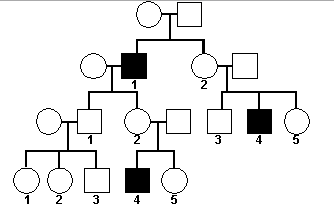
What type of heredity is shown in the pedigree?
(hint: check your notes - "modes of inheritance")
a)
Sex-Linked Dominant
b)
Sex-Linked Recessive
c)
Autosomal Dominant
d)
Autosomal Recessive 
39.
What are the blood types of the possible children that a woman (type O) and man (type AB) can have?
a)
O and AB
b)
O and A
c)
O and B
d)
A and B
40.
Which gender is more likely to inherit an X-linked, recessive trait and why?
a)
Females - 2 X chromosomes
b)
Males - only 1 X chromosome
c)
Females - no Y chromosome
d)
Males - the Y chromosome is smaller than the X chromosome
41.
In the second generation-how many people have the disease or display the physical trait?
a)
2
b)
4
c)
5
d)
6
42.
What percentage of the female offspring will be a carrier for this recessive disease?
a)
0%
b)
50%
c)
100%
d)
25%
43.

Bacteria cells can be used to produce insulin for the treatment of diabetes in humans. Which best explains how the bacteria cells are able to produce insulin for humans?

a)

The bacteria have been grown on a petri dish containing insulin.

b)

The bacteria have been genetically engineered to contain the DNA needed to produce insulin.

c)

The bacteria have been exposed to radioactivity to create mutant strains capable of producing insulin.

d)

The bacteria have been grown on a petri dish containing sugar; the bacteria produce insulin in response to the sugar.

44.

Genetic engineering has directly increased productivity in which U.S. industry?

a)

agriculture

b)

automobile

c)

media

d)

none of the above

45.

Which is a genetic engineering advancement directly related to a career in biotechnology?

a)

improving solar energy collection

b)

transporting textiles at higher rates

c)

creating crop foods that resist insect pests

d)

repairing historical sites with quality materials

46.
What kind of genetically modified crops would be most successful in wet-tropical countries that are overcrowded? 
a)
crops that are drought- and pest-resistant
b)
high-yield crops that do not need a lot of sunshine
c)
high-yield crops that are pest-resistant
d)
crops that are drought-resistant and need a lot of sunshine
47.
The way that crimes are solved today was affected by which of the following technologies? 
a)
gene therapy
b)
DNA fingerprinting
c)
genetic testing
d)
Genetic modification
48.
Which organisms are used to manufacture human insulin?
a)
Protozoans
b)
Algae
c)
Bacteria
d)
Amoebas
49.
Organisms that contain genes from different species are called___________ organisms.
a)
Blended
b)
Hybrid
c)
Transgenic
d)
Freaky
50.
This project was established to identify all 300,000+ genes found in our DNA.
a)
Human genome project
b)
Animal DNA study
c)
Human genetics road map project
d)
The DNA solution
51.
Which best describes the technique of genetic engineering?

a)
Adding foreign DNA to organisms to modify the organism’s DNA
b)
Manufacturing synthetic DNA in the laboratory from chemicals
c)
Cutting segments of DNA of an organism under a microscope
d)
Exposing DNA of an organism to radioactivity for mutations
52.
When an electrical current is used to separate a mixture of DNA...

a)
electricity
b)
restriction maps
c)
gel electrophoresis
d)
electron map
53.
The difference in the physical traits of an individual from those of other individuals in a group is called a(n)
a)
change
b)
adaption
c)
species
d)
variation
54.
which of the folllowing is an exammple of a vestigial structure?
a)
the wings of a red-tailed hawk
b)
the hind limbs of a house cat
c)
the fins of sharks
d)
the wings of an ostrich
55.

What is suggested by the anatomical similarity of different species of vertebrates?

a)

no evolutionary relationships between the groups

b)

recent common ancestry

c)

similar environments in the past

d)

evolution from a distant common ancestor

56.
Some organisms that share a common ancestor have features that have different functions, but similar structures.  These are known as
a)
vestigial structures
b)
analogous structures
c)
homologous structures
d)
fossil structures
57.
Genetic variation can arise from a random change in the DNA of a gene.  The change is called a(n)
a)
mutation
b)
gene flow
c)
gene pool
d)
allele
58.
Mutations are important because they bring about
a)
death of the organism in which they develop
b)
genetic variation needed for a population to evolve
c)
benefits for the individual, not for the population
d)
Hardey-Weinberg equilibrium within a population
59.
What is speciation?
a)
combining of tow species to form one with different traits
b)
isolation that affects mating behaviors
c)
timing of mating that prevents normal sexual selection
d)
divergence of two or more species from an existing one
60.
An earthquake causes an ocean channel top open and separate an island into two.  the species on each section are now in
a)
geographic isoliation
b)
behavioral isolation
c)
disruptive selection
d)
temporal isolation
61.
two species are in different environments and look very similar.  However, that are not closely related (analogous).  Their resemblance is most likely an example of.
a)
sexual selection
b)
temporal isolation
c)
convergent evolution
d)
divergent evolution
62.

What is the term for a feature that allows an organism to survive better in its environemtn?

a)

variation

b)

adaptation

c)

homologous structure

d)

vestigial structure

63.

The combined alleles of all individuals in a population is called the population's

a)

phenothype

b)

gene pool

c)

mutation rate

d)

allele frequency

64.

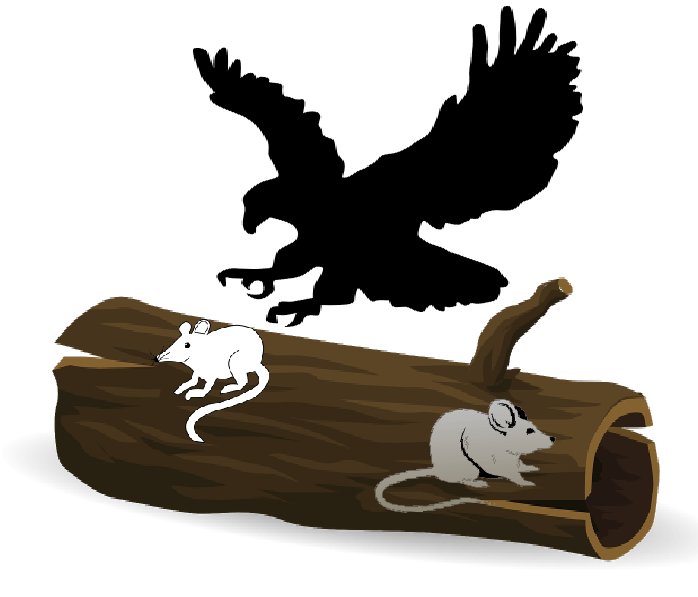
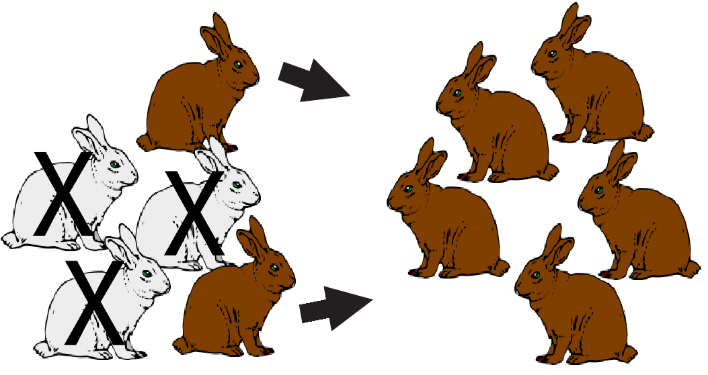
Over the years, white mice became extinct and darker mice survived. This is

a)

stabilizing selection

b)

directional selection

c)

disruptive selection

d)

due to exercise

65.

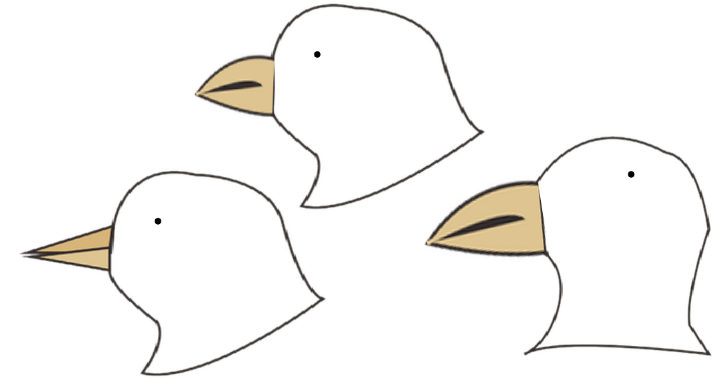
Birds with smaller beaks die out when a disease kills all food sources except hard nuts.

a)

adaptive radiation

b)

respiration

c)

an anomoly

d)

unlikely

66.

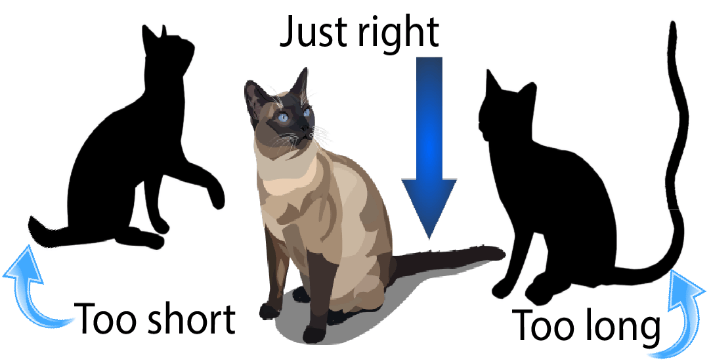
Average phenotypes are favored in the environment, while extremes have lower survival rates.

a)

seasonal selection

b)

distruptive selection

c)

directional selection

d)

stabilizing selection

67.

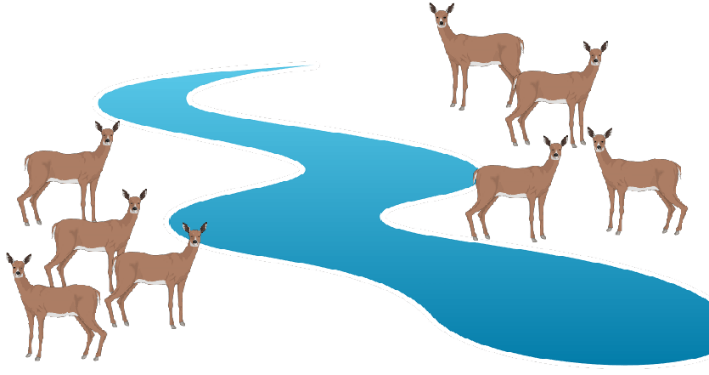
Two populations of the same species are separated by land barriers like rivers or mountains.

a)

geographical isolation

b)

temporal isolation

c)

adaptive ratiation

d)

behavioral isolaton

68.

Isolated small populations speed up genetic drift.

a)

Gene Pool

b)

Mitosis

c)

Speciation

d)

Founders Effect

69.

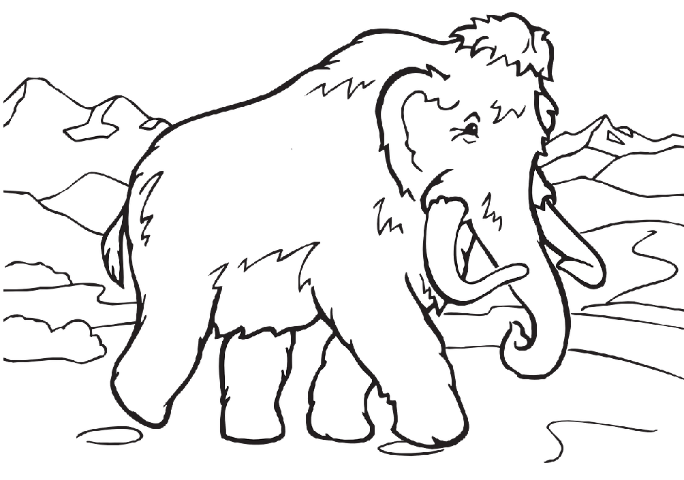
Severe population reduction reduces the gene pool

and increases the rate of genetic drift. Woolly mammoths became extinct. Elephants survived.

a)

Gene Pool

b)

Bottleneck Effect

c)

Founders Effect

d)

Gene Frequency

70.

The extreme population phenotypes are favored by the environment.

a)

Disruptional (Diversifying) Selection

b)

Directional Selection

c)

Stabilizing Selection

d)

All of the above

71.
Organisms whose cells have NO nucleus are classified as...
a)
Eukaryotic
b)
Prokaryotic
c)
Dead
72.

(Taxonomy) What is hierarchy of classification from broad to most specific?

a)

Species, Genus, Family, Order, Class, Phylum, Kingdom, Domain

b)

Kingdom, Domain, Phylum, Family, Order, Class, Genus, Species

c)

Domain, Kingdom, Phylum, Class, Order, Family, Genus, Species

d)

Domain, Kingdom, Phylum, Order, Family, Class, Genus, Species
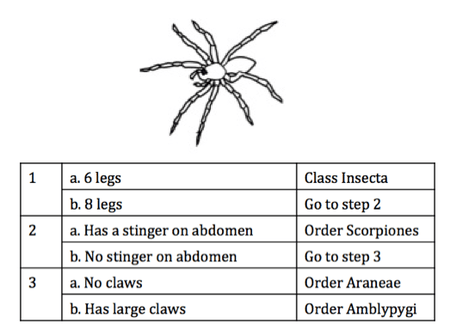
73.
An illustration and a dichotomous key are given. What is the correct classification for this organism?
a)
Class Insecta
b)
Order Amblygygi
c)
Order Araneae
d)
Order Scorpiones
74.
Using the cladogram:  a common ancestor of amphibians and ray-finned fish would have
a)
a bony skeleton
b)
four limbs
c)
scaly skin
d)
eggs with shells
75.
The two extant species that are closely related to each other are __.
a)
A and B
b)
B and C
c)
C and D
d)
D and E
76.
What is this called?
a)
Food Web
b)
Food Chain
c)
Abiotic Factors
77.
relationship in which two species live closely together
a)
resource
b)
mutualism
c)
succession
d)
symbiosis
78.
What is the term for each step in the transfer of energy and matter within a biological community?
a)
energy path
b)
food web
c)
trophic level
d)
food pyramid
79.
The amount of energy that usually transfers from one trophic level to the next...
a)
10%
b)
20%
c)
80%
d)
50%
80.
The diagram below depicts the water cycle.  Which process is represented by the number 2?
a)
precipitation
b)
evaporation
c)
surface runoff
d)
condensation
81.
An increase in the atmospheric levels of carbon dioxide (CO2) is the biggest contributor to which of the following?
a)
El Nino
b)
global warming
c)
wind storms
d)
ozone depletion
82.
Which human activity has had the greatest impact on climate change?
a)
building skyscrapers
b)
deforestation
c)
burning fossil fuels
d)
production of nuclear waste
83.
The graph below shows population data for two species.  What can be said about the relationship between species 1 and species 2?
a)
When the population of species 1 increases, the population of species 2 decreases.
b)
The population of species 1 and species 2 stay the same over the time period shown.
c)
The population of species 1 is not influenced by the population of species 2.
d)
When the population of species 1 increases, the population of species 2 increases.
84.
What two factors have been the GREATEST contributors to the exponential growth of the human population during the last two centuries?
a)
plentiful food and a mild climate
b)
the industrial revolution and peace
c)
agricultural developments and peace
d)
good sanitation and medical advances
85.
78% of Earth's atmosphere is nitrogen gas. All living things need nitrogen as a part of DNA and RNA. Yet you and I, and other living things, cannot use the nitrogen in our atmosphere directly. One type of organism is responsible for "fixing" nitrogen or helping to put it in a form so other living things can use it. That organism is
a)
bacteria.
b)
fungi.
c)
plants.
d)
viruses.
86.

Algae growth in a lake can be a result of which of these?

a)

Eutrophication/Nitrogen runoff

b)

Over population of fish

c)

Not enough clouds

d)

Commensalism

87.

Which of these are examples of Commensalism?

a)

Barnacles riding on a whale.

b)

Remora feeding of food scrapes left by a shark.

c)

A tick sucking blood from its host.

88.

A relationship in which both species benefit is called...

a)

Parasitism

b)

Commensalism

c)

Mutualism