wayground logo

Free Printable Worksheets

Font size

S
M
L
XL
Worksheets

Biology Spring Final Review

Total questions: 100

Worksheet time: 2hrs 1mins

Name
Class
Date
1.
Which sequence of DNA bases would pair with this partial strand
ATG TGA CAG
a)
ATG TGA CAG
b)
TAC ACT GTC
c)
GTA AGT GAC
d)
CAT TCA CTG
2.
Which of the following best describes a DNA molecule?
a)
double helix
b)
contains ribose
c)
made of amino acids
d)
contains Uracil
3.
Which of the following units are repeatedly joined together to form a strand of DNA?
a)
amino acids
b)
nucleotides
c)
fatty acids
d)
polysaccharides
4.
In a molecule of double-stranded DNA, the amount of Adenine present is always equal to the amount of
a)
cytosine
b)
guanine
c)
thymine
d)
uracil
5.
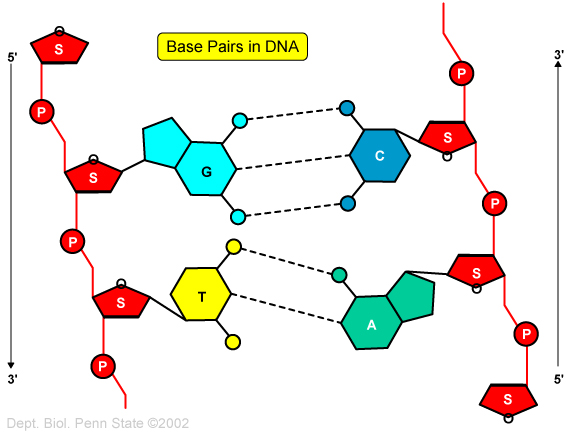
Guanine bonds with ______________.
a)
Adenine
b)
Guanine
c)
Cytosine
d)
Thymine
6.
Why is DNA important?
a)
it is very small and very complicated
b)
it's in everything
c)
it serves as the blueprint for traits of all living things
d)
because we eat it every day for energy
7.
What determines the code, or information, of a DNA molecule?
a)
the shape (structure) of the nitrogen bases
b)
the order (sequence) of the nitrogen bases
c)
the color of the nitrogen bases
d)
the frequency (number) of nitrogen bases
8.
Which 2 molecules form the sides (backbone) of the DNA ladder?
a)
deoxyribose sugar and adenine
b)
deoxyribose sugar and a hydrogen bond
c)
deoxyribose sugar and the nucleus
d)
deoxyribose sugar and phosphate
9.
Which organelle is DNA usually found in?
a)
cell membrane
b)
vacuole
c)
chloroplast
d)
nucleus
10.
Nitrogenous bases are joined by which type of bond?
a)
polar bonds
b)
ionic bonds
c)
covalent bonds
d)
hydrogen bonds
11.
Replicate the following strand of DNA: 
AATCATGGA
a)
AATCATGGA
b)
TTAGTACCT
c)
UUAGUACCU
d)
GGATAUCUA
12.
DNA replication results in two DNA molecules,
a)
each one with two original strands
b)
each one with two new strands
c)
each one with one new strand and one original strand
d)
one with two new strands and the other with two original strands
13.
order of replication
a)
3, 2, 1, 4
b)
2, 1, 4, 3
c)
2, 3, 1, 4
d)
3, 4, 1, 2
14.
What are the three components of a nucleotide?
a)
sugar, hydrogen, nitrogen base
b)
sugar, oxygen, nitrogen base
c)
sugar, phosphate, nitrogen base
d)
sugar, phosphate, protein
15.
In what phase of the cell cycle does DNA replication take place?
a)
G1
b)
S
c)
G2
d)
M
16.
In RNA, Uracil pairs with ______. 
a)
cytosine
b)
adenine
c)
guanine
d)
thymine
17.
The process to go from DNA to mRNA is _______
a)
translation
b)
transcription
c)
replication
18.
The process to go from mRNA to a protein is called ____
a)
transcription
b)
rRNA
c)
replication
d)
translation
19.
Choose the nucleotide sequence of the RNA strand that would be complementary to the following strand: 
GTAGTCA
a)
UATUAGA
b)
ACGACTG
c)
CAUCAGU
d)
CATCAGT
20.
The main function of tRNA is to...
a)
carry a message that, when translated, forms proteins
b)
form a portion of ribosomes
c)
string together complementary RNA and DNA strands
d)
bring amino acids from the cytoplasm to the ribosomes
21.
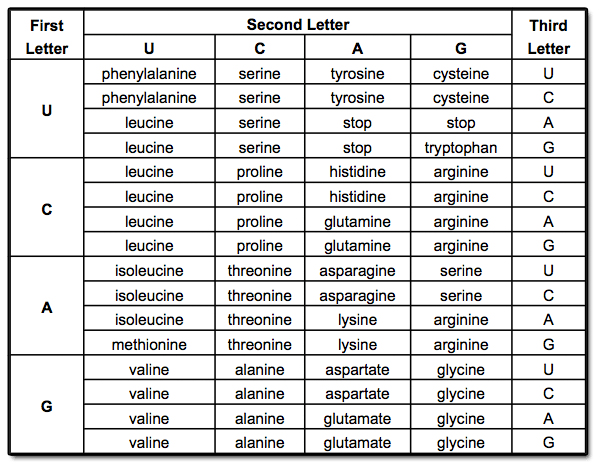
What amino acid is represented by the codon UUA?
a)
Phenylalanine
b)
Tyrosine
c)
Leucine
d)
Stop codon
22.
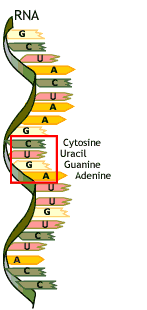
What process is going on in this photo? 
a)
Transcription 
b)
Translation 
c)
Replication 
d)
All the above 
23.
Which component of DNA determines the traits of an organism? 
a)
Nitrogen Bases
b)
Sugar-Phosphate Backbone
c)
Hydrogen bonds
24.

What is the location in the cell for translation?

a)

nucleus

b)

mitochondria in cytoplasm

c)

ribosome in cytoplasm

d)

chloroplast in cytoplasm

25.
What is the three base sequence of mRNA that codes for a single amino acid?
a)
Anticodon
b)
Codon
c)
Protein
26.
What is the location in the cell for transcription?
a)
nucleus
b)
cytoplasm
c)
ribosome
d)
mitochondria
27.

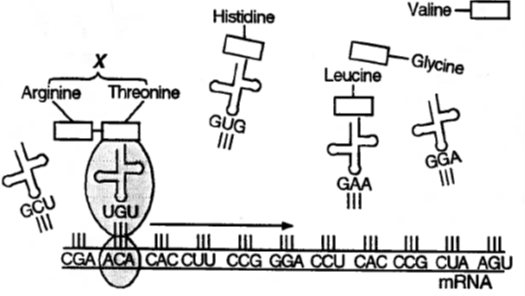
What process is happening in the diagram?

a)

transcription

b)

translation

c)

dna replication

d)

mitosis

28.
In asexual reproduction, all of the offspring are:
a)
Physically Identical
b)
Genetically Identical
c)
Physically and Genetically Identical
d)
Not Identical
29.
a)
budding
b)
binary fission
c)
sporulation
d)
regeneration
30.
How many parent(s)are needed for asexual?
a)
4
b)
1
c)
9
d)
100
31.
When a starfish grows a new body off a broken arm, what kind of reproduction is this?
a)
Sexual
b)
Differentiation
c)
Asexual 
d)
Specialization
32.
What is organized DNA called?
a)
Genes
b)
Deoxyribonucleic Acid
c)
Chromosomes
d)
Nucleus
33.
What parts of the chromosomes code for traits?
a)
Genes
b)
Deoxyribonucleic Acid
c)
Chromosomes
d)
Nucleus
34.
What causes genetic variation in meiosis?
a)
chromosomes lining up
b)
crossing over of chromosomes
c)
separation of chromosomes
d)
chromosomes pulling apart
35.
What kind of cells are made in MEIOSIS?
a)
Haploid cells
b)
Diploid Cells
c)
Skin Cells
d)
Liver Cells
36.
How many daughter cells does Meiosis create?
a)
2
b)
4
c)
8
d)
1
37.
Meiosis makes sperm and egg cells. In humans, sperm and egg cells each have _____ chromosomes. Therefore a fertilized human egg cell (sperm and egg cell combined) would create a cell with _____ chromosomes.
a)
23, 46
b)
46, 23
c)
2, 4
d)
50, 100
38.
A human zygote should have _____ chromosomes inside.
a)
46
b)
23
c)
92
d)
64
39.
Which cellular process is shown?
a)
meiosis
b)
endocytosis
c)
mitosis
d)
phagocytosis
40.
When homologous chromosomes match up, they form a structure call a ___________.
a)
tetrad (pair of chromosomes, one from mom and one from dad)
b)
triad
c)
diploid
d)
quad (group of 4 replicated chromosomes, 2 from mom and 2 from dad)
41.
The chromosomes that pair up during meiosis, are called __________ chromosomes.  
a)
homozygous 
b)
asexual
c)
homologous
d)
genes
42.
Diploid Cells are represented by
a)
2n
b)
n
c)
4n
d)
1/2 n
43.
Mitosis is a type of ________________ reproduction.
a)
Sexual
b)
Asexual
44.
How many daughter cells are produced in mitosis?
a)
1
b)
2
c)
4
d)
6
45.
Fruit fly body cells have 8 chromosomes. After mitosis, you would expect a resulting fruit fly daughter cell to have ...
a)
16 chromosomes.
b)
46 chromosomes.
c)
8 chromosomes.
d)
4 chromosomes.
46.

How many chromosomes are normally found in human body cells?

a)

46

b)

23

c)

26

d)

44

47.
What is a phenotype
a)
The genetic make up (code)
b)
The physical trait
48.
having two different genes for a trait (sometimes called hybrid).
a)
protein
b)
homozygous
c)
heterozygous
d)
genotype
49.
having two of the same genes for the trait (sometimes called purebred).
a)
homozygous
b)
hetrozygous
c)
protein
d)
chromosome
50.
Term for an organism that display two dominant phenotypes at the same time
a)
codominance
b)
incomplete dominance
c)
multiple alleles
d)
linked genes
51.
Incomplete dominance means that the traits are
a)
expressed equally
b)
dominant
c)
recessive
d)
blended
52.
Which of the following is homozygous dominant?
a)
Yy
b)
Y
c)
yy
d)
YY
53.
An allele whose trait only shows up when no dominant allele is present.
a)
hidden allele
b)
dominant allele
c)
recessive allele
d)
present allele
54.
Snapdragon flowers come in red, pink and white.  What type of inheritance is this?
a)
Complete Dominance
b)
Incomplete Dominance
c)
Codominance
d)
Polygenic Inheritance
55.
One form of a gene is called_______________
a)
a DNA
b)
a Phenotype
c)
a trait
d)
an allele
56.
If green is dominant over purple, then what is the genotype for this individual?
a)
Purple
b)
Green
c)
GG
d)
gg
57.
Brown fur color is dominant over black fur color. Which of the following is the actual genotype of ALL of the offspring in the next generation of this cross for fur color?
AA x aa
a)
AA
b)
Aa
c)
aa
d)
brown fur
58.
A child is diagnosed with a rare disease. Neither parent has the disease. How did the child inherit the disorder?
a)
The disorder is dominant and carried by a parent.
b)
The disorder is recessive and carried by both parents.
c)
The disorder is sex-linked and inherited only from the father.
d)
A mutation in the child occurred.
59.
Most genetic disorders are caused by the expression of___.
a)
recessive alleles
b)
2 dominant alleles
c)
one dominant allele
d)
sex-linked heredity
60.
Which of the following situations is most usual for a dominant allele that results in severe effects in the offspring?
a)
both parents have the trait
b)
the trait occurs by mutation
c)
only a single offspring has the trait
d)
none of these
61.

The diagram below represents the karyotype of a person with a genetic disorder.

Which is the likely cause of this condition? (3.2.2)

a)

nondisjunction during mitosis

b)

nondisjunction during meiosis

c)

chromosomal deletion during mitosis

d)

chromosomal deletion during meiosis

62.

A human egg cell might contain (3.2.1)

a)

22 autosomes and an X chromosome

b)

22 autosomes and a Y chromosome

c)

45 autosomes and an X chromosome

d)

45 autosomes and a Y chromosome

63.

A pair of identical twins were separated at birth and raised by different parents. Both were found to have the gene for type II diabetes, but only one developed the disease. What could explain this? (3.2.3)

a)

mutation and genetic recombination

b)

independent assortment

c)

environmental influence

d)

segregation of alleles

64.

Human males are much more likely to have hemophilia than human females. This is the case because: (3.2.2)

a)

the gene for hemophilia is carried on the Y chromosome

b)

hemophilia is carried on autosomes

c)

the gene for hemophilia is sex-linked

d)

hemophilia is a contagious disease to which males are more susceptible

65.

What type of inheritance is shown in the pedigree below? (3.2.2)

a)

autosomal dominance

b)

codominance

c)

incomplete dominance

d)

sex-linked recessive

66.

Which of the following statements can be determined from the karyotype below? (3.2.2)

a)

it is a normal female

b)

it is a female with Down Syndrome

c)

it is a normal male

d)

it is a male with Down Syndrome

67.

Achondroplasia is a dominant human disorder that results in dwarfism. If two people that are heterozygous for achondroplasia have a child, what is the probability it will be tall? (3.2.1)

a)

0%

b)

25%

c)

50%

d)

75%

e)

100%

68.

How can a person's muscle cells have the same exact DNA sequences as their nerve cells even though the look and perform completely different?

a)

The two different cells become mutated

b)

The proteins expressed in each cell are different

c)

They actually have different DNA in the two types of cells.

d)

The genome of the different cells changes

69.
Activation or deactivation of genes by environmental experiences throughout development
a)
turn on genes
b)
gene expression
c)
environmental factors
d)
gene markers
70.
The complete instructions for making an organism, consisting of all the genetic material in that organism's chromosomes.
a)
genome
b)
epigenome
c)
genetic markers
d)
RNA codon
71.
The difference between DNA code and the epigenome is that the DNA code is
a)
flexible, while the epigenome is fixed for life
b)
fixed for life, while the epigenome is flexible
c)
determined by the environment, while the epigenome is not
d)
determined by one's stress level, while the epigenome is not
72.
A flash flood carried a raft of Amazon ants away from their original population. There is enough distance between the two groups, that they will never meet in nature again. What type of reproductive barrier is this?
a)
behavioral isolation
b)
temporal isolation 
c)
gametic isolation
d)
geographic isolation 
73.
Some female peacocks prefer males with large, colorful tales while other female peacocks prefer males with no tail at all. Females are beginning to only mate with the type of males with the tail they prefer. What type of reproductive barrier is this?
a)
behavioral isolation
b)
hybrid sterility 
c)
temporal isolation
d)
mechanical isolation 
74.
The flowers of pink tulips open in the morning, while the flowers of lavender tulips open in the early afternoon. The bees that pollinate these tulips cannot carry pollen back & forth between the two types of tulips because of their flowers being closed at different times of day. What type of reproductive barrier is this?
a)
behavioral isolation
b)
hybrid sterility 
c)
temporal isolation
d)
mechanical isolation 
75.
The term for the formation of new and distinct species over the course of evolution is...
a)
speciation
b)
biological species concept
c)
reproductive barrier
d)
natural selection
76.
What is a species? 
a)
A group of organisms that can mate with each other and produce fertile offspring. 
b)
A group of organisms that can mate and produce offspring even if those offspring are infertile.
c)
A group of organisms that genetically are very different from each other. 
d)
Indivual organisms that live in the same environment. 
77.
When reproductive barriers separate a population of a species in nature, the species no longer share a... 
a)
taxa
b)
gene pool 
c)
phylogenetic tree
d)
species 
78.
What is the cause for all variation within a population?
a)
Natural Selection
b)
Adaptation
c)
Mutation
d)
Environmental Changes
79.
When has speciation occurred?
a)
When populations no longer look the same
b)
When populations no longer have the same frequency of alleles
c)
When populations are living in different environments
d)
When populations can no longer interbreed
80.
What type of genetic drift occurs when the population size is greatly decreased due to a random event?
a)
Founder's Effect
b)
Bottleneck Effect
c)
Intrasexual Selection
d)
Intersexual Selection
81.
A chance occurrence that negatively affects a population because the population is small is 
a)
genetic drift
b)
mutation
c)
speciation
d)
migration
82.
Which of the following is an example of positive feedback to indirectly maintain homeostasis?
a)
the chemical reactions involved in blood clotting
b)
your blood vessels dilate and you begin to sweat in response to elevated body temperature
c)
your blood vessels constrict and you begin to shiver in response to low body temperature
d)
your coach compliments you on your performance in practice
83.
Homeostasis
a)
allows for a wildly fluctuating internal environment
b)
is impossible in vertebrates
c)
is the maintenance of a relatively stable internal environment and often incorporates a form of feedback regulation
d)
is the maintenance of a relatively stable external environment and often incorporates a form of feedback regulation
84.
Homeostasis in the human body is often maintained by a: 
a)
neutral feedback loop 
b)
solar feedback loop
c)
positive feedback loop
d)
negative feedback loop
85.
When you are cold, you shiver and your blood vessels contract, which warms you up. When you are hot, you sweat and your blood vessels expand, which cools you down.  
a)
Positive Feedback Response
b)
Negative Feedback Loop 
86.

What is an example of a positive feedback mechanism?

a)
b)
87.
Maintaining body temperature is an example of a:
a)
negative feedback loop
b)
positive feedback loop
88.
When glucose levels in the blood rise, your brain sends a signal to your pancreas. The pancreas releases insulin, which opens channels in cell membranes to allow glucose to enter the cell, lowering blood sugar levels. 
a)
Positive Feedback Response
b)
Negative Feedback Loop 
89.

What hormone is produced in the pancreas that lowers blood sugar?

a)

Insulin

b)

Glucagon

c)

Ketones

d)

Glucose

90.

What is the direct cause of rising sea levels?

a)

Melting Sea Ice

b)

Melting Land Ice

c)

Climate Change

91.
Which of the following is the best conclusion that can be made from this graph?
a)
atmospheric carbon dioxide levels have been decreasing since 1960
b)
Hawaii has a lot of carbon dioxide
c)
humans have been working hard to decrease carbon dioxide levels
d)
atmospheric carbon dioxide levels have increased steadily since 1960
92.

Which of the following have been changed or altered due to climate change ?

a)

droughts

b)

flooding

c)

melting of polar ice caps

d)

all of the above

93.
How does the concentration of carbon dioxide in the atmosphere affect climate?
a)
As carbon dioxide concentrations increase, temperatures increase
b)
As carbon dioxide concentration increase, temperatures decrease.
c)
Carbon dioxide concentrations have no affect on climate
d)
As carbon dioxide concentrations increase, temperatures become more random.
94.
Which natural process removes carbon dioxide from the atmosphere?
a)
forest fires
b)
volcanic eruptions
c)
cellular respiration
d)
photosynthesis
95.
What do humans do that releases greenhouse gases into the atmosphere?
a)
Burn fossil fuels (like gas and coal)
b)
Build cement buildings
c)
Ride bikes and use solar energy
d)
Compete in the Olympics
96.
Which of the following must occur for speciation to happen?
a)
geographic isolation
b)
reproductive isolation
c)
temporal isolation
d)
behavioral isolation
97.
Gentoo penguins will present a mate with a pebble that they find to attract a mate. Emperor penguins have a specific call and movement that they make to attract a mate. Which type of isolation do these penguins demonstrate?
a)
temporal isolation 
b)
behavioral isolation
c)
geographical isolation
d)
anatomical isolation
98.

In the Great Lakes region of North America, gray wolves and coyotes are similar species but do not mate because their breeding periods occur at different times of the year.

a)

Geographic isolation

b)

Behavioral isolation

c)

Temporal isolation

99.

A mutation is defined as:

a)

A change in the cell's structure

b)

Anything that changes in an embryo

c)

Any change in the physical features of a human

d)

A change in the DNA sequence

100.

A mutation in which only one nucleotide is altered is called a:

a)

Frameshift Mutation

b)

Deletion Mutation

c)

Point Mutation

d)

Insertion Mutation