wayground logo

Free Printable Worksheets

Font size

S
M
L
XL
Worksheets

Biology and Lab Final Review Chapters 11& 12

Total questions: 89

Worksheet time: 1hrs 27mins

Name
Class
Date
1.

What plant did Mendel use to study genetics?

a)

peas

b)

corn

c)

flowers

d)

apricots

2.
An organism's appearance or other observable characteristics:
a)
phentoype
b)
genotype
c)
recessive
d)
dominant
3.
Which of the following alleles is homozygous recessive?
a)
Tt
b)
tt
c)
TT
d)
T
4.
If Mendel's first experiment involved cross-pollinated a true-breeding round pea plant and a true-breeding wrinkled pea plant, what would the genotypes of the parents have to be?
a)
RR x Rr
b)
Rr x Rr
c)
rr x rr
d)
RR x rr
5.
What did Gregor Mendel discovery in the results of his first experiment?
a)
Only the dominant trait appeared!
b)
The offspring were all different!
c)
Only the recessive trait appeared!
d)
The plants were more healthy
6.
Originally, Mendel crossed two true breeding plants (RR x rr) for Round and Wrinkled peas. What is the genotype(s) of the offspring that he then allowed to self-pollinate in the first generation?
a)
RR x Rr
b)
Rr x Rr
c)
rr x RR
d)
rr x Rr
7.
A trait that is not expressed when a dominant allele is present.
a)
Recessive
b)
Co-dominant
c)
Incomplete Dominant
d)
Dominant
8.
The combination of alleles.
a)
DNA
b)
Phenotype
c)
Genotype
d)
Genetics
9.
If something is heterozygous, it is also...
a)
purebred
b)
hybrid
c)
dominant
d)
recessive
10.
True/False: Different genotypes can code for the same phenotype.
a)
True
b)
False
11.
This image shows a...
a)
Punnett Square
b)
Phenotype
c)
Genotype
d)
Dominant allele
12.
What does a Punnett Square help you do?
a)
Determine the ratio of phenotypes
b)
Determine the ratio of genotypes
c)
Predict possible traits the offspring will have
d)
All of the above
13.

Genetics is the study of

a)

anatomy

b)

heredity

c)

cardiology

d)

all of the above

14.
The Father of Genetics is:
a)
Mendel Gregor
b)
Howie Mendel
c)
George Mendel
d)
Gregor Mendel
15.
What gender has an X and a Y chromosome?
a)
male
b)
female
c)
transgender 
d)
all of the above
16.

What is the complex molecule that carries genetic information that defines an organism's traits? Hint: It is stored in the nucleus.

a)

DNA

b)

protein

c)

RNA

d)

glucose nucleic acid (GNA)

17.

Gregor Mendel demonstrated that the inheritance of genetic traits is determined by -

a)

two alleles from mom

b)

two alleles from dad

c)

one allele from mom and one allele from dad

d)

depends on the offspring

18.

Gregor Mendel removed the male parts from the flowers of some plants in order to:

a)

prevent hybrids from forming

b)

prevent cross pollination

c)

make controlled crosses between plants

d)

prevent females from pollinating

19.

Gregor Mendel removed the male parts from the flowers of some plants in order to:

a)

prevent hybrids from forming

b)

prevent cross pollination

c)

make controlled crosses between plants

d)

prevent females from pollinating

20.

In the Punnett Square shown, which of the following is true about the offspring resulting from the cross?

a)

About half are expected to be short.

b)

All are expected to be short.

c)

About half are expected to be tall.

d)

All are expected to be tall.

21.

The Punnett Square shows that the gene for pea shape and the gene for pea color:

a)

assort independently.

b)

are linked.

c)

have the same alleles.

d)

are always homozygous.

22.

How many different allele combinations would be found in the gametes produced by a pea plant whose genotype is RrYY?

a)

2

b)

4

c)

8

d)

16

23.
This is an example of ___________?
a)
Incomplete dominance
b)
Co-Dominance
24.
This is an example of ___________.
a)
 Incomplete Dominance
b)
 Codominance
25.
What type of inheritance do two alleles have if their traits blend together? 
a)
Incomplete Dominance
b)
Co-Dominance
26.
This type of inheritance pattern is a MIXTURE of both traits.
a)
incomplete dominance
b)
co-dominance
c)
complete dominance
27.
If you cross a black chicken with a white chicken, only checkered chickens would be produced.  What kind of inheritance pattern does this follow?
a)
incomplete Dominance
b)
Co-Dominance
28.
polygenic means that _________ control a characteristic
a)
many genes
b)
single genes
c)
3 genes
d)
no genes
29.
an example of polygenic inheritance is...
a)
height
b)
hitch hikers thumb
c)
blood types
30.
What is the genotype of a person with type A blood, who had a father with type O blood?
a)
AB
b)
AO
c)
AA
d)
OO
31.
What is NOT a possible genotype for someone with type B blood?
a)
BB
b)
AB
c)
BO
32.
What blood type would an individual have if this was one of the cells seen under a microscope?
a)
Type A
b)
Type B
c)
Type AB
d)
Type O
33.
What causes genetic variation in meiosis?
a)
chromosomes lining up
b)
crossing over of chromosomes
c)
separation of chromosomes
d)
chromosomes pulling apart
34.
What kind of cells are made in MEIOSIS?
a)
Haploid cells
b)
Diploid Cells
c)
Skin Cells
d)
Liver Cells
35.
Diploid Cells are represented by
a)
2n
b)
n
c)
4n
d)
1/2 n
36.
If the Diploid number of Carrots is 18, the haploid number is
a)
18
b)
9
c)
27
d)
36
37.
The chromosomes that pair up during meiosis, are called __________ chromosomes.  
a)
homozygous 
b)
asexual
c)
homologous
d)
genes
38.
When homologous chromosomes match up, they form a structure call a ___________.
a)
tetrad (pair of chromosomes, one from mom and one from dad)
b)
triad
c)
diploid
d)
quad (group of 4 replicated chromosomes, 2 from mom and 2 from dad)
39.
Crossing over creates
a)
male genotype
b)
genetic variation (differences)
c)
DNA replication
d)
mitosis
40.
Which cellular process is shown?
a)
meiosis
b)
endocytosis
c)
mitosis
d)
phagocytosis
41.
Which of the following best describes meiosis?
a)
It is carried out in all tissues theat require cell replacement
b)
It occurs only in cells in the reproductive structures of an organism
c)
It happens in all of the tissues except the brain and spinal cord
d)
It is the first stage of mitosis
42.
What phase is represented?
a)
metaphase 1
b)
metaphase 2
c)
anaphase 1
d)
anaphase 2
43.
What phase is represented?
a)
metaphase 1
b)
metaphase 2
c)
anaphase 1
d)
anaphase 2
44.
products of meiosis are genetically
a)
different
b)
identical
45.
A human zygote should have _____ chromosomes inside.
a)
46
b)
23
c)
92
d)
64
46.
Meiosis makes sperm and egg cells. In humans, sperm and egg cells each have _____ chromosomes. Therefore a fertilized human egg cell (sperm and egg cell combined) would create a cell with _____ chromosomes.
a)
23, 46
b)
46, 23
c)
2, 4
d)
50, 100
47.
How many daughter cells does Meiosis create?
a)
2
b)
4
c)
8
d)
1
48.
Which of the following terms refers to a segment of DNA the controls the expression of a trait?
a)
Chromosome
b)
Chromatid
c)
Gene
d)
Histone
49.
Who discovered the process of transformation while trying to create a vaccine against bacterial pneumonia?
a)
Griffith
b)
Avery
c)
Hershey and Chase
d)
Watson and Crick
50.
What organism was Griffith using when he discovered that a harmless strain of bacteria could transform into a lethal strain of bacteria?
a)
pea plants
b)
fruit flies
c)
bacteriophages
d)
mice
51.
Which two radioactive isotopes were used to label the DNA and protein components of viruses called bacteriophages?
a)
Nitrogen and Phosphorus
b)
Phosphorus and Sulfur
c)
Nitrogen and Sulfur
52.
Which sequence of DNA bases would pair with this partial strand
CAT TCA CTG
a)
ATG TGA CAG
b)
TAC ACT GTC
c)
GTA AGT GAC
d)
CAT TCA CTG
53.
Which of the following units are repeatedly joined together to form a strand of DNA?
a)
amino acids
b)
nucleotides
c)
fatty acids
d)
polysaccharides
54.
DNA replication results in two DNA molecules,
a)
each one with two original strands
b)
each one with two new strands
c)
each one with one new strand and one original strand
d)
one with two new strands and the other with two original strands
55.
order of replication
a)
3, 4, 2, 1
b)
3, 1, 4, 2
c)
2, 1, 4, 3
d)
3, 4, 1, 2
56.
In what phase of the cell cycle does DNA replication take place?
a)
G1
b)
S
c)
G2
d)
M
57.
Which enzyme is responsible for adding nucleotides?
a)
Topoisomerase
b)
DNA Polymerase
c)
Ligase
d)
Primase
58.
The process of DNA replication is called semi conservative because it results in
a)
none of these
b)
Two DNA molecules.  One original molecule and one with two new strands
c)
two exact copies with new strands
d)
two identical molecules, each with 1 original strand and one new.
59.
Based on the diagram, the enzyme (represented in gray) is most likely...
a)
DNA polymerase
b)
DNA Ligase
c)
Nuclease
d)
Helicase
60.
Why does DNA replicate?
a)
To create another copy for the new cell
b)
To create a duplicate copy in case the original gets damaged
c)
To create a new copy to replace the damaged original
61.
Which of the following best describes a DNA molecule?
a)
double helix
b)
contains ribose
c)
made of amino acids
d)
contains Uracil
62.
In a molecule of double-stranded DNA, the amount of Adenine present is always equal to the amount of
a)
cytosine
b)
guanine
c)
thymine
d)
uracil
63.
Why is DNA important?
a)
it is very small and very complicated
b)
it's in everything
c)
it serves as the blueprint for traits of all living things
d)
because we eat it every day for energy
64.
What determines the code, or information, of a DNA molecule?
a)
the shape (structure) of the nitrogen bases
b)
the order (sequence) of the nitrogen bases
c)
the color of the nitrogen bases
d)
the frequency (number) of nitrogen bases
65.
Which organelle is DNA usually found in?
a)
cell membrane
b)
vacuole
c)
chloroplast
d)
nucleus
66.
What are the three components of a nucleotide?
a)
sugar, hydrogen, nitrogen base
b)
sugar, oxygen, nitrogen base
c)
sugar, phosphate, nitrogen base
d)
sugar, phosphate, protein
67.
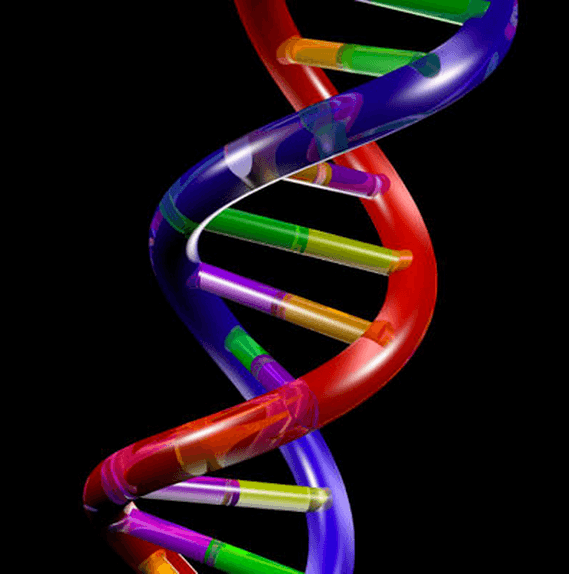
Name this structure
a)
double helix
b)
nucelotide
c)
twisted ladder
d)
hydrogen bond
68.
Any change in the sequence of DNA is...
a)
transgenic shift
b)
Single Genotype
c)
Monohybrid Trait
d)
Mutation
69.

Where is DNA and RNA made?

a)

nucleus

b)

cytoplasm

c)

mitochondria

d)

ER

70.

Where are proteins made?

a)

ER

b)

nucleus

c)

cytoplasm

d)

mitochondria

71.

RNA contains which sugar?

a)

deoxyribose

b)

Ribose

c)

glucose

d)

fructose

72.

RNA has what base that is instead of thymine?

a)

guanine

b)

adenine

c)

thymine

d)

uracil

73.

What enzyme does transcription use?

a)

DNA polymerase

b)

ligase

c)

RNA polymerase

d)

helicase

74.

Which RNA brings amino acids?

a)

rRNA

b)

tRNA

c)

mRNA

75.

Which RNA forms part of the ribosomes?

a)

tRNA

b)

mRNA

c)

rRNA

76.

Which RNA carries the message?

a)

mRNA

b)

rRNA

c)

tRNA

77.

The goal of transcription is to make RNA.

a)

True

b)

False

78.
What is the correct amino acid sequence for the mRNA code AUGCCAGUAUGA
a)
Met-Pro-Ala-Val
b)
Met-Pro-Val
c)
Tyr-Gly-His
d)
Tyr-Gly-Arg-His
79.
What will be the resulting mRNA from this DNA sequence:
GAT-TAC-AGA-TTA-CAT?
a)
CTA-ATG-TCT-AAT-GTA
b)
GAU-UAG-UGA-UUA-GUT
c)
CUA-AUG-UCU-AAU-GUA
d)
CAT-ACA-TAC-ATA-TAG
80.
The anti-codon 
a)
contains a sequence the same as the codon
b)
contains a sequence complementary to the codon 
c)
contains the base thymine
81.
Amino acids are joined together in order to form
a)
DNA
b)
ribosomes
c)
proteins 
d)
RNA
82.
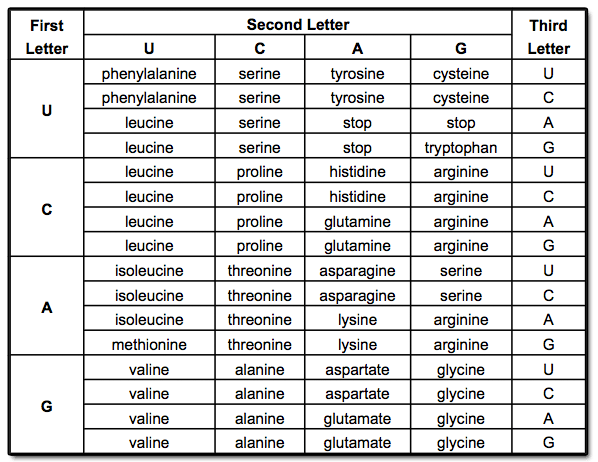
Which amino acid is made from the RNA codon UUA?
a)
Phenylalanine
b)
Leucine
c)
Serine
d)
Tyrosine
83.
What is the correct sequence?
a)
RNA --> DNA --> Protein
b)
Protein --> RNA --> DNA
c)
DNA --> RNA --> Protein
d)
DNA --> Protein --> RNA
84.
How many bases are in one codon?
a)
1
b)
2
c)
3
d)
4
85.
What is occurring in this picture?
a)
Translation
b)
Replication
c)
Translocation
d)
Transcription
86.
Which phrase best describes translation?
a)
converts mRNA into a polypeptide
b)
catalyzes bonds between amino acids
c)
produces RNA from DNA molecules
d)
recycles tRNA molecules for reuse
87.
How many amino acids are coded for by this sequence of nucleotides:
ATG GGA ACT CCA
a)
4
b)
2
c)
6
d)
12
88.
Which phase of which process does this picture show?
a)
Transcription
b)
Translation
c)
Replication
89.
The codon is located on the 
a)
DNA
b)
mRNA
c)
tRNA
d)
rRNA