wayground logo

Free Printable Worksheets

Font size

S
M
L
XL
Worksheets

Bio Final Review 2019

Total questions: 135

Worksheet time: 2hrs 33mins

Name
Class
Date
1.
What phase of mitosis is shown in the picture?
a)
Prophase
b)
Anaphase
c)
Telophase
d)
Metaphase
2.
Chromatid pairs line up in the middle of the cell.
a)
Metaphase
b)
Telophase
c)
Anaphase
d)
Interphase
3.
What phase of mitosis is shown in the picture?
a)
Prophase
b)
Anaphase
c)
Telophase
d)
Metaphase
4.
What phase of mitosis is shown in the picture?
a)
Prophase
b)
Anaphase
c)
Telophase
d)
Metaphase
5.
Chromatid pairs separate and move to opposite ends of the cell
a)
Metaphase
b)
Telophase
c)
Interphase
d)
Anaphase
6.
Chromosomes duplicate, the cell grows and develops
a)
Metaphase
b)
Telophase
c)
Interphase
d)
Anaphase
7.
What phase of mitosis is shown in the picture?
a)
Prophase
b)
Anaphase
c)
Telophase
d)
Metaphase
8.
Chromatid pairs can be seen, spindle fibers form and nuclear membrane disappears
a)
Metaphase
b)
Telophase
c)
Anaphase
d)
Prophase
9.
Two new nuclei form and the cytoplasm splits
a)
Metaphase 
b)
Telophase
c)
Anaphase
d)
Prophase
10.
How many chromosomes does a human cell have?
a)
42
b)
46
c)
24
d)
64
11.
Which of the following lists, in order, the phases of mitosis?
a)
interphase, metaphase, anaphase, telophase
b)
prophase, metaphase, anaphase, telophase
c)
prophase, metaphase, anaphase, interphase
d)
prophase, anaphase, metaphase, telophase
12.
How many daughter cells are produced in mitosis?
a)
1
b)
2
c)
4
d)
6
13.
In which phase does the cell spend most of it's life?
a)
Interphase
b)
Nuclear Division
c)
Telophase
d)
Mitosis
14.
DNA will condense into...
a)
Centromeres
b)
Chromosomes
c)
Nuclei
d)
Spindle fibers
15.
Which of the following is NOT occuring during interphase?
a)
Cell growth
b)
DNA being copied
c)
DNA condensing
d)
Two new cells are made
16.
Fruit fly body cells have 8 chromosomes. After mitosis, you would expect a resulting fruit fly daughter cell to have -
a)
16 chromosomes.
b)
46 chromosomes.
c)
8 chromosomes.
d)
4 chromosomes.
17.
Before cells can divide, what must be copied?
a)
mitochondria
b)
cytoplasm
c)
DNA
d)
Cell Wall
18.
What causes genetic variation in meiosis?
a)
chromosomes lining up
b)
crossing over of chromosomes
c)
separation of chromosomes
d)
chromosomes pulling apart
19.
What kind of cells are made in MEIOSIS?
a)
Haploid cells
b)
Diploid Cells
c)
Skin Cells
d)
Liver Cells
20.
Diploid Cells are represented by
a)
2n
b)
n
c)
4n
d)
1/2 n
21.
If the Diploid number of Carrots is 18, the haploid number is
a)
18
b)
9
c)
27
d)
36
22.
The process of crossing over occurs in what phase of meiosis?
a)
anaphase 1
b)
prophase 1
c)
prophase 2
d)
telophase 1
23.
The chromosomes that pair up during meiosis, are called __________ chromosomes.  
a)
homozygous 
b)
asexual
c)
homologous
d)
genes
24.
What phase is represented?
a)
metaphase 1
b)
metaphase 2
c)
anaphase 1
d)
anaphase 2
25.
What phase is  shown in the picture?
a)
metaphase 2
b)
anaphase 2
c)
metaphase 1
d)
telophase 1
26.
products of meiosis are genetically
a)
different
b)
identical
27.
How many daughter cells does Meiosis create?
a)
2
b)
4
c)
8
d)
1
28.
Which of the following cell types is formed by meiosis?
a)
muscle cells
b)
skin cells
c)
sperm cells
d)
blood cells
29.
Which best describes the process shown?
a)
mutation in which the DNA content of the gene is ltered
b)
segregation of sister chromatids
c)
condensation and segregation of the alleles
d)
crossing-over which alleles are exchanged
30.
If an intestinal cell in a butterfly contains 24 chromosomes, a butterfly egg would contain
a)
3
b)
6
c)
12
d)
24
31.
What is one advantage of sexual reproduction?
a)
offspring are identical to parents
b)
offspring are resistant to viruses
c)
offspring are born live, rather than from eggs
d)
offspring inherit a wider variety of genetic information
32.
A male shark has 40 chromosomes in each of its sex cells. How many would be present in its body cells?
a)
20
b)
40
c)
80
d)
160
33.
Which of the following sequences of processes correctly reflects the central dogma?
a)
protein synthesis, transcription, translation
b)
protein synthesis, translation, transcription
c)
transcription, translation, protein synthesis
d)
translation, transcription, protein synthesis
34.
If the structure of DNA were likened to a ladder, what would make up the “supporting structure” (not the “rungs”) of the ladder?
a)
amino acids and sugars
b)
nucleotide bases, including thymine
c)
nucleotide bases, including uracil
d)
sugar-phosphate molecules
35.
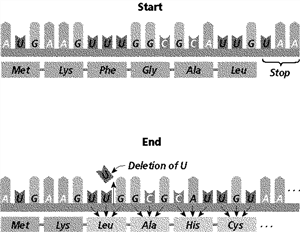
What type of mutation has occurred in Figure 12-3?
a)
substitution
b)
frameshift
c)
lethal
d)
insertion
36.
What is the complimentary mRNA sequence to the DNA sequence A-T-T-G-C-A.
a)
T-A-A-C-G-T
b)
U-A-A-C-G-T
c)
U-A-A-C-G-U
d)
T-A-A-G-C-U
37.
Which defines a codon in DNA or mRNA?
a)
pair of nucleic acid and sugar
b)
pair of phosphate and sugar
c)
three-base code
d)
two-base code
38.
What mutation has occurred here? 
T-G-A-C-C-A
T-G-A-G-C-A
a)
Substitution
b)
Deletion
c)
Insertion
d)
Frameshift 
39.
Any change in the sequence of DNA is...
a)
transgenic shift
b)
Single Genotype
c)
Monohybrid Trait
d)
Mutation
40.
Which organelle is DNA usually found in?
a)
cell membrane
b)
vacuole
c)
chloroplast
d)
nucleus
41.
What are the building blocks of proteins called?
a)
DNA
b)
RNA
c)
Ribosomes
d)
Amino Acids
42.
DNA has a ______ strand; RNA has a ______ strand.
a)
double/double
b)
double/triple
c)
double/single
d)
single/single
43.
In RNA, the nitrogen base____ replaces ____ that was present in DNA. 
a)
A, U (adenine, uracil)
b)
C, G (cytosine, guanine)
c)
U, T (uracil, thymine)
d)
U, A (uracil, adenine)
44.

Which Nucleotide matches to Cytosine?

a)

Guanine

b)

Adenine

c)

Uracil

d)

Thymine

45.

This is the process by which double stranded DNA produces single stranded RNA:

a)

Photosynthesis

b)

Translation

c)

Pollination

d)

Transcription

46.

This organelle is crucial for the translation process:

a)

Mitochondria

b)

Ribosome

c)

Gogli Apparatus

d)

Vacuole

47.

The start codon is _______:

a)

AUG

b)

GGG

c)

UCG

d)

AAU

48.
What is the sugar in RNA?
a)
glucose
b)
ribose
c)
fructose
d)
lactose
49.
Which of the following is a function of DNA?
a)
speeds up body functions
b)
provides structural support
c)
stores energy
d)
stores genetic information
50.
What holds the nitrogen bases together?
a)
sugar-phosphate bonds
b)
nitrogen bonds
c)
hydrogen bonds
d)
carbon bonds
51.
In DNA, A will pair with ___ and G will pair with ___.
a)
U, C
b)
T, C
c)
G, A
d)
T, U
52.
Who was Gregor Mendel?
a)
A French Botanist
b)
A German Physician
c)
An American Cowboy
d)
An Austrian Monk
53.
If Mendel's first experiment involved cross-pollinated a true-breeding round pea plant and a true-breeding wrinkled pea plant, what would the genotypes of the parents have to be?
a)
RR x Rr
b)
Rr x Rr
c)
rr x rr
d)
RR x rr
54.
What did Gregor Mendel discovery in the results of his first experiment?
a)
Only the dominant trait appeared!
b)
The offspring were all different!
c)
Only the recessive trait appeared!
d)
The plants were more healthy
55.
If you cross two heterozygous traits (Rr x Rr), as Mendel did in his second experiment, what ratio will you get between offspring with the dominant and recessive phenotypes
a)
1:1
b)
2:1
c)
3:1
d)
4:1
56.
A trait that is expressed over other traits.
a)
Recessive
b)
Co-dominant
c)
Incomplete Dominant
d)
Dominant
57.
A trait that is not expressed when a dominant allele is present.
a)
Recessive
b)
Co-dominant
c)
Incomplete Dominant
d)
Dominant
58.
The combination of alleles.
a)
DNA
b)
Phenotype
c)
Genotype
d)
Genetics
59.
The physical or behavioral appearance of a trait
a)
Phenotype
b)
DNA
c)
Genotype
d)
Genetics
60.

What plant did Mendel use to study genetics?

a)

peas

b)

corn

c)

flowers

d)

apricots

61.
Gametes are also known as
a)
genes
b)
sex cells
c)
alleles
d)
hybrids
62.
What did Mendel call the two kinds of traits exhibited by the pea plants (one coming from the father, one from the mother)?
a)
Genesis
b)
Elective traits
c)
Alleles
d)
Quadrants
63.
What is another way of saying "purebred"?
a)
homozygous
b)
dominant
c)
recessive
d)
heterozygous
64.
An organism's appearance or other observable characteristics:
a)
phentoype
b)
genotype
c)
recessive
d)
dominant
65.
Which of the following alleles is homozygous recessive?
a)
Tt
b)
tt
c)
TT
d)
T
66.
The brain or "control center" of the cell. 
a)
Mitochondria
b)
Cell Membrane
c)
Cytoplasm
d)
Nucleus
67.
The watery liquid that fills the cell: 
a)
Chromatin
b)
Nucleolus
c)
Cytoplasm
d)
Cell Membrane
68.
The "power plant" of the cell that produces energy. 
a)
Mitochondria
b)
Cytoplasm
c)
Centrioles
d)
Lysosomes
69.
"Garbage collectors" of the cell that remove waste: 
a)
Cell Membrane
b)
Centrioles
c)
Lysosomes
d)
Nucleus
70.
Protective outermost layer of the cell: 
a)
Cell Membrane
b)
Nucleus
c)
Chromatin
d)
Microtubules 
71.
Protective membrane that surrounds the nucleus: 
a)
Chromatin
b)
Vesicles 
c)
Centrioles
d)
Nuclear Envelope
72.
Makes protein for the cell: 
a)
Nucleus
b)
Ribosomes
c)
Cytoplasm
d)
Cell Membrane
73.
Maze-like organelle that makes ribosomes: 
a)
Rough Endoplasmic Reticulum
b)
Lysosomes
c)
Nucleus
d)
Chromatin
74.

A large central vacuole is found in a _____ cell.

a)

animal

b)

plant

75.

What is the function of a chloroplast?

a)

makes proteins for animal cells

b)

allows materials in and out of the cell

c)

provides structure and support

d)

absorbs sunlight for photosynthesis

76.

Looking in a microscope, you see cells that have rectangular shapes and a green color. What type of cells are you probably viewing?

a)

plant cells

b)

animals cells

c)

muscle cells

d)

blood cells

77.
I am a protein packaging and shipping machine! Who am I?
a)
vacuole
b)
ribosome
c)
endoplasmic reticulum
d)
golgi apparatus
78.
What is this?
a)
mitochondria
b)
lysosomes
c)
chloroplast
d)
endoplasmic reticulum
79.
Proteins are made of monomers called ___________
a)
Nucleotides
b)
Monosaccharides
c)
Amino Acids
d)
Glycerol and fatty acids
80.
DNA and RNA are examples of 
a)
Carbohydrates
b)
Lipids
c)
Proteins
d)
Nucleic Acids
81.
Monosaccharides are monomers of
a)
Carbohydrates
b)
Lipids
c)
Proteins
d)
Nucleic Acids
82.
Waxes, oils and fats are examples of
a)
Carbohydrates
b)
Lipids
c)
Proteins
d)
Nucleic Acids
83.
What type of macromolecule are enzymes?
a)
Protein
b)
Carbohydrate
c)
Lipid
d)
Nucleic Acid
84.
Which of the following organic compounds is the main source of energy for living things?
a)
carbohydrates
b)
lipids
c)
nucleic acids
d)
proteins
85.
Which macromolecule stores energy, insulates us, and makes up the cell membrane?
a)
lipids
b)
proteins
c)
carbohydrates
d)
nucleic acids
86.
What are the four macromolecules?
a)
proteins, nucleic acids, carbohydrates, and lipids
b)
monosaccharides, lipids, polysaccaharides, and proteins
c)
RNA, DNA, proteins, and carbohydrates
d)
proteins, DNA, RNA, and steroids
87.
What is the main function of a carbohydrate?
a)
Repair Tissue
b)
Main source of energy for cells
c)
Hydrate the body
d)
create struc
tures 
body structures
88.
What are the functions of proteins?
a)
build structures and provide quick energy
b)
repair tissue and store long-term energy
c)
build structures/
hormones/ transport/ enzymes
d)
provide energy/ transport
89.
What is the function of starch?
a)
carb storage in plants
b)
carb storage in animals
c)
makes up cell walls
d)
it's an enzyme
90.
Evolution of two or more species from a common ancestor. May retain ancestral features in common.
a)
Divergent
b)
Convergent
c)
Parallel
d)
Co-evolution
91.
______ _________ explains how two or more organisms could evolve similar traits even though they are not related to each other.
a)
convergent evolution
b)
reproductive isolation
c)
derived characters
d)
hybrid vigor
92.
__________ characters are similar characteristics that have evolved separately in two unrelated organisms.
a)
analogous
b)
homologous
c)
cladistic
d)
phylogenic
93.
_________ characters may or may not be similar between two organisms but they developed from a common ancestor.
a)
homologous
b)
analogous
c)
cladistic
d)
phylogenic
94.
________ structures are reduced in size or function.
a)
vestigial
b)
homologous
c)
cladistic
d)
phylogenic
95.
T8. Two species are in different environments and look very similar.  However, that are not closely related (analogous).  Their resemblance is most likely an example of.
a)
sexual selection
b)
temporal isolation
c)
convergent evolution
d)
divergent evolution
96.
T8. Other insects can not, but, a bumble bee has just enough weight to open up the snapdragon flower and pollinate.  This adaption is ....
a)
convergent evolution
b)
co-evolution
c)
divergent evolution
d)
speciation
97.
T8. Two species that are closely related become increasingly different through
a)
divergent evolution
b)
competitive relationships
c)
convergent evolution
d)
disruptive selection
98.
T8. The forelimbs of penguin, alligator, bat, human are which of the following?
a)
homologous structures
b)
vestigial structures
99.
T9. When the DNA of an organism is altered it is referred to as…
a)
Mutation
b)
Gene Flow
c)
Genetic Drift
d)
Sexual Selection
100.
T9. Evolution can occur at different rates; however, for evolution to occur, there must be:
a)
variations within a species 
b)
extinction of the species
c)
asexual reproduction
d)
no change in the genes of an organism
101.

The theory that evolution happens slowly and steadily

a)

Punctuated equilibrium

b)

Gradualism

c)

Hardy-Weinburg equilibrium

d)

Divergent Evolution

102.
The image displays which type of anatomical structure?
a)
Analogous
b)
Homologous
c)
Vestigial
103.
Study of embryos of organisms to show a common ancestor because of similarities in development
a)
Evolution
b)
Natural Selection
c)
Speciation
d)
Embrology
104.
The butterfly diagram on the right refer which model?
a)
Selection
b)
Gradualism
c)
Punctuated Equilibrium
d)
Adaptive
105.
What is the study of the distribution of species in geographic space and through time?
a)
Biology
b)
Biogeography
c)
Geography
d)
Geology
106.
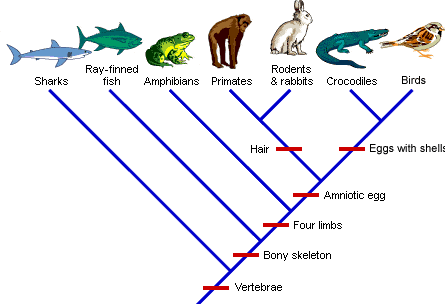
According to this cladogram, sharks are MOST closely related to which organism? 
a)
Amphibians
b)
Ray finned fish
c)
Crocodiles
d)
Birds
107.

Which group of animals on this tree are most closely related to birds?

a)

Saurischian dinosaurs

b)

Ornithischian dinosaurs

c)

Crocodiles

d)

None of these are related to birds

108.

According to this tree, which of these animal phyla are most closely related?

a)

Arthropoda & Mollusca

b)

Arthropoda & Chordata

c)

Chordata & Mollusca

109.

The diagram below represents possible genetic relationships between groups of organisms.

Which statement is a valid conclusion that can be drawn from the diagram?

a)

Insects are more complex than mammals.

b)

Earthworms and sea stars have a common ancestor.

c)

Snails appeared on Earth before corals.

d)

Sponges were the last new species to appear on Earth.

110.

bursts of change followed by periods of stability

a)

speciation

b)

extinction

c)

gradualism

d)

punctuated equilibrium

e)

coevolution

111.

Plants need ________ to conduct photosynthesis

a)

Oxygen

b)

Soil

c)

Carbon dioxide

d)

Sugar

112.
Why do plants conduct photosynthesis?
a)
To make light
b)
To make mitochondria
c)
To make glucose
d)
To release carbon dioxide
113.
Which organelle in the plant cell performs photosynthesis?
a)
Chloroplast
b)
Mitochondria
c)
Nucleus
d)
Cytoplasm
114.
How does carbon dioxide get into the leaves of a plant?
a)
It's absorbed by the roots
b)
It's made in a chemical reaction in the stem
c)
It enters through the stomata
d)
It goes through the flowers
115.
What are the products of photosynthesis (what is made)?
a)
Glucose and Chlorophyll
b)
Glucose and Oxygen
c)
Water and Light
d)
Carbon dioxide and Water
116.
What is the source of energy for photosynthesis?
a)
Carbohydrates (chemical energy)
b)
Light (radiant energy)
c)
Heat (thermal energy)
d)
Wind (kinetic energy)
117.
What are the products of photosynthesis?
a)
water and carbon dioxide
b)
oxygen and glucose
c)
oxygen and carbon dioxide
d)
oxygen and water
118.
Most plants appear green because chlorophyll
a)
absorbs green light.
b)
absorbs violet light.
c)
does not absorb green light.
d)
does not absorb violet light.
119.
Which of the following would have affect the rate of photosynthesis?
a)
amount of water
b)
carbon dioxide concentration
c)
temperature
d)
all of these
120.
Enzymes catalyze reactions by ___________ Activation Energy.
a)
Increasing
b)
Decreasing
121.
Most enzymes have the ending:
a)
-ase
b)
-ose
c)
-ic acid
d)
-ate
122.
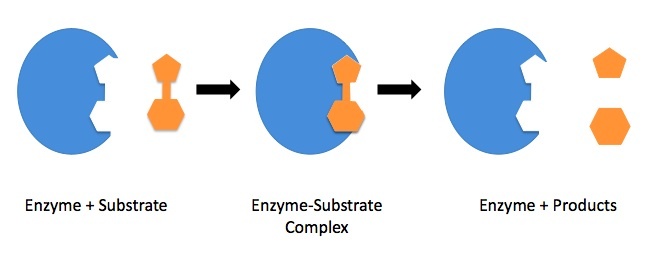
The molecule an enzyme is working on is called the:
a)
Substrate
b)
Solvent
c)
Allosteric Inhibitor
d)
CoEnzyme
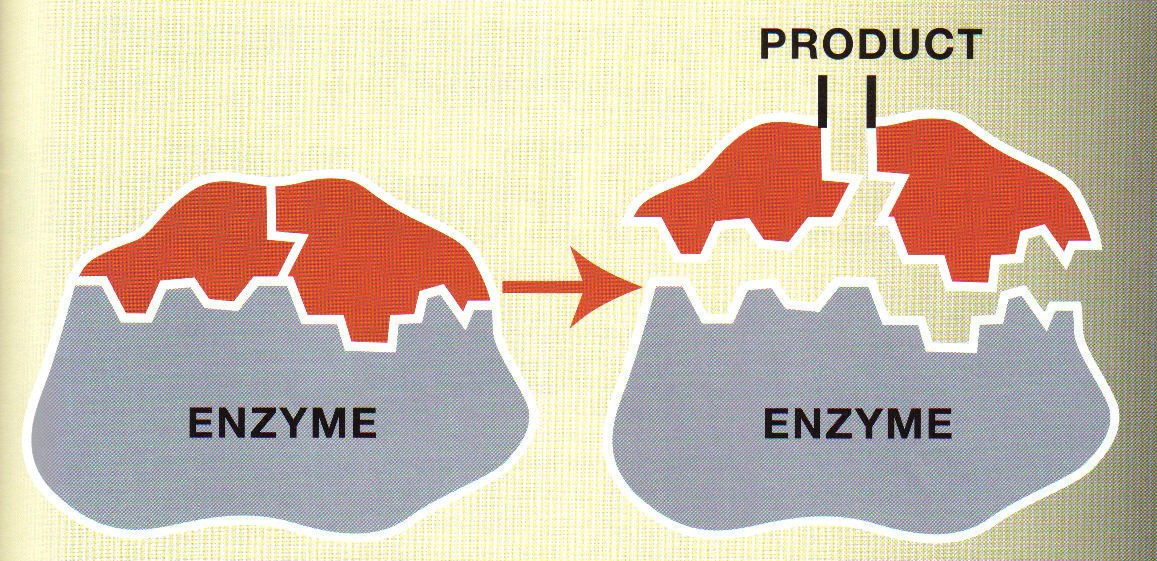
123.
Enzymes are considered to be 
a)
Lipids
b)
Carbohydrate
c)
Protein
d)
Nucleic Acid
124.
What is the purpose  of an enzyme?
a)
give permission for the reaction
b)
raise activation energy
c)
speed up reactions
d)
control how many reactions occur
125.
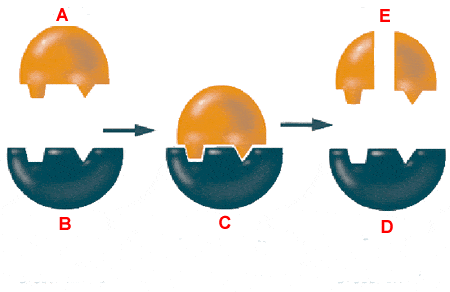
What is the name for the mechanism of enzyme activity?
a)
Lock and key
b)
jigsaw puzzle
c)
hammer and nail
d)
two hands pattern
126.
What makes an enzyme substrate specific?
a)
Size
b)
Shape
c)
Name
d)
Location it is found in
127.
When particles move from areas of high concentration to areas less concentrated, this has taken place.
a)
diffusion
b)
mitosis
c)
endocytosis
d)
photosynthesis
128.
Diffusion is the movement of molecules from an area of _____ concentration to an ______ concentration
a)
High, low
b)
Low, high
c)
Low, low,
d)
High, high
129.
In diffusion, particles move down a _______ ________
a)
Concentrate gradient
b)
Conceited gradient
c)
Concentration gradient 
d)
Concentrated orange juice
130.
If there is more oxygen in the blood than in an organ, which direction would the oxygen move?
a)
Out of the blood
b)
Into the blood
131.
Osmosis is the movement of _____ across a membrane.
a)
food
b)
energy
c)
oxygen
d)
water
132.
Permeable means
a)
things can pass through
b)
the concentration levels are different
c)
it is permanent
d)
things are stuck
133.

The diffusion of WATER through a semi-permeable membrane is called?

a)

Osmosis

b)

Cell wall

c)

Diffusion

d)

Respiration

134.
The term used to describe when some molecules are able to pass through a membrane and others are not.
a)
Osmosis
b)
Diffusion
c)
Selective Permeability
d)
Equilibrium
135.
Molecules will move from an area of high concentration to an area of low concentration until they reach
a)
osmosis
b)
equilibrium
c)
selective permeability
d)
diffusion