wayground logo

Free Printable Worksheets

Font size

S
M
L
XL
Worksheets

Study Guide Ch. 5 Genetics

Total questions: 133

Worksheet time: 2hrs 12mins

Name
Class
Date
1.

1. A Punnett square shows you all the ways in which ___________________ can combine.

a)

alleles

b)

eggs

c)

sperm

d)

colors

2.

In a Punnett square, a capital letter stands for a _____________ allele.

a)

recessive

b)

dominant

c)

heterozygous

d)

homozygous

3.

Of the following, which represents a homozygous recessive genotype?

a)

TT

b)

tt

c)

Tt

d)

TTT

4.

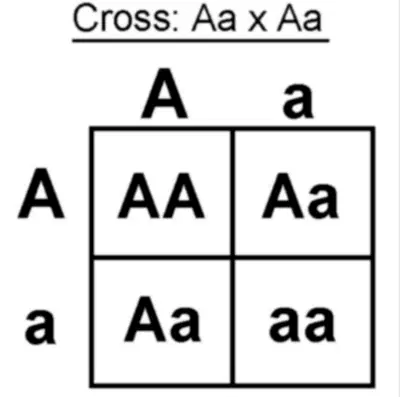
In this cross between two pea plants, the offspring are

a)

100% smooth.

b)

50% smooth and 50% wrinkled.

c)

75% wrinkled and 25% smooth.

d)

75% smooth and 25% wrinkled.

5.

A heterozygous orange-flowered plant is crossed with a homozygous purple-flowered plant. If orange is a dominant allele and purple is recessive, what color ratio will the flowers of the offspring plants have?

a)

1 purple: 3 orange

b)

4 purple: 0 orange

c)

2 purple: 2 orange

d)

0 purple: 4 orange

6.

A man and a woman want to have a child, but the man is heterozygous (Cc) for a recessive trait that causes a fatal illness. What is the probability of a child’s inheriting the trait?

a)

0%

b)

25%

c)

50%

d)

75%

7.

A and B are the same kind of fish. A has a genotype for narrow fins (ww), and B has a genotype for wide fins (W-). Which of the following genotypes of parent fish will produce only offspring having wide fins?

a)

Ww and Ww

b)

WW and ww

c)

Ww and ww

d)

ww and ww

8.

Some ____________________ are due to environmental influences.

a)

phenotypes

b)

pedigrees

c)

Punnett squares

d)

offspring

9.

Different forms of a gene are called ___________________________.

a)

alleles

b)

jeans

c)

flowers

d)

homozygous

10.

A ____________________ square is a model that helps make genetic predictions.

a)

Punnett

b)

Pedigree

c)

Podigree

d)

Pungent

11.

A(n) ____________________ is a visual tool for following a trait through generations of a family.

a)

Punnett Square

b)

Pedigree

c)

Mobius strip

d)

Applet

12.

Identify three environmental factors that can affect an organism’s phenotype.

a)

soil acidity or alkalinity, lifestyle choices, temperature

b)

rain, power outage, temperature

c)

lifestyle choices, memory, brain cells

d)

parents, siblings, neighbors

13.

A yellow pea plant (Yy) and a green pea plant (yy) could produce ____________________ green offspring.

a)

1

b)

2

c)

3

d)

4

14.

Organisms with two different alleles for a trait are called _____________.

a)

heterozygous

b)

homozygous

c)

heritage

d)

complacent

15.

When an intermediate form (mixed) is expressed in offspring

a)

incomplete dominance

b)

co-dominance

c)

random dominance

d)

legal dominance

16.

When more than two alleles control a trait, it is called ________________.

a)

co-dominance

b)

multiple alleles

c)

incomplete dominance

d)

genes

17.

The physical appearance of an organism is its

a)

genotype

b)

phenotype

c)

blood type

d)

mental type

18.

Which of the following genotypes is heterozygous?

a)

Bb

b)

BB

c)

bb

d)

B

19.
In a heterozygous genotype, the ___________ allele takes over in the phenotype.
a)
recessive
b)
dominant
c)
lower case letter
d)
both 
20.
Which of the following is a phenotype?
a)
Aa
b)
red hair
c)
heterozygous
d)
DNA
21.
How many alleles (letters) do each person carry for a trait?
a)
1
b)
2
c)
3
d)
4
22.
Complex molecule that carries genetic information that defines an organism's traits. It is stored in the nucleus.
a)
DNA
b)
protein
c)
RNA
d)
glucose nucleic acid (GNA)
23.
How many alleles (letters) does a child get from each parent for each trait?
a)
1
b)
2
c)
3
d)
4
24.
Two brown eyed parents (Bb) have a baby. What is the chance the baby is blue eyed?
a)
0 %
b)
25%
c)
50%
d)
75%
25.
If a heterozygous tall pea plant is crossed with a short pea plant, what are the possible genotypes of the future offspring?
a)
100% Tt
b)
50% Tt, 50% tt
c)
75%Tt, 25%tt
d)
25%TT, 50%Tt, 25%tt
26.
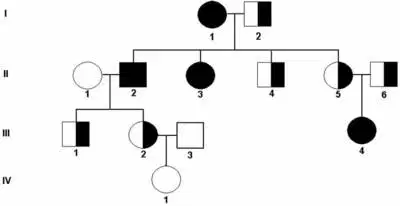
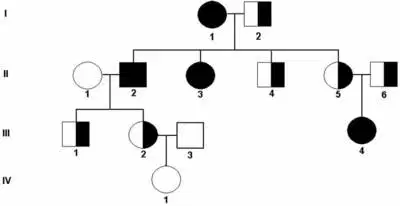
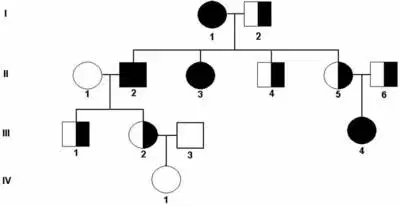
How many generations are shown in this pedigree?
a)
1
b)
2
c)
3
d)
4
27.
How many females are in this pedigree?
a)
3
b)
4
c)
6
d)
7
28.

Deoxyribonucleic acid, a self-replicating material present in nearly all living organisms as the main constituent of chromosomes. It is the carrier of genetic information.

a)

Chromosomes

b)

Gene

c)

DNA

d)

Offspring

29.

A unit of heredity that is transferred from a parent to offspring and is held to determine some characteristic of the offspring

a)

Chromosomes

b)

Gene

c)

DNA

d)

Offspring

30.

Threadlike structure of nucleic acids and protein found in the nucleus of most living cells, carrying genetic information in the form of genes.

a)

Chromosomes

b)

Gene

c)

DNA

d)

Offspring

31.

Passing on of physical or mental characteristics genetically from one generation to another.

a)

Heredity

b)

Asexual Reproduction

c)

Trait

d)

Sexual Reproduction

32.

Feature of an organism,A characteristic that an organism can pass on to its offspring through its genes

a)

Heredity

b)

Asexual Reproduction

c)

Trait

d)

Sexual Reproduction

33.

Describes a trait that covers over, or dominates another form of that trait.

a)

Recessive Traits

b)

Dominant Traits

c)

Pedigree

d)

Diverse

34.

Trait that typically do not show in person unless both genes for the trait inherited.

a)

Recessive Traits

b)

Dominant Traits

c)

Pedigree

d)

Diverse

35.

The study of heredity

a)

Genotype

b)

Phenotype

c)

Zygote

d)

Genetics

36.

Genetic makeup of an organism

a)

Genotype

b)

Phenotype

c)

Zygote

d)

Genetics

37.

A chart that shows all the possible combinations of alleles that can result from a genetic cross.

a)

Probality

b)

Punnett Square

c)

Hybrids

d)

Gregor Mendel

38.

the likelyhood that a specific trait will occur.

a)

Probability

b)

Punnett Square

c)

Hybrids

d)

Gregor Mendel

39.

Offspring of crosses between parents with different traits.

a)

Probability

b)

Punnett Square

c)

Hybrids

d)

Gregor Mendel

40.
Squidward has light blue skin, and his genotype for this trait is Bb. Would Squidward be considered a purebred or hybrid for light blue skin?
a)
Purebred
b)
Hybrid
41.

Having two of the same genes for the trait (sometimes called purebred).

a)

homozygous

b)

hetrozygous

c)

protein

d)

chromosome

42.
A single piece of coiled DNA found in the cells; contains genes that encode traits.
a)
gene
b)
chromosome
c)
trait
d)
DNA
43.

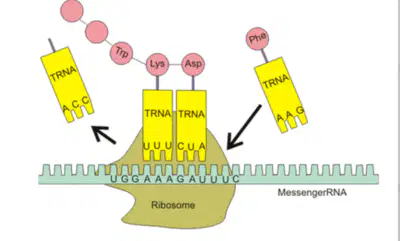
Makes proteins using directions from DNA

a)

nucleus

b)

organelles

c)

ribosomes

d)

vacuole

44.
If you cross a homozygous dominant purple flowered pea plant with a homozygous recessive white flowered pea plant, what % of the offspring will have white flowers?
a)
0%
b)
50%
c)
75%
d)
100%
45.
Overall shape of DNA (twisted ladder)
a)
Purine
b)
Double Helix
c)
Deoxyribose
46.
Building blocks of DNA made up of a sugar, a nitrogenous base, and a phosphate group
a)
Purine
b)
Double helix
c)
Nucleotide
47.
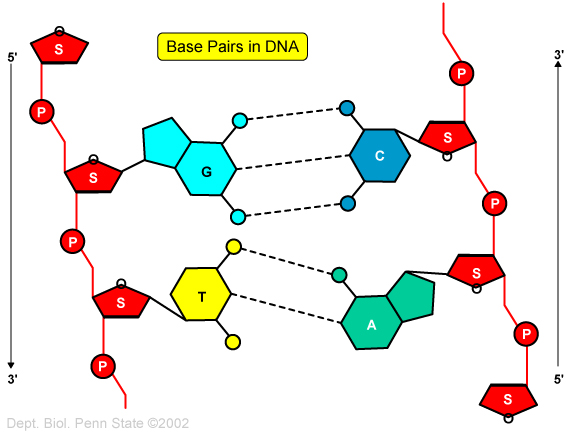
In DNA: A bonds with T, G bonds with C; in RNA: A bonds with U, G bonds with C
a)
Base Pairing Rules
b)
Spiral
c)
Bonding
48.
Connect the nitrogenous bases to each other in DNA forming the rungs in the DNA ladder shape
a)
Double Helix
b)
Hydrogen Bonds
c)
Protein
49.
Sugar backbone part of DNA
a)
Sugar
b)
Spine
c)
Deoxyribose
50.
Sugar backbone part of RNA
a)
Ribose
b)
RNA
c)
Backbone
51.
DNA copies itself prior to mitosis or meiosis
a)
Transcription
b)
Translation
c)
Replication
52.
DNA makes mRNA copy which carries genetic instructions outside the nucleus to ribosomes
a)
Transcription
b)
Messenger RNA
c)
Cycle
53.
RNA that carries the DNA instructions (message) outside the nucleus to be carried out (messenger RNA)
a)
mRNA
b)
DNA
c)
RNA
54.
RNA that makes up the structure of the ribosome together with other proteins (ribosomal RNA)
a)
rRNA
b)
mRNA
c)
DNA
55.
RNA that transfers amino acid building blocks to the ribosome
a)
mRNA
b)
rRNA
c)
tRNA
56.
mRNA is read by a ribosome in order to produce protein.
a)
Translation
b)
Reading
c)
Check
57.
Adenine bonds with ______________.
a)
Guanine
b)
Thymine
c)
Cytosine
d)
Adenine
58.

What is DNA made of?

a)

Sugar, Phosphate, nitrogen base

b)

Phosphate, Adenine, nitrogen base

c)

Thymine, Adenine, Cytomine

d)

Phosphate, Nitrogen, Adenine

59.
Guanine bonds with ______________.
a)
Adenine
b)
Guanine
c)
Cytosine
d)
Thymine
60.

What are the 4 nitrogen bases?

a)

adenine, thymine, cytoplasm, and guanine

b)

adenine, thymine, cytosine, and guanine

c)

adenine, thymine, cytosine, and gylcerol

d)

adenine, thymine, cytosine, and glucose

61.
Which organelle is DNA usually found in?
a)
cell membrane
b)
vacuole
c)
chloroplast
d)
nucleus
62.
Which 2 molecules forms the sides (backbone) of the DNA ladder?
a)
deoxyribose and adenine
b)
deoxyribose and a hydrogen bond
c)
sugar and the nucleus
d)
deoxyribose (sugar) and phosphate
63.
Which sequence of DNA bases would pair with this partial strand
ATG TGA CAG
a)
ATG TGA CAG
b)
TAC ACT GTC
c)
GTA AGT GAC
d)
CAT TCA CTG
64.
Why is DNA important?
a)
it is very small and very complicated
b)
it's in everything
c)
it serves as the blueprint for traits of all living things
d)
because we eat it every day for energy
65.
Nitrogenous bases are joined by which type of bond?
a)
polar bonds
b)
ionic bonds
c)
covalent bonds
d)
hydrogen bonds
66.
What do we call the process of turning DNA into mRNA?
a)
Translation
b)
Transcription 
c)
Replication
67.
Amino acids are the building blocks of... 
a)
DNA
b)
RNA
c)
Atoms
d)
Proteins
68.
One difference between DNA and RNA is that....
a)
Only RNA has the base Uracil
b)
only RNA contains the base Thymine
c)
only RNA contains the base Cytocine
d)
only RNA contained the base Guanine
69.
_______ is made during transcription and ________ is made during translation.
a)
mRNA / a protein
b)
a protein / mRNA
c)
Ribosome / Nucleus
d)
mRNA / tRNA
70.
Which is the organelle that makes proteins?
a)
Nucleus
b)
Ribosomes
c)
Rough ER
d)
Golgi Apparatus
71.
Codons contain ______ bases
a)
1
b)
3
c)
6
d)
9
72.
An organism's appearance or other observable characteristics:
a)
phentoype
b)
genotype
c)
recessive
d)
dominant
73.
An organism's genetic make-up:
a)
phenotype
b)
genotype
c)
dominant
d)
recessive
74.
What is another way of saying "purebred"?
a)
homozygous
b)
dominant
c)
recessive
d)
heterozygous
75.

DNA polymerase moves in the _________ to ____________ direction

a)

3' to 5'

b)

easiest

c)

5" to 3"

d)

9 to 5

76.

Enzyme that connects the DNA to the backbone (glues)

a)

Ligase

b)

Polymerase

c)

Helicase

d)

Primase

77.

Enzyme that breaks hydrogen bonds (unzips)

a)

Ligase

b)

Polymerase

c)

Primase

d)

Helicase

78.

What is this monomer?

a)

DNA

b)

Nucleotide

c)

Nitrogen base

d)

Phosphate

79.

Which enzyme is responsible for adding nucleotides?

a)

Helicase

b)

Ligase

c)

Primase

d)

Polymerase

80.

Which mutation results from a nucleotide being added?

a)

Insertion

b)

Deletion

c)

Substitution

81.

Which mutation results from a nucleotide being changed?

a)

Insertion

b)

Deletion

c)

Substitution

82.

Which mutation results from a nucleotide being removed?

a)

Insertion

b)

Deletion

c)

Substitution

83.

where is the site of translation ?

a)

ribosomes

b)

telomerase

c)

helicase

d)

primase

84.
A Punnett square shows you all the ways in which ___________________ can combine.
a)
eggs
b)
sperm
c)
colors
d)
alleles
85.
Of the following, which represents a homozygous recessive genotype?
a)
TT
b)
tt
c)
Tt
d)
TTT
86.
A man and a woman want to have a child, both the man and woman are heterozygous (Cc) for a recessive trait that causes a fatal illness. What is the probability of a child’s inheriting the trait?
a)
0%
b)
25%
c)
50%
d)
75%
87.
When an intermediate form (mixed) is expressed in offspring
a)
incomplete dominance
b)
co-dominance
c)
random dominance
d)
legal dominance
88.
The physical appearance of an organism is its
a)
genotype
b)
phenotype
c)
blood type
d)
mental type
89.
In a heterozygous genotype, the ___________ allele takes over in the phenotype.
a)
recessive
b)
dominant
c)
lower case letter
d)
both
90.
How many alleles (letters) does each person carry for a trait?
a)
1
b)
2
c)
3
d)
4
91.
Complex molecule that carries genetic information that defines an organism's traits. It is stored in the nucleus.
a)
DNA
b)
RNA
c)
glucose
d)
nucleic acid
92.
Deoxyribonucleic acid, a self-replicating material present in nearly all living organisms as the main constituent of chromosomes. It is the carrier of genetic information.
a)
DNA
b)
chromosome
c)
gene
d)
offspring
93.
Squidward has light blue skin, and his genotype for this trait is Bb. Would Squidward be considered a purebred or hybrid for light blue skin?
a)
purebred
b)
hybrid
94.
Connect the nitrogenous bases to each other in DNA forming the rungs in the DNA ladder shape
a)
Double Helix
b)
Hydrogen Bonds
c)
Protein
d)
Helicase
95.
DNA copies itself prior to mitosis or meiosis
a)
Transcription
b)
Translation
c)
Replication
96.
DNA makes mRNA copy which carries genetic instructions outside the nucleus to ribosomes
a)
Transcription
b)
Translation
c)
Replication
97.
RNA that carries the DNA instructions (message) outside the nucleus to be carried out (messenger RNA)
a)
mRNA
b)
DNA
c)
RNA
98.
RNA that transfers amino acid building blocks to the ribosome
a)
Messenger RNA (mRNA)
b)
DNA
c)
transfer RNA (tRNA)
d)
RNA
99.
mRNA is read by a ribosome in order to produce protein.
a)
Transcription
b)
Translation
c)
Replication
100.
What are the 4 nitrogen bases?
a)
adenine, thymine, cytoplasm, and guanine
b)
adenine, thymine, cytosine, and guanine
c)
adenine, thymine, cytosine, and gylcerol
d)
adenine, thymine, cytosine, and glucose
101.
Which organelle is DNA usually found in?
a)
cell membrane
b)
chloroplasts
c)
nucleus
d)
vacuole
102.
Which sequence of DNA bases would pair with this partial strand ATG TGA CAG
a)
ATG TGA CAG
b)
GTA AGT GAC
c)
TAC ACT GTC
d)
CAT TCA CTG
103.
Amino acids are the building blocks of...
a)
DNA
b)
RNA
c)
Atoms
d)
Proteins
104.
Enzyme that connects the DNA to the backbone (glues)
a)
Polymerase
b)
Helicase
c)
Primase
d)
Ligase
105.
Enzyme that breaks hydrogen bonds (unzips)
a)
Polymerase
b)
Helicase
c)
Primase
d)
Ligase
106.
Which enzyme is responsible for adding nucleotides? (builder)
a)
Polymerase
b)
Helicase
c)
Primase
d)
Ligase
107.
Which mutation results from a nucleotide being added?
a)
Insertion
b)
Deletion
c)
Substitution
d)
Translation
108.
Which mutation results from a nucleotide being changed?
a)
Insertion
b)
Deletion
c)
Substitution
d)
Translation
109.
Which mutation results from a nucleotide being removed?
a)
Insertion
b)
Deletion
c)
Substitution
d)
Translation
110.
Heredity can be defined as
a)
A characteristic that an organism can pass onto its offspring through its genes.
b)
the scientific study of phenotypes.
c)
the passing of traits from parent to offspring.
d)
none of the answers are correct.
111.
Fertilization that occurs when pollen from one plant lands on the pistil of a flower on the same plant
a)
true breeding
b)
hybrid
c)
cross pollination
d)
self pollination
112.
What did Mendel conclude about inherited traits?
a)
One factor(gene) controls each inherited trait
b)
Two factors(genes) control each inherited trait
c)
Multiple factors(genes) control each inherited trait
d)
No factors(genes) control each inherited trait
113.
If a heterozygous mother with brown eyes mated with a father who is homozygous dominant for brown eyes. Create a Punnett square to determine the percentage of offspring would have brown eyes?
a)
100%
b)
75%
c)
50%
d)
25%
114.
A woman with curly hair mated with the man who is heterozygous for straight hair. Create a Punnett square to determine the ratio of offspring that will have curly hair.
a)
1/2
b)
3/4
c)
1/4
d)
4/4
115.
T - tall and t = short in the Punnett square below, what belongs in the missing square
a)
tt
b)
Tt
c)
Bb
d)
TT
116.
Based on the completed Punnett square, what is the phenotypic Ratio?
a)
1:2:1
b)
3:2
c)
3:1
d)
1:3:1
117.
Which of the following is not a base found in DNA?
a)
adenine
b)
thymine
c)
cytosine
d)
uracil
118.
What does tRNA do?
a)
provides information from DNA to ribosomes
b)
makes up ribosomes
c)
transfers amino acids to the ribosomes
d)
builds proteins
119.
A triplet (3 bases) of mRNA is called a
a)
codon
b)
anticodon
c)
amino acid
d)
peptide bond
120.
Translation happens in the -
a)
ribosome
b)
nucleus
c)
chloroplast
d)
smooth endoplasmic reticulum
121.
Genetic mutations can be...
a)
beneficial, harmful, or neutral
b)
beneficial only
c)
harmful only
d)
neutral only
122.
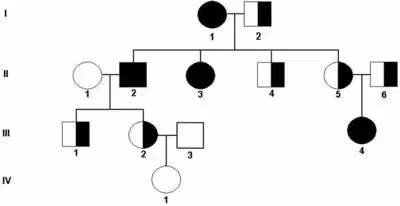
What do half colored symbols represent?
a)
The individual is a carrier (heterozygous).
b)
The individual has both recessive alleles.
c)
The individual expresses the trait.
d)
The individual has both dominant alleles.
123.
In the second generation-how many people are carriers of the trait?
a)
2
b)
3
c)
4
d)
7
124.
How many people in this whole pedigree have the trait/disease?
a)
2
b)
3
c)
4
d)
7
125.
How many females are in this pedigree?
a)
2
b)
3
c)
4
d)
7
126.
This is a pedigree that follows blue eyes which is a recessive trait. What is the phenotype of the mother (circle) in generation 1?
a)
Brown
b)
Blue
c)
1 blue, 1 brown
127.
How many generations are shown in this pedigree?
a)
1
b)
2
c)
3
d)
4
128.
What does a filled in square represent?
a)
not affected female
b)
not affected male
c)
affected male
d)
affected female
129.
Brown eyes are dominant to blue eyes. Which genotype represent a person with blue eyes? (select all that apply)
a)
BB
b)
bb
c)
Bb
130.
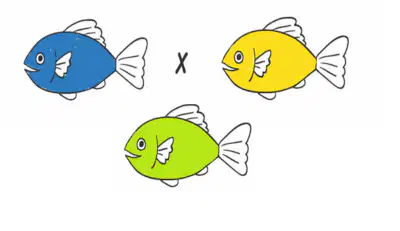
This is an example of ___________?
a)
Incomplete dominance
b)
Codominance
c)
Multiple Alleles
d)
Polygenic Inheritance
131.
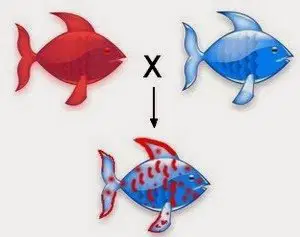
This is an example of ___________.
a)
Incomplete dominance
b)
Codominance
c)
Multiple Alleles
d)
Polygenic Inheritance
132.
Eye color is a trait coded by there separate genes and three different alleles (brown, green, blue). What type of inheritance pattern is eye color?
a)
Incomplete dominance
b)
Codominance
c)
Multiple Alleles
d)
Polygenic Inheritance
133.
How did Rosalind Franklin's photo 51 affect the work of Watson and Crick?
a)
It was used to determine the physical structure of DNA
b)
It was used to determine the theory of independent assortment
c)
It was used to identify the four bases that make up DNA
d)
It was used to show DNA was the molecule of inheritance