
 Worksheets
Unit 4 Review
Total questions: 132
Worksheet time: 3hrs 49mins

ATG TGA CAG
This repetitive sequences of DNA on the ends of chromosomes (TTAGGG) for protection.
telomeres
telomerase
Okazaki fragments
primer
How do the leading and the lagging strands differ?
The leading strand is synthesized in the same direction as the movement of the replication fork, and the lagging strand is synthesized in the opposite direction.
The leading strand is synthesized at twice the rate of the lagging strand.
The leading strand is synthesized in short fragments that are ultimately stitched together, whereas the lagging strand is synthesized continuously.
The leading strand is synthesized by adding nucleotides to the 3' end of the growing strand, and the lagging strand is synthesized by adding nucleotides to the 5? end.

TAT GGC ACT

AUG AAU UGU UGA
Mutation: ATC GCAT
What mutation occurred?
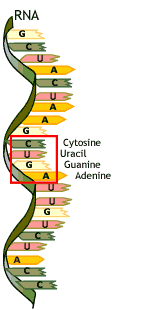

Which enzyme joins the Okazaki fragments in the lagging strand?
Helicase
DNA Polymerase
Ligase
Primase
The strand of DNA that is replicated continuously from 5' to 3' is known as
leading strand
lagging strand
parallel strand
antiparallel strand
How can a person's muscle cells have identical DNA sequences as their nerve cells even though they perform different functions?
The two different cells become mutated
The proteins expressed in each cell are different
They actually have different DNA in the two types of cells.
The genome of the different cells changes


chromosomal mutations cause a segment of the chromosome to repeat itself during replication.
inversion
duplication
translocation
deletion
Mutation: ATC GCAT
What mutation occurred?
New DNA: CAT AT
What mutation occurred?
New Gene: BBC
What mutation
ATTGAGCC - Mutated
The example above is an example of a
GTAGTCA
Any change in the nucleotide sequence of a gene is called
a mutation
a codon
a translation
an anticodon
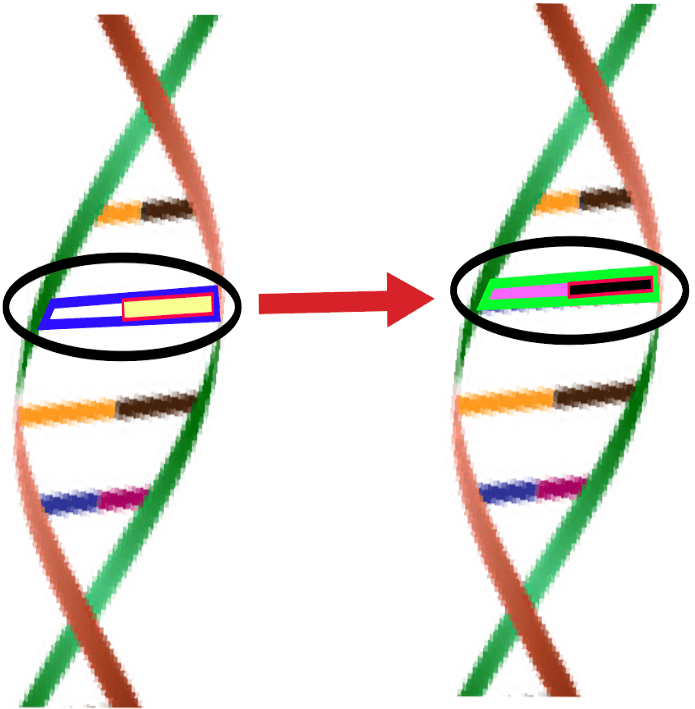
A permanent change in the DNA sequence
which can affect a single gene or group of genes
Homeostasis
Somatic Cell
Chromosomal Mutation
Gene Mutation

A point mutation where one nucleotide base replaces an original nucleotide base
Inversion Mutation
Chromosomal Mutation
Translocation
Substitution Mutation

A nucleotide base is inserted or deleted shifting the entire DNA sequence. Entire protein will be changed.
Substitution Mutation
Silent Mutation
Frameshift Mutation
Translocation

A frameshift mutation where a nucleotide base
is removed from the DNA sequence.
Deletion Mutation
Substitution Mutation
Translocation
Silent Mutation
Mutations that involve parts of or all of
a chromosome
Replication
Deletion Mutation
Chromosomal Mutation
Transcription

Part of a chromosome is repeated
Gene Mutation
Point Mutation
Deletion Mutation
Duplication Mutation

Part of a chromosome is reversed.
Inversion Mutation
Deletion Mutation
Translocation
Point Mutation

Part of one chromosome is transported and attached
to a non-homologous chromosome
Inversion Mutation
Translocation Mutation
Duplication Mutation
Point Mutation
What are the building blocks of DNA?
carbohydrates
lipids
proteins
nucleotides
Describe the double helix structure of DNA.
A straight line formed by a single strand of nucleotides
A twisted ladder-like shape formed by two strands of nucleotides held together by hydrogen bonds.
A circular shape formed by three strands of nucleotides
A square shape formed by four strands of nucleotides
What are the four nitrogenous bases found in DNA?
Thymine, Uracil, Cytosine, Adenine
Adenine, Thymine, Uracil, Guanine
Adenine, Uracil, Cytosine, Guanine
Adenine, Thymine, Cytosine, Guanine
Explain the role of DNA in protein synthesis.
DNA provides the instructions for making proteins through the process of transcription and translation.
DNA is not involved in protein synthesis
Protein synthesis occurs without the involvement of DNA
Proteins provide the instructions for making DNA
What is the primary function of RNA?
Regulate gene expression by binding to specific proteins
Carry out the instructions encoded in DNA for protein synthesis
Store genetic information in the form of a double helix
Facilitate the transfer of amino acids to the ribosome during protein synthesis
Differentiate between DNA and RNA structure.
DNA is single-stranded with ribose sugar and uracil base, while RNA is double-stranded with deoxyribose sugar and thymine base.
DNA is double-stranded with deoxyribose sugar and thymine base, while RNA is single-stranded with ribose sugar and uracil base.
DNA and RNA have the same structure and composition.
DNA is single-stranded with deoxyribose sugar and thymine base, while RNA is double-stranded with ribose sugar and uracil base.
What is the genetic code and how is it read?
The genetic code is the set of rules by which information encoded in genetic material (DNA or RNA sequences) is translated into proteins. It is read by the ribosome in a process called translation.
The genetic code is a secret message hidden in the DNA that only certain people can read
The genetic code is a type of barcode that can be scanned to reveal genetic information
The genetic code is a language spoken by cells to communicate with each other
Explain the process of transcription in protein synthesis.
Protein binds to DNA and creates a complementary RNA strand.
RNA polymerase binds to RNA and creates a complementary DNA strand.
DNA polymerase binds to RNA and creates a complementary DNA strand.
RNA polymerase binds to DNA and creates a complementary RNA strand.
What are the three types of RNA and their functions?
mRNA, tRNA, and rRNA with their respective functions
aRNA, bRNA, and cRNA with their respective functions
xRNA, yRNA, and zRNA with their respective functions
pRNA, qRNA, and sRNA with their respective functions
How does the genetic code determine the sequence of amino acids in a protein?
The genetic code determines the sequence of amino acids in a protein through the process of transcription and translation.
The sequence of amino acids in a protein is determined by the environment
The sequence of amino acids in a protein is determined by random chance
The genetic code is not involved in determining the sequence of amino acids in a protein
What is the role of tRNA in protein synthesis?
tRNA carries the genetic code from the nucleus to the ribosome.
tRNA carries amino acids to the ribosome and matches them to the coded mRNA message.
tRNA synthesizes new strands of DNA.
tRNA has no role in protein synthesis.
What is the difference between purines and pyrimidines?
Purines are single-ringed structures, while pyrimidines are double-ringed.
Purines are double-ringed structures, while pyrimidines are single-ringed.
Purines and pyrimidines are the same.
Purines are proteins, while pyrimidines are nucleotides.
What is the process of DNA replication?
DNA replication is the process of producing two identical replicas from one original DNA molecule.
DNA replication is the process of producing proteins from DNA.
DNA replication is the process of producing RNA from DNA.
DNA replication is the process of producing carbohydrates from DNA.
What is the role of mRNA in protein synthesis?
mRNA carries the genetic code from the nucleus to the ribosome.
mRNA synthesizes new strands of DNA.
mRNA carries amino acids to the ribosome and matches them to the coded tRNA message.
mRNA has no role in protein synthesis.
What is the difference between a nucleotide and a nucleoside?
A nucleotide is a nucleoside with one or more phosphate groups, while a nucleoside is a nucleotide without any phosphate groups.
A nucleoside is a nucleotide with one or more phosphate groups, while a nucleotide is a nucleoside without any phosphate groups.
Nucleotide and nucleoside are the same.
A nucleotide is a protein, while a nucleoside is a carbohydrate.
What is the role of the ribosome in protein synthesis?
The ribosome synthesizes new strands of DNA.
The ribosome carries the genetic code from the nucleus to the mRNA.
The ribosome carries amino acids to the mRNA and matches them to the coded tRNA message.
The ribosome reads the mRNA and joins the appropriate amino acids to form a protein.
What must happen to a newly made polypeptide before it can be secreted from a cell?
it must be translated by a ribosome found in the cytoplasm of the cell and then sent toward the cell membrane
it must be produced by a ribosome on the rough ER and sent to the golgi apparatus
It must be produced by a ribosome in the golgi apparatus and sent to the rough ER.


5'-AUG-UCU-UCG-UUA-UCC-UUG-3'
What is a promoter?
Sequence of DNA at the beginning of the gene that tells RNA polymerase where to start transcription.
Sequence of RNA that tells the ribosome where to start translation.
Sequence of DNA at the beginning of the gene that tells the ribosome where to start transcription
Sequence of RNA that tells RNA polymerase where to start translation.

The image shows part of a polypeptide. What determines the order in which the amino acids are connected to each other in the polypeptide?
the chemical structure of each R-group in the amino acid
the order of the the nitrogenous bases in a gene
the random nature of ribosome function
the sequence of amino acids that make up the gene

Which RNA functions as site of protein synthesis?
mRNA
rRNA
tRNA
Which RNA functions to bring amino acids to the ribosome?
mRNA
rRNA
tRNA
Which RNA is the transcript from DNA template?
mRNA
rRNA
tRNA
Which RNA has an anticodon that pairs with codon?
mRNA
rRNA
tRNA
Which RNA has the codons sequence for translation?
mRNA
rRNA
tRNA
Which enzyme is responsible for transcription?
Ligase
Primase
RNA Polymerase
Transcriptase
In transcription, which direction is DNA read?
3' to 5’
5' to 3’
C terminus to N terminus
N terminus to C terminus
In transcription, which direction is RNA made?
3' to 5’
5' to 3’
C terminus to N terminus
N terminus to C terminus
Function of 5' Cap...
Add phosphates to the RNA
Provide ATP for transcription
Protect from hydrolytic enzymes
Site of ribosome binding
Function of Poly A tail...
Add phosphates to the RNA
Provide ATP for transcription
Protect from hydrolytic enzymes
Site of ribosome binding
What is the process of transcription?
Synthesizing DNA under the direction of DNA
Synthesizing DNA under the direction of RNA
Synthesizing RNA under the direction of DNA
Synthesizing RNA under the direction of RNA
What type of virus will violate the central dogma?
Bacteriophage
DNA virus
Retrovirus
All of the above
What enzyme is responsible for transcription?
DNA polymerase
Helicase
Primase
RNA polymerase
Which strand is read for transcription?
3’ to 5’ coding strand
5’ to 3’ coding strand
3’ to 5’ noncoding strand
5’ to 3’ noncoding strand
Which direction is RNA synthesized?
3’ to 5’
5’ to 3’
What is the function of the
poly A tail?
Binds to the promoter region
Decrease degradation by hydrolytic enzymes
Remove noncoding information
Site of ribosome binding
What is the function of the 5’ cap?
Binds to the promoter region
Decrease degradation by hydrolytic enzymes
Remove noncoding information
Site of ribosome binding
Antibiotics can be used to kill the specific pathogenic bacterium, Mycobacterium tuberculosis, that causes tuberculosis. The appearance of antibiotic-resistant strains has made it more difficult to cure M. tuberculosis infections. These antibiotic-resistant bacteria survive and pass on the genes to their offspring, making the resistant phenotype more common in the population.
DNA analysis indicates that the genes for antibiotic resistance are not normally present in bacterial chromosomal DNA.
Which of the following statements best explains how the genes for antibiotic resistance can be transmitted between bacteria without the exchange of bacterial chromosomal
DNA?
The antibiotic-resistant bacteria release a hormone that signals neighboring bacteria to become resistant.
The genes for antibiotic resistance are located on a plasmid that can be passed to neighboring bacteria.
The antibiotic-resistant bacteria are the result of bacteria that specifically modify their own chromosomal DNA
DNA to neutralize the antibiotics.
The antibiotic alters the bacterial genome of each bacterium, which results in an antibiotic-resistant population.

Which of the following correctly explains the process shown in Figure 1 ?
DNA replication is occurring because replication is semi-conservative and the new strand is a copy of the template strand.
Initiation of transcription is occurring because a strand of RNA
is being produced from a DNA template strand.
Translation is occurring because the two strands have separated and a new strand is being produced.
Alternative splicing of mRNA is occurring because the mRNA
strand is being synthesized from only one strand of DNA
.
Mendel called the distinct heritable features
alleles
chromosomes
characters
traits
In peas, tall plants are dominant over dwarf. Mendel crossed two pea plants that are tall and studied the offspring. Of the 100 offspring, 78 were tall and 22 are dwarf. What were the genotypes of the parents?
TTXTt
ttXTT
TtXtt
TtXTt
In peas, tall plants are dominant over dwarf. Mendel crossed two pea plants that are tall and studied the offspring. Of the 100 offspring, 78 were tall and 22 are dwarf. What were the genotypes of the tall plants from the cross?
TT only
Tt only
TT and Tt
There is not enough information to know for sure.
Alternative versions of genes are called
alleles
traits
characters
chromosomes
States that the two alleles for a heritable character separate (segregate) during gamete formation and end up in different gametes.
Law of Loci
Law of Dominance
Law of Segregation
Law of Independent Assortment
In peas, purple flowers are dominant over white flowers. If a heterozygous purple pea plant is crossed with a white flower, what portion of the offspring would be expected to be white?
0%
25%
50%
75%
100%
States that each pair of alleles segregates independently of each other pair of alleles during gamete formation.
Law of Dominance
Law of Segregation
Law of Loci
Law of Independent Assortment
Genes located near each other on the same chromosome tend to be _____________.
Inherited together.
not inherited together.
mixed together.
separated.
Multiplication Rule:
If two parents have the genotypes AAbbCc X aaBbcc, what is the probability of having an offspring with AabbCc?
1/4
1/16
1/32
All of them.
The phenotype of F1 hybrids is somewhere between the phenotypes of the two parental varieties.
incomplete dominance
codominance
complete dominance
multiple alleles
Two dominant alleles affect the phenotype in separate, distinguishable ways.
incomplete dominance
codominance
law of dominance
complete dominance
In snapdragons red and white are incompletely dominant, the heterozygous condition results in pink. What is the probability of getting white offspring when a white and a pink flower are crossed?
0%
25%
50%
75%
100%
Disease that is fatal; a dysfunctional enzyme causes an accumulation of lipids in the brain
Achrondroplasia
Down's Syndrome
Sicke Cell Anemia
Tay Sachs
What are the blood types found in humans. Check all that apply.
A
B
C
AB
O
Most genes have multiple phenotypic effects, a property called
codominance
pleiotropy
epistasis
norm of reaction
Some traits may be determined by two or more genes, this is
incomplete dominance
codominance
pleiotropy
epistasis
Skin color in humans is involve a variation along a continuum involving several genes, this is
codominance
polygenic inheritance
epistasis
pleiotropy
Heterozygous individuals who carry the recessive allele but are phenotypically normal are referred to as
carriers
affected
normal
diseased
In this disease, the allele results in defective or absent chloride transport channels in plasma membranes
Symptoms include mucus buildup in some internal organs and abnormal absorption of nutrients in the small intestine
Huntington's
achondroplasia
Sickle cell anemia
cystic fibrosis
A degenerative disease of the nervous system
The disease has no obvious phenotypic effects until the individual is about 35 to 40 years of age.
Huntington's
Sickle cell anemia
cystic fibrosis
Achondroplasia
The disorder caused by nondisjunction of chromosome 21 is known as
Down's syndrome
Turner's syndrome
Klinefelter's syndrome
Triple X syndrome
Chromosomes with genes for traits unrelated to sex are called
autosomes
complete
deutosomes
linked genes
Two processes that increase genetic variation during meiosis are crossing over and _____
Synapsis
Tetrad
Independent assortment
Gameiosis

A person with Turner syndrome has only one X chromosome. This means one of their gametes was missing a chromosome.
Which of the following is why gametes sometimes lack a complete chromosome?
Incomplete dominance
Nondisjunction
Inversion mutation
Substitution mutation
Which genotype represents a male with hemophilia?

