wayground logo

Free Printable Worksheets

Font size

S
M
L
XL
Worksheets

2nd Sem Exam Review - HBio

Total questions: 129

Worksheet time: 2hrs 19mins

Name
Class
Date
1.
Which cells are more efficient at obtaining nutrients?
a)
Small Cells
b)
Medium Size Cells
c)
Large Cells
d)
X-Large Cells
2.
High Surface area to volume ratio allows cells to do what quickly?
a)
Move materials around inside the cell
b)
Move materials in and out of the cell 
c)
Communicate to other cells
d)
Divide
3.
This image shows how materials move into various sized cells in a given amount of time.... why does one square cell have more pink coloring than the others? 
a)
The surface area was too larger to get through
b)
The volume of the other cells was too large for the dye to get through
c)
There was not enough surface area for the dye to get through
d)
The volume was too low for the dye to stay in the square
4.

Bacteria reproduce asexually by a process called

a)

replication

b)

meiosis

c)

mitosis

d)

binary fission

5.

Select ALL stages of Interphase

a)

G1

b)

S

c)

G2

d)

Mitosis

6.

Humans have 46 chromosomes. So somatic (body cells) would have ____ and gametes would have ___.

a)

23; 46

b)

46; 92

c)

46; 23

d)

92; 46

7.

After mitosis is complete, the new cells:

a)

are all identical

b)

are half identical and half different

c)

are all different

d)

are all stretched out

8.
Place these cells in order of mitosis.
a)
A, B, C, D, E
b)
B, E, D, A, C
c)
C, E, A, D, B
d)
B, D, A, E, C
9.
During which phase of the cell cycle does the cell spend the most time?
a)
Mitosis
b)
Cytokinesis
c)
Interphase
10.
The phase in mitosis where chromosomes move away and are pulled apart by spindles to opposite sides of the cell.
a)
prophase
b)
anaphase
c)
metaphase
d)
telephase
11.
The dark "spider" looking things on opposite sides of the cell are called "Spindle Fibers".  What is their job?
a)
Eating the chromosomes
b)
Pulling the chromosomes apart
c)
Putting the chromosomes together
12.

Which of the following is/are results of the cell cycle ?

a)

growth

b)

repair of damaged cells

c)

replacement of dying cells.

d)

All of the above

13.
Put the following actions in order: DNA replicates, cell grows, cell divides, cell prepares for mitosis. 
a)
DNA replicates, cell grows, cell prepares for mitosis, cell divides
b)
cell grows, cell prepares for mitosis, DNA replicates, cell divides
c)
cell grows, DNA replicates, cell prepares for mitosis, cell divides
d)
DNA replicates, cell prepares for mitosis, cell grows, cell divides
14.
Uncontrollable cell growth is known as _____
a)
obesity
b)
cancer
c)
diabetes
d)
hepatitis
15.

What is Apoptosis?

a)

Cell programmed Death

b)

Inflammation of cell

c)

Phagocytosis

d)

Plasmolysis

16.

Mass of rapidly dividing cells that can damage surrounding tissue.

a)

growth factor

b)

human growth hormone

c)

cancer

d)

tumor

17.

Which is a function of cyclins?

a)

regulate gene expression by turning genes on and off

b)

repair DNA in the beginning of cell cycle through base pairing

c)

regulate the cell cycle by initiating events of mitosis

d)

stop cells in Go and prevent them from dividing

18.

Stem cells are

a)

undifferentiated or unspecialized cells in the body.

b)

differentiated or specialized cells in the body.

c)

only found in the inner mass cells of blastocyst

d)

only found in a fetus

19.

CROSSING OVER INCREASES

a)

LIFE SPAN

b)

GENETIC VARIATION

c)

THE NUMBER OF OFF-SPRING

d)

ALL ARE TRUE

20.

WHAT TYPE OF CELLS STORE THE GENETIC INFORMATION THAT IS PASSED TO OFF-SPRING

a)

BODY CELLS

b)

MITOSIS

c)

EGG

d)

SPERM

e)

EGG AND SPERM

21.

MEIOSIS PRODUCES 4 CELLS-THE CHROMOSOME NUMBER IS ...

a)

DIPLOID

b)

HAPLOID

22.

NORMAL HUMANS HAVE 46 CHROMOSOMES, HOW MANY WILL THE GERM CELLS HAVE AFTER MEIOSIS?

a)

46

b)

23

c)

12

d)

92

23.
The chromosomes that pair up during meiosis, are called __________ chromosomes.  
a)
homozygous 
b)
asexual
c)
homologous
d)
genes
24.

What does heterozygous mean?

a)
An organism that has the same alleles for a trait (TT or tt)
b)
An organism that has different alleles for a trait (Tt)
c)
When neither allele is fully dominant; offspring is a mixture of both
d)
the different forms of a trait (hair color--> brown, blonde, red
25.

Mendel developed the law of ________________ which states that during the production of gametes, the two hereditary factors for each trait separate

a)

dominance

b)

segregation

c)

fertilization

26.
Round seeds (R) are dominant over wrinkled seeds (r). What percentage of the offspring will be round from the following cross?
Rr X Rr
a)
100%
b)
75%
c)
50%
d)
25%
27.
Tomato plants usually have hairy stems. Hairless stems are present in tomato plants that are homozygous recessive for this trait. If the stem characteristics are determined by a single gene, what are the expected phenotype percentages for the offspring of a heterozygous hairy plant and a hairless plant?
a)
100% hairy, 0% hairless
b)
75% hairy, 25% hairless
c)
50% hairy, 50% hairless
d)
25% hairy, 75% hairless
28.

What gamete possibilities could come from this parent's genotype?

a)

AB, aB

b)

Ab, AB, ab

c)

Ab

d)

AB, aB, ab, aB

29.

A male beetle has the genotype Ttbb. If this beetle mates with a female with genotype TTBb, what is the chance their offspring will have the genotype TtBb?

a)

3/16

b)

4/16

c)

8/16

d)

12/16

30.
A roan cow shows co-dominance in fur color (orange and white). What is the phenotype ratio expected if a roan cow and a roan steer mate together?
a)
4: Orange and White
b)
1: Orange : 1 White
c)
2 Orange: 2 Orange and White: 0 White
d)
1: Orange: 2 Orange and White: 1 White
31.
How are Incomplete Dominance and Co Dominance different than a normal Mendelian cross?
a)
There is no difference
b)
The heterozygous genotype has a unique phenotype
c)
There is no heterozygous genotype
d)
There is only one phenotype regardless of genotype.
32.
What are the blood types of the possible children that a woman (type O) and man (type AB) can have?
a)
O and AB
b)
O and A
c)
O and B
d)
A and B
33.
Type of Trait that is controlled by MANY genes at once. Many Genes will 'contribute' to one phenotype.
a)
Multiple Allele Trait
b)
Polygenic Trait
c)
Monogenic Trait
d)
Co-Dominant Trait
34.
This graphic shows an example of...
a)
Sex Linked Trait
b)
Complete Dominance
c)
Co-Dominance
d)
Incomplete Dominance
35.

If a woman is a carrier for an X-linked recessive trait of hemophilia and her husband has hemophilia, which of the following is true?

a)

All sons will have hemophilia but daughters would not have hemophilia

b)

all daughters will have hemophilia

c)

50% of daughters and 50% of sons could have hemophilia

d)

100% of sons could have hemophilia and 100% of daughters could be carriers

36.

If a female fruit fly heterozygous for red eyes (XRXr) crossed with a white-eyed male (XrY), what percent of their offspring would have white eyes?

a)

0%

b)

25%

c)

50%

d)

75%

37.
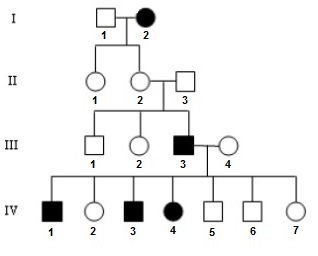
Is this trait (the shaded individuals) dominant or recessive?
a)
dominant
b)
recessive
38.

This pedigree shows a ___ trait.

a)

sex-linked dominant

b)

sex-linked recessive

c)

autosomal dominant

d)

autosomal recessive

39.

This pedigree represents the inheritance of hemophilia in this family. What is the genotype of II-2?

a)

XHXh

b)

XhXh

c)

XHXH

d)

Hh

e)

XHY

40.

The pedigree above is an example of:

a)

dominant

b)

recessive

41.

What is the genotype of individual IV – 2 If this is a dominant, autosomal pedigree?

a)

HH

b)

Hh

c)

hh

42.

This is a recessive disease pedigree. What is the genotype of the II-4?

a)

Rr

b)

RR

c)

rr

d)

R?

43.

This is a recessive disease pedigree. What is the genotype of the III-2?

a)

Rr

b)

RR

c)

rr

d)

R?

44.

A mom has blood type A. She and her husband have three kids who are type O, type A and type AB. What is the dad's genotype?

a)

IᴬIᴬ

b)

IᴮIᴮ

c)

IᴬIᴮ

d)

ii

45.
Avery added an enzyme known to break down proteins to his extract, and saw that the bacteria were ____________________
a)
still transformed
b)
not transformed
c)
all killed
d)
all sick
46.
Avery added an enzyme known to break down DNA to his extract, and saw that the bacteria were __________________
a)
still transformed 
b)
not transformed
c)
all sick
d)
all killed
47.

Hershey and Chase labelled the DNA (with radioactive phosphorous) and protein (with radioactive sulfur) components of viruses and let the viruses infect the bacterial What were the results?

a)

radioactive sulfur was inside the cell

b)

radioactive phosphorus was inside the cell

c)

neither were inside the cell

48.

X-ray diffraction showed us that DNA helical. This helped us figure out DNA's

a)

function

b)

structure

c)

location

d)

composition

49.

Bacterial use DNA to transform. Because the new traits acquired through transformation are passed on to future generations, this tells us that

a)

DNA controls heredity

b)

DNA is made of two strands of nucleotides

c)

viruses inject DNA into cells.

d)

mice die when injected with virulent DNA
50.
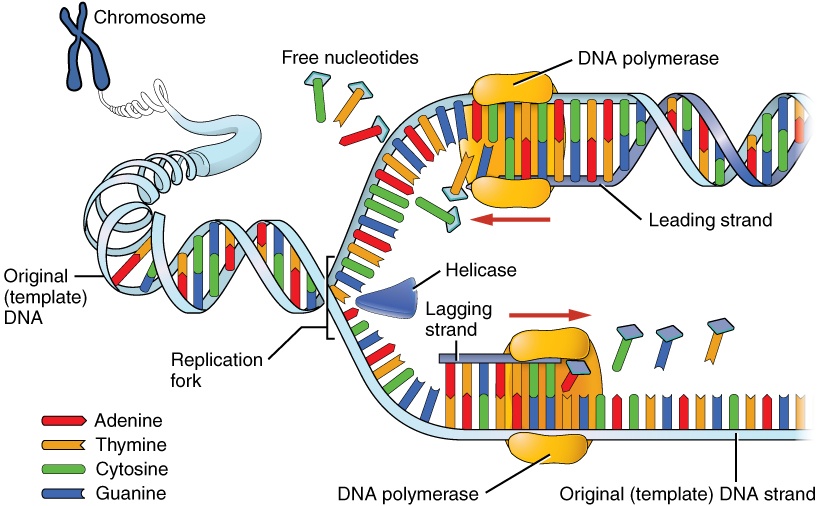
What are the three components of a nucleotide?
a)
sugar, hydrogen, nitrogen base
b)
sugar, oxygen, nitrogen base
c)
sugar, phosphate, nitrogen base
d)
sugar, phosphate, protein
51.
Cytosine always pairs with
a)
Adenine
b)
Thymine
c)
Uracil
d)
Guanine
52.
What is the complement to the DNA strand below:
5'-ATGCCAT-3'
a)
5'-TACGGTA-3'
b)
3'-TACGGTA-5'
c)
3'-ATGGCAT-5'
d)
5'-ATGGCAT-3'
53.
What is the significance of the sequence (order) of the Nitrogen Bases in DNA?
a)
The order of the Nitrogen Bases determines the number of chromosomes present in an organism.
b)
The order of the Nitrogen Bases determines the traits that an organism will possess (have).
c)
The order of the Nitrogen Bases determines the gender of an organism.
d)
The order of the Nitrogen Bases determines whether an organism is abiotic biotic.
54.

What is the first step of DNA Replication?

a)

DNA Helicase unwinds the DNA strands

b)

RNA polymerase adds nucleotides

c)

DNA polymerase adds nucleotides

d)

DNA Helicase zips up/closes up DNA

55.

Base pairing is used to...


Choose all that apply.

a)

copy a DNA molecule

b)

copy a gene into mRNA

c)

bring the correct amino acid to the ribosome

d)

unravel DNA

e)

edit mRNA molecules

56.

DNA's diameter is consistent because

a)

purines pair with pyrimidines

b)

purines pair with other pyrimidines

c)

the sugar and phosphate are in the backbone

d)

DNA is helical

57.
In RNA, Uracil pairs with ______. 
a)
cytosine
b)
adenine
c)
guanine
d)
thymine
58.
The process to go from mRNA to a protein is called ____
a)
transcription
b)
rRNA
c)
replication
d)
translation
59.
The process to go from DNA to mRNA is _______
a)
translation
b)
transcription
c)
replication
60.
Choose the nucleotide sequence of the RNA strand that would be complementary to the following strand: 
GTAGTCA
a)
UATUAGA
b)
ACGACTG
c)
CAUCAGU
d)
CATCAGT
61.
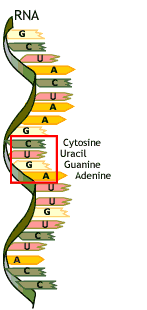
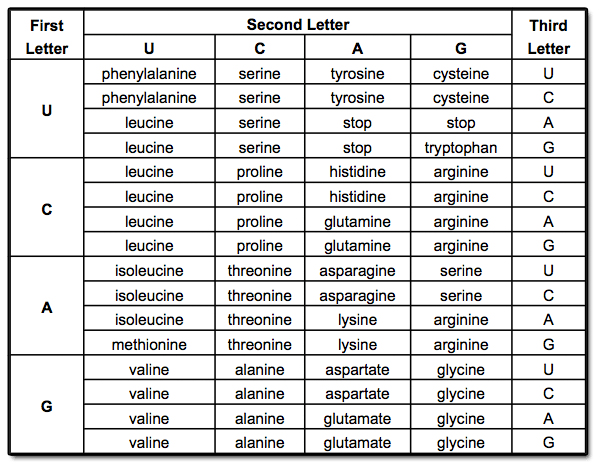
What amino acid is represented by the codon UUA?
a)
Phenylalanine
b)
Tyrosine
c)
Leucine
d)
Stop codon
62.

What is the location in the cell for translation?

a)

nucleus

b)

mitochondria

c)

cytoplasm

d)

chloroplast

63.

What is the three base sequence of mRNA that codes for a single amino acid?

a)

Anticodon

b)

Codon

c)

Protein

d)

DNA

64.
What is the correct amino acid sequence for the mRNA code AUGCCAGUAUGA
a)
Met-Pro-Ala-Val
b)
Met-Pro-Val
c)
Tyr-Gly-His
d)
Tyr-Gly-Arg-His
65.
When experimenting with the growth of a plant, a scientist uses three (of the same type of) plants, two different fertilizers, equal light, and equal water. What type of variable is the fertilizer?
a)
Dependent
b)
Independent
c)
Control
66.
A student is planning an experiment to find out how the height from which he drops a ball affects how high the ball bounces. The dependent variable is the _____.
a)
Diameter of the ball
b)
Force acting on the ball
c)
Height that the ball bounces
d)
Height from which the ball is dropped
67.
This part of the experiment serves as a basis of comparison; the one variable being tested has been omitted. 
a)
experimental group
b)
control group
c)
data
d)
variables
68.
If a student thinks an apple a day keeps the doctor away what are some constants they need to consider?
a)
the number of apples eaten by test subject, who eats them, amount of sleep testing subjects recieve
b)
the apples
c)
the number of doctors visits
d)
the age of the test subjects, the general sleep and meals eaten by test subjects
69.

A scientist wants to test the ability of various cleaners to kill bacteria on a surface. What is a control for this experiment?

a)

type of cleaner

b)

How long the cleaner is allowed to sit on the surface

c)

checking the bacterial growth without any cleaner used

d)

the number of cleaners tested

e)

the amount of bacteria on the surface after cleaning

70.

Which of the following statements is false?

a)

DNA uses thymine, while RNA uses uracil

b)

DNA and RNA utilize different sugars in their sugar-phosphate backbones

c)

DNA is typically double-stranded, while RNA is typically single-stranded

d)

DNA and RNA are about the same size.

71.

Which of the following is true about fermentation ?

a)

It is a fast process

b)

It allows organisms to live in places with little oxygen

c)

it functions to keep glycolysis going by replenishing NAD+

d)

all of the above

72.
After intense activity, your muscles feel sore because of 
a)
the accumulation of NAD+
b)
the accumulation of lactic acid 
c)
the accumulation of ATP
d)
the accumulation of carbon dioxide
73.

What is the purpose of the electron transport chain?

a)

to use oxygen

b)

to make water

c)

to empty electron carriers

d)

to make lots of ATP

e)

to make glucose

74.

In aerobic respiration, what is the function of the Kreb's cycle? (aka citric acid cycle)

a)

To make carbon dioxide

b)

to get rid of pyruvate

c)

to load lots of electron carriers

d)

to use oxygen

e)

to recycle citric acid

75.

In aerobic respiration, what is the main purpose of glycolysis?

a)

Break down glucose to get rid of it

b)

Break down glucose to get 2 ATP

c)

Break down glucose to get 2 pyruvate

d)

Make glucose

76.
Which of the following organic compounds is the main source of energy for living things?
a)
carbohydrates
b)
lipids
c)
nucleic acids
d)
proteins
77.
Energy is released from ATP when
a)
a phosphate group is added
b)
adenine bonds to ribose
c)
ATP is exposed to sunlight
d)
a phosphate group is removed
78.
Which is a product of the ETC?
a)
Carbon dioxide
b)
Glucose
c)
Oxygen
d)
Water
79.
Which is a product of Kreb's Cycle?
a)
Carbon dioxide
b)
Glucose
c)
Pyruvate
d)
Water
80.
The overall goal of cellular respiration is to make:
a)
Glucose
b)
ATP
c)
Oxygen
d)
Water
81.
Glucose is broken down during which process?
a)
Calvin cycle
b)
Glycolysis
c)
Krebs Cycle
d)
Photosynthesis 
82.

Why does the electron transport chain need to occur on membranes?

a)

so it can build a concentration gradient of H+

b)

so it can build a concentration gradient of electrons

c)

so it can control the amount of water inside the membrane

d)

so they can store the glucose that's made

83.

What is the electron acceptor in the electron transport chain of photosynthesis? (What removes the electron from the chain, making room for more electrons?)

a)

oxygen

b)

water

c)

glucose

d)

carbon dioxide

e)

NADP+

84.

In green plants, the primary function of the Calvin cycle is to

a)

Use ATP to release carbon

b)

Split water to release oxygen.

c)

Make simple sugars from carbon dioxide.

d)

Use NADPH to release carbon

85.

In the light reactions, Photosystem II absorbs energy and sends through an electron transport chain. What supplies the electron that is lost in Photosystem II?

a)

oxygen

b)

water

c)

glucose

d)

carbon dioxide

e)

NADPH

86.
What is the main purpose of the light dependent reactions?
a)
To provide the energy for the calvin cycle
b)
To capture energy and make sugar
c)
To reflect green light
d)
To make sugars
87.

What are the products to the light reactions?

a)

Sunlight and Oxygen

b)

Sunlight and Water

c)

ATP, NADPH and Oxygen

d)

ADP, NADP+ and Oxygen

88.
The raw materials or reactants of photosynthesis are
a)
sugar and water.
b)
sugar and oxygen.
c)
carbon dioxide and water.
d)
carbon dioxide and oxygen.
89.
If carbon dioxide is completely removed from a plant’s environment, what would you expect to happen to the plant’s production of high-energy sugars (rate of photosynthesis)?
a)
Sugar production will likely increase.
b)
Sugars will not be produced.
c)
The rate of sugar production will decrease .
d)
Fewer sugars will be produced at first, but then the plant will recover.
90.
A student is collecting the gas given off from a plant in bright sunlight at a temperature of 27°C. The gas being collected is probably ________.
a)
oxygen
b)
carbon dioxide
c)
ATP
d)
glucose
91.

The gradual change the genetic make up of a population over time is...

a)
Evolution
b)

Mutation

c)
Adaptation
d)
Natural Selection
92.
The natural differences between individuals of a species is called ___________.
a)
adaptations
b)
natural selection
c)
variation
d)
fitness
93.
What do the similarities of the structures suggest?
a)
a common ancestor
b)
grow at different rates
c)
evolved slowly
d)
lived a long time
94.
Which two species are most related?
a)
B&C
b)
A&B
c)
A&C
d)
C&B
95.
These structures shown are ________.
a)
Homologous structures
b)
Analogous structures
c)
Structural adaptation
d)
Functional adaptation
96.
Which two organisms are the most closely related according to their DNA sequence?
Critter A--> ATG CTT AAC CCG TTA
Critter B--> ATC GTT TTC CCG TAA
Critter C--> ATG CTA TAG GCG TAA
a)
Critter A and B
b)
Critter A and C
c)
Critter B and C
d)
They are all equally related
97.

Which term refers to the process by which individuals that are better suited to their niche survive and reproduce therefore passing down their genes to their offspring? 

a)
Evolution 
b)
Variation 
c)
Adaptation
d)
Natural Selection 
98.
The ability of an organism to survive and reproduce in its specific environment 
a)
diversity.
b)
evolution
c)
adaptation
d)
 fitness
99.

What type of structures are shown?

a)

Homologous

b)

Analogous

c)

Vestigial

d)

Heterologous

100.

All dogs have the common ancestor the wolf. This is an example of -

a)

divergent evolution

b)

convergent evolution

101.

Remains of ancient organisms are called

a)

Extinctions

b)

Fossils

c)

Mutations

d)

Variations

102.
Which layer is the oldest?
a)
1
b)
2
c)
3
d)
4
103.

Which 3 organisms have Four walking legs? Select 3

a)

leopard

b)

salamander

c)

turtle

d)

tuna

104.

Male birds of paradise have extremely long, showy tail feathers. Which of the following statements best

describes a selective advantage for having this trait?

a)

The bird attracts more females and therefore mates more frequently.

b)

The bird is easier for predators to spot.

105.

Mutations are a change in what?

a)

DNA

b)

tRNA

c)

protein

d)

rRNA

106.

Mutations are important because they bring about

a)

death of the organism in which they develop

b)

genetic variation needed for a population to evolve

c)

benefits for the individual, not for the population

d)

changes in genotype, but not phenotype
107.
Why do frogs and other organism reproduce so many eggs or offspring?
a)
so that their babies can have friends to play with
b)
the more offspring the more likely the offspring will survive
c)
the more offspring the less likely offspring will survive 
d)
the more offspring the less competition
108.

Two populations of the same species are separated by land barriers like rivers or mountains.

a)

geographical isolation

b)

temporal isolation

c)

adaptive ratiation

d)

behavioral isolaton

109.

Why has antibiotic resistance evolved in bacteria?

a)

Bacteria reproduce quickly

b)

Bacteria with a resistance to the antibiotic, passed that trait to offspring

c)

Bacteria that are resistant reproduce faster than non resistant strains

d)

Bacteria exposed to antibiotics develop a resistance to them

110.

Genetic drift is change in the allele frequency of a population due to...

a)

random chance

b)

natural selection

c)

non-random mating (sexual selection)

d)

artificial selection

111.

When members of two populations cannot successfully reproduce.

a)

reproductive isolation

b)

lonely isolation

c)

convergent isolation

d)

genetic drift

112.
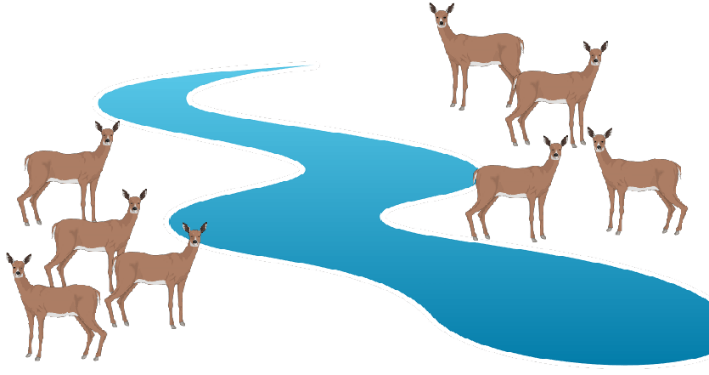
Five hundred years after the deer had established a flourishing population in the park, a few of them venture back to their original woods and have babies with the deer there.
a)
Genetic Drift
b)
Mutations
c)
Non-random mating
d)
Gene flow
113.
What is founder effect?
a)
Any change in the allelic frequencies in a population that is due to chance
b)
›A small sample of a population settles in a location separated from the rest of the population
c)
  The process in which humans select for or against particular features in organisms
d)
›Members of one sex choose mates with particular features
114.
What type of selection is this?
a)
Directional Selection
b)
Stabilizing Selection
c)
Disruptive Selection
d)
Natural Selection
115.
When has speciation occurred?
a)
When populations no longer look the same
b)
When populations no longer have the same frequency of alleles
c)
When populations are living in different environments
d)
When populations can no longer interbreed
116.
Which is a mechanism for change in allele frequency?
a)
gene flow
b)
genetic drift
c)
natural selection
d)
all answers are correct
e)

mutation

117.
An important difference between viruses and living cells is that viruses:
a)
contain more nuclei than cells
b)
need an energy source but cells do not
c)
cannot reproduce outside of cells
d)
cannot mutate but cells can
118.
What is an organism called when it contains membrane bound internal organelles?
a)
Heterotroph
b)
Autotroph
c)
Eukaryote
d)
Prokaryote
119.
What is an organism called when it does not contain membrane bound organelles?
a)
Heterotroph
b)
Autotroph
c)
Eukaryote
d)
Prokaryote
120.
This kingdom is multicellular, autotrophic, and has a cell wall made of cellulose.
a)
Fungi
b)
Plant
c)
Animals
d)
Eubacteria
121.
What species is bird C?
a)
Dunliin
b)
Osprey
c)
Bald Eagle
d)
Baird's Sparrow
122.
What bird is the closest relative to bird K?
a)
D
b)
J
c)
H
d)
B
123.
Do salamanders have claws?
a)
Yes
b)
No
c)
Maybe
124.
The 8 levels of classification, from most broad to most specific are ...
a)
Domain, Genus, Family, Order, Class, Phylum, Kingdom, Species
b)
Domain, Species, Kingdom, Genus, Phylum, Family, Class, Order
c)
Domain, Kingdom, Phylum, Class, Order, Family, Genus, Species
d)
Order, Kingdom, Species, Domain, Phylum, Family, Class, Genus
125.
The scientific name for an organism is made from the:
a)
class and family name
b)
genus and species name
c)
domain and kingdom name
d)
kingdom and phylum name
126.
Organisms in this smallest taxonomic group share many characteristics.
a)
domain
b)
kingdom
c)
species
d)
class
127.
I am prokaryotic and am found everywhere. What kingdom do I belong to?
a)
Eubacteria
b)
Archaebacteria
c)
Fungi
d)
Protista
128.

Organisms in the Animalia kingdom are

a)

multicellular and heterotrophic

b)

multicellular and autotrophic

c)

unicellular and autotrophic

d)

unicellular and heterotrophic

129.

What do plants and animals have in common?

a)

both are heterotrophic

b)

both are autotrophic

c)

both are prokaryotic

d)

both are eukaryotic