
 Worksheets
1 WAVES - 1 Main Question Set
Total questions: 133
Worksheet time: 2hrs 8mins
What happens to frequency when the energy increases?
it increases
it decreases
it stays the same

What part of the wave is shown at letter A (look at the black letter A, not the red)?
crest
trough
wavelength
frequency

Which part of the wave is shown at letter B?
crest
trough
wavelength resting point

Which part of the wave is shown at letter C?
crest
wavelength
resting point
amplitude

Which part of the wave is shown at letter D?
trough
resting point
wavelength
frequency

Which part of the wave is shown at letter E?
trough
crest
resting point
amplitude
What does a wave carry?
boats
matter
energy
water
When wavelength increases, what happens to the frequency?
it increases
it decreases
it stays the same

Which wave has a greater frequency?
wave B
wave C

Which wave has the most energy?
top wave
bottom wave
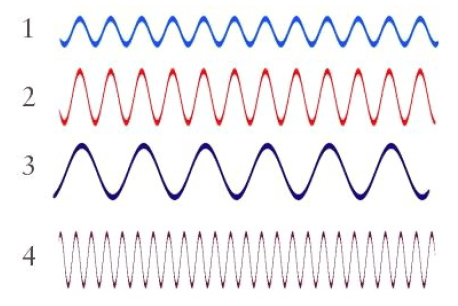
Which wave in the diagram has the greatest frequency?
1
2
3
4

Which of the following is NOT a mechanical wave?
sound
light
ocean
seismic

The highest point on a wave is:
the crest
the trough
the top
the coast

All waves carry ________ as they travel from one place to another.
matter
space
energy
water
Waves move ___ through vibrations
Energy
Matter
Mass
Weight
Transverse waves are ___.
Parallel
Perpendicular
Weird
If the frequency gets higher, the wavelength gets
longer
shorter
If the wavelength gets longer, the frequency gets
higher
lower
The pitch of the sound depends on
frequency
amplitude
wavelength
The frequency of a wave is measured in __________________.
inches
hertz
periods
eras
Any material that a wave travels through is called a ____________________.
vibration
compression
medium
crest
In what type of wave does the medium vibrate parallel to the direction of the wave?
surface wave
longitudinal wave
transverse wave
electromagnetic wave
What are the highest parts of a transverse wave called?
amplitude
trough
resting point
crest
As the frequency of a wave increases, the __________________ decreases.
amplitude
resting point
wavelength
crest
What is the bottom of a wave?
trough
crest
What is the top of a wave?
trough
crest
When you yell under water, what is the medium that sound travels through?
air
water
A wave is a disturbance that transfers:
matter
energy

What kind of wave is pictured?
Transverse
Longitudinal
surface
none of the above
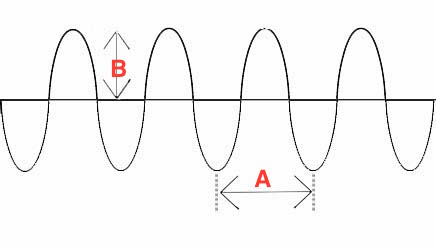
What property of the wave is represented by the letter "B"?
amplitude
crest
trough
wavelength
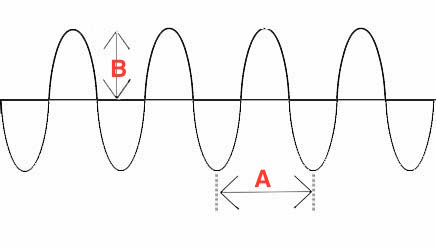
What property of this wave is represented by the letter "A"
amplitude
crest
trough
wavelength
The number of wavelengths that pass a point each per second is:
frequency
period
longitudinal
transverse wave
A mechanical wave cannot travel through...
a vacuum(empty space).
water.
air.
glass.
When light hits an area and bounces back it is called:
echo
refraction
reflection
absorbing
What is the name of a material in which waves, like sound waves, seismic waves, and waves in a slinky will travel
Vacuum
Medium
Mechanical
Space

What kind of wave is pictured below?
compressional wave
transverse wave
sound wave
mechanical wave
The number of waves that pass in a certain amount of time is called
frequency
wavelength
crest
amplitude
Sound waves are...
cool
not cool
transverse waves
longitudinal waves
The direction of a transverse waves is ____ to the disturbance/vibration.
equal
less than
at an acute angle
at a right angle
A disturbance that travels through a medium as a longitudinal wave
sound
wavelength
pitch
frequency
The number of wavelengths that pass a point each second
frequency
wavelength
pitch
amplitude
Material (matter) through which a wave travels
medium
Doppler Effect
sound
pitch
How high or low a sound is; depends on the frequency (greater frequency= higher pitch)
pitch
frequency
sound
medium
A wave in which the vibration is in the same direction as that in which the wave is traveling; sound waves
longitudinal wave
ocean wave
transverse wave
mechanical wave
The number of wavelengths that pass a point each second
crest
amplitude
frequency
pitch
The term for how high or low a sound is:
pitch
volume
sound
medium
Which feature of sound is determined by amplitude?
Pitch
Smoothness
Loudness
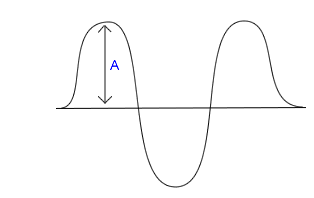
If the distance represented by the letter A (the amplitude) were increased, how would it change the sound?
The sound would be higher.
The sound would be lower.
The sound would be softer.
The sound would be louder.

What is something natural that Sound cannot travel through?
Water
Air
Liquids
outer Space

What is changed in the second picture?
Someone is talking louder in picture 2
Someone is talking softer in picture 2
Someone is talking lower pitch in picture 2
Someone is talking higher pitch in picture 2


True or False: Sound needs a medium.
True
False
Sound is produced by -----
Heat energy
Low temperatures
Vibrations
Friction
True or False: Sound waves are faster than light.
False
True
The number of wavelengths that pass a fixed point each second is known as ----
Hertz
Amplitude
Frequency
What is the term for the distance between two consecutive crests of a wave?
frequency
wavelength
amplitude
period
Which type of wave requires a medium to travel through?
electromagnetic wave
mechanical wave
radio wave
light wave
What happens to the speed of a wave as it moves from a less dense medium to a more dense medium?
It increases
It decreases
It remains the same
It fluctuates
Match the following
Frequency
The number of cycles per second
Wavelength
The length from one crest to another
Amplitude
The height of a wave
Cycle
One complete oscillation
oscillation
The process of vibrating
Frequency is measured in _______.
Hertz (Hz)
Meters per second
Meters
Newtons

7.1.3
A trombone player slides from a note with a high frequency to one with a low frequency. What happens to the wavelength of the sound wave as the frequency gets lower?
The wavelength gets longer
The wavelength gets shorter
The wavelength doesn't change but the wave moves slower
The wavelength doesn't change but the wave moves faster.

What does a wave carry?
boats
energy
matter
water
What do waves transfer?
energy but not matter
energy and matter
matter but not energy

What does Label #3 show?
Trough
Crest
Amplitude
Wavelength
How does sound travel through a medium?
By transferring energy through electromagnetic waves
By the movement of particles in a vacuum
By the vibration of particles in the medium
By changing the temperature of the medium
The measure of how high or low a sound is:
the intensity
the size of the wavelength
how loud or soft a sound is
the pitch
What happens to energy when frequency increases?
it decreases
it increases
it stays the same

What type of wave is shown in the picture?
ocean wave
longitudinal wave
transverse wave
light wave

Which part of the wave is shown at letter C?
Amplitude
Resting Point
Crest
Wavelength
What is the highest point on a wave called?
Trough
Crest
Amplitude
Cycle
Which term describes the lowest point on a wave?
Crest
Frequency
Trough
Wavelength
What does amplitude refer to in a wave?
The number of cycles per second
The height of a wave
The distance between crests
The lowest point on a wave
Which term is defined as the vibration of a wave, or the motion of a wave moving back and forth or up and down?
Oscillation
Cycle
Crest
Wavelength
What is the number of complete wavelengths that pass a point in a given time called?
Amplitude
Frequency
Cycle
Trough
What is the horizontal distance between the crests or between the troughs of two adjacent waves called?
Frequency
Wavelength
Amplitude
Oscillation
A wave that moves the medium in a direction perpendicular (up and down) to the direction in which the wave travels is called:
Longitudinal Wave
Transverse Wave
Frequency
Amplitude
A wave is a disturbance that transfers:
Matter
Energy
Light
Water
What is the best explanation of a longitudinal wave?
Amplitude less than the wavelength.
Amplitude is greater than the wavelength.
Oscillates at a 90 degree angle from the direction of travel.
Oscillates in the same direction as the direction of travel. (Parallel to the direction of travel.)

Which wave has the highest frequency?
Wave 2
All of the waves are the same height and so they are the same frequency
Wave 4
Wave 1
Wave 3

Which of the following statements is true about waves A and B?
Wave A has a higher frequency, which means it has less energy.
Wave A has a higher amplitude, which means it has more energy.
Wave B has a higher frequency, which means it has less energy.
Wave B has a higher amplitude, which means it has more energy.
Which word describes the vibration of a wave, or the motion of a wave moving back and forth or up and down?
Frequency
Oscillation
Wavelength
Crest

What type of wave is shown below?
Light wave
Longitudinal wave
Ocean wave
Transverse wave
Sound is produced by -----
Heat energy
Low temperatures
Vibrations
Friction
What happens when sound waves reflect off a surface?
They create an echo
They diffract through narrow openings
They interfere with each other
They spread out after passing through a doorway
Can you name the three main sections of the ear in order?
Outer ear, middle ear, inner ear
Outer ear, inner ear, middle ear
Middle ear, outer ear, inner ear
Middle ear, inner ear, outer ear
Two people are standing 1000 meters apart. an ambulance is driving between them. Person A will hear (a) because the ambulance is moving away from them. Person B will hear a because (b) the ambulance is moving toward them. This is known as (c) .
A person is talking to you. For them to make a lower voice they will (a) . To make a higher voice they will (b) . To make a louder voice they will have to (c) . To make a less loud voice they will have to (d) .
How does the amplitude of a sound wave change as it travels away from its source?
The amplitude will remain constant
Increases
Decreases
Cannot be determined
True or False: Sound can travel through a vacuum (space).
True
False
Sound is produced by which of the following?
Heat energy
Low temperatures
Friction
Vibrations

Which wavelength would have the highest pitch like a flute or whistle?
Low frequency
High Frequency
Low Amplitude
High amplitude
What is the change in frequency of a wave as its source moves in relation to an observer called?
Shock wave
Doppler effect
Sonic boom
Sound barrier
What makes noise and music different?
The speed of the sounds
The way sound waves combine
The volume of the sounds
The amount of energy put into a wave
Which vocabulary word matches the definition: "The perceived sound a wave makes which is related to the frequency of the sound wave"?
Medium
Pitch
Loudness
Doppler Effect
Which vocabulary word matches the definition: "Matter that carries a mechanical wave"?
Medium
Pitch
Loudness
Doppler Effect
A sound wave hits off of a hard flat surface. Which of the following best describes what will happen?
Most of the sound waves will reflect or bounce off, making an echo.
Most of the sound waves will be absorbed, making an area or a room more quiet.
Most of the sound waves will travel through the hard flat surface.
Most of the sound waves will disappear completely.
What part of the wave is shown at letter A (look at the black letter A, not the red)?
crest
trough
wavelength
frequency
Which part of the wave is shown at letter B?
crest
trough
wavelength resting point
Which part of the wave is shown at letter C?
crest
wavelength
resting point
amplitude
What does a wave carry?
boats
matter
energy
water
Which wave has the most energy?
top wave
bottom wave
Which of the following statements is true about waves A and B?
Wave A has a higher frequency, which means it has less energy.
Wave A has a higher amplitude, which means it has more energy.
Wave B has a higher frequency, which means it has less energy.
Wave B has a higher amplitude, which means it has more energy.

