Wayground logo

Free Printable Worksheets

Font size

S
M
L
XL
Worksheets

Biological Molecules

Total questions: 70

Worksheet time: 58mins
Name
Class
Date
1.
What are the four biological molecules?
a)
proteins, carbohydrates, lipids, nucleic acids
b)
A, T, C, G
c)
water, air, earth, and fire
2.
A biological polymer made of amino acid monomers is a 
a)
protein
b)
lipid
c)
carbohydrate
d)
nucleic acid
3.
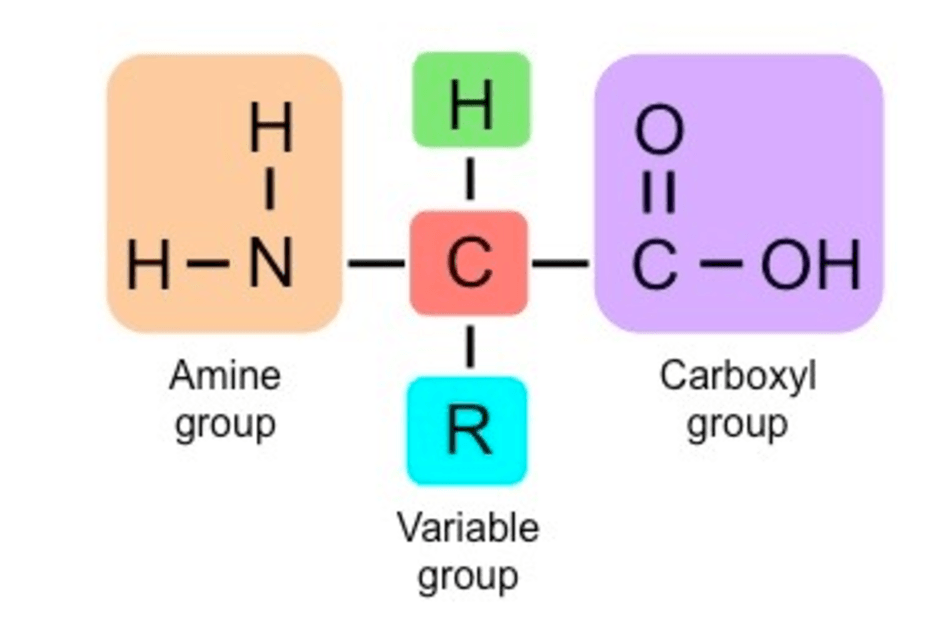
A carbon compound that contains two functional groups: amino and carboxyl
a)
amino acid
b)
enzyme
c)
carbohydrate
d)
nucleic acid
4.
A group of organic molecules that includes sugars, starch, and cellulose care called...
a)
proteins
b)
carbohydrates
c)
nucleic acids
d)
lipids
5.
A biological polymer that stores and transmits genetic information is a ...
a)
nucleic acid
b)
carbohydrate
c)
lipid
d)
protein
6.
What group of biological molecules contains DNA and RNA...
a)
Nucleic acids
b)
carbohydrates
c)
proteins
d)
lipids
7.
A type of biological molecule that includes fats, oils, hormones, waxes, and components of cellular membranes is...
a)
lipids
b)
proteins
c)
carbohydrates
d)
nucleic acids
8.
Carbohydrates broken down into smaller molecules for what purpose?
a)
to form cell membranes
b)
to form muscle
c)
to transmit genetic information
d)
to provide energy
9.
Adenine bonds with ______________.
a)
Guanine
b)
Thymine
c)
Cytosine
d)
Adenine
10.
Guanine bonds with ______________.
a)
Adenine
b)
Guanine
c)
Cytosine
d)
Thymine
11.
Which of these is not considered a macromolecule?
a)
Protein
b)
Water
c)
Carbohydrate
d)
Lipid
12.
What primary function do carbohydrates serve in the body?
a)
Used as a building material
b)
Stores genetic information
c)
Helps to form boundaries
d)
Used as an energy source
13.
What is the building block (monomer) of proteins
a)
simple sugars
b)
amino acids
c)
fatty acids
d)
nucleotides
14.
What is something all organic molecules have in common?
a)
they're all healthy to consume
b)
they're all made of Carbon
c)
they're found in the organic section of Giant Eagle
d)
they all have large amounts of water in them
15.
Lipids are
a)
fats
b)
a type of sugar
c)
the building block of DNA
d)
not macromolecules
16.
This is probably a
a)
protein
b)
fat
c)
nucleic acid
d)
sugar
17.
The function of nucleic acids is
a)
provide energy 
b)
store energy
c)
insulate
d)
store genetic information
18.
To build a starch you would
a)
put together a bunch of lipids
b)
put together a bunch of proteins
c)
put together a bunch of simple sugars
d)
put together a bunch of nucleic acids
19.
Hydrocarbon bonded to a carboxyl group.
a)
lipids
b)
glycogen
c)
fatty acid
d)
monomer
20.
Lipid containing four carbon rings.
a)
steroid
b)
enyzme
c)
nucleotide
d)
functional groups
21.
A large molecule made up of many similar or identical subunits.
a)
lipids
b)
polymer
c)
monomer
d)
monosaccharide
22.

Organic molecules that always contain carbon, oxygen and hydrogen, often in a 1:2:1 ratio

a)

carbohydrates

b)

functional groups

c)

enyzme

d)

monosaccaride

23.

What monomers are carbohydrates made up of?

a)

Single sugars

b)

Fatty Acids

c)

Amino Acids

d)

Glycerol

24.

What monomers are proteins made up of?

a)

Single sugars

b)

Fatty Acids

c)

Amino Acids

d)

Glycerol

25.

Name 2 uses of lipids in animals

a)

Cell membranes

b)

Energy source

c)

Structure

d)

Immunity

26.
The element present in all organic molecules is
a)
Nitrogen
b)
Phosphorus
c)
Hydrogen
d)
Carbon
27.
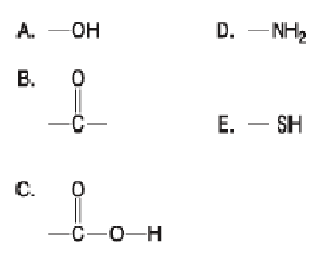
Which of the groups shown above is a carbonyl functional group?
a)
A
b)
B
c)
C
d)
D
28.
Which functional group has the molecular formula of CH3?
a)
Methyl
b)
Amino
c)
Hydroxy
d)
Carbonyl
29.
A class of biological molecules whose defining characteristic is their relative insolubility in water. Examples of these include steroids, oils, fats, and fatty acids.
a)
protein
b)
monomer
c)
lipids
d)
glycogen
30.
Monomer of nucleic acids; consists of a phosphate group, deoxyribose (sugar), and a nitrogen-base. ATP is an example of this.
a)
steroid
b)
nucleotide
c)
polypeptide
d)
polymer
31.
A large, folded chain of amino acids.
a)
protein
b)
steroid
c)
monosaccharide
d)
enyzme
32.
Protein that serves as a catalyst in biological functions.
a)
functional groups
b)
monomer
c)
lipids
d)
enzyme
33.
Storage form of glucose.
a)
monomer
b)
carbohydrates
c)
glycogen
d)
glycerol
34.
Building blocks of polymers.
a)
monomer
b)
polypeptide
c)
monosaccharide
d)
glycerol
35.
Also known as simple sugars, these carbohydrate monomers.
a)
lipids
b)
nucleotide
c)
monosaccharide
d)
monomer
36.
___________ are many monomers bonded together that form a larger molecule.
a)
Polymers
b)
Monomers
c)
Trinominers
d)
DNA
37.
DNA and RNA are examples of 
a)
Carbohydrates
b)
Lipids
c)
Proteins
d)
Nucleic Acids
38.
Which biomolecule is responsible for insulation and energy storage?
a)
Protein
b)
Nucleic Acid
c)
Lipid
d)
Carbohydrate
39.
A biological molecule is analyzed, and it is discovered that the molecule is composed of several amino acids. Which of these identifies the biological molecule?
a)
it is a lipid
b)
it is a protein
c)
it is an unsaturated fat
d)
it is a  monosaccharide
40.
Carbohydrates are made of which of the following elements?
a)
C, H, O
b)
C, H, O, N
c)
C, H, O, N, P
41.
Made of monomers of amino acids
a)
Carbohydrates 
b)
Lipids
c)
Proteins 
d)
Nucleic Acids
42.
Made of monomers of monosaccharides
a)
Carbohydrates
b)
Lipids
c)
Proteins
d)
Nucleic Acids
43.
Include waxes, oils, steroids (hormones)
a)
Carbohydrates
b)
Lipids
c)
Proteins
d)
Nucleic Acids
44.
Include sugars (ex. glucose) and starches
a)
Carbohydrates
b)
Lipids
c)
Proteins
d)
Nucleic Acids
45.
Includes catalase (enzyme), actin, and myosin (muscle fibers)
a)
Carbohydrates
b)
Lipids
c)
Proteins
d)
Nucleic Acids
46.
Includes DNA and RNA
a)
Carbohydrates
b)
Lipids
c)
Proteins
d)
Nucleic Acids
47.
Provide quick energy 
a)
Carbohydrates
b)
Lipids
c)
Proteins
d)
Nucleic Acids
48.
Waterproofs, insulates, and stores energy long-term
a)
Carbohydrates
b)
Lipids
c)
Proteins
d)
Nucleic Acids
49.

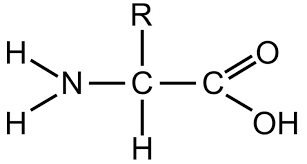
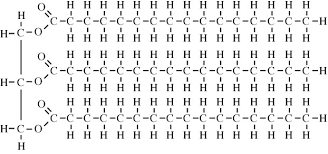
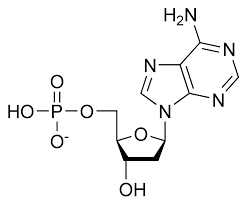
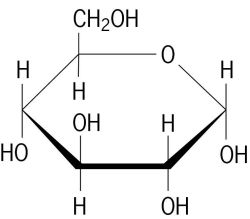
Identify the macromolecule associated with this image.

a)

Protein

b)

Carbohydrate

c)

Lipid

d)

Nucleic Acid

50.

Identify the macromolecule associated with this image.

a)

Protein

b)

Carbohydrate

c)

Lipid

d)

Nucleic Acid

51.

Identify the macromolecule associated with this image.

a)

Protein

b)

Carbohydrate

c)

Lipid

d)

Nucleic Acid

52.

Identify the macromolecule associated with this image.

a)

Protein

b)

Carbohydrate

c)

Lipid

d)

Nucleic Acid

53.

Which organic molecule contains carbon, oxygen and hydrogen, often in a 1:2:1 ratio?

a)

carbohydrates

b)

functional groups

c)

enyzme

d)

monosaccaride

54.
Which polysaccharide is found in plant cell walls?
a)
Glycogen
b)

Cellulose

c)

Amylopectin

d)

Amylose

55.
How many naturally occurring amino acids are there?
a)
35
b)
30
c)
25
d)
20
56.
Why are lipids good for waterproofing?
a)
They are a good conductors of heat
b)
They are insoluble
c)
They are slow conductors of heat 
57.
Which end of the phospholipid molecule is hydrophobic?
a)
The tail
b)
The head
58.
Which type of fatty acids have the highest melting points?
a)

Saturated

b)
Unsaturated
59.
What is the main function of phospholipids?
a)
Storage
b)
Cell membranes
c)
Protection
d)
Support
60.
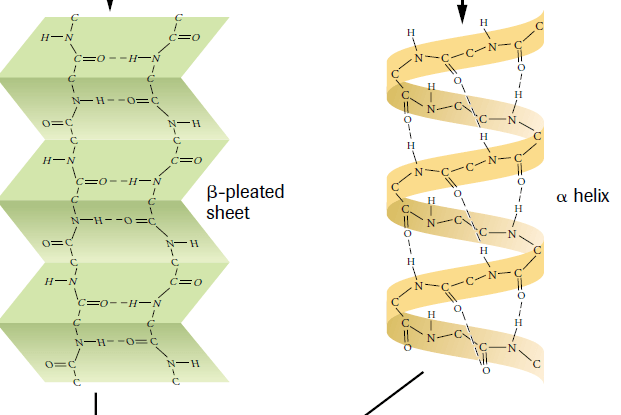
What level of protein structure is this?
a)
Primary
b)
Secondary
c)
Tertiary
d)
Quaternary
61.
What is the monomer of a protein?
a)
amino acid
b)
monosaccharide
c)
fatty acid
d)
nucleic acid
62.
How many structures or stages are there in proteins?
a)
1
b)
2
c)
3
d)
4
63.

which of the following terms refers to the order in which amino acids are linked together in a protein.

a)

Primary

b)

Secondary

c)

Tertiary

d)

Quaternary

64.

The entire polypeptide forms a three-dimensional structure

a)

Primary

b)

Secondary

c)

Tertiary

d)

Quaternary

65.

Two or more polypeptides attached together and work as one unit

a)

Primary

b)

Secondary

c)

Tertiary

d)

Quaternary

66.
What is a peptide bond?
a)
Bond that holds two amino acids together.
b)
A bond that holds hydrogen and oxygen molecules together.
c)
A bond that holds the phosphate group of one nucleotide and a sugar of a neighboring nucleotide.
d)
A bond that is formed by the sharing of electrons.
67.
Refers to the three-dimensional structure of an entire amino acid chain in a protein molecule
a)
tertiary structure
b)
primary structure
c)
secondary structure
d)
fibrous proteins
68.
The two types of folding in the secondary structure are.....
a)
alpha-helix & beta-pleated sheets
b)
polypeptide & nucleotide
c)
globular & fibrous
69.
The main bonding in the secondary structure of a protein is due to.....
a)
covalent bonding
b)
ionic bonding
c)
hydrogen bonding
d)
polar bonding
70.
Water-repelling
a)
hydrophobic
b)
myoglobin
c)
coagulation
d)
gluten