Wayground logo

Free Printable Worksheets

Font size

S
M
L
XL
Worksheets

Recovery Unit 1 Ecology DECEMBER

Total questions: 66

Worksheet time: 1hrs 25mins

Name
Class
Date
1.
What does the graph represent?
a)
Emigration
b)
Exponential growth
c)
Immigration
d)
Logistic Growth
2.
Which limiting factor would increase due to the number of individuals in a population?
a)
Unusual weather
b)
Natural disaster
c)
Births
d)
Disease
3.
Which limiting factor is independent of the number of individuals in a population?
a)
competition
b)
parasitism/disease
c)
stress
d)
natural disasters
4.
As a population grows, it will most likely stop growing at what size?
a)
Growth limit
b)
Exponential limit
c)
Carrying Capacity
d)
It won't stop growing
5.
The carrying capacity of an environment for a particular species at a particular time is determined by the
a)
number of individuals in the species.
b)
distribution of the population.
c)
reproductive potential of the species.
d)
supply of the most limited resources
6.
What will happen to the population when the birth rate is larger than the death rate?
a)
grow
b)
shrink
c)
stay the same
7.
What is the carrying capacity of the following graph?
a)
1000
b)
8000
c)
800
d)
600
8.
Which factor is a density-dependent limiting factor on the population of a species?
a)
seasonal variation
b)
natural disasters
c)
unusual weather
d)
predation
9.
Temperature, light, air, water, and soil are all  _____  parts of the environment
a)
alive
b)
biotic 
c)
abiotic
d)
living
10.

Which of the following would qualify as an "ecosystem"?

a)

a group of prairie dogs

b)

a group of prairie dogs and a group of trees

c)

a group of prairie dogs, a group of trees, and soil

d)

a single prairie dog

11.

Energy ______ and matter ______

a)

flows, cycles

b)

cycles, flows

c)

flows, flows

d)

cycles, cycles

12.

In this food chain the falcon would be classified as a

a)

primary producer

b)

secondary producer

c)

primary consumer

d)

secondary consumer

e)

tertiary consumer

13.

If the grass starts out with 10,000 J of energy...how much of the original energy is available to the snake in this food chain?

a)

1,000 J

b)

100 J

c)

10 J

d)

1 J

e)

0.1 J

14.

Carbon is removed from the atmosphere during

a)

photosynthesis

b)

combustion

c)

cellular respiration

d)

all of these

15.

A hummingbird receives a nectar food reward and the plant benefits by having its genetic material carried to another flower to increase genetic diversity through sexual reproduction. What type of relationship is this?

a)

mutualism

b)

commensalism

c)

predator-prey

d)

parasitoid

16.

Which of the following is a density-independent limiting factor?

a)

disease

b)

predation

c)

a hurricane

d)

lack of food

17.

In this food web...which of these would be the LEAST impacted if mangoes went extinct?

a)

rat

b)

fruit fly

c)

thrush

d)

dragonfly

e)

frog

18.

a symbiotic relationship is

a)

a close relationship between members of different species

b)

a close relationship between members of the same species

c)

competition between different species for the same resources

d)

all of these are true

19.

The carrying capacity for this seal population is around

a)

8500

b)

7500

c)

6500

d)

5500

20.

This type of growth is best described as

a)

logistic

b)

exponential

21.

Carbon is returned to the atmosphere through (select all that apply)

a)

photosynthesis

b)

cellular respiration

c)

combustion

22.

Atmospheric nitrogen can be "fixed" (so that it can be used by plants) in each of the following ways EXCEPT

a)

it can be fixed by lightning in the sky

b)

it can be fixed by the bacteria that live on the roots of legumes

c)

it can be fixed via cellular respiration

23.
A tree is a ....
a)
composer
b)
decomposer
c)
producer
24.
What is a producer?
a)
an organism that gets energy from eating other organisms
b)
an organisms that uses sunlight to make its own food
c)
an organism that gets energy from eating dead organisms, non-living material or waste
d)
an organism that uses chemical energy to make its own food
25.
What is a herbivore?
a)
an animal that gets energy from eating other animals
b)
an organism that gets energy from eating only plants
c)
an animal that gets energy by eating both plants and other animals
d)
an animal that eats only herbs
26.
What does every food chain start with? (Even if it's not drawn or written there!)
a)
producers
b)
sun
c)
consumer
d)
decomposers
27.
An organism that needs to eat other organisms to obtain energy is known as a:
a)
Autotroph
b)
Producer
c)
Consumer
d)
Mutualist
28.
Consumer that eats plants
a)
heterotroph
b)
herbivore
c)
producer
d)
community
29.
What does a food web represent?
a)
All connections of energy flow throughout all organisms in a habitat.
b)
The specific ways that mutualism is carried out.
c)
A single pathway or energy flow between organisms. 
d)
How carnivores get their food. 
30.
relationship in which two species live closely together
a)
resource
b)
mutualism
c)
succession
d)
symbiosis
31.
The rabbit in this food web would be considered a:
a)
Decomposer
b)
Producer
c)
Secondary Consumer
d)
Primary Consumer
32.
Where an organism lives
a)
habitat
b)
niche 
c)
heterotrogh
d)
biosphere
33.
In this Food Web Pyramid Which type of consumer gets only 10% of the energy stored in plants?
a)
Herbivore
b)
Carnivore
c)
Omnivore
d)
Secondary Consumer
34.
Which one is not a consumer?
a)
anemone 
b)
bear
c)
shark
d)
vulture
35.
What is the term for each step in the transfer of energy and matter within a biological community?
a)
energy path
b)
food web
c)
trophic level
d)
food pyramid
36.
The amount of energy that usually transfers from one trophic level to the next...
a)
10%
b)
20%
c)
80%
d)
50%
37.
An illustration that uses arrows to show the MANY possible directions in which matter and energy can pass through the organisms in an ecosystem.
a)
Food chain
b)
Food web
c)
Energy Pyramid
d)
Succession Map
38.
an animal that eats both plants and animals
a)
carnivore
b)
herbivore
c)
omnivore
d)
consumer
39.
An organism that eats another organism.
a)
Autotroph
b)
Heterotroph
c)
Plant
d)
Producer
40.
A food pyramid represent the relative amount of energy in trophic levels. Which of the following correctly shows a food pyramid?
a)
A
b)
B
c)
C
d)
D
41.
The deer, grasshopper, and bird are all examples of which type of consumers on this food pyramid?
a)
decomposers
b)
omnivores
c)
carnivore
d)
herbivore
42.
A secondary consumer 
a)
eats primary consumers
b)
eats producers
c)
eats plants
43.
All the organisms on earth get their energy directly or indirectly from?
a)
Oxygen
b)
Water 
c)
Nitrogen
d)
The Sun
44.
What is the most abundant gas in the atmosphere?
a)
hydrogen
b)
oxygen
c)
helium
d)
nitrogen
45.

As P and N build up, the probability of _______________ increases.

a)

lower BOD

b)

algal blooms

c)

oxygenation

d)

increased DO

46.

How does eutrophication cause the death of aquatic organisms

a)

the build up of carbon dioxide in the water

b)

the lack of nitrogen in the water

c)

the lack of carbon dioxide in the water

d)

the lack of oxygen in the water

47.

The phosphorus cycle does not include the:

a)

biosphere

b)

atmosphere

c)

lithosphere

d)

hydrosphere

48.

What are the main ingredients of most fertilizers?

a)

oxygen, carbon, and hydrogen

b)

nitrogen, phosphorus, and potassium

c)

nitrogen, oxygen, and carbon

d)

phosphorus, carbon, and helium

49.

The phosphorus cycle starts when:

a)

rocks erode from weathering

b)

bacteria break down rocks

c)

animals eat rocks

d)

rocks are broken from animals walking on them

50.

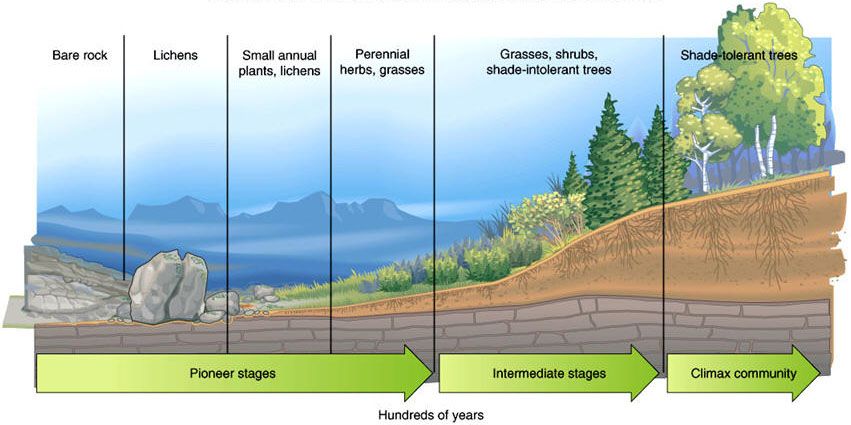
What is the role of the pioneer species in Primary Succession?

a)

To kill any remaining organisms from before the disturbance

b)

To break down rock and rebuild soil

c)

To provide food for large animals

d)

To put fresh oxygen into the air

51.

The picture shows what type of succession?

a)

primary

b)

secondary

c)

tertiary

d)

quadanary

52.
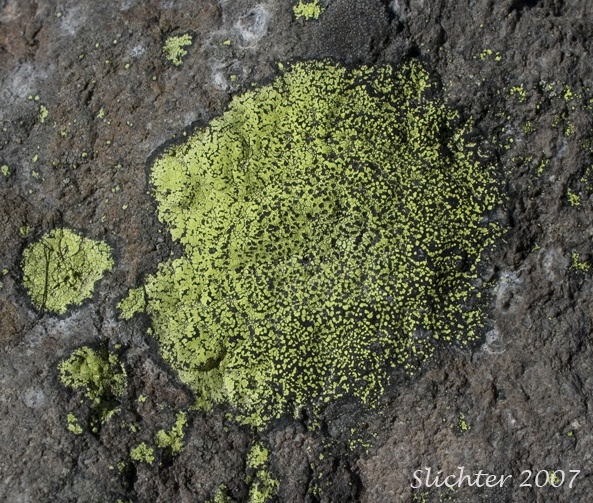
What is the name given to lichen or algae after a primary succession?
a)
pioneer species
b)
volunteer species
c)
founder species
d)
conqueror species
53.

After a volcanic eruption, lava covers the land. What is the order that plants grow to repopulate the area?

a)

Lichens → Shrubs → Grasses → Trees

b)

Lichens → tree → shrubs→Grasses

c)

Grasses → Lichens → Shrubs → Trees

d)

Lichens → Grasses → Shrubs → Trees

54.

Succession type?

a)

primary succession

b)

secondary succession

c)

tertiary succession

d)

variable succession

55.

Succession type?

a)

primary succession

b)

secondary succession

c)

tertiary succession

d)

variable succession

56.

What converts nitrogen gas into a usable form for plants and animals?

a)

bacteria

b)

rain

c)

fungi

d)

car exhaust

57.

How is nitrogen "fixed" into a usable form for plants?

a)

Through action of bacteria only

b)

Through lightning only

c)

Through action of bacteria and lightning

d)

Through photosynthesis

58.

How do animals get the nitrogen they need?

a)

From the air they breathe

b)

From the water they drink

c)

From the food they eat

d)

From the sun

59.

Gas that makes up 78% of our atmosphere.

a)

Oxygen

b)

Nitrogen

c)

Hydrogen

d)

Carbon Dioxide

60.

What is the process of combining nitrogen gas with other elements to make nitrogen into usable compounds?

a)

nitrogen composition

b)

nitrogen fixation

c)

ammonia

d)

denitrification

61.

What process occurs when dead plant and animal matter decomposes and nitrogen is released back into the atmosphere?

a)

Assimilation

b)

Fixation

c)

Ammonification

d)

Denitrification

62.

A symbiotic relationship where both organisms benefit.

a)

mutualism

b)

commensalism

c)

parasitism

d)

predation

63.

A symbiotic relationship where one organism benefits and the other is unharmed.

a)

commensalism

b)

mutualism

c)

apex predator

d)

parasitism

64.

A symbiotic relationship where one organism benefits and the other is harmed.

a)

parasitism

b)

mutualism

c)

commensalism

d)

predation

65.

One organism hunts and eats another organism.

a)

predation

b)

mutualism

c)

carnivore

d)

parasitism

66.

When different species live together.

a)

symbiosis

b)

habitat

c)

competiton

d)

predation