

Wayground logo

Free Printable Worksheets

Font size

S
M
L
XL
Worksheets

N5 metals 2

Total questions: 59

Worksheet time: 5hrs 55mins

Name
Class
Date
1.
The table shows the properties of four elements. Which element in the table is classified as a metal?
a)
Manganese
b)
Sulfur
c)
Silicon
d)
Neon
2.
The alkali metals are in group 1, on the far left of the periodic table. Which of these is NOT an alkali metal?
a)
Lithium
b)
Iron
c)
Potassium
d)
Francium
3.
How can you tell that a metal is reacting with water?
a)
Colour change
b)
Bright light
c)
Fizzing
d)
It gets colder
4.
What gas is always produced when a metal reacts with water?
a)
Oxygen
b)
Carbon Dioxide
c)
Hydrogen
d)
Carbon Monoxide
5.
What else is produced when a metal reacts with water? (HINT: Water has the formula H2O)
a)
Metal Oxide
b)
Metal Carbonate
c)
Metal Hydride
d)
Metal Hydroxide
6.
When the alkali metals react with water, which reacts most vigorously?
a)
Francium
b)
Rubidium
c)
Potassium
d)
Sodium
7.
Metals can also react with acids. This produces a gas. What is the name of this gas?
a)
Hydrogen
b)
Carbon Dioxide
c)
Nitrogen
d)
Oxygen
8.
When sodium reacts with hydrochloric acid, what is the name of the salt formed?
a)
Sodium Hydride
b)
Sodium Chloride
c)
Sodium Hydrochloric
d)
Sodium Chlorine
9.
When potassium reacts with sulphuric acid, what is the name of the salt produced?
a)
Potassium Sulphide
b)
Potassium Sulphur
c)
Potassium Sulphuric
d)
Potassium Sulphate
10.
In order to make use of the many useful properties of metals, we need to extract them so that they are in their pure form. A common way of extracting many of the less reactive metals is to heat their minerals with what?
a)
Carbon
b)
Helium
c)
Oxygen
d)
Silicon
11.

Which of the following is MOST reactive?

a)

Magnesium

b)

Lead

c)

Tin

d)

Copper

e)

Zinc

12.

Which metal is more reactive than calcium?

a)

magnesium

b)

potassium

c)

silver

d)

aluminum

13.

Choose the least reactive metal

a)

calcium

b)

magnesium

c)

iron

d)

copper

14.

Choose the most reactive metal

a)

calcium

b)

magnesium

c)

iron

d)

copper

15.
When metal reacts with liquid water the products are...
a)
metal hydroxide and oxygen gas
b)
metal hydroxide and hydrogen gas
c)
metal oxide and oxygen gas
d)
metal oxide and hydrogen gas
16.
What is the correct equation when potassium reacts with water?
a)
2K (s) + H2O (l) -->  KOH (aq) + H2 (g)
b)
K (s) + 2H2O (l) -->  KOH (aq) + 2H2 (g)
c)
2K (s) + 2H2O (l) -->  2KOH (aq) + H2 (g)
d)
K (s) + H2O (l) -->  KOH (aq) + H2 (g)
17.
Which of the following is arranged according increasing reactivity?
a)
Mg > Li > Na > K
b)
Mg > Na > Li > K
c)
Na > Li > Mg > K
d)
K > Mg > Na > Li
18.
Which of the following does not react with water?
a)
lithium
b)
magnesium
c)
lead
d)
calcium
19.
Which of the following the most reactive in dilute acid
a)
magnesium
b)
calcium
c)
aluminum
d)
zinc
20.
What is made when magnesium reacts with hydrochloric acid?
a)
magnesium nitrate and hydrogen gas
b)
magnesium sulfate and hydrogen gas
c)
magnesium oxide and oxygen gas
d)
magnesium chloride and hydrogen gas
21.
Which of the following is the correct equation when aluminum reacts with sulfuric acid?
a)
2Al (s) + 3H2SO4 (aq) -->  Al2(SO4)3 (aq) + 3H2 (g)
b)
2Al (s) + 3H2SO4 (aq) -->  Al2(SO4)3 (l) + 3H2 (s)
c)
2Al (s) + 3H2SO4 (l) -->  Al2(SO4)3 (l) + 3H2 (g)
d)
2Al (s) + 3H2SO4 (s) -->  Al2(SO4)3 (l) + 3H2 (g)
22.
When a metal reacts with oxygen gas, the product is ...
a)
metal hydroxide
b)
metal oxide
c)
metal oxide and oxygen
d)
metal hydroxide and hydrogen gas
23.
The least reactive in oxygen in the list is 
a)
iron
b)
zinc
c)
copper
d)
lead
24.
Complete the following equation: 
Zn (s)  +  2HNO3 (aq) -->
a)
2ZnNO3 (aq)  +  2H2 (g)
b)
ZnNO3 (aq)  +  H2 (g)
c)
2Zn(NO3)2 (aq)  +  2H2 (g)
d)
Zn(NO3)2 (aq)  +  H2 (g)
25.
If the metal is more reactive than the metal in the compound it completes with the less reactive metal. Therefore, it can concluded that ...
a)
The less reactive metal repel the more reactive metal from its compound
b)
The more reactive metal bonded with  the less reactive metal from its compound
c)
The less reactive metal pushes out or displaces the more reactive metal from its compound
d)
The more reactive metal pushes out or displaces the less reactive metal from its compound
26.
a)
A
b)
B
c)
C
d)
D
27.
a)
A
b)
B
c)
C
d)
D
28.
a)
A
b)
B
c)
C
d)
D
29.
a)
Aluminium
b)
Iron
c)
Lead
d)
Copper
30.
a)
A
b)
B
c)
C
d)
D
31.
a)
A
b)
B
c)
C
d)
D
32.
a)
A
b)
B
c)
C
d)
D
33.
a)
A
b)
B
c)
C
d)
D
34.
a)
1 = Fe
2 = Mg
3 = Cu
b)
1 = Fe
2 = Cu
3 = Mg
c)
1 = Mg
2 = Cu
3 = Fe
d)
1 = Mg
2 = Fe
3 = Cu
35.
a)
5g of copper
b)
5g of iron
c)
5g of magnesium
d)
5g of zinc
36.
a)
1, 2 & 3
b)
1, 2 & 4
c)
1, 3 & 4
d)
2, 3 & 4
37.

During an oxidation-reduction reaction, the number of electrons gained is

a)

equal to the number of electrons lost

b)

equal to the number of protons gained

c)

less than the number of electrons lost

d)

less than the number of protons gained

38.

During which process does an atom gain one or more electrons?

a)

transmutation

b)

reduction

c)

oxidation

d)

neutralization

39.

When a lithium atom forms an Li+ ion, the lithium atom

a)

gains a proton

b)

gains an electron

c)

loses a proton

d)

loses an electron

40.

What does the metal wire and salt bridge transport in voltaic cells?

a)

electrons and ions

b)

electrons and protons

c)

ions and acid

d)

acids and bases

41.
In the reaction
2Ca(s) + O2(g) --> 2CaO(s), calcium is __________
a)
Reduced
b)
Synthesized
c)
Oxidized
d)
None of the above
42.
the loss of hydrogen or electrons is known as 
a)
dehydration
b)
hydrogenation
c)
reduction
d)
oxidation
43.
Another name for a "oxidation-reduction" reaction is
a)
chemical reaction
b)
neutralization reaction
c)
redox reaction
d)
nuclear reaction
44.
Which of the following is the balanced half -reaction for the oxidation of Cu to Cu+2?
a)
Cu   --> Cu+2
b)
Cu + 2 e-   --> Cu+2
c)
Cu  --> Cu+2  + 2 e-
d)
Cu - 2e-  --> Cu+2
45.
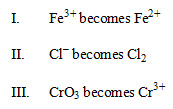
Which are examples of reduction?
a)
I and II
b)
I and III
c)
II and III
d)
I, II and III
46.
If in a reaction, copper is reduced; its number of electrons has:
a)
Increased
b)
Decreased
c)
Remained Constant
d)
Varies Randomly
47.

In the reaction Zn + H2O --> ZnO2 + H2

which element, if any, is oxidised?

a)

Zinc

b)

Hydrogen

c)

Oxygen

d)

None

48.
Which element cannot be extracted from its ore by reduction with carbon?
a)
iron
b)
aluminium
c)
copper
d)
lead
49.
Which series is used to predict the reactions of metals with carbon and other elements?
a)
reactionary series
b)
reaction series
c)
redox series
d)
reactivity series
50.
What is the name of the process that uses electricity to separate the elements in a compound?
a)
reduction
b)
electrolysis
c)
extraction
d)
mining
51.
How could you extract sodium from molten sodium chloride?
a)
reduction by carbon
b)
electrolysis
c)
decomposition
d)
oxidation
52.
How would you best extract iron from haematite (iron ore)?
a)
reduction by carbon
b)
electrolysis
c)
decomposition
d)
oxidation
53.
a)

A

b)

B

c)

C

d)

D

54.
a)

A

b)

B

c)

C

d)

D

55.
a)

A

b)

B

c)

C

d)

D

56.
a)

A

b)

B

c)

C

d)

D

57.
a)

A

b)

B

c)

C

d)

D

58.

A

a)

A

b)

B

c)

C

d)

D

59.
a)

A

b)

B

c)

C

d)

D
