wayground logo

Free Printable Worksheets

Font size

S
M
L
XL
Worksheets

1st Test review-Biology 19-20

Total questions: 78

Worksheet time: 2hrs 17mins

Name
Class
Date
1.
This cell is undergoing mitosis.  What stage of mitosis is shown?
a)
prophase
b)
metaphase
c)
anaphase
d)
telophase
2.
This diagram shows the cell cycle.

Which of the following activities occur in the S phase?
a)
Replication of the DNA
b)
Growth of the cell
c)
Formation of the mitotic spindle
d)
Breakdown of the nuclear membrane
3.
a)

Prophase

b)

Anaphase

c)

Telophase

d)

Interphase

4.

The picture shows a student using a microscope to study a prepared slide of a single-celled organism.A single-celled organism can be classified as a prokaryote based on the absence of —

a)

cell membrane

b)

ribosomes

c)

chromosomes

d)

nucleus

5.

Which molecule synthesized by plants is a major source of energy for cellular processes in both plants and animals?

a)

Wax

b)

Nucleic Acid

c)

Glucose

d)

Cholorphyll

6.

The picture shows a contractile vacuole of a unicellular freshwater organism. The contractile vacuole regulates the flow of water into and out of the cell in an aquatic environment.What conditions cause the contractile vacuole to fill with water?

a)

The concentration of water is greater outside the cell than inside the cell.

b)

The temperature of water in the vacuole is higher than the temperature of its environment.

c)

The concentration of water inside the cell is the same as the concentration outside the cell.

d)

The temperature of water in the vacuole is lower than the temperature of its environment.

7.

Part of the cell cycle is shown in this simplified model.This part of the cell cycle is best described as the process that —

a)

duplicates the DNA

b)

completes cell division

c)

maintains genetic homeostasis

d)

synthesizes new molecules

8.

The human immunodeficiency virus (HIV) often infects and destroys CD4 T cells. These CD4 T cells are one of many kinds of white blood cells that are an important part of the immune system.The most common danger related to the destruction of CD4 T cells is —

a)

an increase in the risk of high blood pressure

b)

an increase in the threat of diseases caused by microorganisms and viruses

c)

a decrease in the flow of blood to vital organs

d)

a decrease in the amount of oxygen being transported to tissues

9.

People who have leukemia, a cancer that affects white blood cells, are often given Cytarabine. This drug inhibits the synthesis of DNA. Which phase of the cell cycle is most affected by Cytarabine?

a)

G1

b)

S

c)

G2

d)

M

10.

Students were given a list of seven elements and asked to identify the four elements that are most abundant in biomolecules. Which table correctly identifies the four most-abundant elements in biomolecules?

a)
b)
c)
d)
11.
 Look at the diagram of a cross-section of a cell membrane below. The cell membrane controls movement of materials into and out of the cell. The following particles are moving from high concentration to low concentration and are using a carrier protein. How would you describe this type of movement across the membrane? 
a)
simple osmosis
b)
active transport
c)
simple diffusion
d)
facilitated diffusion
12.
Look at the cross section of a cell membrane of a eukaryotic cell. H+ ions are being pumped from a low concentration to a high concentration. How do you describe this type of transport across the cell membrane?
a)
active transport
b)
passive transport
c)
facilitated diffusion
d)
co-transport
13.
Which activity can occur without the use of energy?
a)
contraction of muscle tissue
b)
protein synthesis in a cell
c)
active transport of minerals
d)
movement of water across a membrane
14.
The diffusion of water across a selectively permeable membrane is called 
a)
active transport
b)
facilitated diffusion
c)
osmosis
d)
phagocytosis
15.
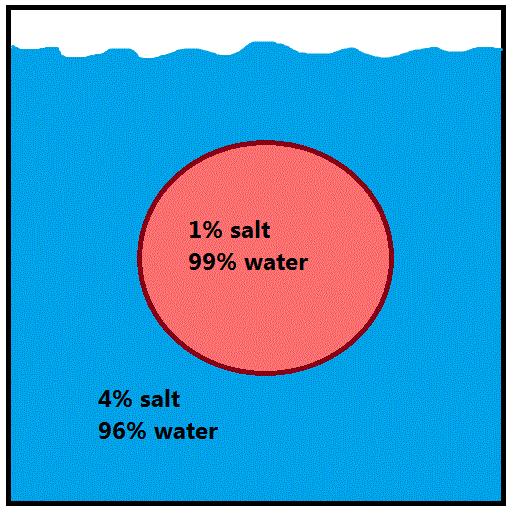
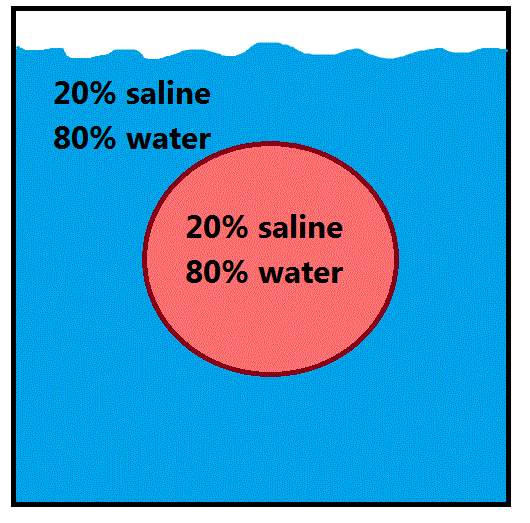
Where will the water go?
a)
Into the cell
b)
Out of the cell
c)
Equally in & out - it's isotonic
d)
There is no water
16.
A blood cell is placed into the jar, as seen. Where will the water go?
a)
Into the cell
b)
Out of the cell
c)
Equally in & out - it's isotonic
d)
The water is a lie
17.
 If a cell containing 5% salt is placed into a glass of water with 20% salt, the water is _______ compared to the cell.
a)
hypertonic
b)
hypotonic
c)
isotonic
18.
 An animal cell placed in a hypertonic (salty) solution will
a)
Stay the same
b)
Shrink- get smaller
c)
Swell- get bigger
19.
During osmosis
a)
water moves from high to low concentration
b)
large or oddly shaped molecules move across a cell membrane
c)
water moves when energy is used
d)
proteins are built
20.
Which type of cell do we have?
a)
Prokaryotic
b)
Eukaryotic
21.
All cells have 
a)
Ribosomes
b)
Nucleus
c)
Mitochondria
d)
Chloroplast
22.
Which does NOT have a nucleus?
a)
Prokaryotic
b)
Eukaryotic
23.
Do all cells have a membrane?
a)
Yes
b)
No
24.
Do all cells have DNA?
a)
Yes
b)
NO
25.
Which cell part is present in eukaryotic cells, but not in prokaryotic cells?
a)
cell membrane
b)
cell wall
c)
cytoplasm
d)
nucleus
26.
Has cytoplasm
a)
Prokaryote
b)
Eukaryote
c)
both
27.
Which type of cell?
a)
Prokaryote
b)
Eukaryote
28.
A single-celled organism that lacks a membrane-bound nucleus, mitochondria, or any other membrane -bound organelle .
a)
Prokaryote
b)
Eukaryote
c)
Nucleus
d)
Single-celled organism
29.

You can distinguish a prokaryote apart from a nucleus by--

a)

The presence of a ribosome

b)

The presence of a cell membrane

c)

The presence of DNA

d)

The presence of a nuclear membrane

30.
What is the capsid of a virus?
a)
the disease it causes
b)
the receptors to which it binds
c)
the genetic material
d)
its protein coat
31.
What is one way that a lysogenic infection differs from a lytic infection?
a)
A lysogenic virus does not act on bacteria as a lytic virus does.
b)
A lysogenic virus can remain in the host DNA for a longer period without becoming active.
c)
A lysogenic virus contains RNA instead of DNA.
d)
A lysogenic virus directs the production of new viruses right away.
32.
Which of the following is a possible result of a disruption in the cell cycle?
a)
cancer
b)
photosynthesis
c)
cellular respiration
d)
protein synthesis
33.

Cell have several mechanisms for regulating their internal environments. Which of these mechanisms involved in maintaining homeostasis requires energy?

a)

osmosis

b)

diffusion

c)

active transport

d)

passive transport

34.
How do viruses reproduce?
a)
They copy their own genetic material inside a protein coat.
b)
They kill a cell and reproduce inside it.
c)
They invade a living cell and use the cell's functions to replicate their genetic material.
d)
They do not reproduce because they are not technically living things.
35.
Viruses are...
a)
prokaryotic
b)
eukaryotic
c)
non-living
d)
endospores
36.
Needs host cell to reproduce.
a)
Virus
b)
Bacteria
c)
Fungus
d)
Protozoan
37.
True or False
The flu is caused by a virus.
a)
true
b)
false
38.
Viruses are cells. 
a)
True 
b)
False
39.
How could you describe the size of a virus?
a)
Smaller than bacteria
b)
Larger than a parasite
c)
About the size of a dime
d)
Smaller than a proton
40.
What is a series of events a cell goes through as they grow and divide?
a)
Cell Division
b)
Cell Cycle
c)
Cytokinesis
d)
Mitosis
41.
What is the longest stage of the cell cycle called?
a)
Cytokinesis
b)
M phase
c)
Interphase
d)
G1 Phase
42.
During what stage does the G1, S and G2 phases happen?
a)
Interphase
b)
M phase
c)
Mitosis
d)
Cytokinesis
43.
During what phase of the cell cycle does cell division occur?
a)
Interphase
b)
M phase
c)
S phase
d)
G2 phase
44.
During what phase of the cell cycle is DNA replicated?
a)
G1 phase
b)
S phase
c)
G2 phase
d)
M phase
45.
During what phase of the cell cycle does the cell grow?
a)
G1 phase
b)
S phase
c)
M phase
d)
Cytokinesis
46.
Put the following stages of mitosis in order: anaphase, prophase, metaphase, and telophase. 
a)
prophase, metaphase, telophase, anaphase
b)
prophase, anaphase, metaphase, telophase
c)
prophase, metaphase, anaphase, telophase
d)
prophase, telophase, metaphase, anaphase
47.
Put the following in order: G2, G1, S, mitosis, cytokinesis. 
a)
G1, G2, S, Mitosis, cytokinesis
b)
G1, S, G2, Mitosis, cytokinesis
c)
G1, G2, S, cytokinesis, mitosis
d)
G1, S, G2, cytokinesis, mitosis
48.
Put the following actions in order: DNA replicates, cell grows, cell divides, cell prepares for mitosis. 
a)
DNA replicates, cell grows, cell prepares for mitosis, cell divides
b)
cell grows, cell prepares for mitosis, DNA replicates, cell divides
c)
cell grows, DNA replicates, cell prepares for mitosis, cell divides
d)
DNA replicates, cell prepares for mitosis, cell grows, cell divides
49.
Why would it be important to replicate DNA before a cell divides in mitosis or meiosis?
a)
In order for genetic information to be transferred into daughter cells.
b)
In order for the cell to be able to increase in size.
c)
In order for the DNA to be contained in the nucleus.
d)
In order for the cell to re-order the DNA sequencing in the new cells.
50.
Cells need to bring in molecules to carry out cellular processes. Often, this requires moving the molecules across the cell membrane against the concentration gradient. How do these molecules get into the cell?
a)
passive transport by diffusion
b)
active transport using ATP 
c)
passive transport by osmosis
d)
 osmosis
51.
A person with swollen gums rinses his mouth with warm salt water, and the swelling decreases. Which of the following has occurred?
a)
The swollen gums have absorbed the saltwater solution.
b)
The saltwater solution lowers the temperature of the water in the gums.
c)
The salt in the solution has moved against the concentration gradient.
d)
The water in the gums has moved out due to the high concentration of salt in the solution. 
52.
What kind of transport does not require energy?
a)
Active 
b)
Vacuole 
c)
Passive 
d)
Na/K Pump 
53.
What structure of the cell forms a frame that holds the cell up in the cytoplasm?
a)
centrioles 
b)
cell wall 
c)
flagella 
d)
cytoskeleton 
54.
What is something that prokaryotic and eukaryotic cells have in common?
a)
They have a nucleus. 
b)
They are multi-cellular. 
c)
They have DNA. 
d)
They have organelles that are membrane-bound.
55.
What is facilitated diffusion?
a)
Transport that uses proteins to help move molecules across the membrane. 
b)
Movements of substances through a membrane. 
c)
When molecules spread from High to Low concentration on their own. 
d)
When pressure pushes something through a membrane. 
56.
Which of the following is the best example of osmosis? 
a)
NA/K Pump 
b)
Water moving though the cell membrane 
c)
Kidneys 
d)
Photosynthesis 
57.
What is the significance of the cell membrane? 
a)
Provides protection 
b)
Maintains homeostasis 
c)
Give a cell hydrophobic ends
d)
Provides cholesterol 
58.
Which of the following terms refers to a membrane allows some molecules to pass through while blocking other molecules?
a)
Homeostatic
b)
Selectively permeable
c)
Hydrophobic
d)
Passively permeable
59.
If the water concentration in a cell is 90% and the water concentration outside the cell is 95%, what direction will the water move?
a)
Into the cell
b)
Out of the cell
c)
The water will not move
60.
What are the two main components of the cell membrane?
a)
Phospholipids and Carbohydrates
b)
Cholesterol and Proteins
c)
 Phospholipids and Proteins
d)
Carbohydrates and Proteins
61.

What type of transport is shown in the diagram?

a)

Ion pump

b)

Facilitated diffusion

c)

Endocytosis

d)

Exocytosis

62.

What type of transport is shown in the diagram?

a)

diffusion

b)

facilitated diffusion

c)

endocytosis

d)

exocytosis

63.

What type of transport is shown in the diagram?

a)

Ion pump

b)

Facilitated diffusion

c)

Endocytosis

d)

Exocytosis

64.

Which of the following are examples of passive transport? Select multiple answers.

a)

Ion pump

b)

Facilitated diffusion

c)

Endocytosis

d)

Exocytosis

e)

Osmosis

65.
Movement of particles from high to low concentration. 
a)
Passive Transport
b)
Active Transport
66.
Osmosis is a form of ______________. 
a)
Passive Transport
b)
Active Transport
67.
A process where one cell forms two identical daughter cells is called...
a)
cell cycle
b)
cell division (mitosis)
c)
interphase
d)
cytokinesis
68.
The cell cycle is ______________.
a)
the process of cells circling throughout the body
b)
the process of splitting the organelles
c)
a process where one cell gets energy
d)
the sequence of stages of growth and division that a cell undergoes
69.
During interphase the cell ___________.
a)
divides into two cells
b)
divides its nucleus
c)
replicates its DNA
d)
replicates the organelles within the cell
70.
Replication is when __________.
a)
the cell makes a copy of its DNA in nucleus 
b)
the cell forms 2 identical cells
c)
the cell produces 2 sets of organelles
d)
the cell continues to complete the same function
71.
Where does replication occur within the cell?
a)
in the cytoplasm
b)
in the nucleus 
c)
in the ribosome
d)
in the chromatin
72.
After interphase is completed the cell moves into the next stage of the cell cycle called _________.
a)
anaphase
b)
cytokinesis
c)
metaphase
d)
mitosis
73.
Where does replication occur within the cell?
a)
in the cytoplasm
b)
in the nucleus 
c)
in the ribosome
d)
in the chromatin
74.
Mitosis is made up of how many phases?
a)
4
b)
5
c)
6
d)
7
75.
Identify the stage.
a)
interphase
b)
metaphase
c)
anaphase
d)
telophase
76.
Identify the stage of mitosis.
a)
interphase
b)
prophase
c)
metaphase
d)
anaphase
77.
Identify the stage of mitosis.
a)
interphase
b)
prophase
c)
anaphase
d)
cytokinesis
78.
Identify the stage of mitosis. 
a)
interphase
b)
prophase
c)
anaphase
d)
cytokinesis